


February 13, 2024 A Closer Look: Maternal Antibodies – Actively Providing Passive Immunity We owe children the most protection when they are at their most vulnerable — early in their lives before they can protect and care for themselves.

 Your new post is loading...
 Scoop.it! February 13, 2024 A Closer Look: Maternal Antibodies – Actively Providing Passive Immunity We owe children the most protection when they are at their most vulnerable — early in their lives before they can protect and care for themselves. 
No comment yet.
Sign up to comment
Scoop.it!
Scandinavian Journal of Immunology, EarlyView.
Scoop.it!

The potential of COVID-19 booster vaccine products (antibodies) passed from mother to offspring through breastmilk.
Scoop.it!
Scoop.it!
Scoop.it!
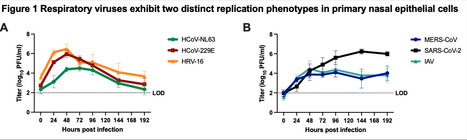
All respiratory viruses establish primary infections in the nasal epithelium, where efficient innate immune induction may prevent dissemination to the lower airway and thus minimize pathogenesis. Human coronaviruses (HCoVs) cause a range of pathologies, but the host and viral determinants of disease during common cold versus lethal HCoV infections are poorly understood. We model the initial site of infection using primary nasal epithelial cells cultured at air-liquid interface (ALI).
HCoV-229E, HCoV-NL63 and human rhinovirus-16 are common cold-associated viruses that exhibit unique features in this model: early induction of antiviral interferon (IFN) signaling, IFN-mediated viral clearance, and preferential replication at nasal airway temperature (33°C) which confers muted host IFN responses. In contrast, lethal SARS-CoV-2 and MERS-CoV encode antagonist proteins that prevent IFN-mediated clearance in nasal cultures. Our study identifies features shared among common cold-associated viruses, highlighting nasal innate immune responses as predictive of infection outcomes and nasally-directed IFNs as potential therapeutics.
Preprint in bioRxiv (Dec.19, 2023): https://doi.org/10.1101/2023.12.18.571720 Via Juan Lama

Sos's curator insight,
February 15, 2024 8:01 PM
Amazing
https://buypsychedelicdrugs.com/product-category/dmt/ https://buypsychedelicdrugs.com/product/5-meo-dmt/ https://buypsychedelicdrugs.com/product/4-aco-dmt/ https://buypsychedelicdrugs.com/product/ayahuasca/ https://buypsychedelicdrugs.com/product/changa-dmt/ https://buypsychedelicdrugs.com/product/buy-dmt-vape-pen/ https://buypsychedelicdrugs.com/product/lsd-tabs/ https://buypsychedelicdrugs.com/product/buy-mimosa-hostilis-root-bark-powdered-mhrb/ https://buypsychedelicdrugs.com/product/nn-dmt/ https://buypsychedelicdrugs.com/product/amanita-muscaria/ https://buypsychedelicdrugs.com/product/buy-dragons-dynamite-truffles/ https://buypsychedelicdrugs.com/product/golden-teachers/ https://buypsychedelicdrugs.com/product/buy-high-hawaiians-truffles/ https://buypsychedelicdrugs.com/product/liberty-caps/ https://buypsychedelicdrugs.com/product/buy-microdosing-psilocybin-truffles-10-pack/ https://buypsychedelicdrugs.com/product/buy-microdosing-psilocybin-truffles-2-pack-in-stock/ https://buypsychedelicdrugs.com/product/buy-microdosing-psilocybin-truffles-20-pack/ https://buypsychedelicdrugs.com/product/golden-teachers/ https://buypsychedelicdrugs.com/product/buy-penis-envy-mushroom/ https://buypsychedelicdrugs.com/product/codeine-promethazine/ https://buypsychedelicdrugs.com/product/ecstasy-mdma/ https://buypsychedelicdrugs.com/product/microdosing-psilocybin-truffles-1-pack-for-sale/ https://buypsychedelicdrugs.com/product/mush-rocks-truffles-for-sale/ https://buypsychedelicdrugs.com/product/pcp-powder/ https://buypsychedelicdrugs.com/product/cocaine/ https://buypsychedelicdrugs.com/product/methamphetamine/ https://buypsychedelicdrugs.com/product/xanax/ https://buypsychedelicdrugs.com/product/lsd-gel-tabs/ https://buypsychedelicdrugs.com/product/lsd-liquid/
https://caluaniemuelearoxidizeusa.com/product/buy-10l-caluanie-muelear-pasteurize/ https://caluaniemuelearoxidizeusa.com/product/buy-20l-caluanie-muelear-oxidize/ https://caluaniemuelearoxidizeusa.com/product/buy-5l-caluanie-muelear-pasteurize/ https://caluaniemuelearoxidizeusa.com/product/buy-caluanie-muelear-pasteurize/
Scoop.it!

On February 1st - World Aspergillosis Day - we are pleased to launch the special issue of the educational journal Seminars in Respiratory and Critical Care… | 15 comments on LinkedIn
Scoop.it!

What we know about Shigella vaccine?
Scoop.it!

Peering into the jungle of microbes that live within us, researchers have stumbled across what seem to be an entire new class of virus-like objects.
Scoop.it!

From
rupress

The cytokine IL-23 plays important roles in intestinal barrier protection and integrity, but is also linked to chronic inflammation. In this issue of JEM, Ohara
|
Scoop.it!

Development of B cell memory is a conundrum that scientists are still exploring. Studies have been conducted in vitro and using advanced animal models to elucidate the mechanism underlying the generation of memory B cells (MBCs), the precise roles of MBCs against pathogens, and their protective...
Scoop.it!

Individuals differ widely in their immune responses, with age, sex and genetic factors having major roles in this inherent variability1–6. However, the variables that drive such differences in cytokine secretion—a crucial component of the host response to immune challenges—remain poorly defined. Here we investigated 136 variables and identified smoking, cytomegalovirus latent infection and body mass index as major contributors to variability in cytokine response, with effects of comparable magnitudes with age, sex and genetics. We find that smoking influences both innate and adaptive immune responses. Notably, its effect on innate responses is quickly lost after smoking cessation and is specifically associated with plasma levels of CEACAM6, whereas its effect on adaptive responses persists long after individuals quit smoking and is associated with epigenetic memory. This is supported by the association of the past smoking effect on cytokine responses with DNA methylation at specific signal trans-activators and regulators of metabolism. Our findings identify three novel variables associated with cytokine secretion variability and reveal roles for smoking in the short- and long-term regulation of immune responses. These results have potential clinical implications for the risk of developing infections, cancers or autoimmune diseases. A survey of 136 factors that may influence cytokine secretion identify smoking, cytomegalovirus latent infection and body mass index as influential factors, with varying effects on innate and adaptive immunity.
Scoop.it!

Des chercheurs de l'institut Curie, du Service d'Ingénierie Moléculaire pour la Santé (SIMoS) au sein du DMTS (CEA/UPSaclay, Gif-sur-Yvette) et de l'Hôpital Européen Georges-Pompidou, décrivent, dans deux publications, Cells et Biomaterials, la synthèse, l'ingénierie et l'évaluation des propriétés de la sous-unité B de la toxine bactérienne de Shiga (STxB), administrée par voie mucosale, comme outil vaccinal. Leurs résultats confirment l'intérêt de l'exploitation d'une STxB synthétique dans une stratégie de vaccination anti-tumorale et anti-infectieuse.
Contact : denis.servent@cea.fr Via Life Sciences UPSaclay
Scoop.it!
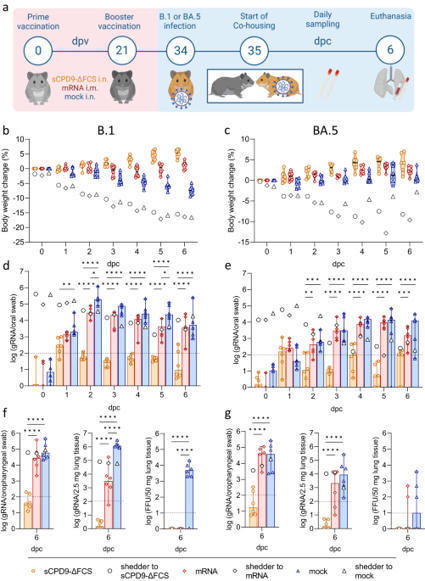
The development of effective SARS-CoV-2 vaccines has been essential to control COVID-19, but significant challenges remain. One problem is intramuscular administration, which does not induce robust mucosal immune responses in the upper airways—the primary site of infection and virus shedding. Here we compare the efficacy of a mucosal, replication-competent yet fully attenuated virus vaccine, sCPD9-ΔFCS, and the monovalent mRNA vaccine BNT162b2 in preventing transmission of SARS-CoV-2 variants B.1 and Omicron BA.5 in two scenarios. Firstly, we assessed the protective efficacy of the vaccines by exposing vaccinated male Syrian hamsters to infected counterparts. Secondly, we evaluated transmission of the challenge virus from vaccinated and subsequently challenged male hamsters to naïve contacts. Our findings demonstrate that the live-attenuated vaccine (LAV) sCPD9-ΔFCS significantly outperformed the mRNA vaccine in preventing virus transmission in both scenarios. Our results provide evidence for the advantages of locally administered LAVs over intramuscularly administered mRNA vaccines in preventing infection and reducing virus transmission. In this study, the authors evaluated the protective capacity of a mucosal, live-attenuated SARS-CoV-2 vaccine and show that it induces systemic and mucosal humoral immunity, protects from clinical disease symptoms, and prevents virus transmission in hamsters more efficiently than an intramuscular mRNA vaccine.
Scoop.it!

Mycobacterium tuberculosis (M.tb) effectively manipulates the host processes to establish the deadly respiratory disease, Tuberculosis (TB). M.tb has developed key mechanisms to disrupt the host cell health to combat immune responses and replicate efficaciously. M.tb antigens such as ESAT-6, 19kDa lipoprotein, Hip1, and Hsp70 destroy the integrity of cell organelles (Mitochondria, Endoplasmic Reticulum, Nucleus, Phagosomes) or delay innate/adaptive cell responses. This is followed by the induction of cellular stress responses in the host. Such cells can either undergo various cell death processes such as apoptosis or necrosis, or mount effective immune responses to clear the invading pathogen. Further, to combat the infection progression, the host secretes extracellular vesicles such as exosomes to initiate immune signaling. The exosomes can contain M.tb as well as host cell-derived peptides that can act as a double-edged sword in the immune signaling event. The host-symbiont microbiota produces various metabolites that are beneficial for maintaining healthy tissue microenvironment. In juxtaposition to the above-mentioned mechanisms, M.tb dysregulates the gut and respiratory microbiome to support its replication and dissemination process. The above-mentioned interconnected host cellular processes of Immunometabolism, Cellular stress, Host Microbiome, and Extracellular vesicles are less explored in the realm of exploration of novel Host-directed therapies for TB
|




