How do intranasal vaccines work? Can flu vaccines be better? Thrilled to announce our newest paper is out, demonstrating memory B cell responses in human upper airway after immunization with the intranasal flu vaccine (Flumist). Great findings by dedicated scientist Dr. Hannah Stacey in the lab, leveraging clever sampling techniques from Dr. Sydney Ramirez. La Jolla Institute for Immunology Science Magazine https://lnkd.in/gtRiyMdS
It appeared less than 40 years ago, while systemic immunity exploded 60 years ago.
It is still a minor part of Immunology teaching and research, while the mucosal immune system is at the frontline of encounters with germs, antigens... in other words the environment.
𝟭𝟲. 𝗜𝘀 𝘆𝗼𝘂𝗿 𝘃𝗮𝗰𝗰𝗶𝗻𝗮𝘁𝗶𝗼𝗻 𝗽𝗿𝗼𝗴𝗿𝗮𝗺 𝗽𝗿𝗼𝘁𝗲𝗰𝘁𝗶𝗻𝗴 ... 𝗼𝗿 𝘀𝗮𝗯𝗼𝘁𝗮𝗴𝗶𝗻𝗴 𝘆𝗼𝘂𝗿 𝗰𝗵𝗶𝗰𝗸𝘀? A brilliant study from the University of Arkansas and Mississippi dropped a truth bomb: 70% of maternal antibodies never make it to the chicks! IgY (the “mother’s shield”) is the only immunoglobulin efficiently transferred to chicks. What about the others? IgA and IgM mostly stay behind in the egg. Less than 1% reaches the chick’s bloodstream. 𝗔𝗻𝗱 𝗵𝗲𝗿𝗲'𝘀 𝘁𝗵𝗲 𝗸𝗶𝗰𝗸𝗲𝗿: by day 14, those maternal antibodies are gone. If your vaccination schedule doesn’t consider this... you’re leaving your chicks naked on the battlefield.
📈 Genetic line 1 had higher antibodies against Newcastle; line 2, more against IBV. But both agreed on one thing: maternal immunity fades fast, and active immunity takes time to show up.
✏️ 𝗧𝗵𝗲 𝘀𝘁𝘂𝗱𝘆 𝗮𝗹𝘀𝗼 𝗿𝗲𝘃𝗲𝗮𝗹𝘀: ✔️ IgY is your best ally: 30% gets transferred to the chick ✔️ IgM is the first one produced by the chick (day 3) ✔️ IgA shows up around day 7 ✔️ Chick-made IgY appears only around day 21 🎯 So, are you still vaccinating without syncing with the chick’s real immune timeline?
💥 It’s time to rethink our strategy. Knowing when and how to vaccinate isn't just technical it’s survival.
📌 𝗧𝗵𝗶𝘀 𝗸𝗻𝗼𝘄𝗹𝗲𝗱𝗴𝗲 𝗶𝘀 𝗲𝘀𝘀𝗲𝗻𝘁𝗶𝗮𝗹 𝗳𝗼𝗿: 🎗️Designing effective breeder vaccination programs. 🎗️Vaccinating chicks without interference from maternal antibodies. 🎗️Understanding why some chicks are protected... and others aren't.
📚 𝗕𝗮𝘀𝗲𝗱 𝗼𝗻: Hamal et al. (2006), University of Arkansas & Mississippi State University Yes, it’s a 2006 papercut like fine wine, 🍷 its value only gets better with time.
📌 𝗡𝗼𝘁𝗲: If any part of this post feels unclear or too technical, I invite you to first check out my previous post: “Introduction to the Avian Immune System”, published yesterday.
It’ll give you the foundation you need to better understand this content. 🔍 Are you aligning your vaccination strategy with the chick’s biological clock?
💬 Drop your thoughts below or share your experience, have you ever looked at it this way?
Honored to have co-authored an invited News & Views in @Nature Cell Biology with Dr. Nardhy Gomez-Lopez.
I’m very grateful to Dr. Nardhy Gomez-Lopez for her guidance, mentorship, and for giving me this great opportunity to contribute to this work. I would also like to thank HAJIME INO for his valuable contributions!
I'm excited to see how this field continues to evolve!
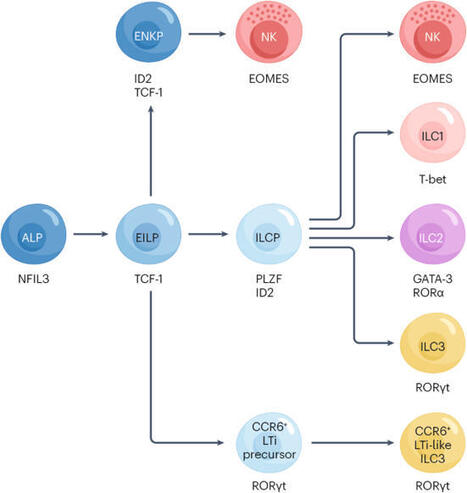
Innate lymphoid cells (ILCs) are emerging as critical modulators of inflammation in rheumatoid arthritis, contributing to both disease pathology and resolution. Group 3 ILCs (ILC3s) mirror TH17 cells in their production of IL-17A and IL-22, promoting fibroblast activation, neutrophil recruitment and synovial inflammatory cascades. By contrast, group 2 ILCs (ILC2s) engage reparative and immunoregulatory pathways via secretion of IL-9, IL-13 and IL-10. Lymphoid tissue inducer (LTi) ILCs contribute to ectopic lymphoid tissue neogenesis and stromal remodelling in early disease. Clinically, alterations in ILC subset composition correlate with disease activity, therapeutic responsiveness and inflammatory burden. Advances in high-dimensional immunophenotyping, spatial transcriptomics and single-cell multi-omics now enable precise mapping of ILC subsets and their effector programmes across peripheral blood and synovial tissue, supporting their use in biomarker discovery and treatment pipelines. Furthermore, modulation of ILCs by targeting upstream cytokines, signalling pathways or the use of microbiota-derived metabolites is a potential therapeutic strategy. Finally, cell-based avenues include IL-10-producing ILC2s (ILC210) and engineered chimeric antigen receptor (CAR)-ILC2s for targeted, tissue-resident immune modulation. Although still in the preclinical stages, these approaches highlight the translational potential of ILCs as biomarkers and therapeutic targets in rheumatoid arthritis. Innate lymphoid cells (ILCs) influence rheumatoid arthritis by amplifying inflammatory circuits through ILC3 activity and promoting immune regulation via ILC2 responses. These context-dependent functions position ILC subsets as emerging biomarkers and targets for innovative therapies.
🦠 Cette découverte est extraordinaire : végétaliser les cours d'école aurait des conséquences incroyables et rapides sur la santé.
Car il ne faut que 28 jours à un enfant déplacé dans une cour végétalisée pour régénérer son microbiote ! J'en parle dans mon prochain livre Bioconscience : https://buff.ly/lUMtXMP
Depuis cinquante ans, asthme et allergies ont explosé dans les pays industrialisés : moins de 5 % des enfants dans les années 1970, plus de 35 % aujourd'hui, et cela pourrait atteindre 50 % avant 2050 selon l'OMS.
L'excellente Marie-Monique Robin, dans son livre et son documentaire Vive les microbes! sur Arte, nomme la cause : l'appauvrissement de notre environnement microbien. C'est l'hypothèse de la biodiversité.
L'idée est simple et radicale. Notre système immunitaire a besoin, pour se calibrer, d'être exposé très tôt à une grande diversité de microbes — bactéries, virus, champignons, parasites. En les éliminant de notre alimentation, de nos sols, de nos espaces de vie, nous privons nos enfants d'un apprentissage fondamental.
La preuve la plus frappante vient de la comparaison des microbiotes des enfants de ferme avec des enfants en milieu urbain. Les premiers présentent jusqu'à 80 % de risques en moins de développer asthme ou eczéma parce qu'ils baignent dès la naissance dans une diversité microbienne intense : étables, animaux, lait cru, terre vivante. L'Union européenne a financé deux grandes cohortes PARSIFAL et GABRIELA, menées sur plus de 8 000 enfants dans cinq pays. PASTURE a suivi 1 000 enfants pendant quinze ans depuis le ventre de leur mère. Tous confirment l'hypothèse et préparent des traitements spécifiques.
Mais la découverte la plus saisissante vient de Finlande. Des chercheurs de l'Université d'Helsinki ont échangé les enfants de quatre garderies urbaines : certains couvertes de béton, d'autres avec des sols forestiers, jardinières, plantes à toucher. En 28 jours seulement, à raison de 90 minutes dehors par jour, le microbiote cutané et intestinal des enfants du béton s'était amélioré, sa diversité avait augmenté, et leur système immunitaire devenait comparable à celui des enfants des écoles végétalisées.
Roslund et al. (2020) - Université d'Helsinki dans Science Advances https://buff.ly/1NPQfSr C'est la première étude au monde à avoir manipulé la biodiversité d'un environnement urbain pour en mesurer les effets sur le microbiote des enfants.
Ce que tout cela dit est immense : végétaliser une cour d'école devient un acte de santé publique. Ramener le végétal et l’animal dans nos vies, c’est refaire milieu. Nous avons passé un demi-siècle à aseptiser notre habitat. La question maintenant est de savoir comment réparer ce que nous avons défait, comment régénérer les corps et les lieux.
What if the immune system could change antibody behavior without changing the antibody itself?
This discovery could redefine IgA Therapeutics, Mucosal Immunity, and Next-Generation Antibody Engineering.For decades, immunology held the view that there were basically two distinct systems of IgA production, monomeric and dimeric, by different populations of plasma cells.
In human circulation, the SAME IgA1 clone can be found in both monomeric IgA and dimer form, bound to J-chain.
• monomeric IgA • J-chain coupled dimeric IgA
But even more astounding: These “structurally promiscuous” clones make up the circulating IgA repertoire.
These different structures of IgAs have various distinct characteristics on: •tissue distribution, •receptor activation, •serumclearance, •neutralization potency and •mucosal transport capacity.
This suggests that it is possible to dynamically adjust antibody function (without altering antigen specificity) by changing assembly state of the immune system.
In other words: One antibody sequence may generate multiple functional immune states.
The potential implications for this are: • Next generation mucosal vaccines • Improved antiviral neutralization • Antibody design using AI platforms • Precision IgA therapeutics • Autoimmune disease targeting, and • IgA nephropathy biology.
The exciting thing is the era of “static antibodies” might come to an end.
In textbooks, CD4+ T cells are typically described as helper cells, and occasionally as cytotoxic cells. But the reality in human tissues doesn't always fit into those neat categories.
In a recent study, we found that tissue-resident CD4 T cells can actually fall on a spectrum between adaptive immunity and innate-like functions. We also showed that co-expression of the molecules CD161 and CD56 can be used to identify this specific population in both the human gastrointestinal tract and blood.
For a broader overview of the project and what these cells might mean for tissue immunosurveillance and inflammatory bowel disease, Karolinska Institutet just published a short news piece summarizing our findings:
Sperm have long been thought of as streamlined DNA delivery vehicles, carrying little more than a father’s genes to the egg.
But a new study shows that in mice, sperm may transmit the father’s influence in another way.
During their passage through the epididymis, the coiled tube where they mature after leaving the testes, sperm pick up messenger RNAs (mRNAs), RNA transcripts of genes that contain the genetic instructions for making proteins.
These mRNAs seem to be transferred to the fertilized egg, where they may affect the developing embryo.
Your nose may be the gateway to a stronger immune system. 👃
At the moment, an influenza vaccine called FluMist is the only licensed intranasal vaccine approved for use in humans. The vaccine is administered through a spray of fluid in the nose, rather than with an injection.
FluMist has proven effective in children, and is licensed for adults—but for a long time there has been no measurable “correlate of protection.” Scientists saw no sign of influenza-fighting immune cells circulating in the blood after adults received FluMist.
Now scientists at La Jolla Institute for Immunology (LJI) have discovered that FluMist can trigger an immune response directly in nasal tissue in adults. The vaccine trains immune cells in the upper nasal passages to recognize and fight influenza virus infection. This immune response stays in the upper airways and can’t be detected via blood samples.
How do intranasal vaccines work? Can flu vaccines be better? Thrilled to announce our newest paper is out, demonstrating memory B cell responses in human upper airway after immunization with the intranasal flu vaccine (Flumist). Great findings by dedicated scientist Dr. Hannah Stacey in the lab, leveraging clever sampling techniques from Dr. Sydney Ramirez. La Jolla Institute for Immunology Science Magazine https://lnkd.in/gtRiyMdS
Camelids have evolved to survive some of the most challenging climatic conditions on our planet and are resilient to physiological stress such as temperature extremes, drought, storms, intense ultraviolet radiation, dehydration, and starvation.
Among tissue-resident immune cells, γδ T cells have a unique role in local immune surveillance. Under homeostatic conditions, they control tissue integrity and maintain the epithelial barrier. In contrast to conventional αβ T cells, γδ T cells sense stress-induced cellular alterations and, therefore, can recognize transformed cells independently of MHC (HLA in humans) molecules. In colorectal cancer and hepatocellular carcinoma, γδ T cells constitute an important part of the antitumour immune response. However, there is evidence that γδ T cells can also promote tumorigenesis. In this Review, we present basic features of γδ T cells and their distribution and function in the context of the local immune response. We discuss the ligands and antigens recognized by circulating and tissue-resident human γδ T cells, as well as the functional diversity of γδ T cell subsets within tumour-infiltrating T cells in colorectal and liver cancer. Given their potent cytotoxic activity and HLA-independent mode of action, there is increasing interest in harnessing γδ T cells for application in cancer immunotherapy. We therefore discuss the current status and future challenges of using γδ T cells as an innovative immunotherapeutic strategy for gastrointestinal and liver cancer. γδ T cells are an important component of local immune surveillance. This Review discusses their role in colorectal cancer and hepatocellular carcinoma development and provides a detailed overview of their therapeutic potential.
High-frequency influenza-specific CD8+ T cells with a tissue-resident phenotype that recognize conserved viral epitopes and have a functional phenotype distinct from cells found in blood were found in the lower airways during viral clearance. Read more: https://ow.ly/o2Kg50ZhTgW.
Des travaux de recherche récents suggèrent que l’endométriose ne devrait pas être réduite à une affection gynécologique, mais considérée comme une maladie inflammatoire qui touche l’organisme dans son intégralité.
💧 L’histoire fascinante des tight junctions celulaires et la découverte des claudines
Pendant longtemps, les épithéliums ont été considérés comme de simples barrières passives. Cette vision change profondément avec les travaux du couple et futurs époux Marilyn G. Farquhar (1928-2019) et George E. Palade (1912-2008) qui, en 1963, utilisent la microscopie électronique en coupes ultrafines pour décrire le complexe jonctionnel apical : tight junctions (zonula occludens), jonctions adhérentes et desmosomes. Ils établissent ainsi l’architecture fondamentale des épithéliums et introduisent le concept de compartimentation cellulaire. Palade recevra le prix Nobel de physiologie ou médecine en 1974 (avec les belges Albert Claude et Christian de Duve) pour ses contributions majeures à la biologie cellulaire.
Dans les années suivantes, une question persiste : si les tight junctions sont des barrières, comment expliquer le transport paracellulaire observé dans de nombreux tissus ? C’est ici qu’intervient une seconde génération de travaux. Dans les années 1980–1990, l’argentin Marcelino Cereijido et ses collaborateurs transforment la vision des épithéliums grâce au modèle MDCK (canine kidney). Ils démontrent que la formation des tight junctions est dynamique, dépendante du calcium, et intimement liée à l’établissement de la polarité cellulaire. Le concept clé émerge : les épithéliums ne sont pas des murs inertes, mais des systèmes auto-organisés, polarisés et régulés.
Parallèlement, l’identification de ZO-1 (zonula occludens-1) dans les années 1980 suggère l’existence d’un réseau moléculaire d’ancrage des jonctions serrées. Mais la véritable révolution survient à la fin des années 1990 avec Mikio Furuse et Shoichiro Tsukita, qui découvrent les claudines, protéines transmembranaires constituant l’ossature fonctionnelle des tight junctions.
Ces travaux aboutissent à une synthèse majeure : les tight junctions ne sont pas seulement des barrières physiques, mais des structures tripartites assurant barrière sélective, maintien de la polarité (“fence function”) et plateforme de signalisation cellulaire.
Ainsi, en quelques décennies, la vision des épithéliums évolue radicalement : d’une structure statique en microscopie électronique → à un système moléculaire dynamique essentiel à l’homéostasie, dont les altérations sont impliquées dans les pathologies rénales, digestives, pulmonaires et neurologiques.
Références : Farquhar & Palade, Journal of Cell Biology, 1963 17(2): 375–412 Stevenson, B.R., etal Journal of Cell Biology,1986 103(3): 755–766 Cereijido M., et al J. Exp. Biol. (1983) Furuse et al.. Journal of Cell Biology. 1998 Valdes Socin H, Weekers L, Jouret F. Physiopathology. BIMS-2006 ULiège 2025. https://lnkd.in/ersyxyDt
The human microbiome is a distributed drug factory.
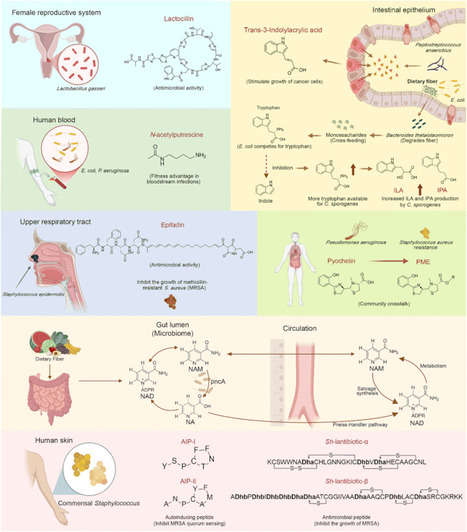
A 2025 review in Natural Product Reports catalogued specialized metabolites, mapped by body site, with defined mechanisms.
Gut: Cross-feeding between B. thetaiotaomicron, E. coli, and C. sporogenes redirects tryptophan flux toward indole-3-lactic acid (ILA) and indole-3-propionic acid (IPA), metabolites with anti-inflammatory and barrier-protective properties.
Microbial catabolism of dietary fiber generates nicotinic acid that enters host NAD+ biosynthesis via the Preiss-Handler pathway.
Skin: Commensal Staphylococcus produce peptides AIP-I and AIP-II, which disrupt MRSA quorum sensing, and Sh-lantibiotics α and β, ribosomally synthesized antimicrobial peptides that directly inhibit MRSA growth.
Vaginal tract: L. gasseri expresses a biosynthetic gene cluster (BGC) encoding lactocillin, a thiopeptide with antimicrobial activity against Gram-positive bacteria.
Respiratory tract: S. epidermidis produces epifadin, a compound with antimicrobial effects against methicillin-resistant S. aureus (MRSA).
The pattern across all of these is commensal bacteria producing pharmacologically active compounds, in situ, under ecological pressure.
BGC mining allowed for these discoveries, but the question of what's expressed, in which ecological contexts, and at what concentrations is still unresolved. That's what we hope to uncover next.
Reference: Kulkarni et al. Mass spectrometry-based metabolomics approaches to interrogate host-microbiome interactions in mammalian systems. Nat Prod Rep. (2025). doi: 10.1039/d5np00021a. | 16 comments on LinkedIn
The probiotics field, a historically popular yet scientifically debated discipline, is moving beyond a decades-long promotion of ‘first-generation’ food-derived strains towards the development of ‘next-generation probiotics’ (NGP) or ‘precision probiotics’, natural and engineered strains featuring improved human colonization, clinical efficacy and safety profiles. In this Review, we outline the evolution of NGP and means by which their development is designed to tackle challenges of live bacterial therapy related to colonization resistance, in-host evolution, long-term safety and insufficient understanding of therapeutic and off-target mechanisms of activity. We showcase how a variety of emerging strategies enable the identification of NGP strains and define consortia featuring therapeutic potentials in metabolic, immune and oncological diseases. Finally, we discuss how computational and artificial intelligence (AI) advances can reshape NGP development, including AI-based discovery of strains and bioactive compounds; computational-driven design of engineered microorganisms and multi-kingdom consortia; and AI-assisted structural and metabolic network-based modelling predicting personalized NGP function, interactions and therapeutic impacts. In this Review, Kern, Tofield, Frame and Elinav discuss recent advances in the design of next-generation probiotics, from identification of candidates to therapeutic applications across diverse disease contexts, and highlight major challenges and the potential of artificial intelligence to develop effective, personalized probiotics with therapeutic functions.
2️⃣ 0️⃣ years ago, a #microbiota analysis of samples from patients with #Crohn's disease turned up something consistent: one bacterium was missing in patients who relapsed, who progressed to surgery, who failed biologics. #Faecalibacterium prausnitzii. And this bacterium exhibited anti-inflammatory effects in vitro and in mice!
What followed was two decades of mechanistic work: ✅ MAM protein blocking NF-κB (https://lnkd.in/eWa9rU6P) ✅ CD4+CD8αα+ regulatory T cells specific for F. prausnitzii (https://lnkd.in/e5EUCAXY), ✅ and CD14+ monocytes rewired toward anti-inflammatory energy metabolism (https://lnkd.in/eREPZy93).
By 2016, that body of evidence was strong enough to build a company. Exeliom Biosciences was founded that year to turn the science into a drug (https://lnkd.in/efAgpyT9).
▶️ The MAINTAIN study is where that bet was tested in humans for the first time.
🦠 After induction with corticosteroids, eight patients with mild-to-moderate Crohn's disease received oral EXL01 (10¹⁰ bacteria/day) for up to 24 weeks. No treatment-related adverse events. EXL01 was recovered in up to 42.8% of stool samples during treatment.
🧬 Ileal transcriptomics detected upregulation of energy metabolism and mucosal immune pathways, without broad compositional shifts in the microbiome. The bacterium acts on host cells directly, not by remodeling the community. The two patients who flared showed markedly higher CRP and platelets at baseline. Before EXL01 was started, suggesting that the corticoid treatment did not work for them.
A phase 2 randomized controlled trial is ongoing to evaluate the effect of EXL01 in preventing postoperative recurrence in CD (NCT06925061) with Groupe REMIND
With Perle Guarino-Vignon, Edouard Louis, Hang Phuong PHAM, Geert DHaens, Philippe Langella, Nathalie Rolhion and all co-authors.
Faculté de Santé de Sorbonne Université INSERM INRAE Greater Paris University Hospitals - AP-HP Crsa Paris Exeliom Biosciences FHU GLIMMER "Gut, Liver & Microbiome Research" Groupe REMIND | 11 comments on LinkedIn
Can a woman with an optimal vaginal microbe donate and thereby resolve molecular vaginal dysbiosis in another woman???
We wanted to answer the question in this first randomised controlled trial - It was one of the studies in Tine Wrønding PhD - she organised more than 900 clinical visits to make this possible and it has been a remarkable team effort - huge thanks to everybody involved💪🙏
Although some women experienced donor microbiome engraftment - especially after pre-treatment - and although we learned a lot about the vaginal microbiome - this is a negative trial - going forward we need to explore who will benefit vaginal microbiome transplantation or find alternative ways to treat vaginal dysbiosis 🔬
To get content containing either thought or leadership enter:
To get content containing both thought and leadership enter:
To get content containing the expression thought leadership enter:
You can enter several keywords and you can refine them whenever you want. Our suggestion engine uses more signals but entering a few keywords here will rapidly give you great content to curate.


 Your new post is loading...