


SEOs complained that adding shortnames to GMB profiles causes reviews to disappear or listings to be suspended. Google says it's working on it.
Via THE OFFICIAL ANDREASCY, Jesús Hernández

 Your new post is loading...
 Scoop.it! SEOs complained that adding shortnames to GMB profiles causes reviews to disappear or listings to be suspended. Google says it's working on it. Via THE OFFICIAL ANDREASCY, Jesús Hernández No comment yet.
Sign up to comment
Scoop.it!

"Adam Holman decided he was fed up with trying to cram knowledge into the brains of the high school students he taught. They weren’t grasping the physics he was teaching at the level he knew they were capable of, so he decided to change up his teaching style. It wasn’t that his students didn’t care about achieving — he taught at high performing, affluent schools where students knew they needed high grades to get into good colleges. They argued for every point to make sure their grades were as high as possible, but were they learning?
“I felt I had to remove all the barriers I could on my end before I could ask my kids to meet me halfway,” Holman said. You can read more about his journey with his students and how they worked together to evolve teaching and learning. “It turned my students into classmates and collaborators because I didn’t have a system in place to deny the collaboration,” he said." Via Jim Lerman, Yashy Tohsaku
Scoop.it!

El avance vertiginoso de la tecnología está transformando las modalidades de aprendizaje y ofrece variadas opciones para enriquecer el diseño de los cursos de e-learning y mejorar la experiencia de usuario. Uno de esos avances es el plugin H5P, que permite integrar la tecnología HTML5 en la plataforma Moodle. Via Net-Learning
Scoop.it!

"Technology is empowering. You can take a peek at the whole world sitting in the corner of a room, using that small mobile in your hand. With such immense power, technology is undoubtedly aiding instructors and students to achieve all that they can through education..."
Via Leona Ungerer
Scoop.it!
Scoop.it!

"Students in online charter schools have generally performed less well than their peers in brick-and-mortar classrooms, but this doesn’t have to be the case. With specific strategies, online schools can be a viable alternative to traditional public education, according to a new report from Public Impact." Via EDTECH@UTRGV 
EDTECH@UTRGV's curator insight,
July 13, 2019 3:21 PM
In addition to good instructional design and trained online faculty, I believe the teacher-student ratio is an important factor to consider. The larger the class size, the less the likelihood that teachers will be able to build personal connections with students.
Scoop.it!

As debate persists around how young is too young for students to begin deciding on careers, the middle grades are increasingly eyed as a good introductory period for a variety of skills. Via EDTECH@UTRGV
Scoop.it!

25 Initiatives Disrupting Education Right Now, from the Khan Academy and flipped classroom to MOOCs and Teach for America. Via Yashy Tohsaku
Scoop.it!

A couple of years ago, MIT released a report titled “Online Education: A Catalyst for Higher Education Reforms.” Among its recommendations were to “support the expandin Via juandoming
Scoop.it!

Discover three ways why using active learning methods in skills transformation/digital transformation initiatives is critical. Via juandoming
Scoop.it!

What’s changing We’re making some improvements to the Google Voice web app. These will make it easier to find the right contact, quicke Via Dr. Tom D'Amico (@TDOttawa)
Scoop.it!

My friend and an educator that I have incredible admiration for, Bill Ferriter, recently wrote a post titled, “The Best Innovation Ever” where he discusses the importance of relationshi… Via juandoming
Scoop.it!

This post lists the best video to MP3 converter and 10 free YouTube video to MP3 converters to help you quickly convert video to MP3. Via Alfredo Calderón |
Scoop.it!

"We use student-centered instruction extensively in our courses and discuss it in teaching workshops we present to faculty members and graduate teaching assistants. The workshop participants generally fall into two categories. On the one hand are the skeptics, who come up with all sorts of creative reasons why student-centered methods could not possibly work. On the other hand are the converts, who are sold on SCI and can't wait to try it. We know the fears teachers have about the instructional methods we advocate, having had most of them ourselves, and we can usually satisfy most of the skeptics that some of the problems they anticipate will not occur and the others are solvable. We worry more about the enthusiasts who leave the workshop ready to plunge right in, imagining that the spectacular results promised by the literature will show up immediately.
"The enthusiasts may be in for a rude shock. It's not that SCI doesn't work when done correctly-it does, as both the literature and our personal experience in two strikingly different disciplines richly attest. The problem is that while the promised benefits are real, they are neither immediate nor automatic. The students, whose teachers have been telling them everything they needed to know from the first grade on, don't necessarily appreciate having this support suddenly withdrawn. Some students view the approach as a threat or as some kind of game, and a few may become sullen or hostile when they find they have no choice about playing. When confronted with a need to take more responsibility for their own learning, they may grouse that they are paying tuition-or their parents are paying taxes-to be taught, not to teach themselves. If cooperative learning is a feature of the instruction, they may gripe loudly and bitterly about other team members not pulling their weight or about having to waste time explaining everything to slower teammates. Good lecturers may feel awkward when they start using student centered methods and their course-end ratings may initially drop.
"It's tempting for instructors to give up in the face of all that, and many unfortunately do. Giving up is a mistake. SCI may impose steep learning curves on both instructors and students, and the initial instructor awkwardness and student hostility are both common and natural. The key for the instructors is to understand how the process works, take some precautionary steps to smooth out the bumps, and wait out the inevitable setbacks until the payoffs start emerging. " Via Jim Lerman, Yashy Tohsaku
Scoop.it!

Beneath the spread of all “fake news,” misinformation, disinformation, digital falsehoods and foreign influence lies society’s failure to teach its citizenry information literacy: how to think critically about the deluge of information that confronts them in our modern digital age. Instead, society has prioritized speed over accuracy, sharing over reading, commenting over understanding. Children are taught to regurgitate what others tell them and to rely on digital assistants to curate the world rather than learn to navigate the informational landscape on their own. Schools no longer teach source triangulation, conflict arbitration, separating fact from opinion, citation chaining, conducting research or even the basic concept of verification and validation. In short, we’ve stopped teaching society how to think about information, leaving our citizenry adrift in the digital wilderness increasingly saturated with falsehoods without so much as a compass or map to help them find their way to safety. The solution is to teach the world's citizenry the basics of information literacy. Via John Evans 
Tina Jameson's curator insight,
July 25, 2019 7:35 PM
A well presented essay / article on the necessity of teaching our 'citizens' digital and information literacy and to cultivate a persistant and healthy scepticism towards the information they read online. My favourite phrase in the piece: "Most importantly, we must emphasize verification and validation over virality and velocity." 
Federico Santarelli's curator insight,
August 4, 2019 11:37 AM
Already, science and technology can help us fight fake news, which is a problem of cultural origin and poor conscience like compulsive sharing, it takes honest conscientious work of individual users in an organization, what do we think, what do we mean, what do we feel ?
Scoop.it!
Scoop.it!

eLearning is quickly becoming the future. Discover the top 7 benefits of eLearning and learn how eLearning is changing the scope of education. Via juandoming
Scoop.it!

Classroom management can be challenging. In this episode, teacher Stacey Corrigan gives us a quick 10-minute look at the basics of classroom management. Via Dr. Tom D'Amico (@TDOttawa)
Scoop.it!

Funds For Learning's ninth annual survey of E-rate applicants finds 70% reporting the program's competitive bidding rules are lowering internet service prices, though home connectivity for students remains a challenge. Via EDTECH@UTRGV
Scoop.it!

Of all the gifts students receive from education, passion is the greatest. If students are taught that learning is difficult, that math and science are boring, that history is a waste of time, they… Via Dr. Tom D'Amico (@TDOttawa)
Scoop.it!
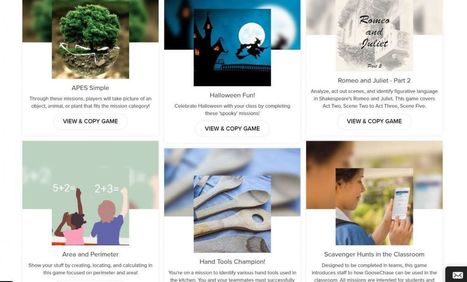
GooseChase EDU can be used to create some amazing activities for any subject. Each step for creating a game has directions next to it. Via Dr. Tom D'Amico (@TDOttawa)
Scoop.it!

Target 4.1: By 2030, ensure that all girl and boys complete free, equitable and quality primary and secondary education leading to relevant and effective learning outcomes Target 4.2: By 2030, ensure that all girls and boys have access to quality early childhood development, care and pre-primary education so that they are ready for primary education Target 4.3: By 2030, ensure equal access for all women and men to affordable and quality technical, vocational and tertiary education, including university Target 4.4: By 2030, substantially increase the number of youth and adults who have relevant skills, including technical and vocational skills, for employment, decent jobs and entrepreneurship Target 4.5: By 2030, eliminate gender disparities in education and ensure equal access to all levels of education and vocational training for the vulnerable, including persons with disabilities, indigenous peoples and children in vulnerable situations Target 4.6: By 2030, ensure that all youth and a substantial proportion of adults, both men and women, achieve literacy and numeracy Target 4.7: By 2030, ensure that all learners acquire the knowledge and skills needed to promote sustainable development, including, among others, through education for sustainable development and sustainable lifestyles, human rights, gender equality, promotion of a culture of peace and non-violence, global citizenship and appreciation of cultural diversity and of culture’s contribution to sustainable development Target 4.a: Build and upgrade education facilities that are child, disability and gender sensitive and provide safe, non-violent, inclusive and effective learning environments for all Target 4.b: By 2020, substantially expand globally the number of scholarships available to developing countries, in particular least developed countries, small island developing States and African countries, for enrolment in higher education, including vocational training and information and communications technology, technical, engineering and scientific programs, in developed countries and other developing countries Target 4.c: By 2030, substantially increase the supply of qualified teachers, including through international cooperation for teacher training in developing countries, especially least developed countries and small island developing States. Via Edumorfosis, Yashy Tohsaku
Scoop.it!

"Want to help students learn to think critically about ‘fake news’? A simple, browser-based game could help. What is Bad News? Bad News is a simple tool to help students understand ‘fake news,’ the (modern?) phenomenon of misinformation and ‘content ..." Via Leona Ungerer
Scoop.it!

Saving time, making connections with influencers, building authority — these are just some of the benefits of content curation. Via Gumersindo Fernández
Scoop.it!

"Learn how gamification can support typing practice in your classroom this school year. Prepare students for everyday success with Typing.com ..." Via Leona Ungerer |






