The U.S. Supreme Court has declined to take up a case involving school punishment of a student for Internet speech critical of school administrators. However, two other appeals raising similar student free-speech issues are pending before the justices.
The high court on Monday turned away the appeal of Avery Doninger, who, as a Connecticut high school junior in 2007, had criticized school officials in her Web journal. After a dispute with officials at her high school in Burlington, Conn., over the scheduling of a band contest, Doninger referred to administrators as "douchebags" and encouraged her readers to email the superintendent "to piss her off more."
School officials, citing disruption by the emails and Doninger's Web comments, barred her from running for senior class secretary, but she wasn't suspended. Doninger and some of her fellow students were also later barred from wearing T-shirts at a school assemby that said "Support LSM Freedom of Speech," referring to Lewis S. Mills High School.
Some of the more than 1,000 teachers expected to retire Dec. 1 to avoid higher health insurance costs could end up back in their classrooms through the end of the school year.
Officials have been scrambling to find a way to avoid disrupting at least 2 percent of Alabama's classrooms with midyear teacher changes. More than 1,200 education employees have already put in retirement notices for Dec. 1. Officials expect the number to grow to about 2,000 and predict more than half of them will be teachers.
The looming problem had become so severe that Gov. Robert Bentley considered calling a special session of the Legislature to address it and Jefferson County's financial problems. But with no agreement in sight on Jefferson County's problems, officials began looking for a non-legislative solution to the teacher exodus.
"I just escaped the whitewashed brick-walled iron-gated prison that is commonly known as middle school."--Annie, a 9th grader
This now high-school student described the inter-personal drama, endless criticism, and fear of being ostracized that characterize the middle school years.
What can be done?
It's a process that students have to go through to figure out who they are, she explained. "I don't think you can really do anything about it."--Annie
Hormones!
Alex Blumberg (producer and former MS teacher), claimed students in middle school are so wrapped up in their hormones and social and emotional learning that they probably aren't retaining much content. "I came away thinking you're sort of wasting your time trying to teach middle school students anything." He (sincerely) agreed with Glass' (joking) suggestion that kids at that age should be sent away to work in factories for a few years.
"Sticky:" May be great time to learn?
Linda Perlstein, a long-time education reporter and author of Not Much Just Chillin', explained that because of the many changes occurring in the brain around puberty, the skills people learn and practice around that time tend to stick.
Peer Pressure Can Be a Positive Force
Significant Adults Can Make a Huge Difference...by turning peer pressure from a weapon used against students to a positive force that teaches students empathy.
Thought-provoking Question:
• What more can teachers do to make middle school a safe and comfortable place? (See our recent Teacher Book Club discussion on cyberbullying for some ideas on this.)
• Is constantly fearing ostracism—or actually being ostracized—really a necessary part of the middle school experience?
• Can kids figure out who they are without feeling the anxiety and even anguish of those years?
The Miami-Dade school district recently decided to eliminate midterms and finals as a requirement. Officials say the move is meant to lighten the testing load on students — many of whom are, of course, thrilled.
The change comes as Florida moves to common end-of-course exams. Last year, Algebra I debuted and in 2012 will see geometry and biology. Those state exams don’t take the place of classroom midterms or finals, said Cheryl Etters, spokeswoman with the state’s Department of Education. “If they already have a system in place — if they had a midterm or final exam — there’s nothing to keep them from doing that,” she said.
In fact, when Virginia moved to state end-of-course exams, Mel Riddile, a former Virginia principal, said he kept midterms and finals, considering it a more comprehensive approach.
“We didn’t want to wait until the end of the year to find out if students were on target to master the course,” said Riddile, now associate director at the National Association of Secondary School Principals. Other reasons: teachers could get final grades quicker; finals could serve as a testing warm-ups and there was no match-up between the end-of-course exam — meant as a minimum bar — and an actual course grade.
"In response to my post 20 Things Students Want the Nation to Know About Education, Tom, who blogs at Stop Trying to Inspire Me. Just Shut Up and Let Me Teach wrote the 20 things teachers like him want the nation to know about education."
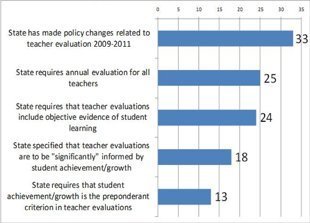
Over the past two years, state governments have taken dramatic steps to transform how they evaluate and retain teachers.
In 2009, just 15 states employed teacher evaluations to judge educator performance, while only four states required students' test scores to be used in those evaluations, according to a new report from the National Council on Teacher Quality.
Today, 24 states require yearly evaluations, and in 13 states, teachers can now be fired if their students do not improve on test scores.
The report finds that 17 states and Washington, D.C., now use student test scores as a meaningful factor in evaluating teachers. (The states are Arizona, Colorado, Delaware, Florida, Idaho, Illinois, Indiana, Louisiana, Maryland, Michigan, Minnesota, Nevada, New York, Ohio, Oklahoma, Rhode Island and Tennessee.)
Not Perfect, But Better Than Nothing?
The reports' authors admit that not all subjects can be tested as easily as math and reading--but they contend that such difficulties shouldn't prevent states from continuing to try to evaluate teachers based on "student achievement," even when different subjects employ different measures of such achievement.
States Notify Parents of "Ineffective Teachers" The authors say they disapprove of policies in Indiana, Michigan, and Florida that notify parents if their child is placed in a classroom with a teacher who was rated "ineffective" by the state's evaluation system. "If a district has evidence that a teacher is ineffective," the report says, "state policy should provide the means for the district to take the necessary steps to remove the individual from the classroom, not humiliate the teacher."
Must Be a Better Way
"You certainly can see the good intention behind that policy. Nobody wants their child to be with a poor teacher, but we think there are other ways to get at that," Jane Hannaway, vice president of the American Institutes of Research, told reporters. The American Institutes of Research has been contracted by some states to develop evaluation systems.
NEA: Value-added measures are unreliable
The country's largest teachers' union, the National Education Association, opposes using students' standardized test scores to evaluate teachers. NEA President Dennis Van Roekel told Yahoo News in September that value-added measures are too unreliable to serve as the chief factor in evaluating teachers.
"The word “bullying” has been turned into the opposite of a euphemism; it has become an epithet, a term of pure condemnation detached from the underlying meaning of the word or its connection to reality.
Like a euphemism, it is an attempt to color or change our perception of reality. Despite the reported decline in language skills among students, kids seem to understand instinctively when adults are using words to obscure or slant reality.
In this case, it seems to have undermined the credibility not only of a word, but also of efforts to address important behavioral challenges in our schools.
John Ryan is president and CEO of the Center for Creative Leadership, a top-ranked, global provider of leadership education and research.
"By deliberately carving out time to wrestle with initial sticky questions and the ones that further reflection prompts, we too can drive results."
As we take on more responsibility..."the more critical it becomes to set aside time for thinking about the key challenges and opportunities facing the organizations (schools) we are privileged to lead, as well as the ways in which we can personally improve as leaders."
Majoring in the Minors
And yet, swamped as we are with packed meeting schedules and constant communications on our Blackberries, iPads, laptops and other mobile devices, it is more difficult than ever to make that time. We are certainly the most informed generation in history. We mistakenly believe that we can multi-task effectively, but we eventually learn that information is worthless... if we are unable to pause long enough to make sense of it.
Reflection and Neuroscience
Multi-tasking is a Myth
Our brains are not wired to consciously attend to more than one thing at a time. What we refer to as multi-tasking, neuroscientists define as "task switching" or repeatedly changes focus or shifting our attention from one task to another. Continous "task switching" results in diminished performance in all involved tasks. http://bigthink.com/samwang
Neuroscience reminds us of a vital truth in a digital, multi-tasking age: our brains can only process so much information at once – and not nearly as much as we’d like to believe they can. If we try to think seriously about more than just a couple things at one time – responding to an e-mail and scanning a document while simultaneously conducting a conference call and pondering what’s for dinner tonight – we get muddled very quickly. Our judgment suffers and our effectiveness declines. At times, it seems the only solution is to go where we can’t be reached easily.
Old Dogs Can Learn New Tricks
Contrary to prior assumptions, our brains are actually highly plastic. It’s not true that old habits are impossible to break, especially as we get older. Instead, we have the power to create new neural pathways and change for the better, provided we are willing to invest the time it takes to build new habits.
Keys to Consistent Reflection
1. Get a Coach! - Coaches and Mentors Help Us Reflect
"At the Center for Creative Leadership, we have found that working with a coach is a good place to start. Effective coaches serve as sounding boards and expert listeners, sparking frequent reflection on how we have operated in the past and how we might improve on our learning, communication and judgment in the future. Not matter how far along we are in our careers and how skilled we are, it is always beneficial to get the objective take on our strengths and weaknesses that coaching provides."
2. Create or find a favorite space to reflect.
3. Build reflection time into your schedule.
4. Take reflection breaks. "Walking the few paces to the conference room and sitting down at the table there helps nurture a shift from a reactive mindset into a more reflective one. The change in scenery serves as a trigger for thinking in a different way as well."
5. Keep a log of critical questions. "These are not questions, in all likelihood, that will be answered during one 20-minute session at the conference table."
6. Chunking Down - Solving Complex Problems Requires Chunking! Long "forced reflection" sessions don't work. "Probing questions will not yield to simple answers or the accelerated schedule on which we like to get everything done. More likely, the first question will lead to another and several more from there."
Key: Breaking your reflection on critical issues into smaller chunks of time divides the learning into discrete and memorable chunks.
7. Visit other schools - We visited more schools than anyone I knew. I respect the professionalism of my colleagues and I always told our people that, no matter how the school was doing or how similar it was to our own, we could always learn a number of strategies that would make our school better.
8. Encourage visitors to your school - We found that visitors kept us on our toes.
- Visitors forced us to close the "say-do" gap--the difference between what we say that we are doing and what we are actually doing.
- Visitors made us reflect on the "why" of what we were doing.
- We always learned as much from the visitors as the visitors learned from us.
Thoughts for School Leaders
We are what we think about...all day long! If you are thinking about a hundred minor irritations, you will never have time to reflect on the really critical issues.
We move toward and become like that which we think about (reflect on). If we are not reflecting we are probably not moving. In other words, we are in a "stuck state."
You cannot create a vision without reflection, and, if you don't have a vision of what you want, you will never get there.
Brady Dickinson, center, Canyon Ridge High School principal, is congratulated by Thomas Boysen, left, representing the Milken Family Foundation, after winning the Milken Educator of the Year award on Wednesday in Twin Falls. State public schools chief Tom Luna is at right. See more photos from Wednesday’s ceremony at Magicvalley.com/gallery.
States and districts should not be bound to traditional principal preparation programs when developing school leaders, according to a report from the progressive Center for American Progress, based in Washington.
One Thing Reformers Agree On
One common element among the groups pushing for school leadership reform is a disdain of the traditional path of earning a master's degree in administration as as stepping stone to the principalship.
Leading
The report released Monday looks at eight states that the center believes are leading the country in terms of expanding the school leader pool and developing innovative ways to improve principal training. Those states are: Delaware, Florida, Georgia, Illinois, Louisiana, New York, Rhode Island and Tennessee.
Delaware: In Delaware, one of the "leading" states, the report pointed to the newly created Delaware Leadership Project, a 14-month intensive preparation program intended to prepare aspiring principals for the state's highest-need schools. The program will feature a "problem-based curriculum, and yearlong school-based residency under the mentorship of an experienced principal."
Lagging
The center also looked at eight states that it says are "lagging" when it comes to this issue, by having a misalignment between state policies and what research has shown are best practices for principal effectiveness. Those states are: Indiana, Kansas, Minnesota, New Mexico, Oklahoma, South Carolina, Texas, and Washington.
Kansas:
In Kansas, identified as a "lagging" state, principals earn certification by getting a master's degree in educational administration, having at least three years of teaching experience, and passing an exam. "The trouble with these criteria is that they are simply inputs and do not require candidates to demonstrate their ability to do the job well," the report says. "Nor is there evidence that these requirements have any kind of correlation with principal effectiveness."
Whole school (or comprehensive) reform models are making a remarkable comeback in policy and practice.
Here's the proposed language:
(iv) WHOLE SCHOOL REFORM STRATEGY- A local educational agency implementing a whole school reform strategy for a school shall implement an evidence-based strategy that ensures whole school reform. The strategy shall be undertaken in partnership with a strategy developer offering a school reform program that is based on at least a moderate level of evidence that the program will have a statistically significant effect on student outcomes, including more than 1 well-designed or well-implemented experimental or quasi-experimental study.
This whole-school reform language is much better than the language in the 1997 Obey-Porter bill that greatly accelerated investments in whole-school approaches. Obey-Porter was clear about the nine (later 11) elements that should be included in whole-school plans (instruction, curriculum, professional development, parent involvement, etc.), but it was vague about the evidence requirement.
Last week's Senate bill, however, is clear that to qualify, whole school programs seeking to turn around the nation's worst-performing schools will have to meet a specific set of evidence standards. That's a big improvement in itself.
"Whatever happens with the overall Senate proposal, I very much hope this provision survives. There are far too many persistently low-achieving schools in the U.S. to expect that each of them is going to invent its own successful approach. While the Senate bill does not (and should not) mandate use of whole-school reforms, its mention of the approach and of rigorous standards of evidence are sure to encourage many schools to consider it. And that would lead many organizations to create, rigorously evaluate, and disseminate a wide variety of models that would empower struggling schools to turn themselves around."
Bob Moesta sees mentoring as the balance of two worlds that overlap for a period of time and a certain amount of effort.
Since Bob tends to think of the world in mathematical terms, we devised this equation as a starting point:
Mentee
The mentee side of the equation describes: How badly does the mentee want to advance his/her career and how much ground do they feel they need to cover to get there?
Drive = How motivated is the mentee?
Distance = Where is the mentee in terms of experience vs. where they need/want to be?
Mentor
The mentor side asks: Can I help and how much effort will it require?
Gap = The amount of experience the mentor has compared with the mentee.
Relevance = The distance between the mentor's expertise and the mentee's goal.
Effort = How much work it will take to bridge any gaps of experience or relevance.
Questions for Mentee
To assess both the Drive and Distance of an aspiring protege, we'd ask two questions:
1. What is it that you would like to learn? What experience do I have, in particular, that can be helpful to you?
2. To date, I have gauged drive simply by whether someone shows up and asks. This is, at best, a shoddy criterion. Some people easily ask for help, but may or may not be motivated to go the distance, while others struggle with the ask, but are intensely driven.
My own experience as a prospective mentee bears out the importance of knowing what specific advice you want from a mentor.
Homework for the Mentee
If a mentee can clear the initial hurdle of having the necessary drive, and knowing what he or she wants to gain from your experience, I'd recommend one more test before saying "yes" — assign a task, such as: "Here are five papers that I'd like you to read," and based on what you've read, "How would you reframe what you want to know?"
Giving such an assignment tells a potential mentee that if he really wants help, he must do the work necessary to achieve his desired outcome. Reading on a particular topic also gives you a common language to tackle the issues at hand.
Mentor Questions
To assess mentor suitability — the other side of the equation — ask:
1. Do I have the relevant experience and time to make this relationship successful?
- First, estimate the level of experience of your prospective mentee versus your own (Gap). The bigger the gap (assuming a basic threshold of experience), the less effort required on your part.
- It may seem counterintuitive, but assuming a basic threshold of understanding, a large initial gap means that your new mentee will not push you to the brink of your experience.
- You have a lot more to teach someone 10 years behind you than someone two years behind you.
2. Now look at what your mentee wants to know (Relevance). If your realm of understanding is a bit distant from the school of experience the mentee is seeking, the relationship may not be a good fit, and you're probably better off referring him elsewhere and/or recognizing that it will involve more of your time.
3. Finally, assess the level of time you're willing to put into developing this person.
- Making sure you have sufficient time to give to a potential mentee is critical to a positive mentoring experience. If you know far more than the mentee, and the expertise he is looking for is in your sweet spot, very little energy may be required.
The ideal mentoring relationship is more complex than a simple equation of "A helps B."
Mentoring can be give and take — both A and B teach each other and everyone benefits. Looking at it from a "jobs-to-be-done" perspective, a prospective mentee is usually trying to get the functional job done of advancing his career.
For a mentor, there's the possibility that you may end up with a network of successful former mentees who are grateful and eager to reciprocate, but the job that typically gets done, and tends to be the most important, is the emotional payback and satisfaction of sharing and seeing your experience valued.
The strategy (of shortening school calendars) is stunting the progress of students, particularly those who are from low-income communities or are learning English as a second language, the report said.
"Released Monday, the report by Education Trust-West -- an Oakland-based school policy, research, and advocacy organization -- underscores how the budget-related reduction of instructional days especially hurts underprivileged students.
"Not surprisingly, the negative impacts of limited instructional time are exacerbated for high-need students, who are less likely than their more advantaged peers to access additional support and enriched learning opportunities outside of school and during the summer months," the report said. "Cuts to summer school classes also hit low-income students the hardest as they are the most likely to suffer from 'summer learning loss,' or the loss of academic skills over the summer.""
UCLA Research says 'It's About Time'
Research has shown that such "decisions have had a disproportionate impact on high-need students -- including English learners and students from low-income families," the report said. It pointed out that a recent UCLA study found that more than half of the principals from low- to medium-income districts cut instructional days compared to just 25 percent of principals from wealthy districts.
The UCLA study also showed that reducing learning time can have adverse consequences for English learners or students struggling with new material, the report said.
Instead of cutting back on instructional days, the report urged districts and schools to find ways to extend learning.
School Leaders Thoughts:
1. When education budgets are cut, the neediest schools and students are hurt the most. Middle class parents can afford to pick up the slack, but poor parents cannot.
2. The great equalizer is instructional time. There is no coorelation between poverty and ability. However, there is a direct relationship between work (time) and effort and achievement.
Roughly 50 percent of the nation's 500,000 foster kids won't graduate from high school, experts say.
Nearly 94 percent of those that do make it through high school do not finish college, according to a 2010 study from Chapin Hall, the University of Chicago’s research arm.
Half of students say teasing, intimidation an issue School officials are trying to curb bullying in Washington-area schools, which persists as a major problem -- from vandalized property to racial remarks -- new school surveys show.
"While many schools are struggling to strike a balance between print and digital curricula for students, textbook publishers are taking to the cloud to house new digital resources and curricula.
But schools are just beginning to tap into the cloud because most lack the technological resources or knowledge for how to do it."
New York City and Chicago plan to include college-readiness metrics in the way they evaluates high schools.
According to Catherine Gewertz of Education Week, "This is something we'll be seeing more and more of, given the national focus on college readiness and the Obama administration's emphasis on judging schools according to how well they prepare students for work or education after high school."
Read the entire post by clicking on the headline above.
"Bethesda-Chevy Chase (MD) High’s Color Day led to injury and punishment Thursday; some said it was an outbreak of hazing."
By Michael Alison Chandler, Published: October 21
Color Day, a popular rite of passage sometimes known to students as “freshmen beat-down day,” resulted in injury and punishment at Bethesda-Chevy Chase High School Thursday in what some students and parents said was an outbreak of hazing.
In a letter to parents Friday afternoon, Principal Karen Lockard reported that “a number of students engaged in very unacceptable behavior” during Color Day, including three students who were cited for alcohol possession and one who was disciplined for assault. A third incident is still under investigation.
“Let me be clear: Alcohol use, violence and intimidation will not be tolerated at B-CC and anyone who is discovered to have been involved in these behaviors will face serious consequences,” Lockard wrote.
Lockard and other principals have taken steps over the years to make such annual events safe for students amid a national crackdown on bullying. But Thursday’s incidents appeared to be a setback.
Police and school officials declined to elaborate on the reported assault, but several students and a staff member said that a freshman was beaten by an older student and might have suffered a cracked rib.
Fair warning
Color Day is a traditional part of Spirit Week, meant to stoke community support leading up to the annual homecoming game. Students demonstrate their pride by wearing class colors and spend the day using spray paint or markers to “tag” other students with their color. Freshmen are sometimes targeted by upperclassmen as a kind of initiation.
School administrators often trumpet warnings against bullying and vandalism during their morning announcements in the days before the event. Many have taken other precautions to protect facilities and students.
At Richard Montgomery High School in Rockville, the administration in recent years has banned bringing spray paint to campus, said Alan Xie, a senior and the student member of the Montgomery Board of Education. “What we have been trying to do is create a condition at our school so that these type of things won’t happen,” he said.
Students said Lockard issued a similar prohibition, but it was largely ignored. At Langley High School in McLean, the principal mandated that all students wear the same color in an alternative “unity” day. Last year, though, students revolted with a spray-paint war and a food fight.
‘We weren’t scared’
Sebastian Medina-Tayac, a senior at Montgomery Blair High School, said Spirit Week is sometimes framed as a “freshman hell week” to incoming students, but the hype has outlived the actual tradition. Spirit Week at Blair this year went smoothly, he said.
At Bethesda-Chevy Chase, Sarah Cesnik Mejac, a parent of a graduate and a sophomore, said she worried that the behavior was getting worse. Her younger son was “slugged” on the bus on the way to school last year as a freshman during Color Day, and she was nervous about hazing again this year.
Freshman Ayele Ba’s white T-shirt was covered with tags by the end of the school day, including a “Fresh 15” tag that her twin sister gave her and giant 12 in blue and gold, tagged by seniors. Some older students were a little rough in the hallway, she said, but most of the hazing was reserved for boys.
“We weren’t scared,” she said. “We enjoyed it.”
The B-CC school day began Thursday with a “senior storm” as the class of 2012 stampeded the hallways. Some seniors tore down other class’s hallway decorations and pushed juniors or younger students out of their way, according to Brad Connell, an 18-year-old senior who spent most of the day wearing a helmet and a cross-country blanket as a cape.
Color Day ended with a pep rally, including a pie-eating contest, a “tug of peace” version of tug of war, and a water-balloon toss.
“It was incredibly fun,” said Connell’s friend, senior Anthony “Spike” Shore. “Everyone had a lot of spirit.” With the uptick in hazing and drinking this year, he and Connell worried that the event’s future could be at stake because a small group took it too far.
“I’m glad we are graduating this year, because Color Day’s probably going to get canceled,” Shore said.
Shore was wearing war paint on his face and blue and gold pajama bottoms with his senior-class T-shirt that read: “Senior SWAG” (teenagers’ translation: awesomeness) on the front. On the back it read: “The world’s not ending, we’re just taking over.”
Schools blend face-to-face and online professional development, but traditional PD still plays a role.
District uses and online discussion forum (Edmodo) to conduct an online booktalk.
New principals forum on Edmodo.
Video library of master teachers demonstrating instructional strategies.
A district's traditional week-long PD for teachers now combines videos, online resources, with live interaction and presentations from master teachers.
7 Benefits of a Hybrid PD Approach
Hybrid professional-development offerings can
1. Cut costs by negating the need to hire substitute teachers and
2. Reducing travel and time.
3. Embed professional development within teachers’ daily practice with students
4. Chunking - Provide “small chunks” of information to educators, and allowing them to try out applications in their classroom in real time.
5. Expand how teachers use and access the material, whether it’s through videos, social networking, or forum discussions.
6. Give teachers 24/7 access to content for easy reivew and recall
7. Differentiate Professional Development- “Teachers need to be able to look at a small module … and try it out right away.”
A Note for School Leaders'
Studies have shown that online instruction is best for providing background and content knowledge, while face-to-face professional development is the favored choice when building skills. Hybrid professional development can do both. Online session can be used to provide content knowledge and live sessions can be used to practice the desired skills.
Overbooked schedules and tight budgets are increasingly pushing K-12 administrators toward online professional development.
"There’s a real need for more high-quality online professional development for school administrators." - John Ross, Author of Online Professional Development
"Principals and other administrators are ripe for online PD opportunities." "Harnessing the power of mobile technologies can allow administrators to listen to lectures or discussions while they are driving or between meetings, she said. “It creates accessible learning opportunities that are really important for [this population],” she said of mobile technology."- Barbara Tracey Center for Online Professional Development
We’re all facing funding cuts and tighter budgets, yet the need for professional development is still there, so we’re seeking new and innovative ways to do that,” said William H. Mayes, the executive director of the Michigan Association of School Administrators, which serves superintendents and building-level administrators in 584 school districts in the state.
“We’re finding that individuals are having a more difficult time getting out of their buildings,” he said. “More and more, in this hectic world we live in, we’re going to go to online or digital professional development.”
300 iPads
Mr. Mayes’ Lansing-based organization recently applied for a grant to place 300 iPads in the hands of Michigan administrators, to help them get access to professional-development opportunities as well as familiarize themselves with the technology.
Benefits of Online Learning
- Convenience - "Just-In-Time Nature"
- Access - “It’s not like I’m sitting across from Penn State,” he said. “[Online] professional development frees you up to take advantage of it when you want, how you want, and when it works for you.”
NOSCA, NASSP and ASCA believe that the principal-counselor relationship is a dynamic and organic relationship that evolves over time in response to the ever-changing needs of a school.
The goal of an effective principal-counselor relationship is to use the strength of the relationship to collaboratively lead school reform efforts to increase achievement for all students.
The desired outcome of an effective principal-counselor relationship is to raise achievement levels for all students and ensure equity in educational outcomes.
Enhancing the Relationship
The principal-counselor relationship toolkit comes from a multiyear research project undertaken by the College Board's National Office for School Counselor Advocacy (NOSCA), the American School Counselor Association (ASCA) and the National Association of Secondary School Principals (NASSP) to learn what principals and school counselors think is important in their relationships, how they view the current status of their own relationships within their schools, and what effective principal-counselor relationships might look like.
The toolkit has been reviewed by a very broad and diverse group, including principals and school counselors, staff from NOSCA, ASCA and NASSP, members of NOSCA’s online counselor community, the College Board Schools principals, several of the school counselors and principals whose stories are highlighted in Finding a Way, and other interested counselors and principals.
"This lively RSAnimate, adapted from Dan Pink's talk at the RSA, illustrates the hidden truths behind what really motivates us at home and in the workplace."
To get content containing either thought or leadership enter:
To get content containing both thought and leadership enter:
To get content containing the expression thought leadership enter:
You can enter several keywords and you can refine them whenever you want. Our suggestion engine uses more signals but entering a few keywords here will rapidly give you great content to curate.


 Your new post is loading...