Your new post is loading...

|
Scooped by
Mel Riddile
October 4, 2011 12:48 PM
|
According to a new report released last week by the National Center for Education Statistics (NCES): "Most school districts offer some sort of dropout prevention program." 8 in 10 high schools offer services such as tutoring and remediation classes for students who have fallen behind less than half of school districts offer an after-school program for high school students at risk of not graduating. Even fewer districts have high schools that offer professional mentors for students, which experts say is one of the most effective ways of keeping a child in school. - 12 percent of school districts keep a professional mentor on staff - 30 percent of districts have community volunteers who mentor students - Graduation Rates have increased from 66% in 1997 to 72% in 2008 Schools and districts are focusing on "early warning indicators:" - 76 percent of districts look at a student's academic failure - 64 percent of districts look at a student's attendance - 45 percent of districts look at a student's behavior in class. Attendance is a major factor! - 90 percent of high school dropouts are chronically truant (missed 20 days or more of school) "Truant students often fall behind their classmates before dropping out." (Robert Balfanz, a Johns Hopkins University researcher) More than half of the nation's dropouts come from high schools that graduate fewer than 60 percent of incoming freshmen (dropout factories) There are 1,600 "dropout factories," mainly in poor areas, both urban and rural. Action Step for School Leaders You and your staff should know the names and be intervening with any student, particularly new ninth graders, who exhibit any of the "early warning indicators including: - 10% or more absence rate - Failed one or more core courses - Read in bottom quartile - Have a GPA below 2.0 - Have ever been suspended
|
|
Scooped by
Mel Riddile
October 4, 2011 2:34 PM
|
by Tom Fishburne: Marketoonist "All children are artists, Pablo Picasso famously said. The problem is how to remain an artist once he grows up. As adults, I think we often forget how creative we are, and were."
|
|
Scooped by
Mel Riddile
October 4, 2011 12:27 PM
|
"The latest enthusiasm about new tests may be justified, however. These are assessments drawn from the Common Core State Standards (CCSS). The CCSS are unique in several ways. First, they are national; even though there are assessments being developed by two large coalitions of states (excluding Alaska, Minnesota, Nebraska, Texas, and Virginia, which are not participating), all state systems will be guided by the CCSS, eliminating much of the wild variation from state to state in standards and assessments. Second, the standards anticipate a focus on higher-order thinking, problem solving, and inquiry, which will encourage teachers to focus more energy on that kind of teaching. Schools and districts are already doing widespread professional development for teachers and administrators on the new standards."
|
|
Scooped by
Mel Riddile
October 4, 2011 11:52 AM
|
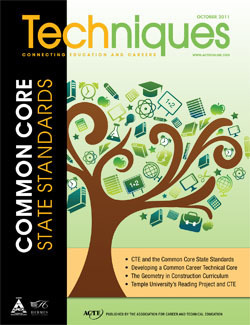
Check out the informative articles on the Common Core State Standards in the October Techniques magazine.
|
|
Scooped by
Mel Riddile
October 4, 2011 11:26 AM
|
High School football player left Friday night's game against Strong Vincent High School in handcuffs after police said he assaulted an East High assistant coach at Veterans Stadium.
Gary M.
|
|
Scooped by
Mel Riddile
October 4, 2011 9:11 AM
|
|
|
Scooped by
Mel Riddile
October 3, 2011 6:58 PM
|
The Academy@Shawnee—part of the 98,000-student Jefferson County school district, which includes the city of Louisville—made adequate yearly progress, or AYP, for the first time in its history, according to information released last week by the Kentucky Department of Education.
The school made progress under the law’s “safe harbor” provision, which allows schools that post more than 10 percent achievement growth to be considered as being on track to meet the law’s objectives, even if those schools don’t hit state proficiency targets.
And the Academy@Shawnee boasted double-digit increases in core subjects. Forty-five percent of students scored at the proficient level in reading, up from 22.58 percent in 2010, and 24.75 percent students scored at the proficient level in mathematics, up from 4.65 percent last year.
|
|
Scooped by
Mel Riddile
October 3, 2011 6:52 PM
|
Flexibility is needed, but so is more accountability from teachers and principals.
|
|
Scooped by
Mel Riddile
October 3, 2011 6:38 PM
|
National Football League Commissioner Roger Goodell re-emphasized his goal today to have all 50 states adopt youth-concussion laws "sooner rather than later." "We recognize that we have an opportunity to make a difference by taking the lead in encouraging health and safety awareness at all levels of football and in all youth sports," Goodell said. In front of an audience of more than 2,000 neurosurgeons at the 2011 Congress of Neurological Surgeons, Goodell spoke about how concussions have affected his league and the sport of football in general. He led off his speech by saying that the NFL considers nothing more important than player safety, and that the "effective prevention, treatment, and diagnosis of concussions" was the league's greatest player-safety issue currently. But he made sure to remind the audience that concussions aren't an issue exclusive to the NFL. "Concussions are not just an NFL or sports issue," said Goodell. "They are a public-health issue. ... Leadership and collaboration across all sports will be critical." During his speech, Goodell referenced the Lystedt Law, named after Zachary Lystedt, a former youth-football player in Washington state who nearly died after sustaining a concussion on the field. Goodell said Lystedt "has inspired me the most" of all coaches, parents, doctors, and student-athletes involved in youth sports. As a result, the NFL has been urging all 50 states (and the District of Columbia) to adopt youth-concussion laws. Goodell noted that the diagnosis of concussions in youth sports has exploded over the past decade, increasing at a rate of 15 percent per year." more....
|
|
Scooped by
Mel Riddile
October 3, 2011 6:29 PM
|
New research shows that making specific plans creates mental space, allowing us to avoid distraction. In addition to work, home, and our normal everyday activities, on average each of us has 15 personal projects ongoing at any one time. Psychologists have known for a century that incomplete goals rattle around in our minds until they're done. It's called the Zeigarnik effect. Plans and goals should be specific. Unless you make very specific plans, you can be distracted by incomplete goals while we're trying to pursue another goal. Plans free up mental space for whatever we are doing right now, allowing us to be more efficient in the long-term. Plans should focus on the process.
|
|
Scooped by
Mel Riddile
October 3, 2011 5:53 PM
|
The case involved four girls who were ordered to submit to a search inside a high school locker room during the first week of the 2009 school year. The search was prompted by another student’s report that $100 had been stolen from her purse after it was left unattended in the girls’ locker room.
|
|
Scooped by
Mel Riddile
October 3, 2011 5:35 PM
|
States that have requirements that students observe a "Moment of Silence" or silent reflection are permitted to continue the practice. According to Mark Walsh of Education Week, Opening its new term on Monday, the U.S. Supreme Court declined to take up a case challenging an Illinois law requiring a daily period of silent prayer or reflection. In the moment-of-silence case turned down Monday, a federal appeals court had upheld the Illinois law requiring schools to observe a daily period for "silent prayer or for silent reflection on the anticipated activities of the day." The only education case to be heard by the court will occur on Oct. 5. At that time, "the court will hear arguments in the lone case that it has agreed to review this term involving schools, at least so far. In Hosanna-Tabor Lutheran Church and School v. Perich, the court will examine whether there is a "ministerial exception" to anti-discrimination laws that covers teachers at religious schools."
|
|
Scooped by
Mel Riddile
October 3, 2011 3:31 PM
|
THE world's leading thinker says social networks are making people lazy and stupid. “I think school is a place where thinking should be taught,” says Mr De Bono. The thinker says research has shown that teaching thinking as a subject at school improves students’ performance in every other subject between 30-100 per cent.
“Teaching thinking for just five hours to unemployed youngsters increased employment 500 per cent,” he says.
|
|
|
Scooped by
Mel Riddile
October 4, 2011 2:38 PM
|
"We should be worrying about the post-secondary track record of males. And we should be doing far more to encourage more women to become risk taking entrepreneurs, engage the hard sciences, run for public office -- or all three."
|
|
Scooped by
Mel Riddile
October 4, 2011 1:22 PM
|
The privatization of public education in Michigan is a "very real" possibility, a state lawmaker said Monday, the Kalamazoo Gazette reports. At a town hall forum in Kalamazoo, Democratic state Sen.
|
|
Scooped by
Mel Riddile
October 4, 2011 12:22 PM
|
TruantToday claims that it can also improve grades, lower dropout rates and reduce crime.
|
|
Scooped by
Mel Riddile
October 4, 2011 11:30 AM
|
|
|
Scooped by
Mel Riddile
October 4, 2011 10:02 AM
|
"Students want and need interaction with peers, which has been shown to improve learning. When students work in groups, what and how much they learn is directly related to the effectiveness of the interaction with their peers." read more @ http://bit.ly/oSlWg2
|
|
Scooped by
Mel Riddile
October 4, 2011 9:07 AM
|
|
|
Scooped by
Mel Riddile
October 4, 2011 9:27 AM
|
Students want and need interaction with peers, which has been shown to improve learning. When students work in groups, what and how much they learn is directly related to the effectiveness of the interaction with their peers. Some groups are naturally more productive than others. While some peer groups seem to interact naturally, others "struggle to maintain a balance of participation, leadership, under-standing, and encouragement." The act of placing students in groups is not in itself an effective instructional strategy. The key is what happens in the groups. Effective groups are characterized by: - Questioning - Explanations using evidence - Elaboration Reflection - Role Identification (Leader, Time Keeper, Scribe...) The fact that a course is being conducted online does not alter the needs of the students. The principles of effective group instruction and support apply to both live and online instruction. The Bottom Line 1. Skilled teachers take the time to instruct students not only the cognitive skills necessary to learn the subject matter, but also the social skills they need to work effectively and collaboratively in a team. 2. Students should only be held accountable for what we teach them, and that includes the skills needed to work effectively in groups. ---- CiteSeerX - Document Details (Isaac Councill, Lee Giles): Placing students in a group and assigning them a task does not guarantee that the students will engage in effective collaborative learning behavior. http://citeseerx.ist.psu.edu/viewdoc/summary?doi=10.1.1.138.569
|
|
Scooped by
Mel Riddile
October 3, 2011 6:44 PM
|
Schools in four states are restructuring their academic programs into "lower division" and "upper division" courses aimed at readying all students for community college by the end of their sophomore year.
|
|
Scooped by
Mel Riddile
October 3, 2011 6:34 PM
|
Literacy is primary factor in poor achievement. "Minority boys are lagging for some of the same reasons white boys from blue collar families are doing so poorly -- literacy shortcomings at a time when literacy demands have soared."
|
|
Rescooped by
Mel Riddile
from "On Teacher Training"
October 3, 2011 6:04 PM
|
*Close to two-thirds of new teachers say they feel unprepared for their jobs. What would happen if a similar percentage of doctors had a similar lack of confidence?
*In the past 12 years, over half the nation's states haven't rated even one teacher preparation program as inferior.
Via Atul Sabnis
|
|
Scooped by
Mel Riddile
October 3, 2011 5:48 PM
|
The North Carolina Teaching Fellows Program. The idea is simple: the state pays top academic students to attend a public college, and in return they spend at least four years teaching in a public school. In the 20 years since the first fellows began teaching, the program has flourished. High school seniors selected for the program average about 1,200 on the SATs compared with a state average of 1,000. Of the 500 fellows chosen each year, about a quarter are black or Hispanic.
|
|
Scooped by
Mel Riddile
October 3, 2011 4:11 PM
|
I just read a good article by Georgia Everse in the Harvard Business Review. In it she talks about eight communication approaches to help you effectively reach employees in ways that change behaviors. I only take issue with this part of her third point: “Messages that inspire are particularly important when you are sharing a significant accomplishment or introducing a new initiative that relates to your strategy. The content should demonstrate progress against goals, showcase benefits to customers, and be presented in a way that gets attention and signals importance. The medium is less important than the impression that you want to leave with employees about the company. Whether you’re looking to build optimism, change focus, instill curiosity, or prepare them for future decisions, you’ll have more impact if you stir some emotion and create a lasting memory.” I think the medium is vitally important – and that the optimal way to build optimism and stir emotion is face-to-face. And that has everything to do with the power of body language. Nonverbal communication plays a critical role in making sure the work force truly receives and understands key messages. This is because in face-to-face encounters, our brains process a continual cascade of nonverbal cues that we use as the basis for building trust and professional intimacy — both of which are critical to high-level communication and persuasion. If you are going to talk about new initiatives, major change, or strategic opportunities, my advice is to do so in person.
|