Your new post is loading...

|
Scooped by
Mel Riddile
October 13, 2011 3:20 PM
|
A dozen experienced Fairfax educators and a state delegate have proposed the Fairfax Leadership Academy; could a charter school in Fairfax actually happen? "A dozen experienced Fairfax educators and a state delegate have proposed the Fairfax Leadership Academy; could a charter school in Fairfax actually happen?"--Jay Mathews Jay Mathews' skepticism may be just the kind of reverse psychology needed to earn approval for the first public charter in Fairfax County (VA), an affluent suburb of Washington, D.C. I know Jay and he has a passion for schools that serve the under-served and under-resourced students that the Fairfax Leadership Academy targets. A few years ago, we would have referred to the Fairfax Leadership Academy as an "alternative school." Today, we call it a public charter school. If nationally renowned Thomas Jefferson High School for Science and Technology (VA) opened today, it would open as a charter school. I am not a fan of any school that controls the admission and withdrawal of students, skims off the best students, gets rid of low-performers, and then compares its students performance to neighborhood public schools, who serve anyone who shows up at their door. According to the staff, the Fairfax Leadership Academy will take applications, but will only "screen" on the basis of potential transportation issues. After all, this school will be located in the middle of the most congested traffic area in the country, and they don't want students who have to 90-minute commutes each way. It just won't work. A Proven Formula To read more, click on this link: http://bit.ly/rcTxpg
|
|
Scooped by
Mel Riddile
October 13, 2011 12:31 PM
|
37 states, the District of Columbia, and Puerto Rico have indicated that they will apply for a waiver under the No Child Left Behind Act. - 17 early-bird say they plan to apply by Nov. 14: Colorado, Florida, Georgia, Indiana, Kentucky, Massachusetts, Michigan, Minnesota, Mississippi, New Jersey, New Mexico, North Carolina, North Dakota, Oklahoma, Tennessee, Vermont and Wisconsin. - 20 others states plan to apply in mid-February: Arkansas, the District of Columbia, Delaware, Hawaii, Idaho, Illinois, Iowa, Kansas, Maine, Maryland, Missouri, Nevada, New Hampshire, Ohio, Puerto Rico, Rhode Island, South Carolina, South Dakota, Virginia, and Washington. - 2 states, Connecticut and Oregon, say they want a waiver but didn't indicate a timeline. - 13 states have not indicated their intentions. Alabama, Alaska, Arizona, California, Louisiana, Montana, Nebraska, New York, Pennsylvania, Texas, Utah, West Virginia, and Wyoming
|
|
Scooped by
Mel Riddile
October 13, 2011 11:52 AM
|
"Students at Bloomfield High School (NJ) took part in a 'Week of Respect,' pledging they would no longer bully." For the week of Oct. 3 through 7, the school district declared it "The Week of Respect." Each school sponsored a series of events to engage awareness among students, teachers, and staff about the dangers of bullying. One lunchtime event had students place their thumbprint on a banner pledging they would stomp out bullying. The high school’s committee is called the "Peace Patrol.
|
|
Scooped by
Mel Riddile
October 12, 2011 4:34 PM
|
The Principal Difference Blog provides an easy-to-read summary of the ESEA Draft released by Sen. Harkin on October 11. http://bit.ly/nOnBV Today, Robert Slavin, writing in Education Week states emphatically, "The draft language gives persistently low-achieving schools the option of implementing proven whole-school reform designs, defined as those found to be effective in at least two large, rigorous randomized or quasi-experimental studies. This is huge, on two counts. First, it reintroduces the idea that schools in difficulty should consider coherent, well-designed approaches, rather than employing consultants to help them start from scratch. Perhaps even more importantly, the mention of specific, relatively high standards of evidence for these programs is the first time in ESEA history that such evidence has been central to options offered to struggling schools. This is not the squishy "based on scientifically-based evidence" of NCLB. This is the real McCoy. If this provision survives into the final bill, it will lead to an acceleration of research, development, and dissemination of whole-school turnaround strategies." Click on the headline above to read Robert Slavin's entire post.
|
|
Scooped by
Mel Riddile
October 11, 2011 4:21 PM
|
What are the pros and cons of tracking? That's a question that I am frequently asked as I work with school leaders around the country. Instead of answering the question, I ask them a question in return. What do you mean by tracking? Instead of an immediate reply, I invariably get a confused look? What is tracking? There are several different forms of grouping, also known as tracking or leveling: 1. "Within-class ability grouping" is typically found in elementary schools and not in high schools. One example might be multi-level reading groups.
2. "Between-class grouping" - Students spend most of the day in “high,” “middle,” or “low” classes and use the same or similar curricula supported by the same set of standards. Schools often refer to these between-class groupings as "advanced" and "standard" courses.
3. "Formal Tracks or Levels" - Students spend most of the day in ability tracks and use curricula substantially adjusted to their ability levels which are often supported by a differing set of standards and expectations.
Many schools and school systems....
To read more, click on the headline of this scoop.
|
|
Scooped by
Mel Riddile
October 10, 2011 10:25 PM
|
That is an interesting title isn’t it? Does it leave you curious? Or does it leave you scanning through words in your mind, in a competitive way, trying to guess if you come up with the right one? Either way, I hope I have influenced you to read on . . . While you likely want to know that word, the most important word in the title isn’t the word that is missing; the most important word is influence. The problem with the common word that I will identify in a minute is that it is used all of the time, and most of us don’t even consider it a problem . . . and it is probably one of the first 100 or so words we learn as a kid. It is common. It is easy. It is powerful in a sneaky kind of way. Two Keys to Influence To influence others is to help them see a new or different perspective, one that is different than their own. Two factors are very important to making this happen: As humans, we want to be acknowledged for who we are, what we know, and therefore for our opinions and perspectives. We know that not everyone will always agree with us, and when we feel valued and important we are in a better place emotionally (and logically too).
When learning new things, our brains work best, in part, when we can connect what we are learning to something we already know. In other words, it is easier for people to learn and incorporate things that are connected to current knowledge, opinion and perspective than to learn something completely new and separate from what is already known.
Our mystery word defeats both of these truths in just three letters. This word acts like an eraser, removing any acknowledgement for the other person and disconnecting what follows from what came before. “I know what you mean, but . . .” “That might have worked there, but . . .” “Your idea might have some merit, but . . .” Do you see how the word “but” erases both the value of the person and their perspective in three short letters? To be more persuasive and influential we must remove the word “but” from most conversations. But creates division. But causes people to pause. But highlights disagreement. But negates. But creates black and white, right and wrong. And none of those things serve you in influencing the other person (or in nurturing your relationship with them). Some people have said that but stands for “Behold the Underlying Truth.” And when you think about it, it makes sense. When we hear “but” we know that the other person only really wants us to hear what comes next. The “Simple” Solution So if “but” is the problem what is the solution? The simple solution is to replace the word but with another three letter word . . . And. “I know what you mean, and . . .” “That might have worked there, and . . .” “Your idea might have some merit, and . . .” Do you see the difference? And is inclusive. And is acknowledging. And is possibilities. And is shades of gray. And all of these things allow the other person to feel acknowledged and be more open to your point of view or perspective —which captures the two keys to influence we just talked about. The Underlying Solution While a simple vocabulary replacement is a good start, underneath the word choice is a more fundamental solution. Choosing the word “and” communicates a different approach, a more inclusive, acknowledging, and open minded viewpoint. And . . . to be truly more effective and influential, it is about more than vocabulary replacement. We need to have an “and” mindset. You might be able to persuade someone to your perspective or idea without applying this simple idea, but it will be harder. AND . . . When you persuade people from a perspective of open-minded inquiry your success will be greater and come easier. Beware “but thinking”. And run towards the “and”.
|
|
Scooped by
Mel Riddile
October 9, 2011 5:49 PM
|
|
|
Scooped by
Mel Riddile
October 9, 2011 12:41 PM
|
a problem HS in Milwaukee has decided to eliminate freshman and sophomore years, disensing students to other high schools in the district. "The Milwaukee Public Schools administration has removed two grades from a 6-12 school in Milwaukee because it can’t find enough certified staff to teach, especially in the math and science courses. This comes about a month into the 2011-2012 school year. This decision affects about 400 9th and 10th graders at Northwest Secondary School, who will be transferred to other high schools in the district." Read more by clicking on the headline above.
|
|
Scooped by
Mel Riddile
October 8, 2011 6:36 PM
|
As Penn State professor John Marsh writes in his new book, Class Dismissed, to reduce poverty on a large scale, we need to "forget about education." Background: Penn State Professor, John Marsh, grew up working class, the son of an Ohio steelworker. During hard times, he says, his family dipped below the poverty line. But through grit and hard work—and a good education—he pulled himself up by his bootstraps, and today he's assistant professor of English at Pennsylvania State University. "If we do want to reduce poverty and inequality, we need to stop talking about classrooms and start talking about class—about economics, about who gets what and why, and how this might be different." Zip Code "If you give me any fourth-grader off the street and ask me to predict his income later in life or whether he'll graduate from high school or college, the best prediction I would make is merely by looking at how much money his family made. That does not mean that other factors don't play a part, you know—how hard the student works, how good his teachers or his schools are—but family income is the best predictor." Focus on Education "To the extent that we can get those to work we should support them with funds, with resources, with time, with personnel. But if our goal is to fight poverty, yes, education can play a certain role, but it's not going to be sufficient." Or Family Background "When people argue that educational achievement depends on family income, then it can begin to seem like family background is destiny, when we know that that's not true; there are all sorts of exceptions ... But [family background] determines a lot." College for all? "There are limits to the number of jobs that require college degrees ...The economy requires more workers with college degrees than ever before, that's true, but for the foreseeable future it's going to be an economy that requires workers without degrees rather than workers with degrees, and it's hard to see how an education will help workers trapped in these low-wage, non-union, no-degree jobs. And nor, very quickly, for that matter, will it do much to reverse the growing economic inequality in the United States ... This sort of monomaniacal focus on education as the only path towards economic prosperity ... may well be inhibiting other avenues toward getting ahead." "But for people who don't [detest school], I think education can do better and different things than it does now." For more detail, click on the headline above.
|
|
Scooped by
Mel Riddile
October 8, 2011 5:32 PM
|
In "It's Poverty, Not Stupid" http://bit.ly/hiobMC I proved that we should seek to raise the achievement of all students, but that our national focus should be on our poorest, under-resourced schools and students, who are the reason for our "average" international ranking. The following was inspired by an article by Marcus Pohlman in the Washington Post and by my personal experiences leading two high-poverty schools: "Those who believe that “great teaching” alone can overcome the effects of living in poverty are underestimating the toll that difficult home lives have on children." Q: Why do school reformers ignore poverty? A: If they acknowledge poverty as a factor... 1. They have no one to blame. 2. They themselves, might have to take action instead of standing on the sidelines. "Some school reformers are fond of saying that “great teaching” can overcome the effects of living poverty on children, and that those people (me included) who insist that poverty matters are only supporting the status quo." Q: What are the affects of poverty on children? A: Poverty does nothing to help and everything to undermine a child's education: 1. Focus - When survival and finding something to eat become the focus of a child's life, education takes a back seat. 2. Stress- Money problems increase family stress. 3. Hunger - Students come to school hungry and some don't eat from Friday, when they leave school, until Monday, when they return. 3. Poverty leads to poor nutrition and medical care. As a principal, our staff spent a considerable amount of time obtaining eyeglasses and hearing aids for indigent students. 4. Literacy - Children living in poverty are talked to less and end up with vocabularies that are about half that of middle-class children. "Research suggests that the first years shape a child’s capacity to learn. Science tells us that it is essential to brain development that babies are spoken to, read to, cuddled, and allowed to engage in physical play. National Institute of Health studies have indicated the foundations necessary for higher learning — working memory, vocabulary, spatial recognition, reasoning, and calculation skills — are set by the time a child reaches puberty." 5. Mobility and Instability - "Children in poverty move from place to place, often several times in a year. Children “churn,” which means they start at a certain school but will not be there by year’s end. 6. Lack basic necessities - Under-resourced children are just that, under-resourcesd. They come to school unbathed, inadequately clothed, and without books. 7. No support system - Frequently, one parent is absent either incarcerated, or otherwise not present. Many under-resourced children are "raised by aunts barely out of their teens, or grandmothers who have watched a family disintegrate from a collective inability to fight the powerful currents of poverty." 8. 9% solution? "Through the 18th birthday, the average child will spend less than 9 percent of life in school. That leaves most education occurring outside the schoolhouse. A poll of kindergarten teachers showed that their classrooms would improve if all families had access to quality pre-kindergarten programs." Strategies While educators cannot cure poverty, we can recommend strategies that will create a level playing field so that under-resourced students are provided the resources they need to bring them up to par with their middle class counterparts. 1. Early Childhood Education - If we know that children in poverty will arrive at school two to three years behind, why do we wait for the train wreck? "The bipartisan New Commission on the Skills of the American Workforce has recommended that public education begin at age 3 for American students. And studies show that the best early childhood programs are staffed by teachers with college degrees and early education certification, offer developmentally appropriate education, include a focus on language development and comprehensive services such as meals and health and developmental screenings and encourage parental involvement." 2. Best Teachers and Principals - Provide incentives for teachers and principals to work in under-resourced schools. The current strategy of "blame and punish" only serves to drive out the most qualified. 3. Funding - Finally, we must acknowledge that it simply costs more to educate some students. We already admit that it costs more to educate special needs and language-learners, why not poor students? 4. Literacy - Reading and writing skills are the great equalizers helping under-resourced students achieve at middle class levels. We know that poor children lack literacy skills, and, therefore, we must provide direct, explicit literacy instruction beginning the day they first arrive at school and every day thereafter. 5. Time - In order to level the playing field, we must provide under-resourced students more time to learn. It's not about ability. These students don't lack ability. They lack resources and supports. Time is the key. If we hold learning time constant, student achievement looks like a bell curve. We need to provide longer school years, after school tutoring and tiered interventions for all students but particularly for children living in poverty.
|
|
Scooped by
Mel Riddile
October 8, 2011 12:33 PM
|
In the poorest county in North Carolina, high-school students learn about business by designing, building, and opening a sleek farmer’s market." This innovative program is designed to "teach public high school students how to design and build working structures, like the sleek open-air farmer’s market pavilion that opened on October 1 in the town of Windsor (population just under 2000) in Bertie County. Over the last ten months, the students have earned school credits (toward high-school graduation requirements and at a local college to get a head start on their higher educations) as well as payment for their efforts during the summer. In the process, they are gaining marketable skills, from how to use software programs such as AutoCAD to physical welding. Pilloton and Miller are also coaching them on creative and analytical thinking, as well as how to budget their projects, evaluate their ideas for feasibility, and present their concepts to potential clients and co-workers." More
|
|
Scooped by
Mel Riddile
October 7, 2011 3:39 PM
|
These collections for secondary maths teachers have been compiled by Craig Barton - Maths AST and creator of www.mrbartonmaths.com (TES Name:mrbartonmaths)...
|
|
Scooped by
Mel Riddile
October 7, 2011 3:34 PM
|
This article is about so much more than a school unveiling a plan to improve student test scores. This is about the pressure that school leaders and teachers are under when a school doesn't make AYP. Like many other states, Pennsylvania holds everyone accountable--districts, schools, principals, and teachers--except the students. This school has no way of knowing if the students gave 100% on the tests. Why should they? The students never see the results and there are absolutely no consequences for poor performance. The reputation and fate of this school and everyone in it rests on the good will of a few students, who try if they feel like it! Mel Riddile Carlisle High School administrators unveiled their official school improvement plan Thursday night after the school failed to make Adequate Yearly... Short-term goals for improving math PSSA scores: 1. up participation in the 4-SIGHT test 2. assess new (or transient) students for proficiency in math and reading within two weeks of their enrollment 3. increase the number of math and English teachers who are part of the high school improvement team.
Long-term plans for improving math PSSA scores:
1. new elective courses, Standards Math 9 and Standards Math 10, which would act as an intervention for ninth- and 10-graders categorized as not proficient in math 2. revising curriculum in math to develop "common core standards." Read more:
|
|
|
Scooped by
Mel Riddile
October 13, 2011 2:07 PM
|
"To qualify for a national merit scholarship, students in different states have to take the same exam, but they don’t have to get the same scores to win."--Valerie Strauss We know that it is impossible to compare schools and students in different states based on the results on state tests. For example, the highest performing district in one state had 67% of its student score at "proficient" or above, while one of the school identified for SIG funds as a "low-performing" school had 82% of its students score at "proficient" or above in reading. In another example, one of the lowest performing high schools in one student, would be among the top performing high schools in ten states. Now we learn that we also cannot compare National Merit Scholars in different states. Here are the highlights of Valerie Strauss' piece in the Washington Post, which I have filtered for review by busy school leaders: Read more by following this link: http://bit.ly/pYQHz0
|
|
Scooped by
Mel Riddile
October 13, 2011 12:04 PM
|
Principal Leads in Technology At first glance, this may appear to be about technology in the classroom, but this is really a story about Principal Leadership. Principal Andre Hauser wanted his school to take the leadership in technology integration. So, he presented a proposal to his local Board of Education to do just that. Perhaps the pendulum has begun swinging away from restrictions and in the direction of allowing and even encouraging the use of personal electronic devices in classrooms. The Regional School District 13 (CT) Board of Education approved a policy changes relating to Computer Use and Internet Safety Policy. The change will allow students to use personal devices in the classroom for "educational purposes" on a permanent basis. The change in policy was first recommended by Coginchaug Principal Andre Hauser in May. Last month Hauser presented the board with findings of a review of the policy, which he deemed successful. High School Principal's Takes the Lead "Coginchaug Regional High School Principal Andre Hauser wants his school to be a trendsetter, not a follower, or worse yet, a place where technology is confiscated, never to be seen or heard from again (or at least until the bell signals the end of the school day). So, on May 11, Hauser convinced the Board of Education to temporarily suspend part of Regional School District 13's "Technology Acceptible Use" policy, effectively giving students the okay to use personal electronic devices - like iPhones or iPads - in class. Exception Students will not be allowed to use devices for personal reasons. Rather, the policy change will give teachers the freedom to allow students to use their own personal devices for "educational purposes." "There are school systems around the state that are highlighting a lot of really interesting and innovative and ultimately, I think, cost saving uses of personal electronic devices," Hauser told the board. Principal Hauser described a classroom assignment in which some students had hand written a copy of a document, made additional copies of it using a school copier machine, and then distributed them among their peers so that each student had a copy of the document. Another group took a photograph of the document using a smartphone and then uploaded the photo to Facebook. Hasuer explained that some schools in the state had already begun purchasing iPads for students to use in the classroom. He said the challenging part for administrators is to find all of the educational uses possible. "Whether it's downloading text, or open source educational materials, or even the fact that you can download a TI-84 (Texas Instruments) calculator, which is a $110 purchase for every single one of our students, onto any droid or iPhone for free. "There's so many, and they're increasing every day, uses for them. A lot of what we currently spend money on we can replicate for free online through internet accessible hand-held devices." Hauser said the current policy was written when very few students had cell phones or other electronic devices. But now, he said, nearly all of them do . "I think over the next couple of years all schools are going to basically fall into one of three camps. There's going to be the trendsetters. The ones who have policies and practices in place that would allow them to encourage teachers to try to look for innovate uses of technology." Hauser said other schools will follow or refuse to adapt. "I would like us to be the vanguard. We have a lot of really creative, really tech savvy teachers. We have a lot of really tech savvy students. I think if we give them the opportunity to start testing their abilities, testing the technology, we're going to see a huge growth in what we can do, how relevant it's gonna be, how much it's going to look like the work world, the personal life world kids are going to grow up into. And I don't think it's going to cost us much." Board member Kerrie Flanagan asked if there was concern that some students did not have their own personal technology devices, and therefore would not be able to participate. Hauser said he felt it was a valid question and was part of the ongoing discussion, while adding that any instruction involving personal technology would not be mandated. With that, the board unanimously voted to suspended the policy until June 30, 2011. Hauser indicated that the month long suspension of the policy should give school staff a "snapshot" of the potential of allowing use of personal devices in the classroom. "We'll get some feedback hopefully in August or September, and we'll see where we go from there," board member and Policy Committee chair Norm Hicks said. "There are teachers who are just waiting for the opportunity" Hauser added. Do you think students should be allowed to use personal technology devices in the classroom for educational use? Tell us in the comments."
|
|
Scooped by
Mel Riddile
October 13, 2011 11:46 AM
|
"A new type of school will enter Chicago's crowded public education system next fall, a kind of high school-community college hybrid that, if successful, could one day become a model for preparing students for professional careers without a university diploma. Not Your Old Vocational School IBM has granted CPS a $400,000 "challenge grant" that "will lay the groundwork for as many as five new schools in Chicago Public Schools in 2012-13, each offering technical training in areas such as computer technology and engineering." Real-World Training "CPS chief Jean-Claude Brizard have talked about the need to increase opportunities not only for collegebound students but for those who bypass college to enter the workforce immediately. The challenge, Brizard has said, is that many graduates lack the real-world training to land "21st century" jobs in math, science and technology. Up to Six Years "Incoming freshmen could be enrolled for up to six years and leave school with an associate's degree and specialized training." Core Subjects: Backbone of the Program "While math and science will form the backbone of study at these schools, other core subjects such as literacy and English comprehension will also play important roles."
|
|
Scooped by
Mel Riddile
October 12, 2011 2:02 PM
|
The following highlights are filtered for the benefit of busy school leaders. Our students need know that employers andcollege admisssions officials are viewing what they post on Facebook and other social media sites and using it to judge thier "worthiness as a student and employee." "According to Kaplan Test Prep’s 2011 survey (http://bit.ly/oW6ii7) of college admissions officers the number of college admissions officials using Facebook to learn more about an applicant has quadrupled in the past year, underscoring the effect social media has on U.S. culture and academic life."
- 24% of admissions officials at 359 selective colleges say they used Facebook, up from 6% the previous year - 20% used Google to help evaluate an applicant.
- admission officials to obtain information about prospective students that they may not be able to gain from an admissions application.
- 12% say what they found “negatively impacted” the applicant’s chances of admission. That’s down from 38% in 2008, when 10% said they consulted social networking sites while evaluating students. - Among offenses cited: essay plagiarism, vulgarities in blogs, and photos showing underage drinking.
|
|
Scooped by
Mel Riddile
October 11, 2011 4:18 PM
|
The following highlights are filtered for the convenience of school leaders. These are highlights of a draft re-authorization proposal released on October 11, 2011 by U.S. Sen. Tom Harkin, D-Iowa, the chairman of the Senate Health, Education, Labor, and Pensions Committee as reported in Education Week by Alyson Kline. No AYP - Adequate Yearly Progress or AYP is eliminated. No Achievement Targets - There would be no specific achievement targets, either for entire groups of students, or for particular subgroups, such as minority students, English-language learners, or students with disabilities. Continuous Improvement - States would have to ensure that all students are making "continuous improvement" in student outcomes. Intervention - States would decide how—and whether—to intervene in schools. Continue the following initiatives: To read more, click on the headline above to go to the Principal Difference Blog.
|
|
Scooped by
Mel Riddile
October 10, 2011 5:06 PM
|
The following is a summary of a Harvard Business Review article by John Hagel III and John Seely Brown. For more detail, click on the headline above. Our Nature We like people who like us. We are attracted to the things, people, activities that we like. "We instinctively seek out those who share our interests." Stress Response In stressful times, we seek the comfort of the familiar. This is especially true in times of increasing pressure and uncertainty. We have an understandable tendency in such times to seek out the familiar and comfortable as a buffer against the unforeseen changes around us. A Self-Imposed "Cage of Similarity" By seeking to reduce stress through a quest for the familiar, "we can inadvertently put ourselves in a cage of similarity that narrows our peripheral vision of the world and our options." The result? We may be even more vulnerable to being blindsided by events and trends coming at us from new and unusual directions. Connectivity Potentiates the Effect "The Internet compounds this narrowing by invisibly removing subjects and people from our online searches and even our casual exploration of websites, explains Eli Pariser in his new book, The Filter Bubble. Worse yet, we tend to become more extreme and entrenched in our beliefs when we become involved in a tight-knit group that shares them." The bottom line: A Narrowing of Experience "The choices we make and the technology we use can progressively narrow the range of experiences we have." The Solution "To counteract the potential stultifying effects of the filter bubble we will have to overcome our natural instinct to seek out the comfort of those who are most like us." 1. Re-do your social network 2. Conference Attendance - "Commit to attend at least one conference every year in a field that may be relevant to your interests but where you have very little experience." 3. Seek out new people 4. Reconnect with old interests or hobbies 5. Seek out the unfamiliar "...burst constraining bubbles of limited viewpoints -...and invite in unexpected encounters with people that can trigger new thoughts, adventures and ways of engaging with others."
|
|
Scooped by
Mel Riddile
October 9, 2011 5:45 PM
|
Personal Note: I worked in a high-poverty school that National Geographic Magazine called "America's most diverse high school." (http://bit.ly/8RTVdf). 70% of our students were born outside the U.S. and spoke English as their second language. Our students represented 88 countries and spoke 66 different languages. We had a simple approach. We welcomed with open arms and served all of those students who showed up at our door. We favored no political party and we promoted no law. We were for anyone and anything that helped us serve our students. School leaders in Alabama are being placed in a precarious situation by their State's new immigration law, which requires them to check students' immigration status. Regardless of their personal opinions, these dedicated educators simply want to serve their students. According to Education Week: "Officials move to reassure parents with new law in effect requiring data collection on immigration status of students. "Alabama school districts are reeling from the impact of the state’s tough, new immigration law and a federal court ruling upholding a portion of the statute that requires schools to report on the immigration status of their students." "And while Alabama administrators have taken steps to reassure families that children would not be denied admission, thousands of Hispanic students were reported absent in the days after the law went into effect Sept. 29. Local officials also worry that continued absences could hurt enrollment-based state education aid to schools and districts."
|
|
Rescooped by
Mel Riddile
from TechTalk
October 9, 2011 12:29 PM
|
High School Begins "College Night/Day" Program to encourage students to explore postsecondary opportunities. "After intense planning New Milford (NJ) HS held its first annual college mini-fair on Thursday, September 15, 2011. The not so mini, mini-fair took place in our main gym with more than 70 colleges from across the country attending. "All students in the school had the opportunity to visit with college reps, fill out response cards and some students even applied to schools on the spot. The event was a huge success in creating awareness about different types of universities, majors and minors, and reinforcing the fact that there is a college for everyone." For more detail, click on the headline above.
|
|
Scooped by
Mel Riddile
October 8, 2011 6:22 PM
|
“A leader knows the way, goes the way, and shows the way.” - John C. Maxwell Effective Team Leaders? 1. Inspire 2. Communicate Effectively 3. Maximize Resources Read more by clicking on the headline of this scoop.
|
|
Rescooped by
Mel Riddile
from TechTalk
October 8, 2011 3:26 PM
|
Color-coded student IDs and separate lunch lines ignited controversy in Orange County. Why would a school use color-coded IDs based on a student's score on a state assessment? When you place reasonable people in unreasonable circumstances, they sometimes behave unreasonably. In this case, California schools are being closed, teachers are being fired, and principals are being transferred or terminated on the basis of state test scores. The real problem is that California refuses to hold students accountable for test results. These tests don't matter for the students. So, some students simply "Christmas Tree" http://bit.ly/a7Ujmb tests, and thus, the careers of professional educators and the reputation of the school and its surrounding community rests on the good will of their students. Holding students accountable by making the tests barriers to graduation works. I know. I worked in a state (VA) prior to the graduation requirement and after it took effect. Our local incentives coupled with caring, dedicated teachers worked, but the "barrier" requirement strongly supported our efforts. Mel Riddile, The Principal Difference ---- The Story by Liz Dwyer Background: "With higher stakes associated with standardized tests than ever before, rewards like a pizza party or an extra school dance are fairly common for students who perform well. But two high schools in Orange County, California have ignited controversy for a rewards program that treated low performers like second-class citizens. The two schools' questionable motivational tactics involved issuing color-coded student identification cards based on performance on state tests. High-performing students received black cards, the ones in the middle got gold ones, and the lowest-scoring group got white IDs. The schools then awarded discounts and perks around campus to the students with the black and gold cards. According to The Orange County Register, black cardholders got into home athletic events for free and received "discounts to school dances and at local businesses." Students with gold card were offered more limited discounts. As for white cardholders, they were forced to pay full price for everything and had to stand in a separate, slower lunch line in the cafeteria." The Commentary Teachers find themselves in a tough position, because they're held accountable for student performance on state tests, ranked as either good or bad based on their students' scores. But shaming kids for not scoring well on one high-stakes test isn't the best way to promote learning. Incentive programs like this may convince a handful of students to improve their performance, but they do much more to hurt students who aren't already high scorers. It must be pretty terrible to go to school knowing you're visually labeled as one of the dumb kids because of the color of your ID, even if you tried your best on the test and otherwise get good grades. It's worthwhile to reward kids for improving their performance, but there has to be a more positive, less humiliating way to do it. For more on this, click on the headline above.
|
|
Scooped by
Mel Riddile
October 8, 2011 12:29 PM
|
By Linda Borg Journal Staff Writer PROVIDENCE — Seven schools — five in Providence and two in Pawtucket — have been targeted for wholesale intervention because they have been failing their students for years, the state Department of Education announced Friday. In 2010, Tolman had a graduation rate of 53.4 percent while Shea’s was 55.8 percent. The state uses a complex formula to determine which schools are among the state’s chronically lowest-performing, including test scores, overall proficiency in core subjects and improvement in student performance over time. Federal Funds Not Sufficient Although the turnaround school designation does usher in additional federal dollars, Providence Supt. Susan Lusi says the aid –– about $300,000 per school –– isn’t enough to transform seven large schools. “Two million dollars is a tiny amount when you are trying to turn around seven schools,” Lusi said. “On the one hand, it’s not enough money. On the other, we have to improve the achievement of our students.” When the federal government made large sums of money available for school improvement, it assumed that states would also make an investment, Lusi said. But the General Assembly has eliminated spending for school turnaround efforts. Timing of Assessments The state assessments are given in October, the results don’t come out until early spring, Principal's Take "Critics say the formula’s emphasis on student performance fails to account for hard-to-measure variables such as school climate: Are students excited to go to class? Do teachers feel their work is respected? Are schools governed by educational leaders who communicate effectively? “Shea High School should be the poster child for the well-meaning but bad judgment of No Child Left Behind,” said Principal Chris Lord, referring to the sweeping school reform plan introduced by former President George W. Bush. “Yes, there has to be school reform. But there are ways to go about it that reflect what is really taking place in the schools.” Shea recently received a glowing report from the prestigious New England Association of Schools and Colleges, which spent a week evaluating the school. Shea has a nationally recognized “government academy,” where students intern in government agencies and the legislature. It has an exchange program with students in China. Yet, none of these successes is recognized in determining which schools are targeted for intervention, Lord said." Waivers? What waivers? "Both school districts will hold meetings with the public and will select one of four reform models within 45 days. The schools will have almost a year to develop plans to implement the reforms."
|
|
Scooped by
Mel Riddile
October 7, 2011 3:38 PM
|
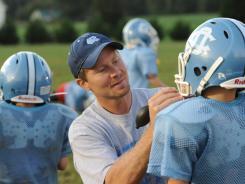
The number of children going to hospitals with concussions is up 60 percent, likely due to parents and coaches being more careful.
|