New York City officials acknowledged that just 25% of students were ready to do college-level work four years after entering high school.
The Education Department used City University of New York standards in making the determination. CUNY requires students to have gotten a 75 on the English Regents test and an 80 on the math version. It also requires students to have received a Regents diploma, meaning students must have earned at least a 65 on five Regents exams.
State requirements for graduation and for passing the Regents exams are lower, noted city Education Department Chief Academic Officer Shael Suransky. He faulted the state Education Department for not moving quickly enough to raise standards.
"One of the biggest barriers, right now, to real college readiness is that our state exams have not shifted to focus on college readiness yet," he said.
Speaking from the perspective of teachers and students, he added: "If the Regents exams are still keyed into the old state standards, they have to respect that and they have to work towards that."
A group called Positive Coaching Alliance is training thousands of coaches and parents to change to culture of youth sports for the better.
“But because sports is so valued, we have the opportunity to change the way people relate to their kids through it. Most research indicates that people coach the way they were coached. So you now have kids who are growing up coached with this model and soon they’ll become coaches themselves, so I think the general impact on our society could be huge.”
But a bigger problem is that youth sports has come to emulate the win-at-all-costs ethos of professional sports. While youth and professional sports look alike, adults often forget that they are fundamentally different enterprises. Professional sports is an entertainment business. Youth sports is supposed to be about education and human development.
What’s needed is a culture change. That’s the goal of the Positive Coaching Alliance, a modest-size organization that punches well above its weight. P.C.A. has trained 450,000 adults, mostly coaches and youth sports leaders, who reach about 4 million children and youths. The organization is working to spread the message that youth sports is about giving young athletes a positive, character-building experience ― not to become major league athletes, but to become “major league people.”
There is a group called PCA that goes around trying to help coaches of younger athletes try and create a more positive enviroment for them. For what we have talked about in our class this seems to have a good portions of the professonial way to go about coaching for individuals.
I think positive coaching is extremely important, especially for our young athletes. Coaches need to be reminded of the impact they have on their athletes.
When you’re looking to innovate, take advantage of an opportunity, or solve a problem… one of your first steps should be to clearly define or “frame” that opportunity or problem. Your frame is how you narrow and pinpoint what you choose to solve. Better framing leads to better solutions.
Think of it like a picture frame, it has in the center what you want to feature.
The questionable activities in high schools appear to be less systemic than the cheating that has roiled Atlanta’s elementary and middle schools, where attention focused on a single exam: the Criterion-Referenced Competency Test. Nevertheless, the improprieties seem no less insidious: cheating on standardized tests, falsifying attendance records and changing grades, all to award undeserved diplomas that helped administrators meet performance targets.
At one Atlanta high school, failure literally was not an option; the minimum grade for all students was 70. At another, the principal allowed no more than 10 percent of seniors to fail, regardless of their grades. Another principal allegedly ordered teachers to change grades and ignore absences so students could receive diplomas. Teachers at several schools apparently obtained advance copies of state tests and gave students the actual questions during practice exams.
Such transgressions call into question the validity of the high school “transformation” that Beverly Hall, the former superintendent of Atlanta Public Schools, touted for half a decade. The district spent millions of dollars and staked a piece of Hall’s reputation on restructuring high schools to reduce absenteeism and increase student performance.
The Los Angeles School Police Department has issued new rules aimed at reducing the number of truancy tickets written to students and focusing efforts instead on helping these students get to and remain in school.
"This notice ... reinforces the [police department's] commitment to support the superintendent's goals of attendance and graduation improvement, and reduce the cycle of student 'push out,' " Chief of Police Steven K. Zipperman said in a statement that accompanied the announcement. "Officers are reminded that they must inquire whether the student has a valid excuse for tardiness or absence."
He added that, whenever possible, officers should focus on getting a student to school. Nor is truancy, by itself, a justification for "frisks, the use of handcuffs or physical restraints, and searches," Zipperman wrote.
"With this directive, school police officers will be a stronger partner with principals, students, parents and teachers to keep students on track within the educational environment by reducing court appearances," Zipperman said.
EVERGREEN PARK, Ill.— Students at one suburban Chicago high school might have to hold it or risk staying after school.
A policy at Evergreen Park High School gives students three restroom visits during class per semester. After that, they have to make up any missed class time after school.
Principal Bill Sanderson tells the (Tinley Park) SouthtownStar (http://bit.ly/qWWm4L ) that the policy is designed to make sure that students don't miss valuable class time. He says it deters them from using restroom visits as an excuse to miss class.
Each teacher gets to decide whether to enforce the policy in their classes.
But some students argue that they don't have time to stop at the restroom otherwise because they only get five minutes between classes.
“Your assumptions are your windows on the world. Scrub them off every once in a while, or the light won’t come in.”
The Stranger and the Ginger Nuts
At the airport after a tiring business trip, a lady’s return flight was delayed. She went to the airport shop, bought a book, a coffee and a small packet containing five ginger nut biscuits. The airport was crowded and she found a seat in the lounge, next to a stranger.
After a few minutes’ reading she became absorbed in her book.
She took a biscuit from the packet and began to drink her coffee. To her great surprise, the stranger in the next seat calmly took one of the biscuits and ate it. Stunned, she couldn’t bring herself to say anything, or even to look at the stranger.
Nervously she continued reading. After a few minutes she slowly picked up and ate the third biscuit. Incredibly, the stranger took the fourth ginger nut and ate it. Then to the woman’s amazement, he picked up the packet and offered her the fifth and last biscuit.
This, being too much to tolerate, the lady angrily picked up her belongings, gave the stranger an indignant scowl and marched off to the boarding gate where her flight was now ready.
Flustered and enraged, she reached inside her bag for her boarding ticket. But rather, she found her unopened packet of ginger nuts.
This is the second story in a week that makes me wonder what is happening to youth sports.
1.The AJC is reporting that Warren County head coach David Daniels was attacked after Friday night’s game against Hancock Central High School. Warren County won the game 21-2. Daniels was allegedly attacked by players from the Hancock team.
The Warren County superintendent has asked the GBI to file criminal charges in the attack, which was so severe that Daniels is in the hospital with head injuries and has undergone major reconstructive surgery to his face to deal with crushed bones above and below his eye.
2. Last week, police in Carroll County said parents tried to fight 11- and 12-year-old football players. Parents reportedly rushed the field after a call that they didn’t like. The parents yelled obscenities at the children, and one held a child down and tried to remove his helmet so another kid could slug him, according to police. Police issued citations to three coaches for disorderly conduct and obscene language.
"A Hendricks County high school is offering students a unique chance to get a leg up in the medical field. One of the school's classes allows students to design an emergency room."
Brownsuburg (IN) High School, near Indianapolis has two unique features:
1. A "medical fast track" program that prepares students for careers in medicine.
2. A "senior academy." You read it correctly. Instead of a "ninth grade academy," Brownsburg HS offers an academy program for seniors that is located in a seperate building.
Whether you're developing yourself or others, three new trends and three not-so-new trends dominate the future of leadership development.
Leadership development is changing quickly.
Changing Trends
1. Personalized - Leadership development will become more personal.
- As organizations become flatter and as they cut back on people expenses, organizations will purchase less and less leadership development.
- Individuals will make the selections of what training is purchased.
- More purchases will be made one-person-at-a-time.
- More will demand the ability to set their own pace.
2. Leadership development becomes more internal.
- More and more of leadership development will continue to be about how to gain the respect and trust of others or how to inspire others.
- Respect and trust become the fuel for the new leader.
3. Simulations - Trial and error feedback loops will accelerate with pace of change.
- We won’t listen to a week-long training class and then try to apply that in our jobs for the next 6 months.
- Chunked-down - We need our leadership development in blog-post sized chunks so we can try them out this afternoon.
- Quick Results - And if they don’t work in a day or two, we’ll try something else.
Continuing Trends
"Leadership development is learned, not taught."
1. Trial and error remains an integral part of leadership development.
2. Earn your wings - We still grant credibility the way we always have.
Credibility is created over time, through results.
3. Trust and Respect - And we tend to extend more credibility to those we experience first hand in their trade. It takes time and positive results to become a credible leadership developer.
We still grant respect the way we always have. As John Maxwell and others have said, “People don’t care how much you know until they know how much you care.” We withhold respect from those we don’t trust.
4. Mentoring - One trend I see taking shape is that the selection of mentors (and those mentored) will become more organic, and less prescriptive.
Because it is increasingly easier for people to find and engage leaders they admire, mentoring relationships are forming outside of conventional boundaries.
While large organizations will always have formal mentoring and training processes, many people will be seeking out guidance from those who specifically inspire them.
The following highlights are excerpted from and article by Valerie Strauss and filtered for the benefit of busy school leaders.
The two largest school systems in the country — New York City and Los Angeles — conceded this week that they are failing too many English language learners and promised to improve.
ELLs Increase 51% in a decade
In the last decade, the number of English language learners enrolled in public schools across the country has skyrocketed, from 3.5 million in 1997-98 to 5.3 million in 2008-09. That’s a 51 percent jump, and many school systems have not had resources to meet the needs of these children.
ELL Performance
- 7% of the New York City’s English language learners were found to have graduated on time and ready for college and careers in 2010. And reading and math standardized test scores for these students were far below city averages.
FAYETTEVILLE, N.C. -- Surveillance video helped lead authorities to two suspects who have been charged in the shooting and wounding of a 15-year-old student at a North Carolina high school.
Crucial Conversations is written by the same folks who brought you these New York Times bestsellers: Change Anything: The New Science of Personal Success, Crucial Confrontations: Tools for Resolving Broken Promises, Violated Expectations and Bad Behavior, and Influencer: The Power to Change Anything.
Authors Kerry Patterson, Joseph Grenny, Ron McMillan and Al Switzler (@VitalSmarts) are all accomplished speakers and developers of training programs and change initiatives for major corporations. The four are also co-founders of VitalSmarts, an innovator in corporate training and organizational performance.
A 7-step primer on managing crucial conversations
Crucial Conversations teaches a 7-step process for managing these conversations:
1. Start with heart. Ask yourself what you really want and what’s at stake.
2. Learn to look. Always be asking yourself whether the conversation is defensive or a dialogue. If you or the other party strays into defensiveness, simply say “I think we’ve moved away from dialogue” or “I’m sorry, I’ve been trying to force my ideas on you.”
3. Make it safe. Another way to deal with defensiveness in difficult conversations is to create a comfortable situation by apologizing, asking a question that shows interest in others’ views or even taking a time out.
4. Master your story. Focus on what happened that made you feel a certain way. Think through your emotions and then choose the appropriate way to respond.
5. State your path. Share your facts and conclusions so that the other party can see where you are coming from.
6. Explore others’ paths. Find out what the other person is thinking. Make sure that you understand each other and look for areas of agreement.
7. Move to action. Come to a consensus about what will happen. Document who will do what by when and settle on a way to follow up.
"Daniel Pink was recently interviewed on a local Washington, D.C. television show along with a local university official. You watch it all here, but I thought the few minutes he spent discussing the role of grades, autonomy and inquiry in education to be particularly thought-provoking. I used Tube Chop to “chop” those two brief segments and have them embedded below."
"Sooner or later, we need to respond to the fact that we have an epidemic of substance abuse that is taking a real toll on the lives of young people in America."--Dr. Keith Ablow
The problem is everywhere.
These are not, by the way, only inner city or impoverished teens who wish to escape the realities of economic or social hardships. They are also suburban young men and women with every opportunity and resource. And they are not using only alcohol and marijuana (although these would be concerning enough).
Every psychiatrist in America sees such teenagers.
Every internist in America sees such teenagers.
Every teacher in America teaches such teenagers. Again: I believe that’s quite literally every, single teacher in America.
Causes
The reasons for this obvious epidemic of drug abuse in teenagers are:
The degree to which our culture now embraces the flight from reality.
Another is the cheap, plentiful and potent supply of illicit drugs.
Another may be increasing rates of underlying and painful disorders like depression.
With data so readily available to confirm the high percentage of secondary school students using illicit substances, it is now imperative to test students for illicit drug use.
I believe we should begin with high school athletes competing on junior varsity and varsity sports teams.
Results would be private, made available only to the student and a physician designated by the student’s parents, or to the parents themselves.
I wrote about unauthorized use of college and pro logos and mascots last October.
In that post, I warned school leaders:
"School leaders would be wise to proactively look into the genesis of their school logo. Otherwise, it could turn out to be both embarrassing and expensive."
Today, I read that the invevitable has happened in Kansas.
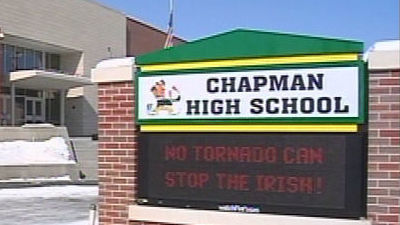
Chapman (KS) High School, whose athletics teams have been known as the Fighting Irish since 1967, has been formally asked by the University of Notre Dame to change its leprechaun logo due to the college’s trademark on the image.
Notre Dame saw the leprechaun logo on the school’s website and promptly fired off a letter to the high school last summer demanding that the high school change its logo, although in their infinite charity, Notre Dame said it would allow Chapman to continue using the Fighting Irish moniker. Oh, and lest I forget to mention it, in 2008, the schools in Chapman were destroyed by a tornado, and through sheer will and determination by the town’s residents, that Chapman High School only reopened last January?
Said Chapman High School principal Kevin Suther, from a KWCH-TV report (via USA Today): “Well when you get a letter from Notre Dame it gets your attention.
“For anything like stationary and school uniforms as long as its Chapman Fighting Irish, we are still the Fighting Irish”, says Suther.
Added superintendent Lacee Sell: “They are no longer allowing us to use the fighting leprechaun mascot.”
School Discipline Changes Move Forward in Colorado
The following highlights are excerpted from an article by AP writer, Ivan Moreno.
Post-Columbine school disciplinary policies that Colorado lawmakers say lead to mandatory expulsions for things like inadvertently having a butter knife in a backpack are facing an overhaul, under a proposal given preliminary approval Tuesday.
A legislative committee moved forward with a proposal that seeks to give education officials more discretion over expulsions and police referrals, which lawmakers say became more common after the 1999 Columbine High School shootings in Littleton, where two students killed 13 people and then themselves. Committee members said zero-tolerance policies adopted during the last decade have tied the hands of school administrators, who are forced to expel students or involve law enforcement for minor infractions.
About 100,000 students in Colorado have been referred to police during the last decade, said lawmakers, who this year created a panel to review school punishment trends to determine whether policy changes are warranted. The panel, made of up legislators, community leaders, and law enforcement, met during the summer and heard instances where students have been referred to police for bringing a wooden replica of a rifle to school or unintentionally hitting a teacher with a bean bag chair.
The proposed legislation would make expulsions mandatory only in cases of students bringing a firearm to school and would amend school discipline codes to distinguish minor infractions from violations that need police involvement. The proposal would also direct school boards to create discipline codes that limit suspensions and expulsions to cases where a student's conduct threatens school safety.
Principal's Opinion
"It is way too prescriptive," said King, the administrator of a Colorado Springs Early Colleges, a charter school where high school students can get an associate's degree.
Still, King said he agrees with the idea of eliminating restrictive zero-tolerance policies. He cited a case where he was forced to expel a student who brought an unloaded BB gun to school.
"I didn't want to expel him but I had to because of state law," he said. Read more by clicking on the headline above.
Full-time U.S.workers who are overweight or obese and have other chronic health conditions miss an estimated 446 million additional days of work each year compared with healthy workers -- resulting in an estimated cost of more than $153 billion in...
October 17, 2011
WASHINGTON, D.C. -- Full-time workers in the U.S. who are overweight or obese and have other chronic health conditions miss an estimated 450 million additional days of work each year compared with healthy workers -- resulting in an estimated cost of more than $153 billion in lost productivity annually.
Implications
The $153 billion in annual lost productivity costs linked to unhealthy workers in the United States is more than four times the cost found in the United Kingdom. The striking difference is the result of fewer unhealthy workers in the U.K. About 14% of full-time U.S. workers are of a normal weight and have no chronic illness, compared with 20% in the U.K.
The high percentages of full-time U.S. workers who have less than ideal health are a significant drain on productivity for U.S. businesses. However, employees and employers have the opportunity to potentially increase productivity if they address the health issues that are currently plaguing the workplace.
The $153 billion in lost productivity estimated in this analysis would increase if it included presenteeism, which is when employees go to work but are less productive in their jobs because of poor health or wellbeing. Including part-time employees would also add to the estimate of costs in lost productivity. Other research that has examined a broader array of factors using a somewhat different list of chronic conditions places the economic effect of lost productivity at $1.1 trillion per year.
"Unequal access to full-day kindergarten means many young children lose a critical opportunity to develop and strengthen foundational skills necessary for success in school and lifelong learning."--Margaret Wright Edelman
I worked all my life in high school. However, I learned through practice that literacy is the key to success in high school and at every grade level for that matter. One of the keys to enhancing student literacy skills is a strong K-12 continuum of direct, explicit literacy instruction coupled with tiered interventions at all grade levels.
Many under-resourced students enter school one or two years behind in their language acquisition. That means that the school help these students make two years of progress in each of the first three grades. Sadly, research shows that students who are below grade level at the end of the third grade never catch in part because that is precisely when most schools stop reading instruction.
The secret to higher performance is to never let students fall behind in the first place. The longer we wait to intervene, the less effective and more costly our efforts will be. Just ask any high school principal about their efforts to turn around off-target ninth graders.
The Bottom Line
Kindergarten is just as important as any other grade. When it comes to leveling the playing field, we must provide under-resourced students the time and instruction they need to achieve at the same level as their resourced, middle class counterparts.
It's About Time, Not Ability
Under-resourced students have the ability. What they lack is the skills and it takes time to develop literacy skills--the skills they are not able to acquire at home. For many of these under-resourced students, additional instructional time is the key to their long-term success.
Read more about the need for full-day kindergarten by clicking on the headline above.
The following highlights are excerpted from an article in the MenloParkPatch for the benefit of busy school leaders.
Administrators in the Sequoia Union High School District are hoping to increase enrollment of students coming from low-income areas in higher level college preparatory classes.
The district seeks to close the existing achievement gap between students coming from low-income areas, and those from more affluent regions.
The district will begin targeting elementary school students in East Palo Alto and Redwood City as early as eighth grade and get them on the track toward thinking about taking Advanced Placement (AP) classes once they reach high school, according to a district report.
"We are opening up a chance for kids who do not think of themselves as AP kinds of kids," said Trustee Olivia Martinez. "There is no doubt this will make a huge difference."
Advancement through Individual Determination (AVID)
The district will look to enroll students who show potential for increased achievement but who need additional supports and guidance. The key is to enroll them early in the AVID program.
AVID is a program designed for students who show potential to perform at a high level academically, despite underachieving in the past.
The program not only offers increased levels of interaction between students and teachers in order to boost achievement, but it is also is designed to teach students skills that can be used in higher education such as note taking and how to properly analyze lessons.
Principal Praises AVID
Woodside High School Principal David Riley spoke highly of his school's AVID program at Wednesday night's meeting. He called it the heart and soul of Woodside's ability to boost academic performance of students who have traditionally not achieved to their fullest potential.
To get content containing either thought or leadership enter:
To get content containing both thought and leadership enter:
To get content containing the expression thought leadership enter:
You can enter several keywords and you can refine them whenever you want. Our suggestion engine uses more signals but entering a few keywords here will rapidly give you great content to curate.


 Your new post is loading...