JavaScript for Line of Business Applications
606.5K views | +6 today
JavaScript for Line of Business Applications
Keeping track of current JavaScript Frameworks that help design your clientside Business Logic Layers.
Curated by Jan Hesse
Beam to my Inbox:
Your new post is loading...

Popular Tags - Filter using the Funnel

Scoop.it!

Apper - Plug and play, restful, real-time application framework for single page apps

Apper - Plug and play, restful, real-time application framework for single page apps | JavaScript for Line of Business Applications | Scoop.it

A real-time framework for single page applications. The idea behind it is to have strong conventions for practices that suit single page apps, including transparent minification and bundling.

It wraps around Express, so route definitions look like a typical Express project, but Apper also has specific places for things like middleware and application settings.

If you’re new to Express then you might like working with the conventions Apper uses, and it will at least push you away from putting everything in a monolithic app.js file.

No comment yet.
Scoop.it!

Require.js packages for building large scale angular applications

Require.js packages for building large scale angular applications | JavaScript for Line of Business Applications | Scoop.it

Require.js is one of my favorite ways to work with large JavaScript applications. It allows you to build AMD (asynchronous module definition) style modules to break up your application into small reusable modules. This is a desirable feature in large code bases.

It's important to know when and why you may consider require.js. If you're working on a small application that doesn't have a need for many files and little logic, you may or may not need the overhead of require.js. However, you still can get value out of it's organization and structure it provides you.

No comment yet.
Scoop.it!

Jest vs. Mocha: Why Jest Wins

Jest vs. Mocha: Why Jest Wins | JavaScript for Line of Business Applications | Scoop.it

When developing front-end applications, my TDD tool belt consists of karma, mocha, sinon, and chai. When I first learned of Jest, I was skeptical of the new JavaScript unit testing framework and was not convinced I should make the switch. After a bit of research and a sample project on Github, I will tell you why I have made the decision to switch and why you should, too. ...

No comment yet.
Scoop.it!

Better Declarative Listeners for ExtJS

Better Declarative Listeners for ExtJS | JavaScript for Line of Business Applications | Scoop.it

The most recent post on the Sencha Blog, Declarative Listeners in Ext JS 5, goes over some of the improvements made in the latest ExtJS release to make attaching event listeners to components a little easier. I have been using a small override in ExtJS 4 for a while that offers a similar declarative approach to attaching listeners, but also gives the developer the ability to traverse the component hierarchy or listen to stores. This small override completely changed the way I develop apps using ExtJS.

No comment yet.
Scoop.it!

Using Sails.js with Ember.js

From the August 2014 Ember London meetup. See more at http://emberlondon.com
No comment yet.
Scoop.it!

Taming the Asynchronous Beast with CSP in JavaScript

Taming the Asynchronous Beast with CSP in JavaScript | JavaScript for Line of Business Applications | Scoop.it

I think things can be simplified to a single abstraction since the underlying problem to all of this is the same. I present to you CSP and the concept of channels. CSP has been highly influential in Go and recently Clojure embraced it as well with core.async. There's even a C version. It's safe to say that it's becoming quite popular (and validated) and I think we need to try it out in JavaScript. I'm not going to spend time comparing it with every other solution (promises, FRP) because it would take too long and only incite remarks about how I wasn't using it right. I hope my examples do a good enough job convincing you themselves.

Jan Hesse's insight:

Communicating sequential processes

No comment yet.
Scoop.it!

Integrating D3.js visualizations in a React app

Integrating D3.js visualizations in a React app | JavaScript for Line of Business Applications | Scoop.it

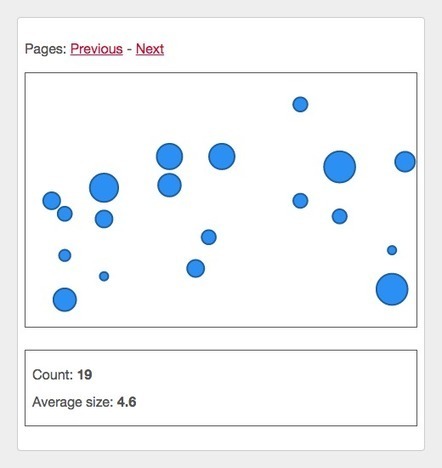
A small example exploring how to integrate D3.js data visualizations into a React app.

I think that using React and D3.js together makes sense because they share a common philosophy of "give me a set of data, tell me how it should be rendered, and I'll figure out which parts of the DOM to update for you". Indeed, React has its virtual DOM diffs, and D3.js has its update selections, making both quite efficient in the business of keeping the UI in sync with data changes.

I find that making D3 components play nice inside a React app becomes easier when you follow these simple guidelines: ...

Scoop.it!

Using Sails Generators To Integrate An ember-cli Project

Using Sails Generators To Integrate An ember-cli Project | JavaScript for Line of Business Applications | Scoop.it

Ember-cli is the missing utility belt for ember based projects. Among its features is a generator that creates a strongly opinionated project structure and build chain.

Along with ember-cli, I ran across sails-ember-blueprints which overrides some of Sails' blueprint templates for compatibility with Ember-Data's RESTAdapter.

I decided to take a stab at creating some Sails generators around these great projects.

No comment yet.
Scoop.it!

Introduction to SailsJS

Introduction to SailsJS | JavaScript for Line of Business Applications | Scoop.it

It is pretty awesome at most of the part, so if you need something like Rails for Node.js, Sails is the way to go.

The Sails.JS is an MVC framework, so there are Models, Views and Controllers.

In Sails.JS you can create models, and model represents the data model, so if for each table you would have a model and in case of no-sql databases, each collection is represented by a model. Inside a model you can describe, the attributes present in that model, their datatype and validation rules.

No comment yet.
Scoop.it!

How to Test Asynchronous Code with QUnit

How to Test Asynchronous Code with QUnit | JavaScript for Line of Business Applications | Scoop.it

Just like synchronous functions, asynchronous ones need love, and even more tests. In this article I’ll teach you how to test asynchronous code with QUnit. In case you don’t recall the assertion methods available, or you totally missed my article, I suggest you read Getting Started with QUnit. The material covered in it will be a prerequisite to this article.

No comment yet.
Scoop.it!

Vic Ramon's Ember Tutorial

Vic Ramon's Ember Tutorial | JavaScript for Line of Business Applications | Scoop.it

Welcome! This tutorial provides an introduction to the Ember JS framework. It shows you how to build an Ember app with a Ruby on Rails backend while explaining all the underlying concepts along the way.


Contents:

Chapter 1: Introduction
Chapter 2: Hello World
Chapter 3: The Ember Object
Chapter 4: Routing in Ember
Chapter 5: Ember Object Flow
Chapter 6: Ember Route
Chapter 7: Ember Controller
Chapter 8: Ember View
Chapter 9: Ember Template
Chapter 10: Our App
Chapter 11: Creating the Rails API
Chapter 12: Creating the Layout
Chapter 13: Modeling Leads
Chapter 14: Listing Leads
Chapter 15: Showing a Lead
Chapter 16: Editing a Lead Part I
Chapter 17: Editing a Lead Part II
Chapter 18: Deleting a Lead
Chapter 19: Creating a Lead
Chapter 20: Searching Leads
Chapter 21: Deploying to Heroku
Chapter 22: Conclusion


No comment yet.
Scoop.it!

Real-time Data for an Ember.js Application using WebSockets

Real-time Data for an Ember.js Application using WebSockets | JavaScript for Line of Business Applications | Scoop.it

Following the release of Orbit.js, Ember Orbit was announced at the Wicked Good Ember conference. Again, I became excited about using smaller JSON Patch payloads (media type "application/json-patch+json"), see RFC 6902. I started a new branch and decided to support a REST source first; then later tackle a WebSocket source. I am a fan of the JSON API specification which does include patch support. Once I had a JSONAPISource working with Ember Orbit on my branch I updated my SocketSource prototype (class) to follow the JSONAPISource prototype so they could share the same serializer. Also if the client's browser doesn't support a WebSocket or perhaps in the case my socket server gets wacky the application can initialize with the JSONAPISource instead of the SocketSource prototype as the connected source to the application's MemorySource.

No comment yet.
Scoop.it!

The Confusion Around Ember Views and Components

The Confusion Around Ember Views and Components | JavaScript for Line of Business Applications | Scoop.it

Somewhere along the way, I noticed that the community had gone HAM on using Components all the time, in almost every circumstance. To me this seemed crazy! Views have their place, Components have their place. I was curious as to how this shift had come about.

No comment yet.
Scoop.it!

Build Desktop Apps with JavaScript and Node WebKit

Build Desktop Apps with JavaScript and Node WebKit | JavaScript for Line of Business Applications | Scoop.it

What if we could approach the problem from a different angle? What if we took an existing, non-visual platform that already allows developers to do whatever they want and put a visual layer on top of it? That platform is Node.js and that visual layer is WebKit. Put them together, with Javascript as the underlying engine and WebKit as the visual layer, and you have Node-WebKit!

No comment yet.
Scoop.it!

jQuery-animations

jQuery-animations | JavaScript for Line of Business Applications | Scoop.it

jQuery-animations : A CSS3 animations development framework based on jQuery provides a easy way to develop cross browser CSS3 animations with the help of animate.css.

No comment yet.
Scoop.it!

angular-data: Data store and caching for Angular.js

angular-data: Data store and caching for Angular.js | JavaScript for Line of Business Applications | Scoop.it

angular-data.js is the full data store that supports collections and communicating with persistence layers. angular-cache.js is a simple key-value store and an api-compatible replacement for $cacheFactory with advanced caching capabilities. Use one, or the other, or use both and angular-data will be able to take advantage of some of the features of angular-cache.

No comment yet.
Scoop.it!

Join the Web Components revolution with Polymer

Join the Web Components revolution with Polymer | JavaScript for Line of Business Applications | Scoop.it
The Polymer library uses Web Components technology supported by all modern browsers, including mobile browsers on iOS and Android. Add custom web elements that encapsulate a complete user interface — including UI interaction handling, transition animation, and flexible CSS styling — to your web applications or hybrid mobile apps.
No comment yet.
Scoop.it!

Start using closures with your AngularJS, EmberJS code, and other JavaScript.

Start using closures with your AngularJS, EmberJS code, and other JavaScript. | JavaScript for Line of Business Applications | Scoop.it

Closures are one of the most powerful tools in JavaScript; they can help you write faster, cleaner, and safer code. No matter if you are using AngularJS, EmberJS, JQuery or another framework, closures are an invaluable tool you should be taking advantage of. Lets review the how and why of closures, and give you some examples to play with on your own.

No comment yet.
Scoop.it!

Talk: Ember.js in Action

From the August 2014 Ember London meetup. See more at http://emberlondon.com

No comment yet.
Scoop.it!

WebRTC chat with React.js

WebRTC chat with React.js | JavaScript for Line of Business Applications | Scoop.it

In this blog post I’m going to share how could be build WebRTC chat with React.js.

In the beginning of the blog post I mentioned that React.js application contains a finite amount of React.js components composed together. In this subsection I’ll illustrate, which are the different components of our application and how they are composed together.

No comment yet.
Scoop.it!

sailsjs-angularjs-bootstrap-example

sailsjs-angularjs-bootstrap-example | JavaScript for Line of Business Applications | Scoop.it

A suite of examples written for Sails.js, AngularJS, and Twitter Bootstrap.
Contents:

* A REST API test page using Sails' transport agnostic routing (HTTP vs. Socket.io)
* A "Todo List" app demo using Sails' Socket.io messaging and REST Blueprints
* Passport middleware authentication integrated with Sails policies.
* Twitter Bootstrap / Font Awesome custom LESS compiles (Grunt)
* Cache busting JS/CSS for production (Grunt)

No comment yet.
Scoop.it!

ASP.NET MVC 4 Cheatsheet

ASP.NET MVC 4 Cheatsheet | JavaScript for Line of Business Applications | Scoop.it
A quick view of ASP.NET MVC 4
No comment yet.
Scoop.it!

Laravel 4 with AngularJS Architecture Solution

Laravel 4 with AngularJS Architecture Solution | JavaScript for Line of Business Applications | Scoop.it

This is the overview of solution to developing a web application using AngularJS and Laravel. My aim is to keep the front-end and back-end as separate as possible. I have envisaged a setup which has a somewhat decoupled architecture where the static front-end AngularJS application is completely separate from the resourceful API back-end Laravel application. It’s worth noting I’m using LinemanJS for my front-end development Workflow but this concept could be applied with your own workflow.

This post also addresses problems when trying to inject the CSRF Token without using a HTTP request and SPA HTML5 push state. So hopefully this saves you some head banging.

No comment yet.
Scoop.it!

Using Pretender to mock a server with Ember.js

Using Pretender to mock a server with Ember.js | JavaScript for Line of Business Applications | Scoop.it

Recently I fell in love with Pretender, the mock server library in Javascript, so I decided to record a screencast showing how to use it in an Ember.js integration test:

No comment yet.
Scoop.it!

Avoiding Common Pitfalls in Ember.js

The mistakes everyone makes, collated from many hours helping people on IRC and the forums
No comment yet.