JavaScript for Line of Business Applications
606.5K views | +11 today
JavaScript for Line of Business Applications
Keeping track of current JavaScript Frameworks that help design your clientside Business Logic Layers.
Curated by Jan Hesse
Beam to my Inbox:
Your new post is loading...

Popular Tags - Filter using the Funnel

Scoop.it!

Testing Ember.js Apps: Managing Dependencies

Testing Ember.js Apps: Managing Dependencies | JavaScript for Line of Business Applications | Scoop.it

Ember has an amazing testing story built upon the fundamentals of encapsulation and OO programming central to the framework. Despite this, every web application will be dependent upon and need to interact with native and network APIs that are hostile: Unreliable, slow, under-documented, and not to be trusted. The challenge in testing Ember applications lies with how to handle these external entities.

In this talk, we distinguish the domain of an application from its implementation dependencies. The dependency is contained such that it avoids leaking into application code, unit tests, and acceptance tests.

No comment yet.
Scoop.it!

UX analytics with Ember.js

You need more information about how your users are interacting with your webapp. There are many reasons for this. Chief among them is smugly rubbing your usability predictions in the face of your senior designer. What follows is an easy way to incorporate Google Analytics into your webapp to track usability.

No comment yet.
Scoop.it!

Managing Your Page States with Backbone Routers

Managing Your Page States with Backbone Routers | JavaScript for Line of Business Applications | Scoop.it

In my last few columns, I've looked at building a Backbone application with TypeScript and shown how to create a client-side Backbone Model that corresponds to a Customer object on my server (which, in turn, is created from data managed by Entity Framework). To bridge the gap from my server to the client, I use a Web API Web Service that returns several Customer objects when synced with the Backbone Collection that manages my Customer Models. I pass that Backbone Collection of Customers to two Backbone Views that work together to generate an HTML dropdown list

No comment yet.
Scoop.it!

Building a Chat App with node-webkit, Firebase, and AngularJS

Building a Chat App with node-webkit, Firebase, and AngularJS | JavaScript for Line of Business Applications | Scoop.it

In this post we are going to build a desktop based chat application named vTak. We will use node-webkit to power the core desktop app and Firebase as our realtime data store. We will be using a slush generator namedslush-wean to scaffold a basic node-webkit/Express/Angular app. The final product will look something like the following figure.

No comment yet.
Scoop.it!

Getting the Most out of JavaScript Stacktraces

Getting the Most out of JavaScript Stacktraces | JavaScript for Line of Business Applications | Scoop.it
JavaScript applications keep getting bigger, more complex, and harder to debug. Without stacktraces, how are we expected to find, decipher, and fix our bugs?
No comment yet.
Scoop.it!

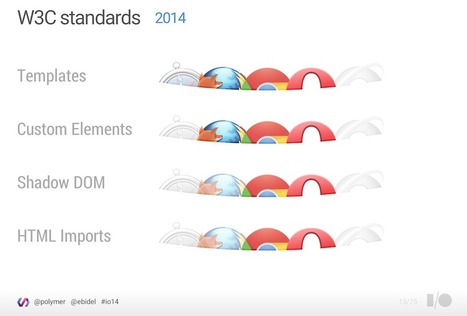
The State of the Componentised Web

The State of the Componentised Web | JavaScript for Line of Business Applications | Scoop.it

An important part of compontent-based development is that components can be composed out of other components. The rich text editor is a great example of this since it will be composed out of buttons, drop downs, some sort of rich view and so on. Another good example is the HTML5 video element which again contains buttons and also an element which renders content from a video data stream.

No comment yet.
Scoop.it!

skatejs - define behaviour for custom and existing elements

skatejs - define behaviour for custom and existing elements | JavaScript for Line of Business Applications | Scoop.it
skatejs - Skate is a web component library based loosely on the Custom Element spec that allows you to define behaviour for custom and existing elements using tag names, attribute names and class names.
Jan Hesse's insight:

http://slides.com/treshugart/skating-with-web-components#/

No comment yet.
Scoop.it!

hitting the open sea with sails.js

One of the strengths of Sails is its ability to interface with a range of databases using a uniform API. In this post I’m going to take a look at integrating with MongoDB - the leading NoSQL database. Hopefully by the end of the post you’ll be set up with a Sails server, Mongo database and the basic structure of an app that you can build upon. Let’s get started.

No comment yet.
Scoop.it!

How JavaScript Objects are Implemented

How JavaScript Objects are Implemented | JavaScript for Line of Business Applications | Scoop.it
Eddy Bruel details how objects are implemented internally in SpiderMonkey as shape trees and slot vectors. This is done in order to minimize the memory footprint and obtain better JIT optimization with inline caching.
No comment yet.
Scoop.it!

An Introduction to Sails.js

An Introduction to Sails.js | JavaScript for Line of Business Applications | Scoop.it

MVC Structure
* Storage agnostic models
* Blueprint based controllers
* Controllers are just Express Middleware
* Server side views are rendered based on the controller

No comment yet.
Scoop.it!

C3.js | D3-based reusable chart library

C3.js | D3-based reusable chart library | JavaScript for Line of Business Applications | Scoop.it

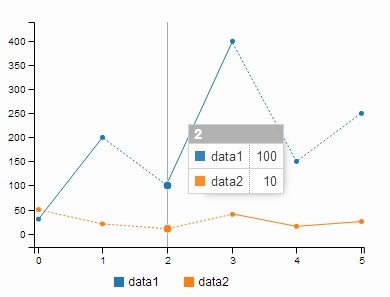
C3 makes it easy to generate D3-based charts by wrapping the code required to construct the entire chart. We don't need to write D3 code any more.

No comment yet.
Scoop.it!

Node, Grunt, Bower and Yeoman - A Modern web dev's Toolkit

Node, Grunt, Bower and Yeoman - A Modern web dev's Toolkit | JavaScript for Line of Business Applications | Scoop.it

This article aims at introducing you to some of the currently most popular tools when developing modern web applications with JavaScript. These are totally not new at all and have been around for a couple of years now. Still, I found many devs still don't use or know about them (as you might), wherefore this article tries to give you a quick, concise intro to get you started.

No comment yet.
Scoop.it!

React’s diff algorithm

React’s diff algorithm | JavaScript for Line of Business Applications | Scoop.it

In this article I will present how the diff algorithm and rendering work in React so you can optimize your own apps.


At any point in time, you describe how you want your UI to look like. It is important to understand that the result of render is not an actual DOM node. Those are just lightweight JavaScript objects. We call them the virtual DOM.

React is going to use this representation to try to find the minimum number of steps to go from the previous render to the next.


No comment yet.
Scoop.it!

CoffeeScript: The Good Parts

CoffeeScript: The Good Parts | JavaScript for Line of Business Applications | Scoop.it
CoffeeScript is controversial to say the least. Many reputable JavaScript and Node.js developers just hate CoffeeScript, but there are lessons we can all learn
No comment yet.
Scoop.it!

Qunit Introduction

Points to Discuss:

* Unit Testing & Test Driven Development

* QUnit

* QUnit API

* Automated Testing (a brief introduction)

No comment yet.
Scoop.it!

Avoiding Event Chains in Single Page Applications

react
No comment yet.
Scoop.it!

Array slices and membranes using ES6 proxies

Array slices and membranes using ES6 proxies | JavaScript for Line of Business Applications | Scoop.it

JavaScript’s dynamic nature, first-class functions and prototypes could always be used for elegant metaprogramming. Proxies let programmers further blur the line between the native, user defined objects and the host objects.

No comment yet.
Scoop.it!

Custom Elements By Example

Custom Elements By Example | JavaScript for Line of Business Applications | Scoop.it

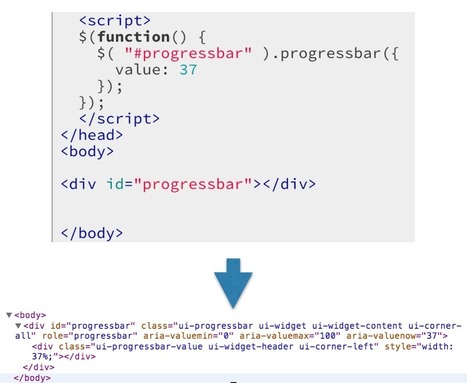
This seems like the perfect opportunity to use a custom element. If we can encapsulate all that behavior, we'll be able to ensure that the progress bar is always rendered when it appears, and we can hide any ugly transformed DOM elements underneath a shiny semantic element. Sounds great! So let's see how this works.

No comment yet.
Scoop.it!

Unit Testing Sails.js Applications With Mocha

Unit Testing Sails.js Applications With Mocha | JavaScript for Line of Business Applications | Scoop.it

As it turns out, getting tests in place for Sails was one of the easier things I've done in my life and I was able to get a few unit tests running withing 30 minutes of sitting down to do it.

No comment yet.
Scoop.it!

Uploading a file in Sails

Uploading a file in Sails | JavaScript for Line of Business Applications | Scoop.it

Here is a new tutorial in the Sails and Angular Series. Actually i was thinking about writing a tutorial on loading effects during Sails Angular API calls . This will be handled in next tutorials.To keep you engaged today we will see how an upload function can be created in Sails.

No comment yet.
Scoop.it!

REST API Development with Sails.js

REST API Development with Sails.js | JavaScript for Line of Business Applications | Scoop.it

One of the things that Sails.js provides us, among many other, is the REST API development easily and quickly. For this reason, I consider that Sails.js is a very important tool in the software stack.

In this article I had planned to write some sections to explain how to develop an API with Sails.js, but as the process is so easy and so fast I’m going to explain it in only one section. Running solely a couple of commands and writing solely a line of code we will be able to develop the same API that we developed in the article API REST Development with MongoDB, NodeJS and Express, but with more features...

No comment yet.
Scoop.it!

Browserify All The Things

This talk is about how to use browserify to develop front-end modular code using Common.JS, and how those modules should be documented, designed, and released using an automated build system. In order to explain these concepts I'll walk you through a few of my own open-source creations, highlighting interesting points as we go along.

No comment yet.
Scoop.it!

JavaScript Memory Management Masterclass

Efficient JavaScript webapps need to be fluid and fast. Any app with significant user interaction needs to consider how to effectively keep memory usage down because if too much is consumed, a page might be killed, forcing the user to reload it and cry in a corner.

Automatic garbage collection isn't a substitute for effective memory management, especially in large, long-running web apps. In this talk we'll walk through how to master the Chrome DevTools for effective memory management.

Learn how to tackle performance issues like memory leaks, frequent garbage collection pauses, and overall memory bloat that can really drag you down.

No comment yet.
Scoop.it!

Browserify and Gulp with React

Browserify and Gulp with React | JavaScript for Line of Business Applications | Scoop.it

The JS world moves quickly, and nowadays, there’re some new kids around the block. Today, we’ll explore Browserify, Gulp, and React and see whether they’d sound suitable for our projects. You might have heard of them but not have had the time to check them out. So we’ll look at the advantages and disadvantages of using Browserify, using Gulp, using React. Because it certainly doesn’t hurt to know our options.

No comment yet.