Your new post is loading...

|
Scooped by
Gilbert C FAURE
April 2, 2022 9:16 AM
|
|
|
Scooped by
Gilbert C FAURE
March 31, 2022 11:10 AM
|
|
|
Scooped by
Gilbert C FAURE
March 27, 2022 4:51 AM
|
Immunity; Components of the immune system; Cancer...
|
|
Scooped by
Gilbert C FAURE
March 20, 2022 3:46 PM
|
Meylan et al. found that tertiary lymphoid structures (TLS) in the tumor microenvironment of clear cell renal cell carcinoma were enriched for B cell and immunoglobulin (Ig) signatures. Various B cell maturation stages to plasma cells producing IgG and IgA could be detected in these areas. Plasma cells producing IgG were also detected in the tumor at a distance of the TLS, and this migration was associated with fibroblasts. IgG binding of tumor cells was associated with apoptosis, suggesting antitumor activity. In a patient cohort treated with immune checkpoint blockade, IgG tumor staining was associated with clinical response to therapy and progression-free survival.
|
|
Scooped by
Gilbert C FAURE
March 16, 2022 11:46 AM
|
|
|
Scooped by
Gilbert C FAURE
March 11, 2022 11:09 AM
|
Tissue-resident immune cells reside in distinct niches across organs, where they contribute to tissue homeostasis and rapidly respond to perturbations in the local microenvironment. Innate lymphoid cells (ILCs) are a family of innate immune cells that regulate immune and tissue homeostasis. Across anatomical locations throughout the body, ILCs adopt tissue-specific fates, differing from circulating ILC populations. Adaptations of ILCs to microenvironmental changes have been documented in several inflammatory contexts, including obesity, asthma, and inflammatory bowel disease. While our understanding of ILC functions within tissues have predominantly been based on mouse studies, development of advanced single cell platforms to study tissue-resident ILCs in humans and emerging patient-based data is providing new insights into this lymphocyte family. Within this review, we discuss current concepts of ILC fate and function, exploring tissue-specific functions of ILCs and their contribution to health and disease across organ systems.
|
|
Scooped by
Gilbert C FAURE
March 1, 2022 4:44 AM
|
Gilbert C. Faure
Conference 2022 Hot-Doc Presentation
Video title
Content curation for teaching and learning immunology and beyond
Authors and Affiliations
Gilbert C Faure1,2
1. Laboratoire d'Immunologie, Faculté de Médecine, Université Lorraine, Nancy, France
2. CREM, Université Lorraine, Nancy, France
Abstract
Background
Amount of information in immunology and beyond, through scientific published papers and social media networks is more and more overwhelming and the
|
|
Scooped by
Gilbert C FAURE
February 25, 2022 6:03 AM
|
Age-related regression of the thymus is associated with a decline in naïve T cell output. This is thought to contribute to the reduction in T cell diversity seen in older individuals and linked with increased susceptibility to infection, autoimmune disease, and cancer.
|
|
Scooped by
Gilbert C FAURE
February 23, 2022 11:19 AM
|
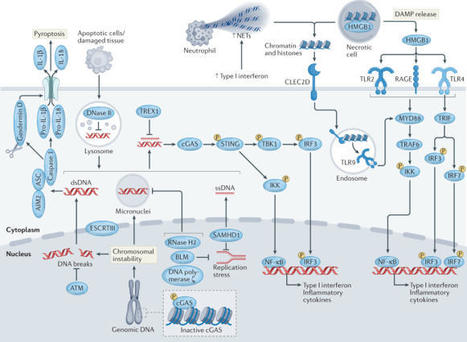
A cell is delimited by numerous borders that define specific organelles. The walls of some organelles are particularly robust, such as in mitochondria or endoplasmic reticulum, but some are more fluid such as in phase-separated stress granules. Either way, all organelles can be damaged at times, leading their contents to leak out into the surrounding environment. Therefore, an elegant way to construct an innate immune defence system is to recognize host molecules that do not normally reside within a particular compartment. Here, we provide several examples where organellar homeostasis is lost, leading to the activation of a specific innate immune sensor; these include NLRP3 activation owing to a disrupted trans-Golgi network, Pyrin activation due to cytoskeletal damage, and cGAS–STING activation following the leakage of nuclear or mitochondrial DNA. Frequently, organelle damage is observed downstream of pathogenic infection but it can also occur in sterile settings as associated with auto-inflammatory disease. Therefore, understanding organellar homeostasis is central to efforts that will identify new innate immune pathways, and therapeutics that balance organellar homeostasis, or target the breakdown pathways that trigger innate immune sensors, could be useful treatments for infection and chronic inflammatory diseases. This Review from Masters and colleagues highlights how damage to intracellular organelles is linked to activation of the innate immune system. The authors propose that a better appreciation of such organellar homeostasis could lead to the identification of novel innate immune pathways and have therapeutic implications.
|
|
Scooped by
Gilbert C FAURE
February 21, 2022 3:27 AM
|
|
|
Scooped by
Gilbert C FAURE
February 18, 2022 5:01 AM
|
Melanoma, a skin cancer that develops from pigment cells, has been studied intensively, particularly in terms of the immune response to tumours, and has been used as a model for the development of immunotherapy. This is due, in part, to the high mutational burden observed in melanomas, which increases both their immunogenicity and the infiltration of immune cells into the tumours, compared with other types of cancers. The immune response to melanomas involves a complex set of components and interactions. As the tumour evolves, it accumulates an increasing number of genetic and epigenetic alterations, some of which contribute to the immunogenicity of the tumour cells and the infiltration of immune cells. However, tumour evolution also enables the development of resistance mechanisms, which, in turn, lead to tumour immune escape. Understanding the interactions between melanoma tumour cells and the immune system, and the evolving changes within the melanoma tumour cells, the immune system and the microenvironment, is essential for the development of new cancer therapies. However, current research suggests that other extrinsic factors, such as the microbiome, may play a role in the immune response to melanomas. Here, we review the mechanisms underlying the immune response in the tumour and discuss recent advances as well as strategies for treatment development. This Review discusses the mechanisms underlying the immune response to melanomas, as well as the mechanisms of response and resistance of these tumours to immunotherapies. The lessons learned in melanoma may apply to other tumour types.
|
|
Scooped by
Gilbert C FAURE
February 15, 2022 10:40 AM
|
Cohesin mediates chromatin loop formation across the genome by extruding chromatin between convergently oriented CTCF-binding elements. Recent studies indicate that cohesin-mediated loop extrusion in developing B cells presents immunoglobulin heavy chain (Igh) variable (V), diversity (D) and joining (J) gene segments to RAG endonuclease through a process referred to as RAG chromatin scanning. RAG initiates V(D)J recombinational joining of these gene segments to generate the large number of different Igh variable region exons that are required for immune responses to diverse pathogens. Antigen-activated mature B cells also use chromatin loop extrusion to mediate the synapsis, breakage and end joining of switch regions flanking Igh constant region exons during class-switch recombination, which allows for the expression of different antibody constant region isotypes that optimize the functions of antigen-specific antibodies to eliminate pathogens. Here, we review recent advances in our understanding of chromatin loop extrusion during V(D)J recombination and class-switch recombination at the Igh locus. Alt and colleagues review recent advances in our understanding of the mechanistic role of cohesin-mediated chromatin loop extrusion in V(D)J recombination and class-switch recombination at the immunoglobulin heavy chain locus.
Unlike the adaptive immune system, the innate immune system has classically been characterized as being devoid of memory functions. However, recent research shows that innate myeloid and lymphoid cells have the ability to retain memory of prior pathogen exposure and become primed to elicit a robust, broad-spectrum response to subsequent infection. This phenomenon has been termed innate immune memory or trained immunity. Innate immune memory is induced via activation of pattern recognition receptors and the actions of cytokines on hematopoietic progenitors and stem cells in bone marrow and innate leukocytes in the periphery. The trained phenotype is induced and sustained via epigenetic modifications that reprogram transcriptional patterns and metabolism. These modifications augment antimicrobial functions, such as leukocyte expansion, chemotaxis, phagocytosis, and microbial killing, to facilitate an augmented host response to infection. Alternatively, innate immune memory may contribute to the pathogenesis of chronic diseases, such as atherosclerosis and Alzheimer’s disease.
|
|
|
Scooped by
Gilbert C FAURE
April 1, 2022 7:46 AM
|
Common variable immunodeficiency (CVID), the most prevalent symptomatic primary immunodeficiency, displays impaired terminal B-cell differentiation and defective antibody responses. Incomplete genetic penetrance and ample phenotypic expressivity in CVID suggest the participation of additional pathogenic mechanisms. Monozygotic (MZ) twins discordant for CVID are uniquely valuable for studying the contribution of epigenetics to the disease. Here, we generate a single-cell epigenomics and transcriptomics census of naïve-to-memory B cell differentiation in a CVID-discordant MZ twin pair. Our analysis identifies DNA methylation, chromatin accessibility and transcriptional defects in memory B-cells mirroring defective cell-cell communication upon activation. These findings are validated in a cohort of CVID patients and healthy donors. Our findings provide a comprehensive multi-omics map of alterations in naïve-to-memory B-cell transition in CVID and indicate links between the epigenome and immune cell cross-talk. Our resource, publicly available at the Human Cell Atlas, gives insight into future diagnosis and treatments of CVID patients. Common variable immunodeficiency (CVID) is the most prevalent primary immunodeficiency. Here the authors perform single-cell omics analyses in CVID-discordant monozygotic twins and show epigenetic and transcriptional alterations associated with activation in memory B cells.
|
|
Scooped by
Gilbert C FAURE
March 27, 2022 4:55 AM
|
The coronavirus disease 2019 (COVID-19) pandemic, causing considerable mortality and morbidity worldwide, has fully engaged the biomedical community in attempts to elucidate the pathophysiology of COVID-19 and develop robust therapeutic strategies.
|
|
Scooped by
Gilbert C FAURE
March 27, 2022 4:48 AM
|
Antimicrobial peptides constitute one of the most promising alternatives to antibiotics since they could be used to treat bacterial infections, especially those caused by multidrug-resistant pathogens.
|
|
Scooped by
Gilbert C FAURE
March 19, 2022 5:25 AM
|
There is a lack of understanding as to why some people suffer from long-lasting symptoms after COVID-19 infection. A new study from Karolinska Institutet in Sweden, the Helmholtz Center Munich (HMGU) and the Technical University of Munich (TUM), both in Germany, now demonstrates that a certain type of immune cell called macrophages show altered inflammatory and metabolic expression several months after mild COVID-19. The findings are published in the journal Mucosal Immunology.
|
|
Scooped by
Gilbert C FAURE
March 16, 2022 5:28 AM
|
|
|
Scooped by
Gilbert C FAURE
March 2, 2022 2:12 PM
|
People suffering from COVID-19 could have several different SARS-CoV-2 variants hidden away from the immune system in different parts of the body, finds new research published in Nature Communications by an international research team. The study's authors say that this may make complete clearance of the virus from the body of an infected person, by their own antibodies, or by therapeutic antibody treatments, much more difficult.
|
|
Scooped by
Gilbert C FAURE
February 26, 2022 3:05 AM
|
Register here!
Click to view
Click to view
Click
|
|
Scooped by
Gilbert C FAURE
February 25, 2022 6:03 AM
|
The serotonin metabolite 5-HIAA is a potent ligand for GPR35 and promotes neutrophil recruitment to inflamed sites.
|
|
Scooped by
Gilbert C FAURE
February 21, 2022 3:50 AM
|
Innate lymphoid cells (ILCs) are a growing family of immune cells that mirror the phenotypes and functions of T cells. However, in contrast to T cells, ILCs do not express acquired antigen receptors or undergo clonal selection and expansion when stimulated.
|
|
Scooped by
Gilbert C FAURE
February 18, 2022 7:13 AM
|
Immunoglobulin G (IgG) adopts a modular multidomain structure that mediates antigen recognition and effector functions, such as complement-dependent cytotoxicity. IgG molecules are self-assembled into a hexameric ring on antigen-containing membranes, recruiting the complement component C1q. In order to provide deeper insights into the initial step of the complement pathway, we report a high-speed atomic force microscopy study for the quantitative visualization of the interaction between mouse IgG and the C1 complex composed of C1q, C1r, and C1s. The results showed that the C1q in the C1 complex is restricted regarding internal motion, and that it has a stronger binding affinity for on-membrane IgG2b assemblages than C1q alone, presumably because of the lower conformational entropy loss upon binding. Furthermore, we visualized a 1:1 stoichiometric interaction between C1/C1q and an IgG2a variant that lacks the entire CH1 domain in the absence of an antigen. In addition to the canonical C1q-binding site on Fc, their interactions are mediated through a secondary site on the CL domain that is cryptic in the presence of the CH1 domain. Our findings offer clues for novel-modality therapeutic antibodies.
|
|
Scooped by
Gilbert C FAURE
February 17, 2022 2:14 PM
|
Bioprosthetic heart valves (BHVs) are commonly used to replace severely diseased heart valves but their susceptibility to structural valve degeneration (SVD) limits their use in young patients. We hypothesized that antibodies against immunogenic glycans present on BHVs, particularly antibodies against the xenoantigens galactose-α1,3-galactose (αGal) and N-glycolylneuraminic acid (Neu5Gc), could mediate their deterioration through calcification. We established a large longitudinal prospective international cohort of patients (n = 1668, 34 ± 43 months of follow-up (0.1–182); 4,998 blood samples) to investigate the hemodynamics and immune responses associated with BHVs up to 15 years after aortic valve replacement. Early signs of SVD appeared in <5% of BHV recipients within 2 years. The levels of both anti-αGal and anti-Neu5Gc IgGs significantly increased one month after BHV implantation. The levels of these IgGs declined thereafter but anti-αGal IgG levels declined significantly faster in control patients compared to BHV recipients. Neu5Gc, anti-Neu5Gc IgG and complement deposition were found in calcified BHVs at much higher levels than in calcified native aortic valves. Moreover, in mice, anti-Neu5Gc antibodies were unable to promote calcium deposition on subcutaneously implanted BHV tissue engineered to lack αGal and Neu5Gc antigens. These results indicate that BHVs manufactured using donor tissues deficient in αGal and Neu5Gc could be less prone to immune-mediated deterioration and have improved durability. In a large cohort of patients who underwent aortic valve replacement, antibody responses to glycans present in bioprosthetic heart valves, notably galactose-α1,3-galactose and N-glycolylneuraminic acid, were implicated in valve calcification and deterioration.
Tuberculosis (TB) is a major global health problem and the only currently-licensed vaccine, BCG, is inadequate. Many TB vaccine candidates are designed to be given as a boost to BCG; an understanding of the BCG-induced immune response is therefore critical, and the opportunity to relate this to circumstances where BCG does confer protection may direct the design of more efficacious vaccines. While the T cell response to BCG vaccination has been well-characterized, there is a paucity of literature on the humoral response. We demonstrate BCG vaccine-mediated induction of specific antibodies in different human populations and macaque species which represent important preclinical models for TB vaccine development. We observe a strong correlation between antibody titers in serum versus plasma with modestly higher titers in serum. We also report for the first time the rapid and transient induction of antibody-secreting plasmablasts following BCG vaccination, together with a robust and durable memory B cell response in humans. Finally, we demonstrate a functional role for BCG vaccine-induced specific antibodies in opsonizing mycobacteria and enhancing macrophage phagocytosis in vitro, which may contribute to the BCG vaccine-mediated control of mycobacterial growth observed. Taken together, our findings indicate that the humoral immune response in the context of BCG vaccination merits further attention to determine whether TB vaccine candidates could benefit from the induction o
|


 Scoop.it!