


There is a war going on. Humanity and nature are on one side and Big Tech is on the other. The two sides are not opposed. They are orthogonal. The human side is horizontal and the Big Tech side is …
Via Vladimir Kukharenko, juandoming

 Your new post is loading...
 Scoop.it! There is a war going on. Humanity and nature are on one side and Big Tech is on the other. The two sides are not opposed. They are orthogonal. The human side is horizontal and the Big Tech side is … Via Vladimir Kukharenko, juandoming No comment yet.
Sign up to comment
Scoop.it!
From
outilsia

L’IA n’en finit plus de générer des sites de toute sorte dans lesquels elle est employée de mille manières. Du plus classique aux I Via Elena Pérez
Scoop.it!

Juan Domingo Farnós La neurobiología en procesos de inteligencia artificial general se refiere a la investigación y comprensión de cómo funciona el cerebro humano para inspirar y mejorar los algoritmos y modelos utilizados en la inteligencia artificial (IA). Esto implica estudiar las estructuras neuronales, las conexiones sinápticas y los procesos cognitivos que subyacen a la… Via juandoming
Scoop.it!

Comment intégrer l'IA dans les activités d'enseignement et d'évaluation? Propositions d'outils et de ressources.
Via Sandrine Decamps
Scoop.it!

Juan Domingo Farnós Miró La autorregulación en la educación disruptiva se refiere a la capacidad de los estudiantes para regular y controlar sus propios procesos de aprendizaje de manera independiente. En el contexto de la inteligencia artificial (IA) en la transformación universitaria, esto implica el uso de tecnologías de IA para personalizar y adaptar la… Via juandoming
Scoop.it!

At the Digital Universities U.S. event in St. Louis, digital transformation, the pandemic’s aftermath and the ongoing rise of AI were front and center. Higher ed moving beyond initial artificial intelligence (AI) fears to focus on practical and specific opportunities for the technology was a recurring theme at the Digital Universities U.S. conference that concluded on Wednesday in St. Louis. Via EDTECH@UTRGV 
EDTECH@UTRGV's curator insight,
May 10, 2024 2:04 PM
"When it comes to AI accelerating academic processes, 'a lot of the new work for us is figuring out what we want to assess in the process, instead of just at the end,'”
Scoop.it!

Blended learning caters to diverse learning styles and enhancing student outcomes effectively with engaging approaches. Via EDTECH@UTRGV
EDTECH@UTRGV's curator insight,
May 10, 2024 2:07 PM
"Blended learning is not a new instructional approach, but it became more mainstream during and after the COVID pandemic, when educators and students elected to keep parts of entirely-online learning they favored during pandemic learning."
Scoop.it!
The 2024 Work Trend Index reveals organizations need to move beyond experimentation and drive growth, manage costs, and deliver value with broad adoption of AI. Via Dr. Tom D'Amico (@TDOttawa) 
san's curator insight,
May 9, 2024 9:51 AM
https://www.acquistarmorpine.com/prodotto/abstral-fentanil-in-pillole/
Scoop.it!

Tech integration in the classroom can either inspire learning or create technology challenges, depending on learning outcomes. Via EDTECH@UTRGV
EDTECH@UTRGV's curator insight,
May 9, 2024 11:30 AM
"Educators use tech to foster a sense of community and keep students engaged"
Scoop.it!

Juan Domingo Farnós La inteligencia artificial (IA) y la inteligencia humana difieren en varios aspectos clave. En el ámbito educativo disruptivo, estas diferencias son fundamentales para comprender cómo se pueden integrar de manera efectiva. Podemos encontrar una serie de disparidades entre ellas así como su aplicación en la educación disruptiva: Diferencias entre Inteligencia Artificial e… Via juandoming
Scoop.it!

From
www
Plusieurs élèves de l'INET ont produit une cartographie des métiers impactés par l'Intelligence artificielle générative dans la fonction publique territoriale, basée sur la méthodologie de l'Organisation mondiale du travail. Via Bibliothèques-Médiathèques de Metz
Scoop.it!

This open access publication presents a global panorama of institutional strategies, academic programs, scholarly insights as well as teaching and learning practices taking stock of the Future Skills Turn taking place in higher education. Future Skills have evolved to be one of the most important priorities for the development of higher education institutions globally. Students and graduates learn how to acquire Future Skills for their lives and careers and for shaping societies towards more sustainable futures. Institutions, teachers and policy makers gain insights into strategies to shape the Future Skills Turn in higher education and create the University of the Future. Via Canadian Vocational Association / Association canadienne de la formation professionnelle, juandoming 
Dr. Joe Boutte's curator insight,
May 10, 2024 7:43 AM
What will universities look like, do, or become in order support the workforce for a sustainable future? This research provides some interest global perspectives on the skills and approaches evolving in higher education based on a paradigm shift known as "Future Skills Turn" . This is a shift in education that emphasizes the development of skills needed for the future workforce, driven by rapid technological advancements, globalization, and evolving societal needs. This approach focuses on cultivating skills such as critical thinking, creativity, digital literacy, emotional intelligence, and lifelong learning, rather than solely on traditional academic knowledge. The impacts on higher education include curriculum transformation, technology integration, industry collaboration, and lifelong learning. This shift not only prepares students for successful careers but also empowers them to make meaningful contributions to a sustainable and equitable world. As we consider the value of current approaches to higher education, this is an important set of perspectives to consider as leaders.
Scoop.it!

Des étudiants sont soupçonnés d’utiliser l’intelligence artificielle pour rédiger leurs travaux de session. Parfois même à l’insu de leurs coéquipiers. Faute d’outils pour détecter la triche, des professeurs reviennent aux bons vieux examens en classe… avec du papier et un crayon. Via Intelligence Economique, Investigations Numériques et Veille Informationnelle |
Scoop.it!

ACODE’s mission is to enhance policy and practice in Australasian higher education around technology enhanced learning and teaching at institutional, national and international levels through:
Via Peter Mellow, juandoming 
Peter Mellow's curator insight,
May 11, 2024 1:30 AM
Best reads is ACODE’s newly release Benchmarks for Technology Enhanced Learning (V2.1) which now includes Technology Enhanced Learning Spaces.
See the resources & publications part of their site.
Scoop.it!

From
www
Sie lügen und betrügen, um ans Ziel zu kommen: Systeme mit Künstlicher Intelligenz (KI) sind in der Lage, Menschen zu täuschen – selbst wenn sie darauf trainiert wurden, hilfreich und ehrlich zu sein. Das ist das Ergebnis einer Übersichtsstudie von Forschern am Massachusetts Institute of Technology (MIT) in Cambridge (US-Bundesstaat Massachusetts), die in der Fachzeitschrift "Patterns" veröffentlicht wurde. In dem Beitrag forderten die Wissenschaftler die Politik auf, so schnell wie möglich strenge Vorschriften zu entwickeln, um KI-Systeme in die Schranken zu weisen.
Learn more / En savoir plus / Mehr erfahren:
https://www.scoop.it/topic/21st-century-innovative-technologies-and-developments/?&tag=ChatGPT
https://www.scoop.it/t/21st-century-innovative-technologies-and-developments/?&tag=AI
https://www.scoop.it/topic/21st-century-innovative-technologies-and-developments/?&tag=Ethics
Via Gust MEES 
Gust MEES's curator insight,
May 11, 2024 3:41 PM
Sie lügen und betrügen, um ans Ziel zu kommen: Systeme mit Künstlicher Intelligenz (KI) sind in der Lage, Menschen zu täuschen – selbst wenn sie darauf trainiert wurden, hilfreich und ehrlich zu sein. Das ist das Ergebnis einer Übersichtsstudie von Forschern am Massachusetts Institute of Technology (MIT) in Cambridge (US-Bundesstaat Massachusetts), die in der Fachzeitschrift "Patterns" veröffentlicht wurde. In dem Beitrag forderten die Wissenschaftler die Politik auf, so schnell wie möglich strenge Vorschriften zu entwickeln, um KI-Systeme in die Schranken zu weisen.
Learn more / En savoir plus / Mehr erfahren:
https://www.scoop.it/topic/21st-century-innovative-technologies-and-developments/?&tag=ChatGPT
https://www.scoop.it/t/21st-century-innovative-technologies-and-developments/?&tag=AI
https://www.scoop.it/topic/21st-century-innovative-technologies-and-developments/?&tag=Ethics
Scoop.it!

Blog de la "RIED. Revista Iberoamericana de Educación a Distancia". La Revista Iberoamericana de la Educación Digital. Via LGA 
ANA MARTIN's curator insight,
January 25, 6:04 AM
El artículo presenta la aplicación de la neuroeducación a través del uso de tecnologías como la electroencefalografía (EEG) para analizar procesos cognitivos implicados en el aprendizaje, especialmente la atención. Este enfoque resulta relevante para la enseñanza de lenguas, ya que permite comprender mejor cómo varía la implicación cognitiva del alumnado durante tareas lingüísticas complejas, como la comprensión oral o la producción escrita. Desde la neuroeducación, se destaca que la eficacia del aprendizaje depende en gran medida de la gestión de la carga cognitiva, la memoria de trabajo y los niveles de fatiga mental. Este tipo de investigaciones refuerza la necesidad de diseñar actividades de lengua que alternen esfuerzo, práctica significativa y pausas, favoreciendo así la consolidación de aprendizajes a largo plazo.
Scoop.it!

Recently, we announced several expansions for education audiences. Microsoft Copilot with commercial data protection is available to all faculty and higher education students ages 18 and above. And, Copilot for Microsoft 365 eligibility will now include education faculty and staff. Via Edumorfosis, LGA
Scoop.it!

Explore how Artificial Intelligence is revolutionizing eLearning, by enhancing personalized learning and optimizing content delivery. Via Vladimir Kukharenko, LGA
Scoop.it!

Por Ángel De-Juanas Oliva y Diego Galán-Casado Universidad Nacional de Educación a Distancia, Facultad de Educación Palabras clave: PEDAGOGÍA SOCIAL, IA, investigación, formación, intervención socioeducativa y comunitaria La sociedad contemporánea se define por la información y el conocimiento y nos sumerge en un entorno de cambios constantes. Esta dinámica redefine la percepción del tiempo, … Continuar leyendo "El papel emergente de la Inteligencia Artificial en la Pedagogía Social" Via Ramon Aragon, Ricard Lloria, juandoming 
Nicolás Cervera Capuz's curator insight,
January 10, 2025 8:35 AM
El artículo "El papel emergente de la Inteligencia Artificial en la Pedagogía Social" de Ángel De-Juanas Oliva y Diego Galán-Casado analiza cómo la IA está transformando la intervención socioeducativa y comunitaria. Destaca que la IA facilita diagnósticos más precisos, optimiza recursos y permite detectar y prevenir problemas sociales de manera más efectiva. Además, herramientas como chatbots pueden apoyar en la planificación de actividades específicas para diversos colectivos.
En mi opinión, la integración de la IA en la Pedagogía Social ofrece oportunidades significativas para mejorar la eficacia de las intervenciones. Sin embargo, es esencial garantizar una formación adecuada para los profesionales, promoviendo un uso crítico y ético de estas tecnologías. Asimismo, se debe asegurar el acceso equitativo a la IA para evitar brechas digitales y garantizar que su implementación beneficie a toda la comunidad. 
Elena Galeote's comment,
December 28, 2025 8:17 AM
Desde una perspectiva crítica positiva, considero que el artículo “El papel emergente de la Inteligencia Artificial en la Pedagogía Social” aporta una reflexión clara y precisa sobre la integración de la IA en el ámbito socioeducativo. Valoro considerablemente cómo destaca el potencial de estas tecnologías para mejorar la personalización de las intervenciones y apoyar la labor de los profesionales de la Pedagogía Social. El artículo invita a repensar las prácticas educativas tradicionales desde una mirada innovadora, sin perder de vista la importancia del contexto social. Considero que ofrece una base sólida para el debate y la reflexión sobre el uso responsable y consciente de la IA en la educación social.

cynthiia.sr9@gmail.com's curator insight,
January 20, 4:57 AM
La Inteligencia Artificial se presenta como una herramienta potente que puede fortalecer la Pedagogía Social al ampliar las posibilidades de inclusión, acompañamiento y personalización de los procesos educativos de enseñanza y aprendizaje. Su uso responsable permite atender mejor la diversidad , facilitando el acceso al conocimiento y el desarrollo de habilidades para la vida. No obstante, su integración no es fácil, ya que el educador debe garantizar el uso responsable de las mismas.
Scoop.it!

Por Marvin Soto La historia de la inteligencia artificial (IA) se remonta a la mitad de siglo XX, con mitos y leyendas que hablan de seres ... Via LGA
Scoop.it!
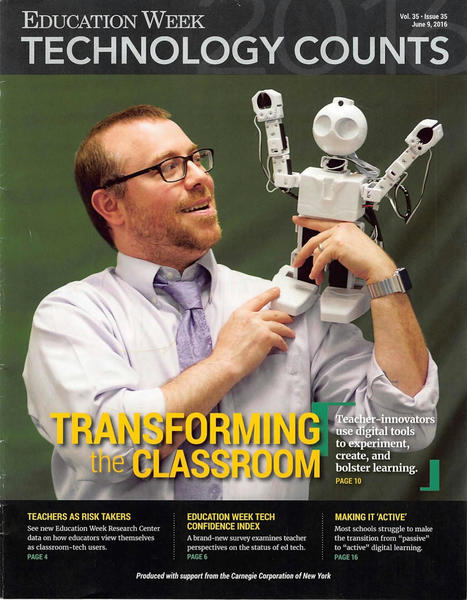
"I have explored lots of different uses of AI for myself and for my students. I'd like to share a few of the ways I have used two tools to help me in those areas." Via EDTECH@UTRGV, juandoming
EDTECH@UTRGV's curator insight,
May 9, 2024 11:32 AM
"I think it is important for teachers to constantly think about equity in all parts of education, and that includes how AI can and will be used by students and staff. There are some great conversations going on about these issues." 
Ashish Kumar's curator insight,
May 10, 2024 3:04 AM
Kindly beware
Before anything you admit in school curricullum and syllabus The poster in which you are depicting Artificial Intelligence shows you holding a robot. Which comes under the Robotics branch of Computers. If a Robot is made to do a task a computer software proggramme has to be prepared and also a computer microchip,programmed will have to be fitted within the robot that could made Robot do task assigned to it. Now during teaching this is what teachers use to say that Central Processesing Unit is the brain of computer so a wrong information got feed into the brains of the pupils that like they have brain computer also had brain where as Central Processing Unit is just an spare part of machine known as computer or robot so to say. Now all together a different discussion which began from the curiousity about computer due to it's ability of calculating complex mathematics problems related to arithmatic could be a prime reason that today we are talking about Artificial Intelligence. Now the Artificial Intelligence as it is discussed or to say being included into daily based conversations has not included a basic element of such type of discussion that is pro's and con's related to Artificial Intelligence and it is indeed a dreadfull situation. Leave apart what harm it could bring it there is no relative explaination that why it should be used in first place. Now I should not wait about rumours that it is only a video film app that video editing tool kit and nothing more. Such type of debatable topic according to my instruction should not be introduced to students. Their is an another example, the deadlock in assembly languages has been resolved by introduction of evolved/advance machine language in computer studies. As per the exitment related to this news suggests their will be a revisiting project about all the used computer languages and also case study for languages like JAVA which has no role play in computer technology must be done. The prefferces that created this situation must also be tackeled wisely from now on. Blog Writer:Ashish Kumar (India)zipcode134102
Scoop.it!

A modern data solution gives educators immediate insights to make informed decisions that positively impact student success. Via EDTECH@UTRGV
EDTECH@UTRGV's curator insight,
May 8, 2024 12:18 PM
"The right data management is make-or-break in student success"
Scoop.it!

In 2020, UF CJC Online developed a comprehensive course design strategy to elevate its online courses, a mission mandated by the State University System of Florida’s 2025 Strategic Plan for Online Education. Via EDTECH@UTRGV
Scoop.it!

EdTech has been a hot button topic for some time now, and the focus on generative AI in 2023 has only amplified interest in EdTech. Proponents see a plethora of ways that AI can improve education outcomes. AI’s potential for transforming education is real, but so are the dangers—so we must move forward with care and intentionality. It is with an eye toward care and intentionality that members of W2050’s Senior Fellows committee on education and work met to discuss how AI could—and how it should—impact education in 2024 and beyond. Via Canadian Vocational Association / Association canadienne de la formation professionnelle, juandoming |






