Your new post is loading...
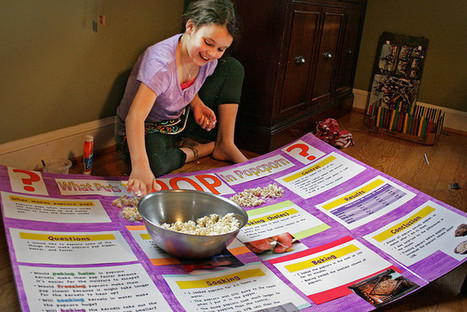
A few years ago, I recall walking past the door of our school makerspace and noticing a crowd of kids surrounding a table. Inside a group of 5th and 6th graders were hovering around someone, listening intently to directions. As I inched closer I heard the quiet voice of a parent demonstrating how to do several hand stitches. The mom, a PTA regular and all-around super volunteer, was showing our students some basics in sewing. Both boys and girls watched as she shared tips and tricks. Soon the students dispersed and moved back to their workspaces around the room working on their pillows, shirts, purses, and other sewing projects.
The parent volunteered an hour each Tuesday around lunchtime to work with our students during our “open studio” time. She served as a facilitator and mentor to young makers in our elementary school for several years. The connection that she made with students helped to demonstrate the link between hands-on learning and its purpose in the real world, as well as the value that parents and community bring to the school setting. This type of active parent involvement is one effective way to begin building a network of creativity and innovation in your school
Via John Evans
Unless you work in a Waldorf school where smartphones are banned, chances are you’ve seen your students video chat with friends when their time might be better spent working on homework. Video chat can, however, support classroom learning. It’s not impossible.Video technology has changed quite a bit
Via EDTECH@UTRGV, Rosemary Tyrrell, Ed.D.
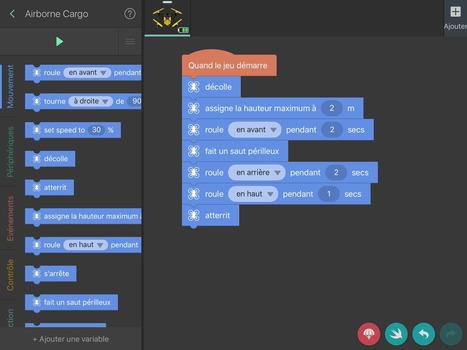
Depuis quelques mois, de nouvelles bestioles sont apparues au sein de quelques établissements scolaires. Elles sont introduites par des profs d'un genre nouveau, les profs pédagogeeks. Ces derniers estiment qu'avec ce matériel intelligent, il est possible de rendre concrètes plusieurs compétences de mathématiques ou autres.. Dans les nouveaux programmes de 2016, l'apprentissage du code doit…
Via Elena Pérez

|
Rescooped by
michel verstrepen
from NumericEduc
June 23, 2016 9:55 PM
|
Le coup d’envoi du brevet 2016 sera donné demain. L’année prochaine, pour la première fois, les candidats devront plancher sur un exercice d'algorithmique ou de programmation informatique.
Via Claude Tran
|
|
Scooped by
michel verstrepen
June 23, 2016 9:53 PM
|
Ninety-one percent of respondents to a recent CDE survey agreed active learning better prepares students for college and careers than traditional education frameworks. So why is it that it’s more common to see rows of desks facing the front of the room instead of workspaces designed for collaboration and exploration in today’s classrooms? Unfortunately, students can often lack the communication, critical-thinking and problem-solving skills they will need in their careers when they graduate. This paper helps school districts change that outcome. It discusses the benefits and challenges of active learning and offers real-life examples and strategies to help districts make their learning environments more engaging and collaborative.
It may be best known for the BB-8, but Sphero's robotic toys have uses well beyond Star Wars.
Aspect Hunter School in Sydney, Australia is a school for children on the autism spectrum. The school is attended by 130 kids, beginning at age four, as well as around 30 Spheros.
Via John Evans
There are five ways in which gifted students tend to learn differently from their peers:
1. They learn new material much more quickly.
2. They have a better ability to remember what they have learned, which reduces or eliminates the need for review.
3. They have ability for abstract or complex thinking that their peers do not have.
4. They become focused on specific topics and are very passionate about them to the exclusion of other topics and subjects.
5. They can take in many stimuli at once, knowing what is going on around them while concentrating on a specific task.
Using these characteristics as a guideline, approximately 6%, or 3 million, students in the United States may be classified as gifted. Although there is little argument that gifted and talented students must be provided with challenges that meet their academic needs, no federal regulations specifically mandate special services for G and T learners. Learn more / En savoir plus / Mehr erfahren: http://www.scoop.it/t/21st-century-learning-and-teaching/?tag=Gifted+kids
Via Gust MEES
|
|
Rescooped by
michel verstrepen
from Numérique & pédagogie
June 22, 2016 4:27 AM
|
Les 1 et 2 juin derniers, nous étions à la French Touch Education. Entreprises, universités, acteurs de la formation professionnelle étaient là pour échanger sur les dernières innovations pédagogiques et interroger le rôle du numérique dans l’apprentissage. On en a profité pour interviewer Antoine Amiel, fondateur de LearnAssembly et co-organisateur de l’événement. Avec le digital, nous …
Via fduport
Comme le rappelait Etienne Cavalié (Lully) dans son post de Bibliothèques (reloaded) en janvier 2015 « le concept d’humanités numériques est vraiment en train de se répandre » depuis quelques années. Mais que représente cette notion qui prend de plus en plus de place dans le champ des sciences humaines et sociales (SHS) ? L’annonce d’une série « Humanités …
Via Gilles Le Page, Franck Rykaczewski
In the age of blended classrooms and digital learning, the popularity of student portfolios has exponentially increased. Digital student portfolios can continue to be used for their original purpose of highlighting work that the teacher or student is particularly proud. Parents will no longer have to take up closet space or secretly dispose of paper…
Via EDTECH@UTRGV
Want to know about two tactics for interactive learning? Check why Gamification And Microlearning are the most effective interactive approaches to learning.
Via EDTECH@UTRGV
|
|
Rescooped by
michel verstrepen
from Corridor of learning
June 20, 2016 7:46 AM
|
A KEYNOTE ON OPEN BADGES PRESENTED AT THE UNIVERSITY OF LONDON, CENTER FOR DISTANCE EDUCATION, RESEARCH AND INNOVATION IN DISTANCE EDUCATION AND E-LEARNING –
Via Alastair Creelman
|
|
|
Rescooped by
michel verstrepen
from Easy MOOC
June 24, 2016 4:02 PM
|
The effort to replace textbooks with open educational resources (OER) is gaining momentum as colleges move past pilots to expand the use of free or inexpensive course materials across states and systems... http://www.scoop.it/t/easy-mooc
Via Lucas Gruez
|
|
Scooped by
michel verstrepen
June 23, 2016 9:59 PM
|
Les auxiliaires personnels d’apprentissage sont partouts, pourquoi ne pas les utiliser ? Les chiffres officiels indiquent que les individus sont mieux équipés de matériel électronique à titre personnel qu’à titre professionnel.
Les individus sont aussi plus souvent familiers avec des logiciels qu’ils ont choisis qu’avec ceux que leur impose leur entreprise. Équipement personnel et choix de logiciels participent d
|
|
Scooped by
michel verstrepen
June 23, 2016 9:56 PM
|
On peut disserter longtemps sur les vertus supposées des programmes ou des dispositifs de formation post-scolaires, dont les ingrédients théoriques sont connus depuis des décennies, mais la réalité a la vie dure : l 'efficacité de la formation professionnelle repose essentiellement sur la qualité et les compétences des formateurs. C'est d'ailleurs sur ces éléments qu'il est nécessaire de se pencher régulièrement pour analyser la façon dont les dispositifs de formation contribuent à les réunir ou, au contraire, à les affaiblir.
|
|
Rescooped by
michel verstrepen
from Keeping up with Ed Tech
June 23, 2016 9:54 PM
|
I use peer evaluation quite a bit in my class. My data is collected via a Google Form and are in a spreadsheet. I use mail merge to send students back the comments of the peer evaluations. While there are pre-made Add-On’s to send out emails, there can be an email limit. This tutorial will …
Via WebTeachers
|
|
Rescooped by
michel verstrepen
from Opening up education
June 23, 2016 1:19 AM
|
This summer, Apple will introduce an addition to its usual Apple Camp program: a coding course for children ages 8 to 12.
Besides its usual interactive storytelling and iMovie classes, kids will have the option to enroll in Coding Games and Programming Robots. The class will use Tynker's software to teach the basics of coding using blocks that can animate characters and move robots. In May, Tynker raised $7.1 million in funding.
Via John Evans
En marge de l’ICT4ALL, une première édition du TEDuX « Pratiques pédagogiques innovantes » a été organisée en Tunisie en 2015. Elle a rencontré un franc succès avec plus de 300 participants. L’IFIC, l'AUF BMO et l’université de Senghor ont alors décidé d’organiser une 2e édition du TEDuX. Cet événement s’est déroulé le 26 mai 2016 au Caire en marge du salon E-learning Africa. Durant 1h30, 4 intervenants ont témoigné sur différents thèmes : de l’animation de communautés en ligne, l’apport de la robotique ou des neurosciences, en passant par l’impact du numérique et des espaces d’apprentissages, jusqu’à l’accompagnement institutionnel. Les retours d’expériences et les conditions favorisant l’émergence de pratiques pédagogiques innovantes ont constitué le fil rouge des quatre interventions. La suite de cet article détaillera le contenu de ce TEDuX-Caire.
Via CECI Jean-François
It’s no secret that we’re big fans of maker education. So during this official National Week of Making 2016, we share with you stories around all types of making–from making updates to apps supporting education to making a difference through funding edtech startups, this week’s edition celebrates many who are making a positive impact on the world of education.
Want to read more about makered? We have a few blogs that might interest you:
Via John Evans
|
|
Scooped by
michel verstrepen
June 21, 2016 5:09 AM
|
L'initiative Un nouveau campus à Lannion ? Oui, mais pas de nouveaux bâtiments.
|
|
Scooped by
michel verstrepen
June 20, 2016 5:07 PM
|
En entretien d’embauche, il y a les questions pièges classiques - « quelles sont vos qualités », « quels sont vos défauts », « où vous voyez vous dans 5 an
|
|
Rescooped by
michel verstrepen
from Vie numérique à l'école
June 20, 2016 9:32 AM
|
|