


The Design Pyramid can help you improve your eLearning design workflow. Read on to learn more.
Via Stephania Savva, Ph.D, Jim Lerman

 Your new post is loading...
 Scoop.it! The Design Pyramid can help you improve your eLearning design workflow. Read on to learn more. Via Stephania Savva, Ph.D, Jim Lerman No comment yet.
Sign up to comment
Scoop.it!

From
www

"Pisa tests, an international standard for comparing education systems around the world, could include a new measurement of global skills in the next round of tests in 2018. The OECD, which runs the tests in maths, reading and science, is considering adding another test which would look at how well pupils can navigate an increasingly diverse world, with an awareness of different cultures and beliefs. The OECD's education director Andreas Schleicher explains why there is such a need for new rankings to show young people's competence in a world where globalisation is a powerful economic, political and cultural force. Education leaders around the world are increasingly talking about the need to teach 'global competences' as a way of addressing the challenges of globalisation." Via Jim Lerman, giovanni nulli, MiniTool Software, Liane Sousa 
Euneos's curator insight,
June 2, 2016 1:23 AM
Kansainvälistyminen nousee uudeksi mitattavaksi asiaksi PISA-tutkimuksissa 2018. Miten mahtaa suomalaisten peruskoulujen käydä? Pystyvätkö ne globaalitaidoissa ja kulttuurienvälisessa osaamisessa yltämään samalle tasolle kuin kansainvälistymisessä pitkälle edistyneet Britannia, Hollanti, Belgia tai Tanska. Oma kokemukseni jo 10 vuotta jatkuneesta Intia-yhteistyöstä (http://www.eumind.net) ei ennakoi Suomen kouluille huipputuloksia. Mutta toivotaan parasta.
Scoop.it!
A team of Harvard engineers has come up with a fun way to get kids hooked on coding. »»» Subscribe to The National to watch more videos here Via Dr. Tom D'Amico (@TDOttawa)
Scoop.it!

better educate and train school administrators rather than continuing to turn out new leaders that know virtually nothing about creating, facilitating, and/or sustaining 21st century learning environments; Via Nik Peachey 
Nik Peachey's curator insight,
June 27, 2016 1:08 AM
Some good points and an interesting discussion in the comments.
Scoop.it!

From
twitter
Notre interview sur Via Michèle Drechsler
Scoop.it!

L'agenda éduscol #STI : Conférence : Travailler dans l'Industrie du Futur
publié le June 24, 2016 at 10:20AM par... https://t.co/RueDJU1OXZ Via Michelle Laurissergues
Scoop.it!

Despite the impressive potential of the maker movement and the aspect of fun learning by making, still, there remain some challenges in mainstreaming the maker movement in education. First of all, it should not be misunderstood that learners should be given to build things without proper acquisition of fundamental skills, such as basic literacy and numeracy, Via Nik Peachey
Nik Peachey's curator insight,
June 26, 2016 1:28 AM
Good background article for people interested in understanding the maker movement in education.
Scoop.it!
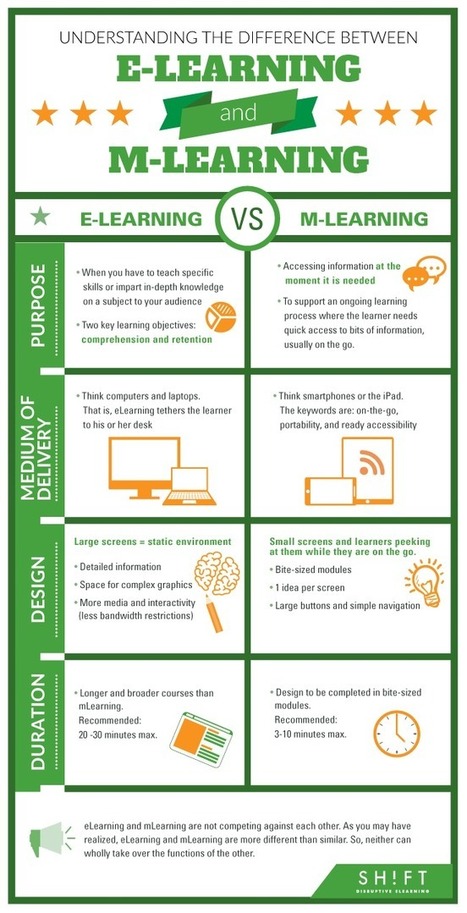
What's the Difference Between eLearning and mLearning? Here, we list down four of the main differences between both. Via Paige Brooks-Jeffiers, benoit tostain 
Armando's curator insight,
June 24, 2016 5:52 AM
Understanding The Difference Between eLearning and mLearning

Serge G Laurens's curator insight,
October 28, 2016 3:15 PM
Understanding The Difference Between eLearning and mLearning
Scoop.it!

From
www
Témoignages vidéo et audio d'enseignants et articles de vulgarisation scientifique, études et d'autres ressources autour de l'usage des TICE dans la classe.
Scoop.it!

Announcing updated version 5 of our Stages of Personalized Learning Environments with practical and clear elements for each stage. Via Kathleen McClaskey, Alfonso Gonzalez 
Kathleen McClaskey's curator insight,
June 21, 2016 12:51 PM
While finishing our next book, How to Personalize Learning to be published Fall 2016, we realized that we had to make even more changes to the Stages of PLE. Download this new version from this site.
Scoop.it!

From
www
'In the past I have always said that a computer could never replace a teacher, because learning was based on relationships. Today, I am not so sure' Via Dr. Tom D'Amico (@TDOttawa) 
Courtney Calhoun's curator insight,
June 26, 2016 1:26 PM
This article really gave me a new look on things. Many teachers are timid about using technology, but they might be missing out on some really great things. I also really liked the idea that kids are able to teach themselves some things. It's no longer a pen and paper generation, they are ready to learn some things on their own.
Scoop.it!

Via Dr. Tom D'Amico (@TDOttawa)
Scoop.it!

Courtney Calhoun's curator insight,
June 26, 2016 1:38 PM
My EdTech502 course showed me the importance of coding and how fun it can actually be. This article gives 5 ways to get students excited about coding. Although Minecraft can be very engaging, there are many other opportunities out there. 
paul rayner's curator insight,
June 26, 2016 4:56 PM
I think this article has some good take aways. I do believe for primary school kids, the use of visual programming is not a problem. The lack of engagement comes from the task, not the environment. Well structured exercises involve plenty of problem solving that will keep kids motivated, without the worry of missing pesky semi-colons that occurs in general purpose languages like python and javascript. |
Scoop.it!

RT @onlinecourse: Collaborating Online: How to Get the Most From Group Work - http://t.co/ImDM4w48... Via bcmini, Liane Sousa
Scoop.it!

Trop souvent limitée à sa mesure par le quotient intellectuel (QI), l'intelligence est pourtant un sujet très vaste et diversifié. En 1983, Howard Gardner, un psychologue du développement, énonçait sa théorie des intelligences multiples. Alors que traditionnellement, à l'école, seules deux types d'intelligence mesurant les capacités verbales et logico-mathématique étaient valorisées, il existerait six autres formes d'intelligence. Des intelligences multiples qui permettent à chaque individu d'être différent et de s'épanouir à sa manière. Via Liane Sousa
Scoop.it!

From
format30
Il y a plus d'une façon de créer un cours en ligne. Celle que j'utilise pour concevoir mes propres formation en e-learning ou mes formations mixtes (blended learning) est la "pensée design".
Via Damien Boeckmans, Ressources pour les cours d'anglais
Scoop.it!

Wondering how to use Connectivism In eLearning? Check this article to discover 5 tips to apply Connectivism In eLearning. Via Dr. Susan Bainbridge
Scoop.it!
Scoop.it!

Un regard rétrospectif sur l'évolution des tendances en ingénierie pédagogique sur ces dernières années. En savoir plus : ICI Via Elena Pérez
Scoop.it!

L'écosystème des MOOCs va t'il se structurer autour d'une économie de plateformes ? L'avenir nous le dira... Une chose est sûre, à coté des mastodontes qui innovent peu, de nouvelles initiatives émergent... Rencontre avec Jean Michel pour nous présenter Windie, une plateforme de nouvelle génération Via benoit tostain
Scoop.it!

Comment définir concrètement et comment modéliser le concept pédagogique innovant de classe inversée Via Gilles Le Page 
Gilles Le Page's curator insight,
June 25, 2016 3:28 AM
#elearning - Conceptualisation issue des réflexions de Marcel Lebrun
Scoop.it!

This is a tutorial to show how to build a home automation system using arduino with Wifi [ESP8266-01], bluetooth (HC-05) and IR remote control.
Via F. Thunus
Scoop.it!

Resources by Academic Subject Math Science History English Resources by Topics Research and Writing Multimedia Presentations Discussion and Collaboration Google Apps for Education Resources by Lear… Via Dr. Tom D'Amico (@TDOttawa) , Alfonso Gonzalez
Scoop.it!

A group of tech-savvy librarians offer up a list of their favorite education apps this year.
Via Louise Robinson-Lay 
Louise Robinson-Lay's curator insight,
June 24, 2016 6:44 PM
A well curated list of apps and tools for teachers and students. Some new ones here with good explanations of them and suggestions for use.
Scoop.it!

Either you are for lecturing (and against active learning) or you’re for active learning (and against lecturing). Is there a viable place in the middle? Via EDTECH@UTRGV |






