


Le kit Internet Attitudes gratuit & en téléchargement : 10 fiches et 3 infographies #EcoleNumerique
Via Canopé Beauvais

 Your new post is loading...
 Scoop.it! Le kit Internet Attitudes gratuit & en téléchargement : 10 fiches et 3 infographies #EcoleNumerique Via Canopé Beauvais 
Willem Kuypers's curator insight,
November 28, 2016 3:10 PM
Il est important d'expliquer internet.
Sign up to comment
Scoop.it!

Culture numérique, culture citoyenne Notre démarche repose sur 2 grands principes : Nous proposons une découverte de la culture numérique à travers différentes approches (historiques, sociologiques, économique, …). Les aspects technologiques ne sont jamais gratuits mais répondent toujours à la nécessaire compréhension de concepts pour appréhender des questions plus générales. Via Corinne RAMILLON, Juergen Wagner 
Corinne RAMILLON's curator insight,
November 5, 2016 4:41 AM
Culture numérique, culture citoyenne Notre démarche repose sur 2 grands principes : Nous proposons une découverte de la culture numérique à travers différentes approches (historiques, sociologiques, économique, …). Les aspects technologiques ne sont jamais gratuits mais répondent toujours à la nécessaire compréhension de concepts pour appréhender des questions plus générales."
Scoop.it!

In our #bigmakerbook, I suggest crafting with paper circuits to learn about simple and parallel circuits before delving into sewing circuitry. Last year, my GirlsinTech campers had a great time with paper circuits, but when we began to explore sewing circuits, they ran into many roadblocks. Some had never sewn before, some couldn’t thread the needle, some had pre-conceived ideas about sewing that led to disastrous short circuits, etc. (Note: I did have great success with teaching a parallel circuit bracelet at the DPL, but I also had 3 extra helpers for that workshop!) So I wanted to try something new this year to get students started sewing and creating circuitry knowledge, but still keep the project simple. I wanted to share that project with you, and give you a list of some of my favorite sewing electronics books that aided me in my own journey to learning about creating and debugging soft circuits. Via John Evans
Scoop.it!

The new book The Distracted Mind: Ancient Brains In A High-Tech World makes the case for managing the tsunami of digital distractions to aid how we learn, absorb information and live. Via Jim Lerman
Scoop.it!
"The important thing is not so much that every child should be taught, as that every child should be given the wish to learn." - John Lubbock We have all heard of Pedagogy (the method and practice of teaching) and Andragogy (the method and practice of teaching adult learners) but what is Heutagogy? Heutagogy is the method… Via juandoming 
Gust MEES's curator insight,
October 23, 2016 11:47 AM
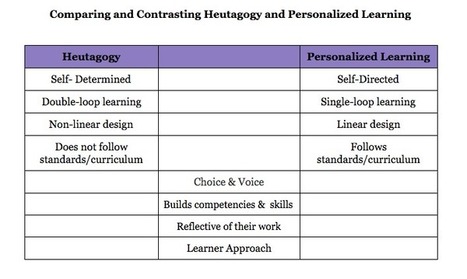
Many educators think that Personalized Learning (student driven learning) and Heutagogy are the same thing. They have many similarities but also many differences that I have illustrated in the chart below. The biggest difference is that with a Heutagogy approach the learner determines what they want to learn; it is not determined by curriculum or standards.
Learn more / En savoir plus / Mehr erfahren:
http://www.scoop.it/t/21st-century-learning-and-teaching/?tag=Heutagogy

Ghiscoopit's curator insight,
October 25, 2016 6:27 AM
Des différences et rapprochement entre heutagogie et apprentissage personnalisé...
Scoop.it!

Au-delà des constats récurrents sur les problèmes posés par les devoirs à la maison aux élèves, à leurs parents, aux accompagnateurs, mais aussi (et on en parle moins) aux enseignants, les...
Scoop.it!

OUTILS NUMÉRIQUES EN CLASSE, DEVENU INDISPENSABLE, POURQUOI PAS ?, VRAIMENT UTILE, POUR BESOINS SPÉCIAUX, DEVENANT INDISPENSABLE Via Michèle Drechsler
Scoop.it!

My suspicion is that “empathy” will turn out to be the wrong word to describe what separates V.R. from the medium of film. Think, for example, about certain ways the first-person perspective of V.R. actually limits what we see. Humans have evolved a complex apparatus for detecting the emotional states of others by intuitively assessing the micromuscular movements of the face. The paradox of V.R. is that when you see the world through someone else’s eyes, you can’t actually see the person’s eyes. You can see what the person is seeing, but it’s much harder to grasp what he or she is feeling. A cinematic close-up conveys emotional depth far more effectively than a point-of-view shot in a 360-degree film can. What V.R. does provide is so new that we don’t really have a word for it: perceptual empathy, sensory immersion. Via Jim Lerman
Scoop.it!

You can edit wikis quickly, in a WYSIWIG environment. Using wikis, teachers can co-construct websites with their students. Many learning management systems have wikis embedded. Yet there is an advantage to using a public wiki (with privacy properly managed). Students will be able to access their work beyond a single school term. Their parents and friends may also be able to see it. Via Jim Lerman 
Jim Lerman's curator insight,
November 3, 2016 8:24 PM
Yes, wikis. They're still great tools for learning.
Scoop.it!

Free resource of educational web tools, 21st century skills, tips and tutorials on how teachers and students integrate technology into education Via Educatorstechnology
Scoop.it!

L’enjeu des #Learning Analytics aujourd’hui est d’être capable d’analyser le comportement des apprenants sur des plateformes numériques, de plus en plus utilisées D’un point de vue informatique, il s’agit de problématiques d’acquisition et de représentation de connaissances, de traces et d’analyses de ces dernières, de web sémantique et de Linked Data, de sensibilité au contexte et d’adaptation, de learning analytics, et de génération dynamique de tableaux de bord pour accompagner toutes les parties prenantes. Repéré depuis L’enjeu des Learning Analytics […]The post L’enjeu des Learning Analytics – Ludovia Magazine appeared first on La Digital Learning Academy .
Via Xavier Van Dieren
Scoop.it!
Quels basculements le numérique engendre-t-il et quels bénéfices pour l’humain en devenir ? Enseigne-t-on aujourd’hui comme on enseignait…
Via Sandrine Decamps |
Scoop.it!

Mettre en place une approche BYOD en classe en favorisant l'utilisation des appareils numériques personnels des élèves, sur des projets collaboratifs Via Brigitte Noirhomme, Elena Pérez, Juergen Wagner
Scoop.it!

AP Computer Science Principles was designed specifically by the College Board and the National Science Foundation to make computing accessible and entice those underrepresented demographics into computer science. Via Tim Boileau
Scoop.it!

"Twenty percent of massive open online courses offered by U.S. News and World Report’s Top 100 National Universities are offered by the Top 5 universities on that list. Over half (i.e., 56%) of MOOCs offered by those National Universities are offered by schools in the Top 20. Almost 90 percent (i.e., 87.6%) of all MOOCs available are offered by schools within the Top 50. Course offerings per institution drop off exponentially at a rate of -700% after those Top 50: that’s an average of 21 MOOCs per university in the Top 50 decaying to an average of 3 MOOCs per university in the bottom 50. Comparing these averages, we see a massively unequal distribution of massive open online courses toward some of the most expensive, highly valued, and heftily-endowed universities in the world. "Looking at these numbers, we begin to see why few institutions have embraced MOOCs full-on. Not only do they cost more to make ($152,000 on the low-end, $244,000 on the high-end) than an average salaried professor, but they also run the possibility of crowding out colleges that are low hanging fruit for MOOCs to replace. At the worst, this means shaking the tree for low- and middle-tier universities. Professors at high-tier universities like Harvard, Yale, Stanford, and U.S. News and World Report’s Top 20 National Universities (i.e., institutions that spearheaded MOOC development) have no need to fear. Their fruit grows high enough on the tree of global higher ed marketplaces for them to be safe. It’s the small schools that may start to feel their stems being picked at: community colleges, liberal arts schools, small private colleges, and non-flagship state schools on the lower end of the rankings." Via Jim Lerman
Scoop.it!

No Student Is Unreachable: 4 Strategies To Reach Students That Don't Seem To Want To Be Reached Via Amy Burns, Dean J. Fusto, Jim Lerman
Gust MEES's curator insight,
November 3, 2016 8:41 PM
No Student Is Unreachable: 4 Strategies To Reach Students That Don't Seem To Want To Be Reached.
Students who are challenging–i.e. victims of disruptive childhoods–do not change overnight. They grow. For many of them, that growth is dependent on grasping onto an extremely diminished set of possibilities, interests, and strengths. Ultimately they’ll have the best shot at a stable life by working from the things they are good at and the things they enjoy. We serve them best by spending as much time seeking and discussing their often fragile and submerged interests and capacities as we do their significant needs and disabilities.
[Gust MEES] THEY might surprise YOU years later WHAT THEY are able to do in professional life! ;) THEY think mostly if there isn't a box, THEY don't fit in any box anyway!!! Which isn't an obstacle, should GET seen as THAT anyway!!!
Learn more / En savoir plus / Mehr erfahren:
http://www.scoop.it/t/21st-century-learning-and-teaching/?tag=innovation
Scoop.it!

IBM Watson proved on Jeopardy it can process and “learn” information much faster than humans. But how well can it help teachers and students learn?Last week, IBM Watson released Element for Educators, an iOS app designed for the iPad to give teachers a better understanding of factors affecting stude Via Dr. Tom D'Amico (@TDOttawa)
Scoop.it!

Pour l'enseignement secondaire et fondamental, préparations, ressources pédagogiques en ligne, cours, leçons et séquences didactiques pour les professeurs et enseignants Via Sandrine Decamps
Scoop.it!

Les maigres résultats du programme européen de lutte contre le chômage des jeunes, la garantie pour la jeunesse, ont été vivement critiqués.
Via Stéphanie Sellier
Scoop.it!

This is not too a difficult question to address, because innovative teaching is good whether or not technology is used. A bad teacher does not suddenly become a good teacher just because technology is included into the mix. Nor does a good teacher need to always use technology to maintain their effectiveness. But before we discuss this question any further, we should define 'innovative teaching.' What is it, and how do we know a good, innovative teacher when we see one?
Learn more / En savoir plus / Mehr erfahren:
http://www.scoop.it/t/21st-century-learning-and-teaching/?tag=innovation
http://www.scoop.it/t/21st-century-learning-and-teaching/?tag=Rise+of+the+Professional+Educator
Via Gust MEES
Gust MEES's curator insight,
November 3, 2016 6:50 PM
This is not too a difficult question to address, because innovative teaching is good whether or not technology is used. A bad teacher does not suddenly become a good teacher just because technology is included into the mix. Nor does a good teacher need to always use technology to maintain their effectiveness. But before we discuss this question any further, we should define 'innovative teaching.' What is it, and how do we know a good, innovative teacher when we see one?
Learn more / En savoir plus / Mehr erfahren:
http://www.scoop.it/t/21st-century-learning-and-teaching/?tag=innovation
http://www.scoop.it/t/21st-century-learning-and-teaching/?tag=Rise+of+the+Professional+Educator
Scoop.it!

Shelly Sanchez Terrell provides great edtech survival tips in this Slideshare presentation she calls Survival Tips for Teaching With Technology. Via Dr. Tom D'Amico (@TDOttawa)
Scoop.it!
From
list

Great list of educational apps that will prove indispensable for both teachers and students. Via Todoele, Patricia Hidalgo , Oskar Almazan
Scoop.it!

La réalité augmentée me fascine depuis un bon moment déjà et je ne suis pas la seule à être impressionnée par cette technologie de plu Via Michèle Drechsler
Scoop.it!
"The important thing is not so much that every child should be taught, as that every child should be given the wish to learn." - John Lubbock We have all heard of Pedagogy (the method and practice of teaching) and Andragogy (the method and practice of teaching adult learners) but what is Heutagogy? Heutagogy is the method… Via juandoming, Tim Boileau
Gust MEES's curator insight,
October 23, 2016 11:47 AM
Many educators think that Personalized Learning (student driven learning) and Heutagogy are the same thing. They have many similarities but also many differences that I have illustrated in the chart below. The biggest difference is that with a Heutagogy approach the learner determines what they want to learn; it is not determined by curriculum or standards.
Learn more / En savoir plus / Mehr erfahren:
http://www.scoop.it/t/21st-century-learning-and-teaching/?tag=Heutagogy
Ghiscoopit's curator insight,
October 25, 2016 6:27 AM
Des différences et rapprochement entre heutagogie et apprentissage personnalisé...
|






