


Technology and interactive tools can help support students as they develop expand their collaboration skills.
Via Grant Montgomery, kathymcdonough, Jim Lerman

 Your new post is loading...
 Scoop.it! Technology and interactive tools can help support students as they develop expand their collaboration skills. Via Grant Montgomery, kathymcdonough, Jim Lerman
Scoop.it!

Seventeen-point flipped learning technology evaluation and certification program goes live. Via EDTECH@UTRGV, Stephania Savva, Ph.D, THE OFFICIAL ANDREASCY
Scoop.it!

below are 50 ways teachers across content areas–and homeschooled learners too–can promote digital media literacy. Via Jim Lerman
Scoop.it!

Once considered the skill of the future, coding is now a necessity for most emerging career fields. If learning to code is like learning a foreign language, then it follows that it might be easier to learn when you're young. And now there's a robot for that. Via John Evans 
Carlos Fosca's curator insight,
February 19, 2017 9:41 AM
Como la tecnología, cuando es desarrollada sobre bases pedagógicas centradas en la persona que aprende, puede producir enormes resultados en los niños, incluso en temáticas aparentemente tan áridas, como lo podría ser la programación.
Scoop.it!

Digital citizenship Web resources come in many shapes and sizes, and this list of 18 includes some of the best ones out there. Via Dr. Tom D'Amico (@TDOttawa) 
Oskar Almazan's curator insight,
February 19, 2017 12:50 AM
There are many reputable and respectable organizations whose life’s work is to develop digital citizenship resources to instill its values in educators and students worldwide. We at the Global Digital Citizen Foundation are proud to be among them. We like to use 6 guidelines for practicing digital citizenship: Respect for self: Having respect for yourself is about being aware of how you portray yourself with your online persona. In doing so, you will set a positive example for others to follow. Responsibility for self: We must be mindful to avoid behavior that puts us at risk, both online and offline. Acting responsibly encourages exemplary personal governance as a habit of mind and adds to our sense of self-worth and self-esteem. Respect for others: Respecting others teaches us the value of being constructive and friendly online. It’s about modeling behavior that focuses on civility and constructive thinking in the face of conflict. Responsibility for others: Don’t be afraid to report abusive and inappropriate behavior towards others. This is how we come to see the value in making others feel protected and valued themselves. Respect for property: Asking permission to share another’s intellectual properties is an important practice. Those who devote their time to creativity in the service of others deserve no less. Learn the rules of “fair use” and copyright laws, and how they apply to sourcing and using online information. Responsibility for property: Treating our property and others’ with care and respect, including intellectual properties, is vital to preserving our digital and global communities. Remember that any kind of digital piracy is still theft and is not a victimless crime. Make a choice to act with integrity and to value what we use or own.
Scoop.it!

TOP 3 : Marie Lecloux pour son infographie "Développer les créativités". Ce travail a beaucoup marqué les jurés par la qualité de l'illustration qui se couple avec une synthèse des apports du MOOC d'une manière admirable. Bravo pour ce travail final !! Merci. 
Bruno De Lièvre's curator insight,
February 18, 2017 4:23 AM
TOP 3 : Marie Lecloux pour son infographie "Développer les créativités". Ce travail a beaucoup marqué les jurés par la qualité de l'illustration qui se couple avec une synthèse des apports du MOOC d'une manière admirable. Bravo pour ce travail final !! Merci.
Scoop.it!
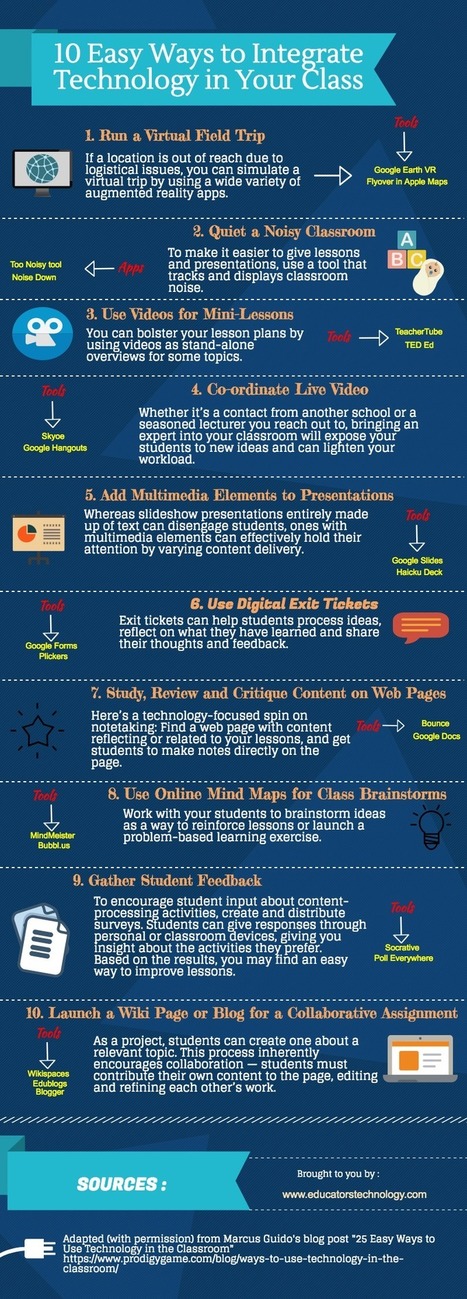
Free resource of educational web tools, 21st century skills, tips and tutorials on how teachers and students integrate technology into education Via Константин
Scoop.it!

Les boulversements technologiques et l'émergence de nouveaux outils numériques bousculent en profondeur l'organisation de la salle de classe
Via Nicole Corsyn, vgpascal 
Patrick Bérard's curator insight,
February 6, 2017 9:15 PM
Les 8 tendances selon EducPros : 1. Les MOOCs pour virtualiser la salle de classe 
Marco Bertolini's curator insight,
June 16, 2017 3:05 AM
Les outils numériques intégrés dans la classe pour la rentrée 2017 ? 
Willem Kuypers's curator insight,
June 17, 2017 11:07 AM
L'AR, VR et gamification ne sont pas selon moi pour 2017. Par contre, le cloud et les tablettes entrent à grande vitesse dans nos cours. Une stratégie digital learning (on ne dit plus e-learning) sans le mobile et le cloud ne correspond tout simplement pas à ce que sont les jeunes : mobiles et connectés.
Scoop.it!

Jon Bergmann with Crystal Kirch. You've heard it before, form follows function. Join us as we look at ideal ways to lay out a classroom for flipped learning. Via Peggy George
Scoop.it!

"Comment optimiser la transmission des connaissances et compétences, tout en favorisant l’autonomie des apprenants" https://t.co/UqnKKKRnpB Via Louis Levy
Scoop.it!

Proposé par l'Agence universitaire de la francophonie, ce cours en ligne vise à former puis à certifier les enseignants du primaire , du secondaire et leurs encadreurs aux usages des technologies de l'information et de la communication en éducation. Inscription gratuite. Via Murielle Godement, Elena Pérez
Scoop.it!

CATEGORIES CRITICAL THINKING BLOOM’S TAXONOMY INQUIRY QUESTIONING STRATEGIES LEARNING BLENDED & FLIPPED LEARNING PERSONALIZED LEARNING PROJECT-BASED LEARNING SELF-DIRECTED LEARNING TEACHING ASSESSMENT INSTRUCTIONAL STRATEGIES LITERACY STUDENT ENGAGEMENT THE FUTURE OF LEARNING TECHNOLOGY DIGITAL CITIZENSHIP DISRUPTION & INNOVATION TRENDS & SHIFTS PROF DEV PODCAST NEWSLETTER INFORMATION AUTHORS TERMS OF USE OUR PRIVACY POLICY ASK TEACHTHOUGHT RECOMMENDED BOOKS SUBSCRIBE INDEX MAIN ADVERTISE FOR PARENTS  February 7, 2017 Does Your School Need Better Technology Or Better Thinking? 426 SHARES FacebookTwitterPinterest  Does Your School Need Better Technology Or Better Thinking? by TeachThought Staff Using technology to enhance learning is an incredibly exciting idea, and as an area of education is growing fast. Blended learning, mobile learning, connectivism, and other increasingly popular ideas all owe their existence to technology. But the reality in the majority of public schools in the United States is less than cutting edge. While there is little data available to pinpoint exactly what is being done where, five of the more common applications of technology in the classroom appear below.
Via Annet Smith
Scoop.it!

Are you pressed for time? Do you also need to provide your online learners with customized course content that caters to their goals? In this article, we’ll share everything you need to know about eLearning automation. You’ll learn about 4 benefits it can bring to your organization and 3 tips to choose the best automated course authoring tool for your eLearning program. Via Edumorfosis |
Scoop.it!

By Stephania Savva This doctoral thesis has two aims equally significant: firstly to explore the potential of an instructional approach for developing museum-school partnerships that would empower the multiliteracies experiences of diverse students; second to reveal the fine details of the performances deriving from these experiences. Via Stephania Savva, Ph.D, THE OFFICIAL ANDREASCY 
Stephania Savva, Ph.D's curator insight,
December 10, 2016 8:44 AM
Take a look into my doctoral thesis investigating the potential of a conceptual framework incorporating museum multiliteracies-based teaching and learning to enhance museum-school partnerships for the 21st century, in particular but not exclusively for culturally and linguistically diverse students.
Know more:
Scoop.it!

Wikiclic est un site d'aide et de tutoriaux informatique qui traite des rubriques suivantes : Via Freewares&Tutos
Scoop.it!
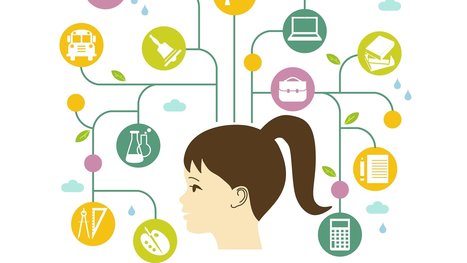
Thanks to the wonders of neuroplasticity, adolescents are primed to improve their performance in school—and beyond. Here’s how to help. Via John Evans
Scoop.it!

Copyscape is a free plagiarism checker. The software lets you detect duplicate content and check if your articles are original. Via John Dalziel
Scoop.it!
Scoop.it!

DynamiQueST is a showcase of the power of simulations and creative student projects that utilize critical thinking skills to analyze complex dynamic systems.
WHO WILL BE THERE? Students (ages 12-18), teachers and parents will participate in the simulation and learn to utilize some of the tools of system dynamics and systems thinking to analyze and clearly communicate critical thinking. Coaches will be there to facilitate both the simulation and the presentation of student projects. JOIN US to play the World Climate Simulation created at MIT and used internationally to facilitate current world climate negotiations. No Experience Needed! Just a desire to delve deeper into real-world challenges. SEE HOW systems thinking and system dynamics (ST/SD) can elucidate both global issues and curricular content. Via Steve Wilhite
Scoop.it!

A recent tweet by another maker librarian, made me realize that I should share my current (and past) organization and circulation for the awesome little robotic orb known as Sphero. Via John Evans
Scoop.it!

Alors que la sidérurgie européenne avait la tête sous l'eau il y a un an, elle a su réagir contre la concurrence chinoise déloyale. Via MIDEST
Scoop.it!

L’enseignement à distance a le vent en poupe grâce au #numérique. Le salon ilearning qui s’est tenu du 24 janvier au 25 janvier à l’espace Champerret à Paris a permis de faire le point sur les nouvelles tendances à l’heure où la #formation doit permettre de produire en masse. Le mobile pour du Fast Learning Première tendance : l’agilité. Pour répondre à cette attente d’agilité, la formation sur mobile (Mobile Learning) permet de préparer ou de réviser une formation à […]The post e-Learning : la formation sur mobile fait gagner en agilité – La Revue du Digital appeared first on La Digital Learning Academy .
Via Xavier Van Dieren
Scoop.it!

Skills define us. They are what make us useful and productive. They are the foundation of our achievements. On our death bed, it is ou Via Ana Cristina Pratas 
miracletrain 夢想驛站's curator insight,
February 8, 2017 2:04 AM
Skills define us. They are what make us useful and productive. They are the foundation of our achievements. On our death bed, it is our skills that we will reflect on with pride.

callooh's curator insight,
February 11, 2017 8:42 AM
The learning professional is at heart a generalist when it comes to skill sets (aka a jack/jill of all competencies)
Scoop.it!

Retrouvez l’édition 2017 du classement L’Usine Nouvelle des écoles d’ingénieurs, avec des critères inédits pour mieux affiner votre recherche. Via Claude Tran 
Claude Tran's curator insight,
February 17, 2017 2:26 AM
Le mouvement de fusions des écoles d’ingénieurs se poursuit plus que jamais, entraînant quelques changements dans le classement 2017 de « L’Usine Nouvelle ». Apparaissent ainsi deux nouveaux établissements de poids : l’Institut Mines-Télécom (IMT) Atlantique, issu de la fusion des Mines de Nantes et de Télécom Bretagne, et l’Institut Mines-Télécom (IMT) Lille Douai, né du rapprochement des Mines de Douai et de Télécom Lille. Centrale Paris, dont l’alliance avec Supélec n’est pas terminée, tout comme Centrale Lyon, avec l’ENI de Saint-Étienne, n’ont en revanche pas pu participer cette année à notre classement. L’Efrei et l’Esigetel, qui partagent déjà leur politique internationale et leur politique de recherche, au sein d’une même structure juridique, ont été classées ensemble, comme un établissement fusionné.
|







Looking for a way to quickly and cheaply collaborate? Google has you covered. Here are seven builing tools to help you collaborate in the classroom.
Google: Between Google Drive and Google+ Hangouts, students can work together on documents and presentations, or meet up online to discuss homework assignments or group projects.