


As higher education reaches a point of transformation, AI's insights offer a different look at what path learning could take.
Via EDTECH@UTRGV

 Your new post is loading...
 Scoop.it! As higher education reaches a point of transformation, AI's insights offer a different look at what path learning could take. Via EDTECH@UTRGV
Scoop.it!

From
tedcurran

Long before AI, it was my teaching philosophy that a teacher’s goal is not only to implant knowledge into learners’ brains, but to help them develop their own [second brain]( — AK… Via Vladimir Kukharenko, Ricard Lloria, juandoming
Scoop.it!
"How do 5,000‑year‑old clay tablets from Iraq, the rise of workplace computers and the 26th president of the United States all connect to AI and the future of work?" Via EDTECH@UTRGV 
EDTECH@UTRGV's curator insight,
January 27, 8:47 AM
"As AI tools become more intuitive and powerful, the real challenge lies not in the technology itself, but in how we integrate them into human‑machine workflows and apply them to problems worth solving"
Scoop.it!
"AI is expanding the productivity frontier. Realizing its benefits requires new skills and rethinking how people work together with intelligent machines." Via EDTECH@UTRGV
EDTECH@UTRGV's curator insight,
January 26, 10:42 AM
"Work in the future will be a partnership between people, agents, and robots—all powered by AI."
Scoop.it!

Explore practical strategies for teaching online and in-person in higher education, with a focus on student engagement, instructor presence, and effective pedagogy across modalities. Via EDTECH@UTRGV
EDTECH@UTRGV's curator insight,
January 26, 10:49 AM
"Modality shouldn’t distract us from sound pedagogy. Whether synchronous or asynchronous, face-to-face or online, our work is grounded in backward design, student-centered approaches, and ongoing assessment." 
Javier Fernández de Córdoba's curator insight,
January 27, 1:32 PM
Gran articulo que expone la enseñanza dual, presencial y online, ofreciendo unas serie de estrategias practicas que ayuden a los estudiantes a aprender con confianza en ambos espacios.
Resulta de gran utilidad para los docentes gracias a las descripciones de las estrategias aplicables al aula, como son: los objetivos de aprendizaje en acción, el aprendizaje activo, la comunicación, presencia y retroalimentación, l diseño y la estructura de los proyectos, la evaluación y la función del docente como guía y diseñador.
Scoop.it!

"Avis à tous les inventeurs, bidouilleurs, designers et passionnés : l’Appel aux Makers pour la prochaine Maker Faire Paris est officiellement OUVERT ! Pour cette édition 2026, nous vous donnons rendez-vous dans un lieu légendaire : le Musée des Arts et Métiers. Imaginez vos projets exposés au milieu des chefs-d’œuvre de l’histoire des techniques… Quand ? Du 10 au 12 avril 2026. Via Laurence 
Laurence's curator insight,
January 24, 10:54 AM
Vous avez jusqu'au 10 février pour déposer votre candidature !
Scoop.it!

This report explores the potential risks generative AI poses to students and outlines what we can do now to minimize them. Via EDTECH@UTRGV
EDTECH@UTRGV's curator insight,
January 23, 3:16 PM
"Since the debut of ChatGPT and with the public’s growing familiarity with generative artificial intelligence (AI), the education community has been debating its promises and perils. Rather than wait for a decade to conduct a postmortem on the failures and opportunities of AI, the Brookings Institution’s Center for Universal Education embarked on a yearlong global study—a premortem—to understand the potential negative risks that generative AI poses to students, and what we can do now to prevent these risks, while maximizing the potential benefits of AI."
Scoop.it!

More students are enrolling in majors centered around artificial intelligence as universities create more programs designed around generative AI. Via EDTECH@UTRGV
EDTECH@UTRGV's curator insight,
January 23, 3:33 PM
"AI programs are a hot trend in universities and colleges, as they seek to capitalize on the popularity of generative AI tools like ChatGPT and Claude."
Scoop.it!
From
uxdesign
EDTECH@UTRGV's curator insight,
January 22, 1:57 PM
"'How can we add AI?' is trend-chasing. It puts technology before purpose, and often leads to bloated features no one asked for, wasted development time, money, and opportunity cost of building something desired and innovative instead." 
Valeria Davila's curator insight,
January 30, 1:54 PM
The author’s main argument centers on a powerful mindset shift: moving away from adding AI simply for hype and instead using AI intentionally to solve real customer problems. I strongly agree with this perspective because the “put some AI in it” approach often leads to shallow features that look impressive but fail to add meaningful value. The Portlandia analogy effectively illustrates how trend-chasing prioritizes appearance over substance, which can distract teams from addressing genuine user pain points. What stood out to me most is the emphasis on AI as a *means*, not the mission—this reframing encourages thoughtful innovation rather than reactive development driven by fear of missing out. Overall, the article makes a compelling case that long-term growth and customer satisfaction come not from showcasing the newest tools, but from asking better questions and using AI strategically to enhance outcomes that truly matter.
Scoop.it!

Explore how AI-powered instruction, personalized learning, and emerging education trends are shaping the 2026 classroom—and what educators can do now to prepare students for an AI-driven future. Via EDTECH@UTRGV
EDTECH@UTRGV's curator insight,
January 21, 1:11 PM
"Across educational organizations, AI is moving from experimentation to impact. Each year, more institutions increasingly accelerate their use of AI."
Valeria Davila's curator insight,
January 30, 4:03 PM
This article paints a compelling picture of how rapidly AI has moved from experimentation to everyday impact in education, and I appreciate its attempt to balance optimism with caution. The data on adoption, personalization, and improved outcomes make a strong case that AI can meaningfully expand access, reduce teacher workload, and support learners who might otherwise be left behind, particularly in language learning and large-scale instruction. At the same time, the concerns about weakened critical thinking, reduced student–teacher connection, and lack of training are significant and cannot be treated as side notes to progress. What resonates most with me is the repeated emphasis that AI’s value depends on how well educators are prepared to guide its use without intentional training and AI literacy; the risks may outweigh the benefits. Overall, the article reinforces that the future of education is not about choosing between AI and human teachers, but about equipping educators and students to balance technological power with human judgment, connection, and critical thinking in an AI-driven world.
Scoop.it!
EDTECH@UTRGV's curator insight,
January 21, 12:59 PM
"ChatGPT's age prediction model estimates a user's age based on behavior and signals from their account, like when the person is active during the day, long-term usage patterns, how long the account has existed, and the user's stated age."
Scoop.it!
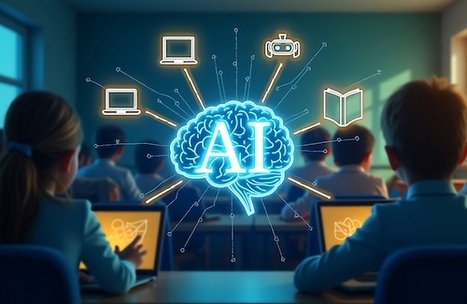
Educators face urgent questions around misinformation, academic integrity, and critical thinking around AI. Visual literacy is key. Via EDTECH@UTRGV
EDTECH@UTRGV's curator insight,
January 20, 3:05 PM
"Teaching students to read images critically, to see them as constructed texts rather than neutral data, strengthens the same skills we rely on for strong reading comprehension: inference, evidence-based reasoning, and metacognitive awareness." 
Claudia Hernandez's curator insight,
May 24, 8:49 PM
This article explains that teaching visual literacy is essential in the age of AI because students must learn how to critically analyze images, videos, and AI-generated content. The author argues that reading images strengthens important literacy skills such as inference, evidence-based reasoning, and critical thinking while helping students become more thoughtful and responsible users of AI.
Scoop.it!

Mar V's curator insight,
January 20, 8:41 AM
La IA ofrece grandes oportunidades, pero también presenta riesgos y dificultades a nivel educativo. Uno de estos riesgos es que los alumnos no se esfuercen por pensar, recurriendo a ella para resolver las tareas. Además, puede provocar que no se desarrolle el pensamiento crítico y reflexivo. Por ello, es fundamental establecer su incorporación a las aulas, definiendo la intención pedagógica, el marco ético o los objetivos de enseñanza y aprendizaje que con su uso se pretenden alcanzar.

cynthiia.sr9@gmail.com's curator insight,
January 20, 11:27 AM
La OCDE deja claro que la tecnología y la inteligencia artificial ya forman parte de la educación, pero que no son una solución mágica. Bien usadas, pueden ayudar a personalizar el aprendizaje y facilitar el trabajo en el aula; mal usadas, pueden aumentar desigualdades o hacer que se aprenda menos. Por eso, el verdadero reto no es tener más tecnología, sino saber usarla con sentido, formar bien al profesorado y poner siempre el aprendizaje y las personas en el centro.

Laura Moreno Fernández's curator insight,
January 22, 10:53 AM
El OECD Digital Education Outlook 2026 es un informe internacional que analiza cómo la inteligencia artificial generativa (GenAI) está transformando el campo educativo y qué criterios hacen que su uso sea efectivo y pedagógicamente significativo. El documento destaca que, aunque herramientas como ChatGPT y otras aplicaciones de IA pueden mejorar la calidad del trabajo escolar, no siempre generan aprendizaje real si se usan sin bases pedagógicas sólidas; es decir, producir buenas respuestas no garantiza que se hayan desarrollado habilidades profundas. Un hallazgo clave del informe es que la IA puede contribuir positivamente al aprendizaje cuando se integra con una intención pedagógica clara, por ejemplo, actuando como tutor o compañero de diálogo que fomenta el pensamiento crítico, la creatividad y la colaboración entre estudiantes. Además, subraya la importancia de rediseñar estrategias de enseñanza para que la IA complemente el proceso educativo sin sustituir el esfuerzo cognitivo necesario para la internalización de conceptos. El informe también reconoce el papel central de los docentes en esta transformación: la IA debe aumentar la capacidad del profesorado para enseñar, no reemplazarla. Herramientas co‑diseñadas con docentes y centradas en objetivos de aprendizaje pueden amplificar la calidad de la enseñanza, manteniendo la agencia profesional del docente como eje del proceso educativo. Este estudio es especialmente relevante para entender la educación digital del siglo XXI porque plantea la necesidad de una integración ética, reflexiva y pedagógica de las tecnologías, impulsando no solo habilidades técnicas sino también competencias cognitivas y metacognitivas que preparan a los estudiantes para enfrentar desafíos complejos en un mundo cada vez más digitalizado.
|
Scoop.it!
From
uxdesign
EDTECH@UTRGV's curator insight,
January 28, 11:00 AM
"This article focuses on one of the widespread misconceptions that could send the future of UX along a very wrong trajectory. I call it chatbot-first thinking: the assumption that conversational interfaces can — or should — replace most existing UI patterns completely."
Scoop.it!

EDTECH@UTRGV's curator insight,
January 27, 8:43 AM
"LLMs are incapable of carrying out computational and agentic tasks beyond a certain complexity level, above which they will deliver incorrect responses."
Scoop.it!

As plataformas digitais reconfiguram a escola à sua imagem, individualizando o ensino e reduzindo o papel do professor. Por isso, no processo educacional, o decisivo não é a tecnologia, mas quem a controla e a desenha. Oferecer a velha educação com uma roupagem tecnológica, embora lucrativo e fácil, não garante preparar as crianças para os grandes desafios que terão de enfrentar Via Inovação Educacional, juandoming
Scoop.it!

A New York magazine article titled “Everyone Is Cheating Their Way Through College” made the rounds in mid-2025. I think about it often, and especially when I get targeted ads that are basically variations on “if you use our AI tool, you’ll be able to cheat without getting caught.” Suffice it to say it’s dispiriting. […] Via EDTECH@UTRGV
EDTECH@UTRGV's curator insight,
January 26, 10:46 AM
"Used wisely, it multiplies productivity. Used foolishly, it multiplies folly. Debates about academic integrity and artificial intelligence force us to really reckon with who we are and what we’re doing."
Valeria Davila's curator insight,
January 30, 2:01 PM
This article makes a persuasive and thoughtful case that the real issue with AI in higher education is not the technology itself, but the ethical choices users make when engaging with it. I strongly agree with the author’s argument that using AI as an assistant to support thinking is fundamentally different from using it as a substitute for thinking, and the power-loader analogy captures this distinction especially well. The comparison highlights how AI can amplify effort without actually building intellectual “muscle” when students rely on it to do the work for them, which undermines learning rather than enhancing it.
Scoop.it!

I recently encountered a term that stopped me in my tracks - cognitive outsourcing (thanks to Professor Miles Berry for that one!). We're all well-acquainted with cognitive offloading. That's the act of letting a tool take the weight of a task so we don't have to. But "outsourcing"? That feels different. It sounds distinctly middle-class,… Via Nik Peachey 
Nik Peachey's curator insight,
January 26, 12:53 AM
Cognitive offloading is often a total hand-off. Dumping the task and walking away. The responsibility transfers completely. You’ve got the answer, job done, move on. 
Richard Platt's curator insight,
February 7, 5:20 PM
Cognitive offloading is often a total hand-off. Dumping the task and walking away. The responsibility transfers completely. You’ve got the answer, job done, move on.
Scoop.it!

Teacher burnout has reached crisis levels, and proposed solutions often miss the mark. Another professional development session on self-care. Another webinar on stress management. Another reminder to practice gratitude. These well-meaning interventions place the burden on individual teachers to cope with systemic problems: inadequate funding, unrealistic mandates and stretched resources.
But what if the conversation shifted from what teachers should do differently to what conditions actually allow teaching to be sustainable? According to Dr. Damian Vaughn, chief programs officer at BetterUp, the answer isn't about individual resilience. It's about how we design the environments where teaching happens. "We're asking schools to do near impossible things with shrinking resources," Vaughn says." Via John Evans
Scoop.it!
"Apple (AAPL.O), opens new tab plans to revamp Siri later this year by turning the digital assistant into the company's first artificial intelligence chatbot, Bloomberg News reported on Wednesday. The chatbot, code named Campos, will be embedded deeply into the iPhone, iPad and Mac operating systems and will replace the current Siri interface, the report said, citing people familiar with the plan."
Via EDTECH@UTRGV
EDTECH@UTRGV's curator insight,
January 23, 3:27 PM
"The chatbot capabilities will come later in the year and Campos, which will have both voice- and typing-based modes, will be the primary new addition to Apple's upcoming operating systems"
Scoop.it!
From
uxdesign
"AI has made work faster almost everywhere. But, are many organisations confusing sheer speed for actual organisational intelligence?" Via EDTECH@UTRGV
EDTECH@UTRGV's curator insight,
January 22, 1:55 PM
"The adoption of AI in organisations may be accelerating work itself, but without reliably making it better. It may even be causing a drift into the trap of conflating outputs with outcomes?"
Scoop.it!

This article explores how and why hy flexible digital learning systems with define the future of education. Via Vladimir Kukharenko, juandoming
Scoop.it!

The power of any data dashboard isn't in the dashboard itself--it's in the conversations that happen around it. Data literacy is critical. Via EDTECH@UTRGV
EDTECH@UTRGV's curator insight,
January 21, 1:18 PM
"Data literacy means asking better questions and approaching data with curiosity. It requires recognizing that the answers we get are entirely driven by the questions we ask."
Scoop.it!

Student attention drops sharply at the 15-minute cliff in online classes. The problem is not the technology or content. Via EDTECH@UTRGV
EDTECH@UTRGV's curator insight,
January 21, 1:01 PM
"Student attention drops sharply 15 minutes into online classes. The problem is not the technology or content. It is how instructors structure the session."
Scoop.it!

One of my earliest memories of using technology for teaching and learning was when I taught English at a small high school outside Waterbury Via EDTECH@UTRGV
EDTECH@UTRGV's curator insight,
January 20, 3:10 PM
"AI may speed up instructional tasks, but it’s educator expertise that ensures those tasks are meaningful, accurate and grounded in students’ needs." |







"Will colleges and universities remain sites of human development, or become credentialing platforms optimized for efficiency alone?"