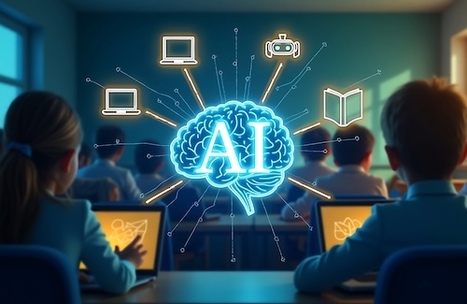
OpenAI is trying to keep teens safer by estimating their age.
|
|
Scooped by
EDTECH@UTRGV
onto Educational Technology News January 21, 12:59 PM
|
Get Started for FREE
Sign up with Facebook Sign up with X
I don't have a Facebook or a X account
|
|
Scooped by
EDTECH@UTRGV
onto Educational Technology News January 21, 12:59 PM
|
OpenAI is trying to keep teens safer by estimating their age.
Your new post is loading...
Watch this video to learn more about the fully online, accelerated, project-based Master of Education in Educational Technology at the University of Texas Rio Grande Valley. For more information, visit: https://www.utrgv.edu/edtech/index.htm
EDTECH@UTRGV's insight:
This 30-hour accelerated program designed to prepare persons in K-12, higher education, corporate, and military settings to develop the skills and knowledge necessary for the classrooms and boardrooms of tomorrow. Students in this program have the opportunity to earn one or more graduate certificates in E-Learning, Technology Leadership, and Online Instructional Design.
Katlego Mofokeng's curator insight,
May 19, 2025 3:46 PM
Using technology in education proves affective in helping students/ learners accelerate their learning progress.
Elena Galeote's comment,
December 29, 2025 6:51 AM
Desde mi punto de vista, el Master of Education in Education Technology responde de manera acertada a las necesidades actuales del ámbito educativo, donde la integración pedagógica de la tecnología es cada vez más importante. El enfoque basado en proyectos potencia un aprendizaje significativo, ya que permite a los maestros diseñar y aplicar recursos digitales directamente en sus contextos escolares. Además, el formato online y acelerado facilita la actualización profesional continua, lo que considero clave para mejorar la práctica docente y promover una educación más creativa y eficaz.
When you master the art of wrapping data in a strategic narrative, your department can move from being seen as a support function to being recognized as a strategic asset.
EDTECH@UTRGV's insight:
"Effective board presentations follow a narrative structure that creates emotional resonance while maintaining analytical rigor. Start with context that grounds your story in the organization's strategic landscape. What challenge or opportunity existed? Why did it matter to the mission?"
"The MOOC Market has transformed education from a location-bound experience into a globally accessible digital ecosystem. What started as free online courses from elite universities has evolved into a multi-billion-dollar industry powering career growth, corporate upskilling, and lifelong learning. Today, MOOCs are no longer optional add-ons - they are a core pillar of the future education economy."
EDTECH@UTRGV's insight:
"The global MOOC market is witnessing strong double-digit growth, fueled by digital transformation, remote work, and the rising need for continuous skill development."
Despite teens' perceptions, states and districts say the restrictions lead to better teacher satisfaction and improved school climate.
EDTECH@UTRGV's insight:
"Only 41% of teens support cellphone bans in middle and high school classrooms, according to polling by Pew Research Center released Tuesday. That contrasts with most surveyed adults — 74% — who are supportive of similar prohibitions, earlier Pew research found."
From
mashable
OpenAI is trying to keep teens safer by estimating their age.
EDTECH@UTRGV's insight:
"ChatGPT's age prediction model estimates a user's age based on behavior and signals from their account, like when the person is active during the day, long-term usage patterns, how long the account has existed, and the user's stated age."
"When middle schoolers chatted with ELIZA, a 1960s chatbot, they uncovered how AI really works (and doesn’t). Along the way, they learned computational thinking and emotional intelligence."
EDTECH@UTRGV's insight:
"The bots were quick, but not “intelligent” without information in its knowledge base, so it couldn’t actually answer anything at all."
A Digital Promise report finds that few states have developed a systematic approach to AI evaluation in schools. The report's authors discuss the impact.
EDTECH@UTRGV's insight:
“We're seeing an important call for more professional learning at all levels of the ecosystem, so that we are all developing AI literacy skills to be able to identify when it's appropriate to use AI-enabled tools and when it's not.”
From
uxdesign
"Why chatbots should admit uncertainty. An analysis of RLHF, tokenization, and the future of transparency in Artificial Intelligence."
EDTECH@UTRGV's insight:
"Chatbots spit out false information with such confidence that it conveys the idea that the information is true, even though the chatbot has little to no evidence for it — yet that fact is never communicated."
From
uxdesign
"The majority of AI products remain tethered to a single, monolithic UI pattern: the chat box. While conversational interfaces are effective for exploration and managing ambiguity, they frequently become suboptimal when applied to structured professional workflows.
To move beyond “bolted-on” chat, product teams must shift from asking where AI can be added to identifying the specific user intent and the interface best suited to deliver it."
EDTECH@UTRGV's insight:
"A robust AI system must recognize and adapt to these 8 distinct modes: Learn, Create,Delegate, Oversee, Monitor, Connect, Play, and Find"
From
uxdesign
"We are building LLMs to sound human. When we add personality and emotional tone, we increase the risk that people will trust them like people. Design them as tools. Not as companions."
EDTECH@UTRGV's insight:
"AI humanization is an intentional design choice that encourages users to perceive AI systems as having human-like qualities such as personality, emotions, or consciousness."
Now that AI can write code, what does the work of a software engineer look like, and what will it look like tomorrow?
EDTECH@UTRGV's insight:
"If the way we produce code has changed this dramatically, it forces a deeper question: what should learning to code optimize for this moment of transition?"
Alternative educational movements offer insights about how to help university students find purpose and hope as they navigate an increasingly complex world.
EDTECH@UTRGV's insight:
"AI has unsettled long-established forms of assessment, simultaneously instigating a return to older assessment models in the interest of 'academic integrity.'”
Maybe I need to drop the illusion that I can spot AI-written text and, instead, devise assignments that AI can’t help with, says David Mingay
EDTECH@UTRGV's insight:
"We also risk undermining the peer-review process if human decisions about methodological soundness or intellectual contribution are replaced with automated gatekeeping by unvalidated software" |
The power of any data dashboard isn't in the dashboard itself--it's in the conversations that happen around it. Data literacy is critical.
EDTECH@UTRGV's insight:
"Data literacy means asking better questions and approaching data with curiosity. It requires recognizing that the answers we get are entirely driven by the questions we ask."
Explore how AI-powered instruction, personalized learning, and emerging education trends are shaping the 2026 classroom—and what educators can do now to prepare students for an AI-driven future.
EDTECH@UTRGV's insight:
"Across educational organizations, AI is moving from experimentation to impact. Each year, more institutions increasingly accelerate their use of AI."
From
www
The generation that struggles to see a brighter financial future is also the most vulnerable to market manipulation. Author Lillian Zhang has tips for a better path forward.
EDTECH@UTRGV's insight:
"In 2030 all high schoolers in California will be required to have taken a course in personal finance or financial literacy before they graduate high school. And across the U.S., about two thirds of states have already implemented or will soon implement similar requirements in their public schools. But what happens in the interim when Gen Z and Gen Alpha students might be left to rely on other sources of financial education and literacy?"
Student attention drops sharply at the 15-minute cliff in online classes. The problem is not the technology or content.
EDTECH@UTRGV's insight:
"Student attention drops sharply 15 minutes into online classes. The problem is not the technology or content. It is how instructors structure the session."
One of my earliest memories of using technology for teaching and learning was when I taught English at a small high school outside Waterbury
EDTECH@UTRGV's insight:
"AI may speed up instructional tasks, but it’s educator expertise that ensures those tasks are meaningful, accurate and grounded in students’ needs."
Educators face urgent questions around misinformation, academic integrity, and critical thinking around AI. Visual literacy is key.
EDTECH@UTRGV's insight:
"Teaching students to read images critically, to see them as constructed texts rather than neutral data, strengthens the same skills we rely on for strong reading comprehension: inference, evidence-based reasoning, and metacognitive awareness."
Instructors are evaluating how artificial intelligence impacts the main goals of education and adjusting their teaching accordingly. This leads to conversations about critical thinking and changing workforce expectations.
EDTECH@UTRGV's insight:
“If all you know how to do in the workforce is how to feed something into a chatbot and then take the output and say, ‘Here it is,’ then you are not employable,”
From
www
A new report warns that AI poses a serious threat to children's cognitive development and emotional well-being.
EDTECH@UTRGV's insight:
"The risks of using generative artificial intelligence to educate children and teens currently overshadow the benefits, according to a new study by the Brookings Institution's Center for Universal Education."
LLMs humanize by design. Adding personality/emotion amplifies risk. Design real tools, not fake friends.
EDTECH@UTRGV's insight:
"LLMs are especially prone to anthropomorphization from users because, unlike the simpler systems of the past, they can carry on extended conversations, remember what was discussed, and generate responses that sound like they came from a person."
Why the Future of EdTech Might Be More Collaborative Than We Think
EDTECH@UTRGV's insight:
"In November, OpenAI quietly rolled out Group Chats in ChatGPT—allowing multiple people to collaborate with each other and with ChatGPT in the same conversation."
Pedro and Enrique Noguera recommend four steps for embracing chatbots—with guardrails.
EDTECH@UTRGV's insight:
"AI tools are changing how teachers teach and how students learn. Some educators see endless possibilities for innovation, while others worry that these same tools could weaken students’ ability to think critically, write clearly, and solve problems independently."
Modernizing education with artificial intelligence is less about buying this or that new tool than about new processes, new applications for data analytics, and reorganizing instructional priorities around new norms.
EDTECH@UTRGV's insight:
"Gen Z and younger learners increasingly expect education to look and feel like the digital experiences they already use: short, visual, interactive and on demand."
Technology is changing the work of teachers, but education must remain human-led.
EDTECH@UTRGV's insight:
"[B]ehind the rapid adoption of digital solutions lie uncomfortable questions. Are teachers being forced to become less like educators and more like tech operators? What does it then mean to be a teacher and to teach?" |
Your new post is loading...

"ChatGPT's age prediction model estimates a user's age based on behavior and signals from their account, like when the person is active during the day, long-term usage patterns, how long the account has existed, and the user's stated age."