


"From AI study assistants to presentation builders, these free tools can help teachers, students, and parents work smarter."
Via EDTECH@UTRGV

 Your new post is loading...
 Scoop.it! "From AI study assistants to presentation builders, these free tools can help teachers, students, and parents work smarter." Via EDTECH@UTRGV
Scoop.it!

From
www

More than three years after ChatGPT debuted, AI has become a part of everyday life — and professors and students are still figuring out how or if they should use it. Via EDTECH@UTRGV 
EDTECH@UTRGV's curator insight,
March 3, 10:18 AM
"More than half of students who used AI for coursework had mixed feelings about it, reporting that it helps them sometimes but can also make them think less deeply."
Scoop.it!

From
ia4marketing
Décryptage des insights IA du Baromètre Numérique 2026 par le CRÉDOC. Découvrez les opportunités stratégiques de l'IA Gen pour le marketing Via Thierry Pires
Scoop.it!

Nik Peachey's curator insight,
March 3, 5:36 AM
Lots of questions about A&E in K-12 in a world with AI - Pearson's free guide is a good resource to generate discussions
Scoop.it!

Passionné par l'innovation, la fabrication numérique et le partage des connaissances. Mon objectif est de rendre la technologie accessible à tous et d'inspirer la créativité. Via Laurence
Scoop.it!

A comprehensive collection of academic research on generative AI in preK12 education organized into three categories: Via Dr. Tom D'Amico (@TDOttawa)
Scoop.it!

Learn how faculty can use AI in teaching to save time, improve feedback, and strengthen pedagogy while keeping human connection at the center of learning. Via Vladimir Kukharenko, juandoming
Scoop.it!

"Whether you’re an AI advocate or a skeptic, the slow AI movement has something to offer." Via EDTECH@UTRGV
EDTECH@UTRGV's curator insight,
February 27, 12:18 PM
"Slow AI resists the cult of acceleration. It does not call for banning AI. Instead, it argues for embedding pause and reflection into how we design, use and teach with these tools."
Scoop.it!
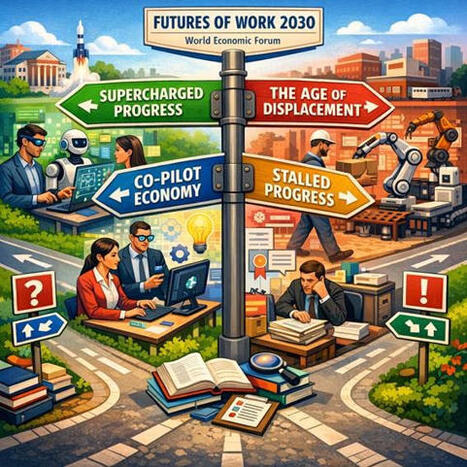
Por Carlos Bravo Reyes y Mercedes Leticia Sánchez Ambriz No te pierdas el podcast con un resumen del informe del WEF En DAVOS se celebró ... Via LGA
Scoop.it!

"Most AI literacy curricula begin and end with the same lesson: here’s how to use ChatGPT responsibly. Learn to prompt. Check your sources. Don’t plagiarize. That’s not AI literacy. That’s a typing tutorial for 2023." Via EDTECH@UTRGV
EDTECH@UTRGV's curator insight,
February 26, 1:02 PM
"The world students are entering — the world that’s arriving right now — requires something far more comprehensive. The chatbot is just the opening act. What follows is an AI environment that will reshape how young people think, feel, relate, work, and build their identities." 
Claudia Hernandez's curator insight,
May 24, 8:54 PM
This article argues that true AI literacy goes far beyond simply learning how to use chatbots responsibly. The author explains that students must understand how AI affects critical thinking, relationships, decision-making, careers, and society so they can navigate an AI-driven world with awareness, agency, and ethical judgment.
Scoop.it!

Flipped classroom pioneer Jon Bergmann wants better AI outside of the classroom and less AI during class time. Via EDTECH@UTRGV
EDTECH@UTRGV's curator insight,
February 26, 12:51 PM
"Bergmann has developed a new teaching framework that combines flipped learning and mastery learning models with the modern realities of AI. He calls it The Mastery Flip, and its three pillars are designed to maximize the beneficial impact of AI while minimizing its harms and preparing students to harness this technology for the future."
Scoop.it!

Conversations with Kevin Hogan: Franklin Township Schools (IN) Director of Technology Integration Nadine Gilkison and Superintendent Dr. Chase Huotari share their three-year journey moving beyond AI policy debates to create authentic learning experiences Via EDTECH@UTRGV
EDTECH@UTRGV's curator insight,
February 26, 12:55 PM
"While many school districts remain stuck debating AI policies and compliance issues, Franklin Township Schools in Indiana has built something different: a culture in which artificial intelligence serves as a learning companion rather than another initiative to fear." |
Scoop.it!
"In graduate school, my experimental archaeology professor told a student to create a door socket—the hole in a door frame that a bolt slides into—in a slab of sandstone by pecking at it with a rounded stone. After a couple of weeks, the student presented his results to the class. “I pecked the sandstone about 10,000 times,” he said, “and then it broke.”
This kind of experience is known as individual learning. It works through trial and error, with lots of each." Via EDTECH@UTRGV
EDTECH@UTRGV's curator insight,
March 3, 10:16 AM
"Technological progress occurs when different forms of expertise are combined."
Scoop.it!

Scoop.it!

Education needs an analog reboot, says neuroscientist Jared Cooney Horvath in his new book, “The Digital Delusion,” which lays out how technology ha Via EDTECH@UTRGV
EDTECH@UTRGV's curator insight,
March 2, 2:14 PM
“Teach someone to use a tool and they’ll be able to use that tool...Teach someone how to think and they’ll be able to use any tool.”
Scoop.it!

From
dayofai
Resources for families to explore AI together or for schools to lead a family-facing AI workshop. Via Dr. Tom D'Amico (@TDOttawa)
Scoop.it!

A thought-provoking article – A world reacting instead of understanding Ever wondered why problems multiply while solutions feel increasingly ineffective?Crises follow crises, reforms follow failures, and yet nothing seems truly resolved. Modern society has become excellent at reacting, but poor at understanding.We respond to what happens,…
Learn more / En savoir plus / Mehr erfahren:
https://www.scoop.it/topic/21st-century-learning-and-teaching?tag=Gust-MEES
https://gustmees.wordpress.com/
Via Gust MEES 
Gust MEES's curator insight,
February 27, 3:59 PM
A thought-provoking article – A world reacting instead of understanding Ever wondered why problems multiply while solutions feel increasingly ineffective?Crises follow crises, reforms follow failures, and yet nothing seems truly resolved. Modern society has become excellent at reacting, but poor at understanding.We respond to what happens,…
Learn more / En savoir plus / Mehr erfahren:
https://www.scoop.it/topic/21st-century-learning-and-teaching?tag=Gust-MEES
https://gustmees.wordpress.com/
Scoop.it!

Increased use of new technologies accompanied by rising fear of being accused of cheating, with many universities’ policies on what is acceptable still unclear, has students on edge. Universities have been urged to reconsider their use of tools that claim to be able to detect artificial intelligence after a survey found three-quarters of U.K. students using AI feel stressed that their work will be wrongly flagged as cheating. Via EDTECH@UTRGV
EDTECH@UTRGV's curator insight,
February 27, 12:15 PM
“While universities are learning, too, this confidence and clarity gap needs to be narrowed and eventually closed.”
Scoop.it!

Microsoft has released a new research report warning that no single technology can reliably distinguish AI-generated content from authentic media, and that deepening reliance on any one method risks misleading the public. Via EDTECH@UTRGV
EDTECH@UTRGV's curator insight,
February 27, 12:20 PM
"The study identified limitations across each authentication method when used in isolation."
Scoop.it!

Blog de la "RIED. Revista Iberoamericana de Educación a Distancia". La Revista Iberoamericana de la Educación Digital. Via LGA
Scoop.it!

Build impactful e-learning 10x faster with QuikAuthor. Our AI-powered microlearning platform uses gamification to drive engagement and knowledge retention. Via Ana Cristina Pratas
Scoop.it!

Por Mercedes Leticia Sánchez Ambriz No te pierdas el podcast de este artículo, escúchalo aquí. El avance del modelo de microcredenciales... Via LGA
Scoop.it!

EDTECH@UTRGV's curator insight,
February 26, 12:58 PM
"[S]hadow AI is the unmonitored use of any unauthorized AI tool or platform by teachers, staff, or students, such as generative AI chatbots or data visualization tools. Having such unvetted AI programs can open schools to the potential for data breaches and other cybersecurity vulnerabilities." |








"The top-tier tools have consistently been super valuable for me—in my teaching, in my job at the City University of New York, and as a dad of two daughters. To save you the time and effort of sifting through the chaff, I’m sharing the ones I find most useful."