Your new post is loading...
Some schools have already banned ChatGPT for students. At the same time, some educators are exploring ways to harness the tool for learning. To help educators understand how artificial intelligence might fit into a classroom environment, Schneider, who is now the director of the Institute of Education Sciences (IES), an independent research arm of the U.S. Department of Education, compares it to the invention of the calculator. “For years there was a question about whether or not students should have calculators when they do a math assessment,” he said. “And this happens all over the place: Some new technology comes [and] it’s overwhelming.”
Eventually educators decided to permit calculators and make test questions more complex instead of constantly having to monitor students’ behavior. Similarly, with ChatGPT, Schneider urges educators to ask themselves, “What do you need to do with this incredibly powerful tool so that it is used in the furtherance of education rather than as a cheat sheet?” In a conversation with MindShift, he addressed teachers’ ChatGPT worries and offered insights on how to ensure students continue to have meaningful learning experiences.
Via John Evans
Juan Domingo Farnós La evolución de la tecnología educativa de la versión 2.0 a la IA en la educación ha permitido una mayor personalización del proceso de enseñanza y aprendizaje, así como una mayor eficiencia en la gestión y análisis de los datos educativos. Además, estas tecnologías pueden mejorar la motivación y el compromiso de…
Via juandoming
Artificial Intelligence has made leaps in recent years, turning from a theoretical concept to an everyday reality. Most of us use some form of AI when we unlock our smartphones, log into social media, use our smart home devices, or make electronic payments. It was only natural for AI to take over the world of online learning as well. In this article, we explore 5 ways you can utilize AI in online learning to bring your eLearning course one step closer to the future. Learn more / En savoir plus / Mehr erfahren: https://www.scoop.it/topic/21st-century-learning-and-teaching/?&tag=AI
Via Edumorfosis, Gust MEES

|
Rescooped by
michel verstrepen
from Into the Driver's Seat
March 5, 2023 4:09 AM
|
Feeling downcast and bored? There's a lot to do online! Check out these fun websites and cure your boredom now. Jim Lerman's insight: There are actually some very interesting sites here and some with real educational value too.
Via Jim Lerman
Dreamscape Learn aims to supplement and radically transform education with 'hands-on' labs conducted in virtual reality.
Via Peter Mellow, juandoming
I’m not sure we have fully grasped what has just happened with ChatGPT, or more generally, generative AI. It is a far more profound shif
Via Marta Torán, Ricard Lloria, juandoming
Blog de la "RIED. Revista Iberoamericana de Educación a Distancia". La Revista Iberoamericana de la Educación Digital.
Via LGA
Data can be incredibly useful for higher education, allowing them to target the prospects most likely to enroll in their school, engaging students on campus, identifying pain points and leading to solutions, and an overall enhanced student experience.
Via EDTECH@UTRGV
Learning spaces and technology infrastructure have become increasingly important to the student experience. Higher education leaders have an obligation to reimagine hybrid learning in ways that can achieve accessible and equitable education for student success.
Via EDTECH@UTRGV, LGA
|
|
Rescooped by
michel verstrepen
from L'eVeille
March 1, 2023 11:16 PM
|
Du moins… comme nous la connaissons et la vivons aujourd’hui. Et ce n’est pas la première fois que j’entends cela. Au cours de toutes mes années en tant qu’enseignant (presque 15 avant d’embrasser pleinement le secteur tech), j’ai assisté à l’introduction de nombreuses technologies dans le monde éducatif ; certaines n’étaient qu’une tendance, d’autres restent …
Via Sandrine Decamps
STEM learning can be challenging, but educational robotics offers students an opportunity for a hands-on, guided problem solving learning experience
Via EDTECH@UTRGV, John Evans
|
|
|
Rescooped by
michel verstrepen
from Les outils du Web 2.0
March 6, 2023 7:07 AM
|
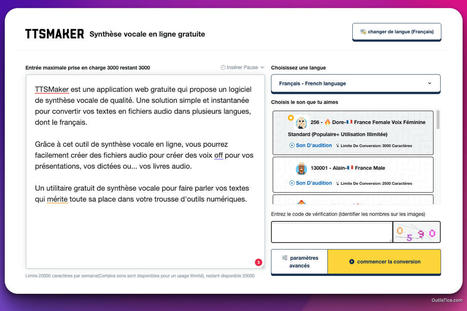
Transformez vos textes en fichiers audio grâce à TTSMaker, un outil de synthèse vocale en ligne gratuit, facile à utiliser et qui parle toutes les langues.
Via Fidel NAVAMUEL
|
|
Rescooped by
michel verstrepen
from L'eVeille
March 6, 2023 1:59 AM
|
Petit, M. et Gourvil, A. (dir). 56 pages téléchargez le cahier (document pdf)) Qu’est-ce que la téléprésence ? Comment être présent à distance ? Comment apprendre en téléprésence ? Comment soutenir un sentiment de présence à distance ? Quels sont les points de vigilance pour former à distance et en
Via Sandrine Decamps
|
|
Rescooped by
michel verstrepen
from Media, Business & Tech
March 5, 2023 12:26 PM
|
And Sydney too. Consolidating some thoughts on an exciting two weeks of surprises, advances, and retreats in AI. The following brings together three twitter threads on the launch of ChatGPT, the…
Via Bruno Renkin
|
|
Rescooped by
michel verstrepen
from Into the Driver's Seat
March 5, 2023 4:09 AM
|
Most of us wish to be born with two skills: to sing and play in tune, and to draw with ease. Unfortunately, most of us can only stare with envy as some of the gifted ones give their talents a bigger stage.
Lucky for us, technology can help. Even if you skip art school, you can always learn how to draw online.
So it’s never too late to dust off the years and take up lessons on how to draw. Think of the websites below as your free online drawing and art classes. Brush up on your skills, and get started!
Via Jim Lerman
When undergraduates can turn to AI chatbots to write their essays, calls for a return to in-class testing will surely grow louder. Closed-book exams are now, some argue, the only way to guarantee academic integrity and fairness.
But it would be wrong to forget why UK universities have moved away from traditional examinations in recent years, even if they continue to be used for at least part of many degree courses.
Via Edumorfosis, juandoming
Juan Domingo Farnós En un futuro cercano, el metaverso se convertirá en una herramienta fundamental para la educación disruptiva, en la que se promueve un enfoque personalizado e interactivo de aprendizaje. Gracias a la inteligencia artificial (IA), el metaverso es capaz de adaptarse a las necesidades y preferencias de cada estudiante, proporcionando una experiencia de…
Via juandoming
Juan Domingo Farnós “Hay una forma específica de pensar, de organizar ideas y representaciones, que es terreno abonado y que favorece las competencias computacionales. Se trata de una forma de pensar propicia para el análisis y la relación de ideas, para la organización y la representación lógica. Esas habilidades se ven favorecidas con ciertas actividades…
Via juandoming
As we look to the future of higher education, blended learning might be the model students need as they navigate an ever-changing and ever-challenging world. Several meta-analysis research studies have already shown that blended learning leads to consistently better effects on students’ academic outcomes compared to traditional in-person learning (e.g., Li et al., 2019; Vallée et al., 2020).
So, what is blended learning? Broadly speaking, it is “the strategic combination of online and in-person instruction” (Graham et al., 2019, p. 11). But, what does the strategic combination of online and in-person instruction really look like in higher education?
Via Edumorfosis, LGA
To get an overview of the topics and trends in the research on MOOCs, Class Central has created a list of the most cited research papers on MOOCs.
Via Peter Mellow, LGA
Although a majority of surveyed employers say they value alternative credentials, many also harbor concerns over assessing the quality of education and understanding the skills and competencies they represent.
Via EDTECH@UTRGV
|
|
Rescooped by
michel verstrepen
from Educación a Distancia y TIC
February 27, 2023 1:54 AM
|
Is Education in need of a reboot or a total rewrite? What's not in question is the need to modernise. A rewrite would require a deconstruction and reassembly of a system creaking at the seams. Would it even be possible? It certainly seems that in its current iteration Edu 1.0 or, if you're lucky Edu 2.0, is unable to cope with the current monumental advancements in technology. It's probably a good time to explain the 3.0 thing.
Via Edumorfosis, LGA
|