Your new post is loading...
Juan Domingo Farnós Imagen: Haohan Xiao Bo Xing Yujie Wang , Peng Yu Lipeng Liu Ruilang Cao Un algoritmo de retroceso, también conocido como algoritmo de retroalimentación o algoritmo de feedback, es un proceso utilizado para proporcionar retroalimentación o comentarios a los estudiantes con el fin de mejorar su aprendizaje. En el contexto de la retroalimentación…
Via juandoming
Aprovecha la Inteligencia Artificial para ofrecer cursos de alta calidad y mejorar la experiencia de aprendizaje. ¡Aprende con blogs de Shift E-Learning!
Via Juan Jesús Baño Egea, juandoming
La devastación pedagógica impulsada en nombre de la innovación educativa tecnocrática. Encontramos en ellos una caja de resonancia de las directrices de diferentes organismos internacionales (OCDE, 2019, 2018, 2016; UNESCO, 2017; UE, 2006; CE, 2019) que han instaurado la competencia digital como...
Via LGA
Some colleges are still offering half or the majority of their classes online in response to student demand. East Los Angeles College, the most populous campus in the California Community College system, offered 60 percent of its courses in a hybrid or online format this past spring, most of them...
Via LGA
Edtech trends evolve, but dedicated teachers will learn to use new tools to foster students' minds and encourage them to reach their potential
Via EDTECH@UTRGV
In my history, economics, and speech and debate classes, the AI tool has been a force for good
Via EDTECH@UTRGV
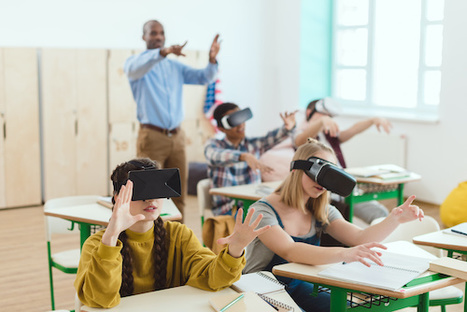
Augmented reality (AR) continues to gain importance in our everyday lives. In the classroom, AR technology can enhance learning by providing students with interactive and immersive experiences, improving their understanding of complex concepts and enabling them to apply their knowledge in real-world scenarios. The use of AR can make learning more accessible while increasing the engagement of all students. Recently, EdSurge spoke to field experts about the benefits of integrating AR in the classroom.
Via EDTECH@UTRGV
“Are we going to talk about classroom management?” Several of my graduate students asked this question last week as we prepared to enter the final month of our methods course. It was clear that as they approached the end of their work in the Masters in the Arts of Teaching program that they felt unprepared […]
Via Yashy Tohsaku, LGA
Generative A.I. has created some very real challenges with academic integrity. Schools have been scrambling to create systems and policies that address the potential for cheating. In the past, I've written about how we might
Via Yashy Tohsaku, juandoming
Carlos Velázquez Callado, doctor en Educación y uno de los mayores referentes educativos a nivel internacional, nos dará las claves sobre cómo implantar con éxito en el aula este tipo de aprendizaje, un enfoque pedagógico cada vez más demandado.
Via LGA
Apparently, studies trace the history of educational/informational communities back to constructivism. This means that true learning stems from the collaboration of learners and their interaction with their surroundings. In addition, the idea is an extension of social learning.
Essentially, these communities have specific goals; academic, professional, social, etc. Accordingly, members come together in a collaborative environment to achieve these goals. In a way, these communities are rather similar to online cohorts but with better engagement tools.
Via Edumorfosis, LGA
En la asombrosa #TNWConference, tuve la oportunidad de sumergirme en el futuro de la tecnología, los datos, las finanzas, el impacto y la diversidad e inclusión. Este evento me dejó completamente motivado, ya que pude apreciar cómo todos estos elementos también están moldeando el porvenir del aprendizaje. En este artículo, compartiré mis principales conclusiones y reflexiones sobre el impacto de la inteligencia artificial (IA) en la educación y cómo podemos aprovecharla de manera responsable y ética.
Via Edumorfosis, juandoming
Most executives acknowledge that learning is crucial to the performance of their business. But at a recent research workshop that my team and I ran with executives from over 40 companies, it became clear that organizations’ traditional learning models are facing pressure from the emergence of new work models. The participants identified these three learning challenges as the most acute:
Via Edumorfosis, LGA
|
The digital changes we are living through are thrilling, jarring, full of opportunity and, at the same time, terrifying. Over the course of my career, I have witnessed at least four digital revolutions: the advent and proliferation of personal computers; the expansion of the internet and search; the rise and influence of social media; and the growing ubiquity of mobile computing and connectivity.
Via Edumorfosis, LGA
This study aims to develop an AI education policy for higher education by examining the perceptions and implications of text generative AI technologies. Data was collected from 457 students and 180 teachers and staff across various disciplines in Hong Kong universities, using both quantitative and qualitative research methods. Based on the findings, the study proposes an AI Ecological Education Policy Framework to address the multifaceted implications of AI integration in university teaching and learning. This framework is organized into three dimensions: Pedagogical, Governance, and Operational. The Pedagogical dimension concentrates on using AI to improve teaching and learning outcomes, while the Governance dimension tackles issues related to privacy, security, and accountability. The Operational dimension addresses matters concerning infrastructure and training. The framework fosters a nuanced understanding of the implications of AI integration in academic settings, ensuring that stakeholders are aware of their responsibilities and can take appropriate actions accordingly.
Via Vladimir Kukharenko, juandoming
- The current cohort of high school students, part of Generation Z, values postsecondary education but is increasingly interested in alternatives to four-year colleges, according to a new report from ECMC Group, a nonprofit focused on student success, and Vice Media.
- In 2023, 65% of surveyed students said they would need education beyond high school, compared to 59% pre-pandemic, the report said. But 59% said they could be successful if they don’t get a four-year degree
- Almost half, 48%, of high schoolers said their postsecondary education would ideally take three years or less, and just over a third, 35%, said it should take two years or less.
Via Edumorfosis, juandoming
Generative AI has been making waves in various industries, and higher education is no exception. With the advent of powerful language models like ChatGPT, the landscape of academic writing, learning, and teaching is undergoing a significant transformation. Let’s see what the potential impact of Generative AI on the university ecosystem is and explore how it might reshape the future of education.
Via Edumorfosis, juandoming
There are many available options for free or low-cost polling to help you engage your students during class. While the free versions of these apps usually have limited features, the instructor also has a choice to purchase a license to add more features. Individual licenses for many of these apps are very reasonably priced. When we are trying to limit costs for our students, purchasing one instructor license is much better than asking many individual students to purchase licenses. Instructor licenses also make it possible to share question sets between instructors teaching sections of the same course.
Via EDTECH@UTRGV
An online tool alleviates cumbersome grading processes lets instructors work directly with students who need help
Via EDTECH@UTRGV
Revista Iberoamericana de Educación a Distancia”>
Via LGA
Advancements in technologies can also present substantial opportunities for innovation in the sector, investors say
Via Vladimir Kukharenko, juandoming
A Social Learning LMS is a smart solution to passive workplace training. It incorporates the interaction model of social media platforms with online learning to develop effective training programs. This way, such platforms differ from your typical learning management systems. The key idea here is to provide social context for better learning and engagement.
Via Edumorfosis, LGA
As we head back to our classrooms and prepare for the upcoming year, there are many things we need to consider. A few of my reflections are: What worked well last year that we should continue and build upon? What did not work well that perhaps we can set new goals for this year? And what are some new ways to engage our students in learning that will best prepare them for the school year and the future as well?
Via Edumorfosis, LGA
A decade after its widespread adoption, it’s safe to say that U.S. schools utterly failed to acclimate our students to social media and to anticipate the profound damage it could do. The result of widespread social media use among students (said the U.S. surgeon general in a recent advisory) is increased anxiety, stress, and depression. Parents are lost, too. As a school technology specialist working with a population of middle- and high-schoolers, I see firsthand parents’ desperation when I host standing-room-only sessions about social media and mental health.
With the swift emergence of A.I., educators have an opportunity to do better.
This summer, K–12 schools must get to work drafting academic policies governing the use of A.I. and facilitating professional development for teachers about the new technology. Educators need to address this trend head-on with students while simultaneously redesigning instruction and assessment in an age of A.I. We cannot start this work quickly enough.
Via John Evans
The world of education is rapidly changing, and the introduction of new future internet technologies like augmented reality, virtual reality, and blockchain are revolutionizing how we learn.
Education in the metaverse has become a hot topic as these advancements have enabled us to expand our learning opportunities beyond traditional classrooms and training rooms. We can now explore different topics through immersive experiences that go far beyond just reading books or listening to lectures.
Via Edumorfosis, LGA
|