Your new post is loading...
The convergence of research, theory, and actual classroom practice emphasizes that relevance is not merely a pedagogical buzzword; it’s a foundational principle that breathes life into learning. As teachers, we are bestowed with the incredible opportunity to shape minds and ignite passions. By intentionally connecting learning to the lives, cultures, and interests of our students, we create a classroom environment that resonates, inspires, and endures.
Via EDTECH@UTRGV, juandoming
"The premise of any self-paced eLearning course is that learners will learn at their pace. It provides learners with the options of what, where, when, and how to learn. They are in total control of their learning. But the risk here is, the learner can, at any time, lose interest in the course and discontinue if it fails to engage him or hold his interest. If this happens, the purpose of the course is lost."
Via EDTECH@UTRGV
Contacto | Tabla de Instituciones | Política de Cookies | Política de calidad | Aviso Legal y Política de Privacidad...
Via LGA
"This is actually a well-documented idea called the ELIZA Effect, where people attribute human-like intelligence and emotions to computer programs, even when they know the responses are generated by simple algorithms. This phenomenon is named after ELIZA, an early A.I. program developed in the 1960s by Joseph Weizenbaum at MIT. Despite the program’s limited capabilities, users often formed emotional connections with ELIZA and attributed understanding and empathy to the program. The ELIZA Effect highlights our tendency to anthropomorphize technology and perceive more intelligence in A.I. systems than may be present. In the case of ELIZA, people knew it was a machine.
What’s fascinating is just how easily humans can be duped by machines. Part of this is due to innate pattern recognition. We have a natural cognitive bias toward finding patterns and attributing causality even when the data is random. When an A.I. produces responses that resemble human communication, our brains recognize the patterns and can be convinced that there’s a human behind the interaction. It just feels more human. Moreover, humans tend to have a default toward trust.
All of this points toward the need for students to understand the difference between an A.I.’s information processing and human cognition."
Via John Evans
In the ever-evolving landscape of online distance education, educators face a crucial challenge: captivating students and igniting their passion for learning within virtual environments. The key to unlocking this new era of educational success lies in the integration of active learning strategies. By immersing students in dynamic activities, stimulating discussions, and collaborative endeavors, educators can transcend the limitations of the digital realm and revolutionize online teaching.
Via EDTECH@UTRGV
There are those who believe that using Chat-GPT is considered cheating as it facilitates academic dishonesty by providing complete articles, solving math problems, and answering questions based on a simple sentence structure. Unlike traditional citation practices, Chat-GPT goes beyond copying existing content and generates original content, undermining academic integrity.
Furthermore, Chat-GPT is used for cheating not only in higher education but also in classrooms from kindergarten to twelfth grade, as many teachers have reported catching students cheating using Chat-GPT.
On the other hand, proponents of Chat-GPT argue that it is similar to a calculator, serving as a tool to assist with complex calculations but not replacing genuine understanding. They also claim that using Chat-GPT can enhance critical thinking by saving students’ time in analyzing complex concepts while the tool handles simple tasks.
Via EDTECH@UTRGV
In this introduction to personalized learning, we explore the benefits and dispel the most common myths and misconceptions.
Via LGA

|
Rescooped by
michel verstrepen
from Technology in Education
August 7, 2023 3:50 PM
|
These are my reflections and takeaways from a captivating 40-minute fireside chat with Stephen Wolfram, shared on August 4, 2023 during the AI x Education Conference streamed via Zoom. Stephen is t…
Via Felix Jacomino
Redesigning assignments can reduce the potential for cheating with AI. Students are more likely to cheat when there is a stronger focus on scores (grades) than learning (Anderman, 2015), there is increased stress, pressure, and anxiety (Piercey, 2020), there is a lack of focus on academic integrity, trust, and relationship building (Lederman, 2020), the material is not perceived to be relevant or valuable to students (Simmons, 2018), and instruction is perceived to be poor (Piercey, 2020).
Via EDTECH@UTRGV
"The examination of how students engage with digital tools comes amid a growing body of research into the impact of pandemic virtual learning ..."
Via Leona Ungerer, juandoming
How has technology-facilitated distance education for teacher professional development changed in the past decade, especially post COVID-19?
Via Nik Peachey
The rise of artificial intelligence (AI) has raised concerns about its impact on white-collar jobs and knowledge workers. Many professionals, including brokers, traders, graphic designers, and software engineers, have been questioning the future of their careers. Traditionally, creatives believed that AI couldn’t replicate the passion and humanity in art. However, recent developments suggest otherwise.
Via EDTECH@UTRGV
|
It is no longer a secret that the traditional methods of training are quickly shifting toward online training. So why not ensure the best of online training with AI? Read on to know the significant role of AI in online training.
Via EDTECH@UTRGV
Teaching students innovative thinking through the use of business case studies and ‘learning by doing’, explained by William Cheung and Edward Yiu
Via Vladimir Kukharenko, LGA
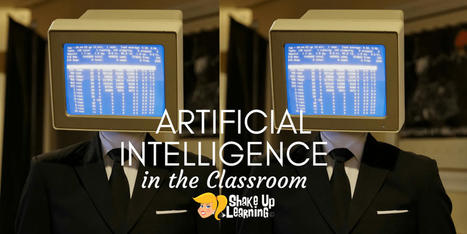
This post is loaded with some simple ways to integrate AI in the classroom. It's easier than you think, and it doesn't require expensive equipment or software. AI or Artifical Intelligence is ready for its closeup! Are you and your students ready to become "AI experimenters."
Via Yashy Tohsaku, LGA
The Future of VET study examined how vocational education and training (VET) has changed since the mid-1990s, and how this may influence future opportunities and challenges.
This synthesis report summarises 3 years of research involving researchers and VET experts across Europe, with discussion of findings on the content and delivery of VET, assessment practices, and the link between initial and continuing VET. In addition to connecting and synthesising the series of research papers and case studies already published, it features an analysis by country. The study provides important insights into how VET in Europe has developed over the past three decades, illustrating observed trends and developments, as well as tendencies of convergence between countries and systems.
The research has also shown that the development of VET does not necessarily form an unbroken chain leading in one direction but can be interrupted by changes of course and even reversals in policy and practice. The future of VET is still unwritten. This report aims to provide a stimulus for developing future research in this area.
Via Canadian Vocational Association / Association canadienne de la formation professionnelle, juandoming
Por Por José Sánchez-Santamaría* y Eva Olmedo Moreno** * Editor de RELIEVE-UCLM ** Directora de RELIEVE-UGR “ Hal, a pesar de tu gran in...
Via LGA
In this article, we delve into the transformative power of AI in education, uncovering the latest trends and insights that are reshaping the future of learning. From ChatGPT to quiz makers, AI has catapulted education into an era of many possibilities.
Via EDTECH@UTRGV
Exclusive: Prof Stuart Russell says technology could result in ‘fewer teachers being employed – possibly even none’
Via LGA
The intersection and collaboration between technology and art is challenging--these different skillsets are often taught in different parts of a campus
Via EDTECH@UTRGV
In a world where artificial intelligence is transforming work, schools face a big decision: stick to the familiar path or evolve to really prepare students for the future?
Traditional testing might seem easy and comfortable. You can directly see what students are doing live, which provides some comfort. But while exams have their place to test knowledge recall, relying too much on them risks wasting young people’s huge potential.
Via Edumorfosis, LGA
"If educators can reclaim their time by using generative AI to do the mundane tasks, they can get back to doing some of the fun stuff that made the
Via Yashy Tohsaku, juandoming
|
|
Rescooped by
michel verstrepen
from tipsmoodle
August 3, 2023 12:13 PM
|
|