
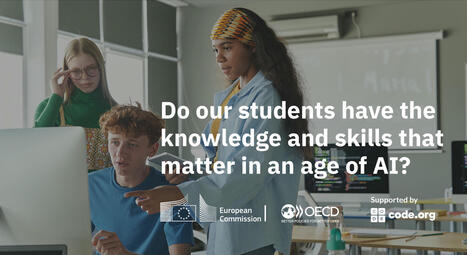
Empower learners for the age of AI with the AILit Framework—a joint EC & OECD initiative, supported by Code.org and international experts.
Via Dr. Tom D'Amico (@TDOttawa)


|
Rescooped by
michel verstrepen
from iGeneration - Humane Use of Technology in an AI world (Pedagogy & Digital Innovation)
onto gpmt June 21, 7:42 AM
|
 Scoop.it!
Empower learners for the age of AI with the AILit Framework—a joint EC & OECD initiative, supported by Code.org and international experts.
 Your new post is loading...
 Your new post is loading...
Your new post is loading...
Scoop.it!

eLearning platforms with AI features completely rebuilt their core systems. Here's what they actually engineered behind the scenes. Via EDTECH@UTRGV 
EDTECH@UTRGV's curator insight,
July 13, 3:32 PM
"eLearning platforms are adding AI in specific places where it solves a problem. But they're also running into real constraints. And they're discovering that rebuilding a platform around AI costs significantly more than bolting AI onto an existing system."
Scoop.it!

Teachers shouldn't fear that AI and advancements in technology will diminish their expertise--instead, they amplify it. Via EDTECH@UTRGV
EDTECH@UTRGV's curator insight,
Today, 10:22 AM
"When we combine the timeless art of great teaching with the new science of artificial intelligence, we create classrooms where every student can truly thrive."
Scoop.it!

Some collective resources (& a free event!) to help make sense of AI in Higher Ed Via Ana Cristina Pratas
Scoop.it!
From
x

🟡 Lorenzo García Aretio: a profound legacy in distance education - an interview via @UNED.
✅ A pivotal figure who both witnessed and shaped the evolution of Distance Education, from its origins in postal correspondence to the current era of AI. ▶https://t.co/rRjkTUigp4 Via LGA
Scoop.it!
"As online education expands, educators face growing challenges in maintaining emotional connections with students while sustaining their own well-being. Emotional intelligence has long been recognized as a cornerstone of effective teaching, yet in digital spaces, cues are harder to read, and connection requires new strategies. This article explores how AI, when applied ethically, can amplify, not replace, the human touch in online classrooms" Via EDTECH@UTRGV
EDTECH@UTRGV's curator insight,
July 10, 11:33 AM
"The use of sentiment analysis tools is a proactive way to help spot the emotional undercurrents by analyzing tone, language, and emotional indicators in students’ discussion posts, their emails, and their assignments."
Scoop.it!

From
www
"Typically, a company identifies a pain point (document processing, customer churn prediction, etc.) and spins up a proof of concept with a small team. It works in the lab, and leadership gets excited. Then it tries to operationalize it, and everything falls apart." Via EDTECH@UTRGV
EDTECH@UTRGV's curator insight,
July 10, 11:38 AM
"The companies that fail at AI are failing because they treat AI as a product to install rather than a capability to develop."
Scoop.it!

From
www
Recraft is a top-ranked text-to-image model and design platform for photorealism, vector generation, custom styles, mockups, and more Via Ana Cristina Pratas
Scoop.it!

Most social learning programs start and end with discussion boards. But real social learning looks nothing like a forum thread. Via EDTECH@UTRGV
EDTECH@UTRGV's curator insight,
July 8, 11:22 AM
"Forums mimic social learning in form but miss it in function. They're passive. They're asynchronous in a way that kills momentum. And they place the burden of engagement entirely on the learner, with no structure to guide the conversation toward a useful outcome."
Scoop.it!

From
www
"Today, we are releasing a fully fleshed out version, 30 skills aligned with each of these roles to help model using AI to support our uniquely human skills,” said Richard Culatta, CEO of the organization." Via EDTECH@UTRGV
EDTECH@UTRGV's curator insight,
July 7, 12:49 PM
“Humans have always used tools to accomplish human tasks. AI is no different, but when we teach AI as a way to support us being better at being human, it is far more relevant and far more meaningful than when we just talk about what AI is.”
Scoop.it!

Higher education was designed for a world in which access to knowledge, expertise, feedback, mentorship, and authentic learning experiences were inherently scarce. By making many forms of intelligence increasingly abundant, AI is inherently redefining the existing paradigm. Via EDTECH@UTRGV
EDTECH@UTRGV's curator insight,
July 7, 12:51 PM
"AI shifts education from information access to capability development: As explanation, feedback, guidance, and simulation become more abundant, higher education must place greater emphasis on judgment, application, competency, and responsible use of knowledge."
Scoop.it!

Learn practical strategies for managing technology change in higher education, reducing change fatigue, and partnering with IT to support teaching success. Via Ana Cristina Pratas
Scoop.it!

In the age of AI, governance is about ensuring that institutions remain capable of directing what intelligent systems are helping them become Via EDTECH@UTRGV
EDTECH@UTRGV's curator insight,
July 6, 1:20 PM
"Higher education continues to treat AI as just another technology to be deployed, managed, and governed. That assumption is increasingly inadequate."
Scoop.it!

From
futurism
"Massive numbers of students are going to emerge from university with degrees, and into the workforce, who are essentially illiterate."
By Joe Wilkins "There’s a silent epidemic building in colleges and universities throughout the country — and as you might imagine, it has everything to do with AI. As one New York financier told Financial Times journalist Gillian Tett, new hires who were seen as “AI natives” are turning out to have alarmingly shallow ideas. So much so, the anonymous finance worker admitted, that his firm now actively avoids seeking out AI-literate STEM graduates, and opts to comb through humanities students instead. “We want critical thinking, not just AI,” the financier told the FT. Over the past few years, a veritable tidal wave of headlines, studies, and think pieces have flooded the internet with horror stories about the decline in literacy rates, social skills, and critical thinking abilities of the country’s college students. The state of higher education is so bad that many of today’s higher ed students are not only offloading their coursework to AI chatbots like ChatGPT — a shortcut, educators say, that’s even impacting their ability to participate in face-to-face discussions. And though universities have many purposes beyond simply preparing students for the workplace, that is one function that they do undoubtedly serve. The results could be rocky: as Cal State Chico ethics professor Troy Jollimore told the New Yorker in 2025, “massive numbers of students are going to emerge from university with degrees, and into the workforce, who are essentially illiterate.” While plenty of thought leaders have waxed lyrical about the importance of “AI literacy” — an understanding of how to effectively use AI tools, basically — the businesses these future students are heading toward are still heavily reliant on literacy literacy. For all its revolutionary potential, there’s ample evidence that AI has yet to meaningfully impact productivity in the US, meaning that students who go all-in on AI at the expense of other skills will likely find themselves ill-prepared for the actual demands of life after college."
For original post, please visit: https://futurism.com/future-society/college-critical-thinking-ai Via Roxana Marachi, PhD |
Scoop.it!
From
www
EDTECH@UTRGV's curator insight,
July 13, 3:35 PM
“Our big urban and suburban school districts, they have technology integration coaches who have been diving into the AI work for the past three years...Rural school districts often don’t.”
Scoop.it!

"I have been a high school teacher for almost three decades, spending almost all that time teaching seniors about American civics. My teaching tenure has overlapped with the rise of the very trends now engulfing our educational system: I have watched my students embrace smartphones, social media, online learning and now artificial intelligence.
But recently I have noticed something I never expected.
Many of my more thoughtful and honest students are becoming critics of the very technologies that shaped them." Via EDTECH@UTRGV
EDTECH@UTRGV's curator insight,
Today, 10:25 AM
"The generation that grew up on iPhones, spending much of every waking hour online, now seems to be awakening to the perils of a digital world neither they nor their parents fully understood."
Scoop.it!
From
sup
Guide pédagogique interactif et autonome pour comprendre et exploiter DigComp 3.0.
Scoop.it!

From
www
Read books with AI guidance, vocabulary support, and interactive quizzes to improve learning retention. Via Nik Peachey 
Nik Peachey's curator insight,
July 10, 6:39 AM
ReadAlly looks like an interesting AI reading assistant to make reading more interactive https://www.readally.io/ Has a useable free subscription.
Scoop.it!

Aligned to existing ISTE standards and principles, the expanded Profile of an AI-Ready Graduate defines six roles and associated skills and practices students should have mastered when they graduate. Via EDTECH@UTRGV
EDTECH@UTRGV's curator insight,
July 10, 11:36 AM
“This profile is not about getting your foundational knowledge about AI..It’s not about all of the deeply critical thinking that you need to learn to do with AI. It’s about the skills that you’re going to be expected to apply in the workforce when you graduate.”
Scoop.it!

From
capturable
Plan, generate, and export AI videos from a single chat. Describe your idea and get a structured script, scenes, voiceover plan, and cost estimate instantly. Via Ana Cristina Pratas
Scoop.it!
From
www
Streaming solved the problem of access. Now, we must solve the problem of engagement. Via EDTECH@UTRGV
EDTECH@UTRGV's curator insight,
July 8, 11:25 AM
"Vinyl records and AI are actually similar technologies. Both seem to provoke a human response to technology: the easier something becomes via technology, the more we begin questioning what was valuable about the underlying use in the first place."
Scoop.it!

From
www
"Rote memorization is a better way to learn things like math facts and vocabulary words than whatever the latest trendy method is at the moment." Via EDTECH@UTRGV
EDTECH@UTRGV's curator insight,
July 8, 11:29 AM
“Every issue that exists in public schools is a microcosm of the issues that exist in society in general, and until society fixes itself, the things that are broken about the system won’t get better.”
Scoop.it!

AI must evolve beyond a simple information dispenser; it must design structured environments that respect human perceptual organization, guiding the learner seamlessly toward a comprehensive and lasting understanding of the whole. Via EDTECH@UTRGV
EDTECH@UTRGV's curator insight,
July 7, 12:55 PM
"[I]f Vygotsky’s principles guide us on when to introduce challenge and how to scaffold the learner, Gestalt theory ensures that the final destination of that challenge is a sudden, meaningful cognitive reorganization."
Scoop.it!
Last modified: August 25, 2025 Under the Duke Community Standard, unauthorized use of generative AI is treated as cheating. This means you have the discretion to define how, if, an Via Ana Cristina Pratas
Scoop.it!

Even when students use AI entirely within institutional rules, they still most likely bypass the struggle through which learning often occurs Via EDTECH@UTRGV
EDTECH@UTRGV's curator insight,
July 6, 1:21 PM
"Artificial intelligence has broken a premise that universities have relied upon for centuries: the assumption that strong performance usually reflects genuine competence." |






