Your new post is loading...

|
Rescooped by
michel verstrepen
from Digital Delights
July 6, 6:34 PM
|
Last modified: August 25, 2025 Under the Duke Community Standard, unauthorized use of generative AI is treated as cheating. This means you have the discretion to define how, if, an
Via Ana Cristina Pratas
Even when students use AI entirely within institutional rules, they still most likely bypass the struggle through which learning often occurs
Via EDTECH@UTRGV
Anki - a program which makes remembering things easy.
Via Nik Peachey
"Dr. Jared Cooney Horvath’s recent testimony before the U.S. Senate Committee on Commerce, Science, and Transportation warning about the rapid expansion of EdTech and the explosion of student screen time should spark an important national conversation about learning, cognition, and the future of education."
Via EDTECH@UTRGV
A bilingual educator examines how alignment with AI emerges not from better prompting but from deliberate boundary-setting and sustained correction over time—building on the practitioner lens first developed in Holding the Line.
Via EDTECH@UTRGV
Docubix is a RAG platform to upload documents, create knowledge bases, and ship AI chat assistants with cited answers. Free plan available.
Via Nik Peachey
Vinton Cerf, que contribuyó a inventar los protocolos de red que sustentan la web moderna, advierte de algunos principios que podrían determinar si la IA prosperará como lo hizo internet.
Via LGA
Por Carlos Brao Reyes y Mercedes Leticia Sánchez Ambriz La educación superior enfrenta un problema que no se resuelve con más información. ...
Via LGA
Some tech leaders have a vision for a world where you spend a lot less time looking at your phone. Is it the solution to screen time, or just a new dystopia?
Via EDTECH@UTRGV
Blog personal de Garcia Aretio donde reflexiona sobre educación a distancia y virtual, educación universitaria, publicaciones y distinciones
Via LGA
Some students with disabilities rely on assistive technology to learn, and they worry it could be swept up in the movement to get screens out of schools.
Via EDTECH@UTRGV
|
|
Scooped by
michel verstrepen
June 29, 2:45 PM
|
Application pédagogique interactive et autonome pour comprendre le fonctionnement des agents IA.
|
In the age of AI, governance is about ensuring that institutions remain capable of directing what intelligent systems are helping them become
Via EDTECH@UTRGV
"Massive numbers of students are going to emerge from university with degrees, and into the workforce, who are essentially illiterate." "There’s a silent epidemic building in colleges and universities throughout the country — and as you might imagine, it has everything to do with AI.
As one New York financier told Financial Times journalist Gillian Tett, new hires who were seen as “AI natives” are turning out to have alarmingly shallow ideas. So much so, the anonymous finance worker admitted, that his firm now actively avoids seeking out AI-literate STEM graduates, and opts to comb through humanities students instead.
“We want critical thinking, not just AI,” the financier told the FT.
Over the past few years, a veritable tidal wave of headlines, studies, and think pieces have flooded the internet with horror stories about the decline in literacy rates, social skills, and critical thinking abilities of the country’s college students.
While there’s a kernel of truth that these factors had already been slowly dwindling prior to the widespread adoption of AI, the tech only seems to be accelerating the drop-off in real-life abilities, particularly among young people for whom it can serve as a cognitive crutch.
The state of higher education is so bad that many of today’s higher ed students are not only offloading their coursework to AI chatbots like ChatGPT — a shortcut, educators say, that’s even impacting their ability to participate in face-to-face discussions.
And though universities have many purposes beyond simply preparing students for the workplace, that is one function that they do undoubtedly serve. The results could be rocky: as Cal State Chico ethics professor Troy Jollimore told the New Yorker in 2025, “massive numbers of students are going to emerge from university with degrees, and into the workforce, who are essentially illiterate.”
While plenty of thought leaders have waxed lyrical about the importance of “AI literacy” — an understanding of how to effectively use AI tools, basically — the businesses these future students are heading toward are still heavily reliant on literacy literacy. For all its revolutionary potential, there’s ample evidence that AI has yet to meaningfully impact productivity in the US, meaning that students who go all-in on AI at the expense of other skills will likely find themselves ill-prepared for the actual demands of life after college." For original post, please visit: https://futurism.com/future-society/college-critical-thinking-ai
Via Roxana Marachi, PhD
Every day, another op-ed lands in my feed: AI is destroying education.
Via EDTECH@UTRGV
"Since at least the 1960s, the connection between education and economic outcomes has been the subject of substantial research—both theoretical and empirical. Economists have long demonstrated that higher levels of education are associated with increased productivity, higher earnings and stronger economic growth."
Via EDTECH@UTRGV
Free AI Course Creator which helps you build your online course in minutes. Automate assessment, course authoring and convert files to eLearning. Click to try Coursebox AI, the best AI course generator.
Via Nik Peachey
Drawing on experience across higher education in the UK and Malaysia, two academics argue that the real AI divide in universities is not about access to tools but about institutional readiness — and why it is an urgent equity issue policymakers can no longer afford to ignore.
Via EDTECH@UTRGV
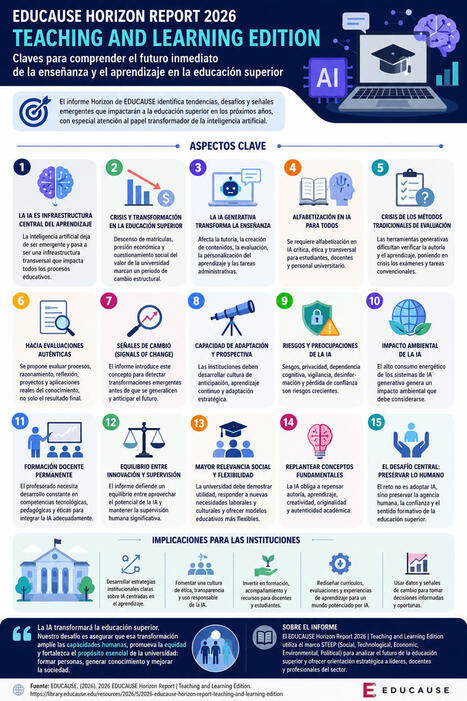
The pace of development and proliferation of artificial intelligence tools — generative, agentic, physical — can be hard to follow, but IT leaders must do their best to stay apprised of potential innovations and risks.
Via EDTECH@UTRGV
Inteligencia artificial, educación, talento y aprendizaje continuo protagonizan la sexta mesa del Festival Forbes España 30 Under 30.
Via LGA
It shows you which model answered and why, redacts your personal data on-device before anything leaves, checks the hard answers across multiple models, and estimates the CO₂, water and energy footprint of every request. Built in Vienna 🇦🇹. Your AI, your rhythm.
Via Nik Peachey
Why story-driven training sticks — and how to build it fast in SHIFT Meteora AI Studio or deliver it through the LMS you already use.
Via EDTECH@UTRGV
|