



IT leaders from Minnesota and Wisconsin explain how telepresence is changing teaching and learning at their institutions.

 Your new post is loading...
 Scoop.it! IT leaders from Minnesota and Wisconsin explain how telepresence is changing teaching and learning at their institutions. 
No comment yet.
Sign up to comment
Scoop.it!
Here's a technology that any student can use to 'blend' the traditional lecture with online productivity tools.
Take notes and they are wirelessly uploaded to Evernote, along with a sync track of the lecture you're listening to. Very slick.
~ I recommend this! Dennis O'Connor Via juandoming, Ramon Aragon, Adriana Favieri, Rui Guimarães Lima

Rhys Williams's curator insight,
March 9, 2015 12:09 PM
This article was pretty cool as it deals with wifi and smartpens.
Scoop.it!

WordPress LMS (WPLMS) is a robust SCORM compliant learning management system built on the WordPress platform. Up and Running in 5 Minutes! Via Heiko Idensen, Mark Smithers
Scoop.it!

A Georgia-based company today announced at Educause 2012 the availability of an enterprise extensible LMS built fully on Drupal technology. The company expects to take Moodle, Instructure and Blackboard head on by leveraging one of the world’s largest open source communities to deploy an enterprise open source learning management system.
Scoop.it!

As universities and institutes like yours scramble to meet the complex, and often conflicting, demands of learners, investors, accreditation agencies, and governments alike, technologies and delivery models from another era cannot possibly serve...
Scoop.it!

By Ryan Bretag
"When the focus of technology is on the teacher and teaching not learners and learning, it is easy to see EdTech as a failure: a waste of time, money, and resources. For many of us, we’ve argued for a move away from teacher-centered only to find a movement and investment in EdTech that is the antithesis of such a movement. We’ve simply added teacher-centered technology to teacher-centered classrooms.
"Is it any wonder we find ourselves unable to fulfill the promise we’ve preached about EdTech?
"The expectation is that the teachers have the latest and greatest technology for teaching. Yet, there is little concern about what the students have in their hands for learning. This is one of the fundamental disconnects we experience when it comes to educational technology, when it comes to 21st Century teaching and learning, when it comes to student engagement and empowerment." Via Jim Lerman
Scoop.it!
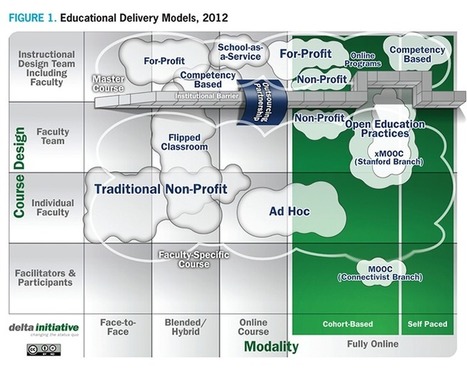
Although there has been a long history of distance education, the creation of online education occurred just over a decade and a half ago—a relatively short time in academic terms. Early course delivery via the web had started by 1994, soon followed by a more structured approach using the new category of course management systems.
Scoop.it!

Education in our digital age has the potential to offer something we, as students, have been hard pressed to achieve in the past: a real voice and a sense of ownership over our educational process.
This is the first digital platform I’ve encountered to place its primary emphasis on the student’s workflow, and the focus group reached out to varied types and demographics of learners. Their goal was first to understand, and then to address, the specific individual needs of students.
Scoop.it!
Learn more at http://www.ericsson.com/networkedsociety
Can ICT redefine the way we learn in the Networked Society?
Technology has enabled us to interact, innovate and share in whole new ways. This dynamic shift in mindset is creating profound change throughout our society. The Future of Learning looks at one part of that change, the potential to redefine how we learn and educate. Watch as we talk with world renowned experts and educators about its potential to shift away from traditional methods of learning based on memorization and repetition to more holistic approaches that focus on individual students' needs and self expression.

Nancy L Zingrone's curator insight,
January 26, 2013 8:04 PM
There are a lot of videos on the internet that lead us into a state of treasured anticipation and then fall flat because the voices are not as knowledgable as they might be, or the ideas are not really on the forward edge of whatever it is that interests us. I had one of those flat moments recently with the PBS piece on MOOCs, terms mis-used, ideas mis-understood, not so useful.
But The Networked Society is one of those sublime moments when that treasured anticipation is rewarded with more and more. Watch this! It's a bit of peak into a wonderful future.
Scoop.it!

Digital Educations Strategies (DES) is a centralized unit within The G. Raymond Chang School of Continuing Education at Ryerson University in Toronto. Annual enrollments at The Chang School exceed 70,000 students, with over 20,000 students in distance courses alone. The Chang School delivers both professional and post-graduate certificates, undergraduate courses, as well as courses that prepare students for accreditations. The Chang School currently has about 400 courses available in distance format, including 14 fully online certificate programs and 22 blended certificate programs that combine online and in-class learning.
Scoop.it!

A faculty member used to teaching in a bricks-and-mortar classroom explains why she's embraced a virtual one.
Scoop.it!

As "nontraditional" students gradually become the majority, professors must adjust their thinking and teaching methods.
Scoop.it!

A handful of successful startups have already come out of these edtech incubators, but as the number and variety of these incubators grows worldwide, the ranks of edtech superstars likely will, too, which could have major ramifications for the...
|
Scoop.it!
Robin Good: Ve.rbatim.com is a free web-based co-browsing tool which allows you to co-navigate with one or more people any web page, while being able to see the mouse cursor of your partner when desired.
The web app is very easy to use. You just click on "Start a sesson" on this page http://ve.rbatim.com/ and the new page that opens up has a URL that you can share with anyone you want to cobrowse with.
On this page you have an additional address bar in which you can input any url you want to cobrowse. An integrated text chat area is made visible by clicking on the large down arrow visibile on the top right side of your screen.
Free to use.
Check this video: http://youtu.be/XgeTWHSjhTQ
Google Chrome Extension: https://chrome.google.com/webstore/detail/mjiigdnknfcmjgaapnimjbmopdfbkech
Try it out now: http://ve.rbatim.com/ ;
Via Robin Good
Scoop.it!
|

|
Scooped by
Kim Flintoff
November 8, 2012 7:36 PM
|
Scoop.it!

Built on top of Drupal Open Source technology Adrenna Academic brings together the most powerful capabilities of today’s learning management systems at half the cost.
|
|
Scooped by
Kim Flintoff
November 7, 2012 8:24 PM
|
Scoop.it!

Echo360 will help us build an active learning platform that revolutionizes how people teach and learn with technology in and out of the classroom.
|
|
Scooped by
Kim Flintoff
November 4, 2012 9:34 PM
|
Scoop.it!

The mission of the International Journal of ePortfolio (IJeP) is to encourage the study of practices and pedagogies associated with ePortfolio in educational settings. The journal’s focus includes the explanation, interpretation, application, and dissemination of researchers’, practitioners’, and developers’ experiences relevant to ePortfolio. It also serves to provide a multi-faceted, single source of information for those engaging in projects and practices associated with ePortfolio. A refereed (blind) peer-reviewed journal, IJeP embraces inquiry into ePortfolio in educational settings holistically; therefore, manuscripts considering the following areas of investigation are welcomed:
instruction and principles of learning that utilize and inform practical, effective ePortfolio methodologies;
evaluation and assessment methodologies and practices supported by ePortfolio;
case studies and best practices regarding applications of ePortfolio for learning, assessment, and professional development supported by scholarship of teaching and learning practices and research methodologies;
theoretically rich accounts of the principles grounding ePortfolio work and its relationship to larger social and cultural phenomena; and
innovative development and applications of technologies that enable new ePortfolio practices.

|
Rescooped by
Peter Mellow
from Higher Education Teaching and Learning
November 4, 2012 7:31 PM
|
Scoop.it!

Does eLearning kill creativity? Brind on the eLearning revolution! What do you believe about open-source learning? What eLearning developers can learn...
|
|
Scooped by
Kim Flintoff
November 2, 2012 8:12 PM
|
Scoop.it!

At Duke University, business school students use a state-of-the-art “virtual lecture hall” to have conversations with CEOs and fellow students from around the world.
At Harvard, physics students learn from each other—as well as their professor—by discussing key “concept questions” in small groups periodically during class.
And at dozens of institutions nationwide, students continue their discussion of lessons long after the class period is over, through “social collaboration” platforms that move the conversation online.
Welcome to higher education circa 2012, where on many campuses, the stale, passive lecture model is being replaced by a more dynamic way of teaching and learning—one in which students and instructors collaborate in a give-and-take fashion to “make meaning together,” says Tony O’Driscoll, a professor of business administration at Duke.
KF: Connectivist pedagogy in other terms?
|
|
Scooped by
Kim Flintoff
November 1, 2012 5:10 PM
|
Scoop.it!

|
|
Scooped by
Kim Flintoff
October 31, 2012 10:01 PM
|
Scoop.it!

Will They be the Real “Game Changers” in Online Learning and Post-Secondary Education?
What a month October 2012 has been in the world of corporate educators!
In October, Pearson, the world’s leading learning company, announced that it would acquire EmbanetCompass, a company which partners with post-secondary institutions to provide fully online learning solutions for more than 100 university programs, for a whopping $650 million – in cash. Its stated reason: great opportunities for growth and impact in online education and educational services.
|
|
Scooped by
Peter Mellow
October 29, 2012 1:41 AM
|
Scoop.it!
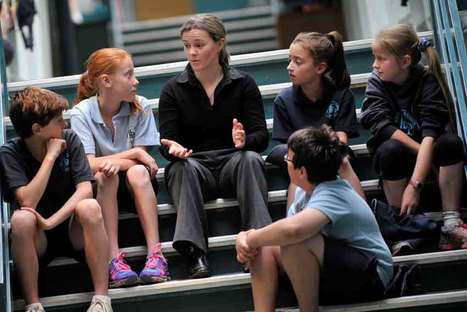
The majority of Australian children aged nine and up already fail to meet the nation's guidelines, with just 40 per cent of those aged nine to 13 achieving the recommended 60 minutes of vigorous physical activity each day. In what medical experts describe as a modern epidemic, nearly one in four Australian adolescents are overweight or obese.
|
|
Scooped by
Kim Flintoff
October 24, 2012 2:17 AM
|
Scoop.it!

WGU Texas and three community colleges — Sinclair Community College in Ohio, Broward College in Florida and Texas' own Austin Community College — have received a shared $12 million dollar grant from the U.S.
Now that approach, in which students advance after proving their mastery of a concept rather than after a predetermined amount of time in a class, is poised to move from the internet to the physical campuses. “There is nothing magic about online and competency-based,” said Mark Milliron, the chancellor of WGU Texas.
|
|
Rescooped by
Kim Flintoff
from MOOCs, SPOCs and next generation Open Access Learning
October 23, 2012 1:54 AM
|
Scoop.it!

Resisting technological change is futile, according to the Minister for Tertiary Education, Chris Evans.
Resisting technological change is futile, according to the Minister for Tertiary Education, Chris Evans. So how should Australian universities respond to the technological change of online education?
This was the big question posed to The Conversation panel at yesterday’s symposium on the Future of Higher Education, put together in collaboration with the Office for Learning and Teaching.






