




It's State Department-sponsored, but it's also spy-proof. It's used in emergency situations, from earthquakes to censorship. This could be the tech to connect us all, one device at a time.

 Your new post is loading...
 Scoop.it! It's State Department-sponsored, but it's also spy-proof. It's used in emergency situations, from earthquakes to censorship. This could be the tech to connect us all, one device at a time.
Kim Flintoff's insight:
So, will the face of eLearning change as MESH networks develop? 
Scoop.it!

With more and more faculty being asked to teach blended or online courses, the need for faculty training has never been higher. CT looks at tried-and-tested strategies for molding better online instructors.
1) Maximize Your Digital Savvy 2) Be an Active and Engaged Participant 3) Reinvent Your Wheel 4) Include Your Learners in the Learning Process 5) Reassess Assessment 6) Realize It's Okay to Fail
Kim Flintoff's insight:
There really arern't any secrets in here -the best teachers already know and do this - and students intutitively recognise the difference.
Scoop.it!

Automating services and communication provides students with efficiency related to administrative and tedious tasks associated with their educational experience so they can focus on what educators agree is most important: learning. Further, faculty would be able to focus on the delivery of instruction where it is needed most, rather than leaving the students’ ability to receive and process course content to chance. Adaptive learning technologies, for example, are popping up in a variety of major educational systems as a way to adjust the learning experience to the needs of the individual student in real time, in a highly scalable way.
Scoop.it!

Designing a blended learning course may seem complicated, but EDUCAUSE hopes to remedy that problem by offering a free MOOC on blended learning courses.
Scoop.it!

Recently, a project I spent some time on last spring and summer came to life. Teaching in the Connected Learning Classroom is now available for free download as a PDF or a 99 cent eBook via the Ama... Via Stephanie Sandifer

Jeffrey Miles's curator insight,
March 17, 2014 11:05 PM
I am interested in connected learning, and how it will change the future of the classroom 
Melissa Marshall's curator insight,
March 17, 2014 11:16 PM
Free PDF - Teaching in the Connected Learning Classroom.
Scoop.it!

Tim Robinson: If our students think that the discussion posting is useless and not at all entertaining. It likely means that it is useless and not at all entertaining. We know this because we often feel the same way when we have to make contrived discussions posts. It’s not that our jobs are about entertaining students, but we do need to do what we can do make it at least tolerable.

Marta Torán's curator insight,
April 7, 2014 5:35 PM
Ideas para que las discusiones o debate on line sean una gran experiencia para los alumnos 
Jamie Torgerson Willett's curator insight,
April 10, 2014 8:03 PM
Online discussions can be awesome or a pain. I think we've all experienced that. Here's a way to help ensure that they are awesome. 
dawsonloane's curator insight,
April 29, 2014 6:05 AM
some ideas on how to make online discussions more engaging - an important issue for many online courses!
Scoop.it!

In this debate, the question might not be so much about whether online education is effective, but whether it could be any worse than the existing model.
Scoop.it!

37 Blended Learning Resources You Can Use Tomorrow: blended learning, elearning, digital tools, khan academy, youtube (37 Blended Learning Resources You Can Use Tomorrow http://t.co/UpomdHQdYm via...

Steve Vaitl's curator insight,
April 3, 2014 9:16 AM
For my teaching friends. Some you likely know others you may not. Nice list of technology resources for teaching.
Scoop.it!

A relationship with one of my AP Stats students went sour this week, and it was a little unexpected.
Kim Flintoff's insight:
A teacher asks about what's required from a teacher with regards a student learning in a contemporary blended setting.
Scoop.it!

Although low cost and flexible access make online learning appealing to administration, the topic provokes considerable tension among faculty. The authors explore why this might be so and outline the University of Washington Tacoma's top-down, bottom-up approach to change. A key piece is the UWT Initiative in Innovative Course Redesign, a competitive fellowship program aimed at creating a new mentor-apprenticeship model for online educators to help them better guide the next generation of leaders, thinkers, and dreamers.
Scoop.it!

This Education Week special report is the latest installment in an ongoing series about online education. These stories examine the opportunities and persistent questions that surround schools' and districts' implementation of blended learning, the widely used instructional approach that combines technology-based instruction with traditional, face-to-face lessons. Via Lynnette Van Dyke
Scoop.it!

Because online courses have fewer opportunities for the spontaneous, real-time exchanges of the face-to-face classroom, online instruction requires a deliberate approach to design and facilitation. As Bethany Simunich says, “Online, learning doesn’t happen by chance.” In an interview with Online Classroom, Simunich, associate director of online learning at Kent State University, offered the following techniques to improve an online course: Via SusanBat

Scott Holcomb's curator insight,
February 12, 2014 11:06 AM
Great tips for Virtual teachers/students! 
Sanjay Malaviya's curator insight,
February 12, 2014 11:24 AM
Five Pedagogical Practices to Improve Your Online Course

Eduardo Martins Occulate's curator insight,
May 1, 2014 10:03 AM
Every ID should go for ways to improve online learning. Here is an interesting interview with tips for IDs. Enjoy it!
Scoop.it!

At the Council for Higher Education Accreditation, Diana Oblinger asks educators and accreditors to consider the policy questions technology creates.
|
Scoop.it!

Professors at Northwestern University are training students to build online identities that can advance their academic and professional careers. Via Ana Cristina Pratas

Ana Cristina Pratas's curator insight,
April 22, 2014 12:02 PM
"Because a 2-year-old can swipe their finger on an iPad, suddenly every young person, every child, is just universally knowledgeable about digital media," she says. "But there is so much more to using digital media than turning it on or starting an app." 
Inma Contreras's curator insight,
April 22, 2014 5:25 PM
Siempre he dicho que lo de los nativos digitales era un cuento chino,ahora,documentado.
Scoop.it!

New Compilation of Articles on the Flipped ClassroomApril 16, 2014 Inside Higher Ed is today releasing a free compilation of articles and essays -- in print-on-demand format -- about the flipped classroom. The articles and essays reflect key discussions about pedagogy, technology and the role of faculty members. Download the booklet here. This booklet is part of a series of such compilations that Inside Higher Ed is publishing on a range of topics.
Scoop.it!
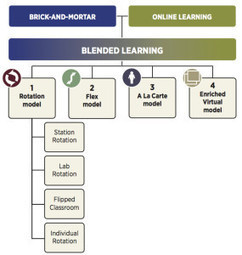
The definition of blended learning is a formal education program in which a student learns: (1) at least in part through online learning, with some element of student control over time, place, path, and/or pace; (2) at least in part in a supervised brick-and-mortar location away from home; (3) and the modalities along each student’s learning path within a course or subject are connected to provide an integrated learning experience.
Via Peter B. Sloep

Peter B. Sloep's curator insight,
April 12, 2014 3:41 PM
The focus of these scoop.it pages is networked learning. As the above definition points out, online learning is part and parcel of blended learning experiences. In some cases, the online part is of a social nature, thereby qualifying it as a form of networked learning. Apart from that, next to MOOCs blended learning is another attempt at marrying the online and the offline in learning. Although the terminology used is different, although the intentions are different (for sure if it concerns xMOOCs), there are a lot of similarities worth drawing attention to. This is particularly so since the various forms of blended learning discussed in this short scoop offer useful food for thought for those interested in furthering the evolution of MOOCs. I am thinking in particular of the à-la-carte model and the enriched-virtual model. Also, the classification is unlikely to be exhaustive and therefore provides food for the imaginative thinker. @pbsloep 
Milena Bobeva's curator insight,
April 25, 2014 8:28 AM
The link above is no longer available, but the full details are publishes in the following paper:
Scoop.it!

You know how some days, you feel older than others? I always tend to feel old when I look at education trends and examine just how far technology has come since I was in graduate school (which really doesn’t feel that long ago). Even though I was in graduate school during the late 2000′s, many things still had not made the jump to being technology based. Many things weretech based, but some of the big stuff – like research- had only come about halfway.
The handy infographic below takes a look at how Google has changed student research with a special focus on graduate students. Google is not only the most widely used search engine, but they’ve developed a lot of education specific research tools to help students out. Keep reading to learn more.
Scoop.it!

We usually do not acknowledge the fact that our students who are enrolled for on-campus courses will actually spend only a fraction of their time in that physical space and even then, the significance of it being a university campus will be simply the place they happened to be when they were online. We usually care about how our physical spaces look and what amenities are available but never notice poor wireless networks frustrating students trying to work online or worry about the less than professional online content provided to them for use in their studies.
Scoop.it!

LeClercq and Poumay's (2005) Eight Learning Events Model propose a ‘palette’ of 8 specific ways, referred to as Learning Events, that the eLearning designer can use to describe any point in the development of learning activities.
Scoop.it!

How bipartisan politics are influencing online learning and the potential of its success in college and universities across the country.
Scoop.it!

The 4 Ways Educational Technology Is Changing How People Learn Infographic presents how EdTech alters the way we learn.
Scoop.it!
What happened when four industry leading professionals talked about ways to improve the state of elearning?
Scoop.it!

In our second look at the NMC Horizon Report: 2014 Higher Education Edition, we cover the six “significant challenges” it identifies as impeding the adoption of technology in higher education
1- Low digital fluency among faculty 2- Relative lack of rewards for teaching 3- Competition from new models of education (MOOCs) 4- Scaling teaching innovations 5- Expanding access 6- Keeping education relevant
Scoop.it!

Which online instructor characteristics help students succeed? It’s a rather basic question that has not been adequately answered. We did a literature search to find if anybody had done any research from the students’ perspective on what constitutes a quality online instructor. Via SusanBat
Scoop.it!

"Below is one such collection. It is curated by Mrs. J. Porritt from W.S. Hawrylak School. Generously included are notes for each of the tools she uses in her classroom. If you are looking for a new tool, or want to know more about an existing tool, check out her useful collection of teaching tools." Via John Evans

Sandra Carswell's curator insight,
February 10, 2014 11:37 PM
Includes description of what the teacher uses the tool for. Some of these are apps and some are online tools. 
Character Minutes's curator insight,
February 11, 2014 5:50 PM
Like all the sites that were provided. 
Ness Crouch's curator insight,
February 23, 2014 4:40 PM
What an array of tools. I'd like to sit down and figure out what tools I depend on in the classroom! |







While not strictly "open source", this is a very interesting means of decentralizing the internet that creates a network that can not be easily taken down or "controlled/censored" by anyone, anything or any government.