


After two years of blended learning, a low-performing high school became one of the country's best. Read about how they shifted the learning, teaching, and culture.

 Your new post is loading...
 Scoop.it! After two years of blended learning, a low-performing high school became one of the country's best. Read about how they shifted the learning, teaching, and culture. 
No comment yet.
Sign up to comment
Scoop.it!

The Blended Synchronous Learning Handbook is the primary output of the Blended Synchronous Learning Project. It includes the summative findings of the Blended Synchronous Learning case studies, a Blended Synchronous Learning Design Framework, and a range of other resources and information to support blended synchronous learning design research and practice.
The Blended Synchronous Learning Handbook can be downloaded from here (4.77 MB).
Scoop.it!
Scoop.it!

26 ways to ensure kids have safe & vibrant learning opportunities in & out of the classroom. The Aspen Task Force is here: bit.ly/1oAuCah
Scoop.it!

The vision of the ADL Initiative is to provide access to the highest quality learning and performance aiding that can be tailored to individual needs, and delivered cost effectively at the right time and at the right place.
Scoop.it!

How can we get beyond the polarization of the digital and the physical, and optimize both local and virtual spaces in ways that will empower students to be effective collaborative learners?
Universities have largely operated in the realm of the physical, while the burgeoning learning ecosystem has largely been virtual. This roundtable will get beyond this binary way of thinking and look at how both sides could interpenetrate the other, blending the best of the physical and vi...
Scoop.it!

From
time

It was just 18 months ago that we were living in the "Year of the MOOC." Massive open online courses—MOOC for short—were supposed to revolutionize the way people learned and deliver high-quality education to the masses. But the idea faced a tough 2013.
Scoop.it!

Students have just one chance to hear a lecture - and mostly it's just someone reading their notes aloud
Scoop.it!

From
www
It was a revolution moving higher education from bricks to clicks… and now it's started to go back to bricks again. Online university providers, which offered people the chance to study from home, are turning full circle by creating a network of learning centres where students can meet and study together. Instead of demolishing the dusty old classrooms, the online university revolution is responsible for opening some new ones.

Peter Mellow's curator insight,
May 29, 2014 6:38 PM
I really like Stanford Online's review report. They are doing some great work. Thanks for sharing.
Scoop.it!

Marisol Araya Fonseca's curator insight,
May 24, 2014 7:28 PM
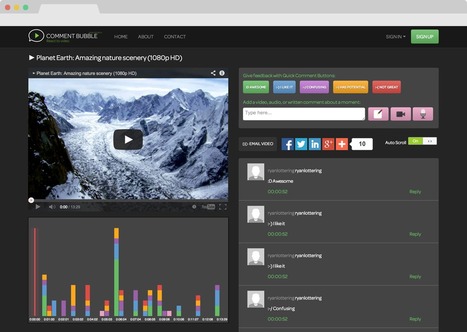
Useful to give feedback to student´s video projects. 
BI Media Specialists's curator insight,
May 29, 2014 9:15 PM
I have a feeling that there will be many more video projects next year with the implementation of iPads. This is a great tool to use when commenting on a video.
Scoop.it!

From
www
Educational Technology In The College Classroom Infographic shows how educational technology is transforming the way our college students learn in and out of the classroom.

Ana Loureiro's curator insight,
May 5, 2014 6:50 AM
how educational technology is transforming the way our college students learn in and out of the classroom 
Steve Vaitl's curator insight,
May 5, 2014 12:45 PM
I'm not usually big on infographics however this one has some very good information and is well laid out.
Scoop.it!
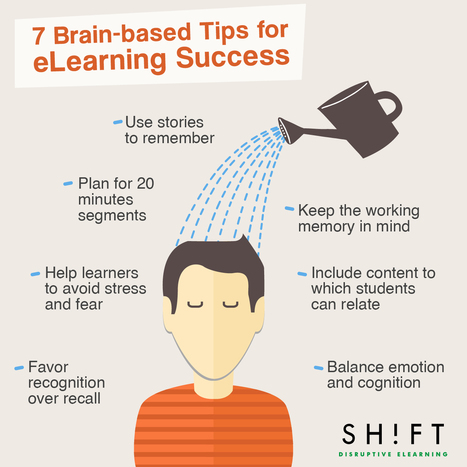
The brain is constantly on the lookout for ways to improve by obtaining new knowledge and skills, even before birth. Unfortunately, retaining information can be challenging, simply because instructors and course designers do not always use methods that facilitate remembering. The following seven points look at key principles from neuroscience research paired with tips that will allow course creators to achieve effective eLearning development.
|
Scoop.it!
The Learning Accelerator (TLA), a nonprofit organization supporting the implementation of high-quality blended learning in school districts and states across the U.S., and the Rhode Island Department of Education (RIDE) today announced an ambitious initiative to make Rhode Island the first fully “blended-learning state” in the nation. The announcement coincides with the release of TLA’s Framework for Cultivating High-Quality Blended Learning at the State Level, which outlines steps states can take to catalyze blended learning.
Scoop.it!

Traditional college instruction is part of a well-established tradition that has remained fairly unchanged over time. Becoming an instructor in this environment has meant conformity to teaching standards that have also remained fairly unchanged. Via Ana Cristina Pratas

Tony Guzman's curator insight,
July 31, 2014 9:13 AM
Has the role of instructor changed when teaching within the online modality? 
Pushpa Kunasegaran's curator insight,
July 31, 2014 8:27 PM
Very useful pointers to becoming a Modern Educator! 
Héctor Alas's curator insight,
August 11, 2014 2:10 PM
para mantener un desarrollo en ascenso en lo profesional
Scoop.it!

These 10 strategies can help keep learners on track to successfully finish your online course.
Marko Teräs, researcher in immersive virtual environments, gamification and authentic learning at Curtin University in Perth, Australia, begins every class with an exercise to break the ice and help learners get to know one another.
Scoop.it!

As MOOC mania approached its peak in 2012, Anant Agarwal, the president of the Massive Open Online Course platform edX, claimed: Online education for students around the world will be the next big thing…
Scoop.it!

The Tin Can API (sometimes known as the Experience API or xAPI) is a brand new specification for learning technology that makes it possible to collect data about the wide range of experiences a person has (online and offline). This API captures data in a consistent format about a person or group’s activities from many technologies. Very different systems are able to securely communicate by capturing and sharing this stream of activities using Tin Can’s simple vocabulary.
Scoop.it!

Digital Collaboration and Classroom Practice presents our findings, including insights on why educators did or did not use Connect; what might have made Connect more useful; and what external tools educators use for similar purposes. Among our key findings: Administrators and teachers with school-wide roles used Connect much more heavily than teachers who did not hold school-wide roles.The educators who used ARIS Connect most frequently did so because they felt it was required as part of the NYC DOE’s Inquiry process (in which teams meet regularly to develop data-based strategies for addressing the needs of struggling students).Educators reported a number of obstacles to using Connect, including confusion about its purpose, a lack of training, and technical challenges.Educators use other online tools to fill three basic functions: communicating with students, sharing files, and searching for resources. The brief delves further into each of these findings, offering lessons and recommendations for NYC and other school districts as they develop new tools aimed at improving classroom instruction.
Scoop.it!

The higher education sector needs to rethink its approach to flexible learning, a new report finds
Scoop.it!

Raise the bar on your online training as you go mobile. Produce more effective, more engaging mLearning in a fraction of the time required to develop unengaging eLearning. How fast? How about 8 hours to produce training with 10 distinct learning activities? With built-in addictive learning games, extensive leaderboard capabilities, and the most extensive analytics on the market.
Scoop.it!

Anyone looking to learn more about comprehensive design can read the book Universal Principles of Design, which features more than 200 descriptions in alphabetical order along with images to aid the explanations. For those interested just in those concepts that are most relevant to eLearning design, this post sums up some of the most important definitions.
Via Fernando Seijo
Scoop.it!

From
www
The 2014 NMC Technology Outlook for Australian Tertiary Education: A Horizon Project Regional Report reflects a collaborative research effort between the NMC and Open Universities Australia to help inform Australian education leaders about significant developments in technologies supporting teaching, learning, and creative inquiry in tertiary education. This report was produced to explore emerging technologies and forecast their potential impact expressly in a tertiary education context. In the effort that took place from January through March 2014, a carefully selected panel of experts was asked to consider hundreds of relevant articles, news, blog posts, research, and project examples as part of the preparation that ultimately pinpointed the most notable emerging technology topics, trends, and challenges for Australian tertiary education over the next five years. View the work the produced the report and meet the expert panel at aus.wiki.nmc.org.
Scoop.it!

The PC is dying, long live the PC! These headlines have been thrown around for years, as sales of laptops and desktops have continually dwindled downward.
Kim Flintoff's insight:
The implications for learning engagement are significant. Recent data suggests that mobile engagement can potentially target 93% of the world's population. Learning design must shift to accommodate these growing patterns for engagement - instructional design and knowledge of more dynamic mobile platforms will need to become more common. Universities are still a decade or more behind current trends. What will blended and elearning look like in another few years if anyone takes notice of this?

Kim Flintoff's curator insight,
May 5, 2014 2:31 AM
The implications for learning engagement are significant. Recent data suggests that mobile engagement can potentially target 93% of the world's population. Learning design must shift to accommodate these growing patterns for engagement - instructional design and knowledge of more dynamic mobile platforms will need to become more common. Universities are still a decade or more behind current trends. What will blended and elearning look like in another few years if anyone takes notice of this? |







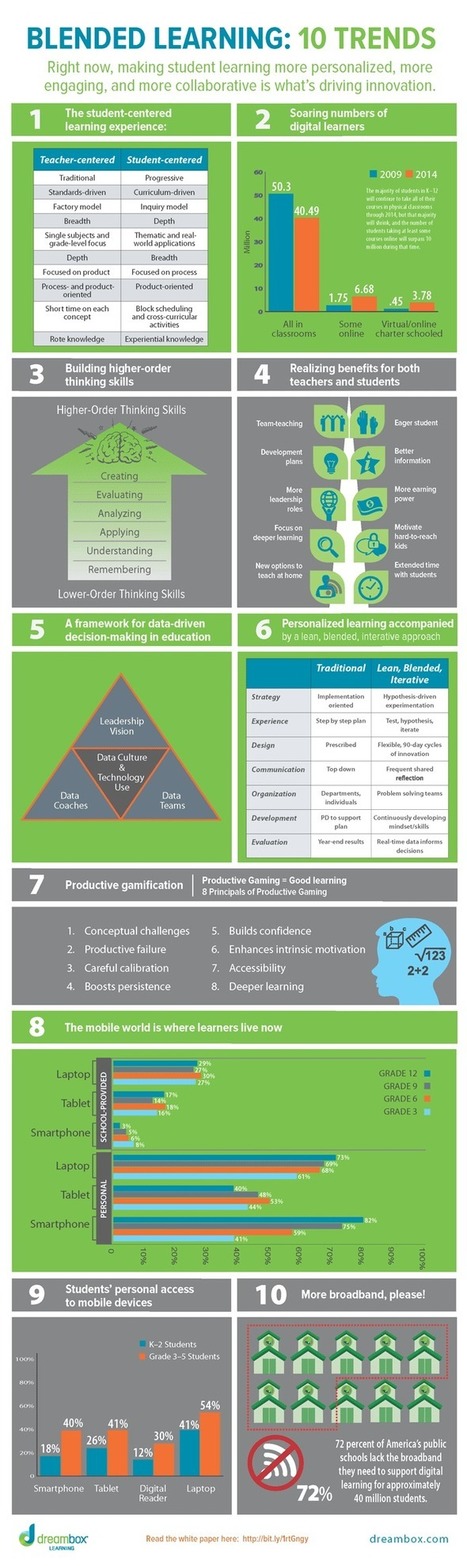


The principles apply across sectors...