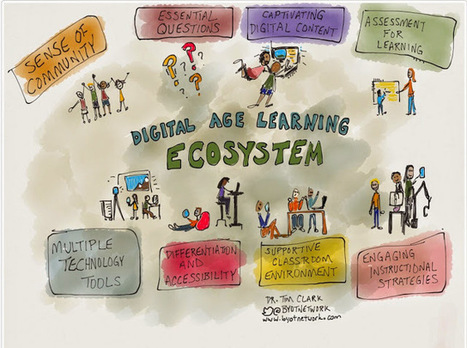
Students and professors at the University of San Diego have a new way to share photographs, videos, interactive conversations and comments in real time.

 Your new post is loading...
 Scoop.it! Students and professors at the University of San Diego have a new way to share photographs, videos, interactive conversations and comments in real time. 
No comment yet.
Sign up to comment
Scoop.it!

Course starts Feb. 23 and runs for 5 weeks. Aimed at K-16 educators.
" EDUCAUSE and the University of Central Florida (UCF) are bringing back the Massive Open Online Course (MOOC) on Instructure's Canvas Network with "BlendKit2015: Becoming a Blended Learning Designer," their second installment on the merits and methods of blended learning. The BlendKit2014 course was EDUCAUSE's first-ever MOOC, and it elicited a tremendous response from the higher education and K-12 communities." Via Jim Lerman, juandoming
Scoop.it!

At a school where the average age of students is 38, delivering online education requires a unique combination of tactics.
Scoop.it!

Video recordings and materials from Education in the Digital Era conference now online
Scoop.it!

Find 3 Reasons why you should Use Blended Learning in your eLearning Videos.
Scoop.it!

An outstanding new book provides a road map for truly effective teaching with technology.
Scoop.it!
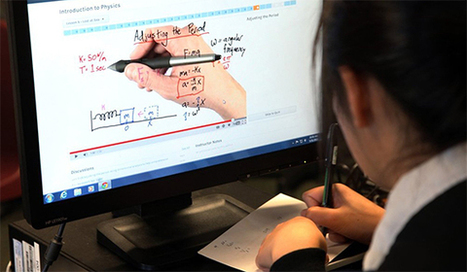
"An annual report by The Open University said the current key challenge for education specialists is to engage thousands of learners in productive discussions while learning in a collaborative, online environment." Via EDTECH@UTRGV

Empowerment's curator insight,
February 23, 2015 6:50 AM
There is a strong trend of discovery in learning organizations

Willem Kuypers's curator insight,
February 24, 2015 3:34 PM
C'est toujours intéressant de suivre l'Open University dans ses opinions sur la formation.
Scoop.it!

The conceptual age is upon us. How does your classroom need to change? This infographic presents the basics of new blended learning models that will enable you to rethink school and prepare students for the world they’re about to enter. Via Andrea Zeitz
Scoop.it!

"The commercial and private use of drones is soaring. The devices are capturing news video, assisting farmers, filming movies, delivering packages, surveying real estate, recording vacation ..." © Via Leona Ungerer, Pauline Farrell
Peter Mellow's insight:
Scoop.it!
Scoop.it!

As large format LCD screens reduce in price, Paul Mullen, Director of andersDX asks, is there a future for interactive whiteboards?
Scoop.it!

This project-based course explores educational technologies and the theories underlying their development through interviews with experts in the field.
|
Scoop.it!

Tony Karrer:
As always I do this by looking through eLearning Learning and related sites like Communities and Networks Connection. I looked at Virtual Classroom, Distance Learning, ILT, Teaching Distance Learning. I also did some quick searches for various kinds of things and added them into eLearning Learning (via delicious). So together, I’ve collected a bunch of resources pretty quickly. That said, there’s so much already out there on this – I’m at this point not quite sure what the real question was/is. Certainly a lot of this is already findable. I hope this is useful. But I think the problem at this point might be something else. Still here are 60 great resources.

asli telli's curator insight,
January 30, 2015 12:38 AM
A mini resource database of online learning by an expert in the field...
Scoop.it!

Design thinking focuses on users and their needs, encourages brainstorming and prototyping, and rewards out-of-the-box thinking that takes "wild ideas" and transforms them into real-world solutions.
Scoop.it!

Many have attempted to identify the skills important for a learner today in this era of the 21st century (I know it is an overused phrase). I have an affinity towards the skills identified by Tony...

Fiona Harvey's curator insight,
January 28, 2015 3:34 PM
I particularly liked the 'hope and optimism' bit here :-) nice graphic
Scoop.it!

In February 2014, Edreform.com published a paper on digital and blended learning that points out over “68 percent of parents support digital learning” and “digital learning has tri-partisan support, with 61 percent of Republicans, 65 percent of Independents, and 67 percent of Democrats in favor.” Such strong support may make blended learning the future standard for education. How can you make blended learning a success in your school or classroom? The following resources explore the topic from various angles.
Scoop.it!

ONLINE teacher training has the potential to overcome the malaise affecting the sector, with a major audit suggesting the pool of teacher talent is significantly improved using distance education, particularly in regional and remote Australia.
Students enrolled in online courses are achieving at the same level academically as their peers who turn up to campus every week, the audit by the NSW Board of Studies, Teaching and Educational Standards has found.
Academics, policymakers and the Australian Education Union have long argued that too many students are trained to become teachers, that there is not enough focus on practical skills in their training and that there is a mismatch between graduates and the types of jobs available.
NSW has gone further in a series of policy shifts, and in its latest degree teaching audits, by tackling the “job for life” mentality, insisting on ongoing teacher assessment and addressing deficiencies in the quality of teacher training.
Audits into how NSW universities are preparing teachers have found many primary school teachers are poorly trained to help students learn to read and are overloaded with theory at the expense of practical skills. The online audit has revealed a potential new talent pool of skilled and motivated student teachers.
Scoop.it!
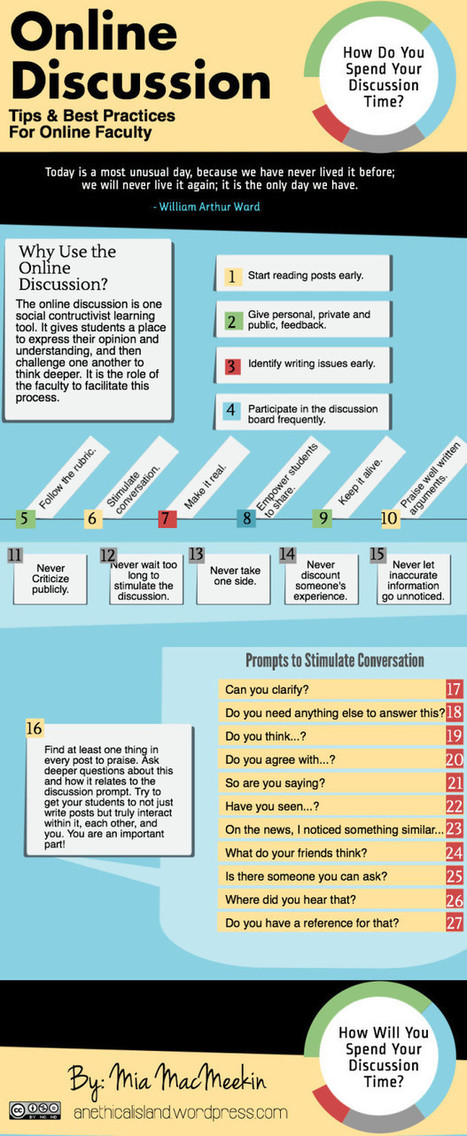
Facilitating discussions between students is one of those things that is infinitely easier when you’re teaching in a physical classroom rather than online. When the students are all in one room, discussions happen more naturally. Facilitating the same type of productive, useful discussion when teaching online is more of a challenge.

Irmgard Huppe's curator insight,
November 28, 2014 5:13 AM
short and sharp collection of a few important pointers 
Almudena Rueda's curator insight,
February 7, 2015 1:17 PM
Another great Infographics from Edudemic.
Scoop.it!

About EDUsummIT EDUsummIT is a global community of researchers, policy-makers and educators committed to supporting the effective integration of Information Technology (IT) in education by promoting active dissemination and use of research.
EDUsummIT EDUsummIT is organized in association with prominent international and national organizations actively promoting the use of IT in education, including: the Society for Information Technology and Teacher Education (SITE), the International Society for Technology in Education (ISTE), Kennisnet (The Netherlands), the International Federation for Information Processing (IFIP) WG 3.3. (Research on Education and Applications of Information Technology), the Association of Teacher Educators (ATE), and the Teacher Development and Higher Education Division at UNESCO.
Scoop.it!

The University of Central Florida's (UCF) Center for Distributed Learning (CDL) offers the Teaching Online Pedagogical Repository (TOPR) as a public resource for faculty and instructional designers interested in online and blended teaching strategies. Each entry describes a strategy drawn from the pedagogical practice of online/blended teaching faculty, depicts this strategy with artifacts from actual courses, and is aligned with findings from research or professional practice literature.

Dennis Swender's curator insight,
November 11, 2014 3:52 PM
A novel approach in education: Collecting and disseminating empirical evidence to justify beliefs and ideas in contrast with making or supporting decisions based on hearsay, anecdotes, and/or past experiences. 
Paula King, Ph.D.'s curator insight,
November 12, 2014 11:28 AM
I have not used this but will check it out.
Scoop.it!

The infThis hub contains the 2014 student and faculty studies from the EDUCAUSE Technology Research in the Academic Community research series. In 2014, ECAR collaborated with 151 institutions to collect responses from 17,451 faculty respondents across 13 countries about their technology experiences. ECAR also collaborated with 213 institutions to collect responses from 75,306 undergraduate students about their technology experiences.

Peter Mellow's curator insight,
November 4, 2014 9:11 PM
The infographic has many take home messages about our students, their use of technology, and our teaching methods.
The report is a great read.
66% of undergrads haven't heard of MOOCs!
Scoop.it!

Highlights include:
Scoop.it!

"Education is essential to helping the world progress, both technologically and socially. Unfortunately for many, access to education is not always readily available. There are many theories about how education can be improved but the ability to broadcast and disseminate knowledge is one of the easiest steps we can incorporate to enhance the standards of global education." Via EDTECH@UTRGV, Peter Mellow
Scoop.it!
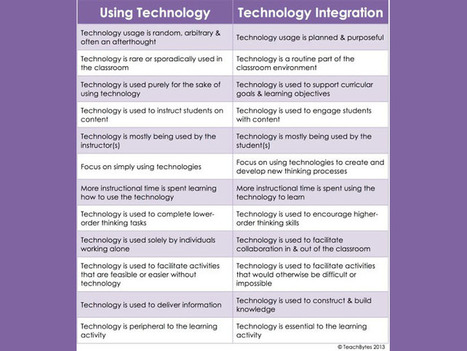
The Difference Between Technology Use And Technology Integration
Karen Miller's insight:
Useful chart outlining the important differences between using technology and integrating it deeply into the learning experiences of students.
|