


Blended learning is generally and loosely defined as 'l…
Via Alfredo Calderón, Edith Irizarry, Peter Mellow

 Your new post is loading...
 Scoop.it! Blended learning is generally and loosely defined as 'l… Via Alfredo Calderón, Edith Irizarry, Peter Mellow 
No comment yet.
Sign up to comment
Scoop.it!

The future of higher education is more than a digital replica of yesterday's campus or even today's classroom. The building blocks of our future higher education institutions are physical and virtual; they are human and technological. By combining these capabilities—the best of both the traditional (the campus) and the digital (computing), we can build colleges and universities that are designed to engage, thus bringing us closer to achieving the mission and goals of higher education.
Scoop.it!

Advocates say going online in higher-ed allows for educator collaboration, competitive advantage.
Scoop.it!

Critical Thinking Can Help Learners Learn and Retain Better in e-Learning Solutions. Utilizing Blended Learning To Encourage Critical Thinking. Via EDTECH@UTRGV
Scoop.it!

Since then, I've tried lots of different strategies in my classes and, despite the fact that our world has become more connected through social technologies in recent years (that are easy to use and often free), I still have students who regularly share with me that my class is different -- because they feel like they know me and they feel like I care. This isn't to say that online instructors who use voice/video and interactive tools to design and facilitate their courses are the only instructors who care. But these strategies are key to my ability to be present in the experiences of my students. And they're key to my ability to share my inflection, my concern, and my enthusiasm for them -- nuances text cannot convey.

Peter Mellow's curator insight,
May 7, 2015 7:56 PM
Thanks to @stephenharlow for pointing out this great resource.
Scoop.it!

The Top 10 Instructional Design Challenges in eLearning Design and Development that eLearning Professionals face and most importantly, how to overcome them! Via Ana Cristina Pratas

Lauren Coakley's curator insight,
April 29, 2015 9:29 AM
Good article that addresses challenges with advice to overcome while moving your career forward. 
Carol Hudnell's curator insight,
May 8, 2015 7:48 PM
Perfect article for people new to ID. It gives a few strategies to address each of the challenges.
Scoop.it!

Online education is good for the planet and good for the student, according to a new study by sustainability scientists at Arizona State University and Dell.
Scoop.it!

Today’s colleges and universities are quickly turning to alternative pathways to traditional teaching and learning approaches, especially for core courses such as developmental mathematics and algebra—and collaboration enabled through modern Learning Management System (LMS) functionality may be one way to accomplish this rejuvenation.
Leveraging today’s key methods and technologies can create collaborative spaces that enhance student learning and outcomes. A teacher can recapture time spent on traditional lecture and create opportunities for exploration of concepts that lead to increased student engagement and mastery level learning—all while accommodating individual student learning pace variations and asynchronous learning.
The technology to help accomplish this form of pedagogy can be brought together in what is being called the “Collaboratory Approach” or simply “Collaboratory.” The term collaboratory is credited to William Wulf for interacting and sharing via software as early as 1989 (Wulf, 1993).
Scoop.it!

"Although not a panacea, advanced learning technologies have shown enormous potential in K- 12 and university settings, and arguably offer even greater value for busy adults trying to build essential skills to improve their lives," said Matt Muench, program officer at the Joyce Foundation, which supported the research project. "If there is any area of the education market that would seem most to cry out for new thinking and new tools, it would be this enormous slice of American learners. Yet few entrepreneurs are engaged with the challenges, venture capital dollars ignore the problem and when we go to the education innovation events around the country, there is almost no discussion about this problem and how technology and new thinking might solve it."
Scoop.it!

Abstract
Scoop.it!
Stephen Downes, Senior Researcher for the National Research Council of Canada and pioneer of many major e-learning developments – such as MOOCs, syndicated learning and the concept of connectivism – tells ONLINE EDUCA BERLIN that MOOCs as we know them are on the way out; it’s time to make way for open online learning.
Scoop.it!

In the era of online learning, colleges and universities are quickly learning that it’s not enough to provide online content—the content must be accessible for all. But how can institutions provide online accessibility; and is it a legal requirement?
Scoop.it!

by Laura Gibbs:
"Using a five-point scale, where 5 means strongly agree and 1 means strongly disagree, please indicate your level of agreement with the following statement: I love teaching online...
... it seems to me that asking people what they love about teaching is a very important question. So, here are my Top Ten Reasons Why I Love Teaching Online. I’ll do the Top-Ten list backwards, Letterman-style. Meanwhile, if you are curious about the specific classes I teach, I’ve provided that background information at the bottom of the post."

Meryl van der Merwe's curator insight,
February 16, 2015 7:47 AM
I agree!! I first got into online teaching really tentatively about 2 years ago and now I love it. My physical classroom is so limited in comparison. My favorite thing is how I can give each student personal attention without ignoring the rest of the students. 
Sande Woodson's curator insight,
February 16, 2015 12:46 PM
Many good insights here... a positive attitude about online teaching, instead of a "less than" approach. �� |
Scoop.it!

EDUsummIT is a global community of researchers, policy-makers and educators committed to supporting the effective integration of Information Technology (IT) in education by promoting active dissemination and use of research.
Scoop.it!
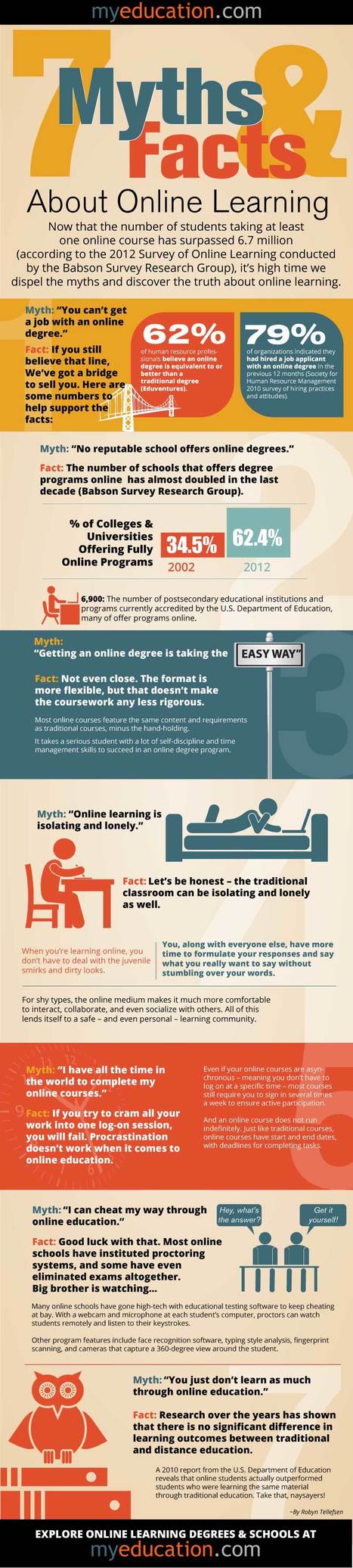
Now that the number of students taking at least one online course has surpassed 6.7 million it’s high time we dispel the myth and discover the truth about online learning. Via: www.myeducation.com

ChristopherBell's curator insight,
May 14, 2015 10:47 PM
Awesome stuff to share with parents and graduating seniors! 
Carlos Godoy Rodríguez's curator insight,
May 15, 2015 1:13 PM
7 mitos y realidades sobre la formación online.
Mito nro. 1, no se puede obtener un empleo acreditando un diploma logrado mediante aprobación de cursos en línea. Reaalidad: 62% de los profesionales de RRHH creen que los diplomas obtenidos por cursos online son equivalentes o mejores que los logrados en universidades tradicionales.
Mito nro 2, sólo universidades de dudosa reputación ofrecen programas que se imparten totalmente en línea. Realidad: el porcentaje de instituciones que ofrecen programas completamente virtuales se ha duplicado en la última década hasta alcanzar 62.4%.
Mito nro. 3, los programas virtuales contribuyen con el aislamiento de sus estudiantes. Realidad: los cursos distribuídos en el formato presencial tradicional pueden también incentivar el aislamiento.
Mito nro. 4, obtener un diploma en línea es tomar el camino fácil. Realidad: si bien es cierto que el formato eLearning es más flexible, ello no significa que los cursos dictados en ésta modalidad sean menos rigurosos.
Mito nro. 5, "Tengo todo el tiempo del mundo para culminar mi curso online". Realidad: si intenta retrazar indefinidamente el cumplimiento de las tareas asignadas en un curso online, muy problamente, no superá ese curso. La procastinación no funciona el mundo real ni en el virtual.
Mito nro. 6, usted no aprenderá mucho tomando cursos vía eLearning. Realidad: investigaciones recientes indican que no hay diferencias significativas entre los resultados de aprendizaje por estudios virtuales y el método presencial tradicional.
Mito nro. 7, puedo hacer fraude en los programas de formación online. Realidad: muchas escuelas online han implementado sistemas de protección antifraude. Algunas otras exigen la realización de exámenes presenciales a sus alumnos. ¡ El gran hermano siempre está observando...! 
Ellen Comito McKeown's curator insight,
July 22, 2015 6:16 PM
A great, visual way to explain the value of online education.
Scoop.it!

There is a growing need for today’s pre-service teachers to be equipped with skills and competencies for blended, online, and technology-rich teaching and learning environments. As teaching candidates progress through teacher education programs, they should be exploring, evaluating, and applying methods and tools for effective instruction in the dynamic learning environments that exist in today’s K-12 schools.
Kim Flintoff's insight:
That engaging with online and blended strategies is seen as optional in teacher training seems to me problematic in itself. The articles suggests some approahces to engaging preservice teachers -in these areas - I suggest that ubiquity is probably the next big step.
Scoop.it!

María Dolores Díaz Noguera's curator insight,
May 12, 2015 7:25 AM
Universidad Digital ... Preparación para la Universidad Digital |scoopit travésAnaCristinaPrts http: //sco.lt / ... 
Alfredo Corell's curator insight,
May 15, 2015 3:55 PM
Preparing for the digital university: a review of the history and current state of distance, blended, and online learning Athabasca University, University of Edinburgh, University of Texas Arlington, University of South Australia 
Risto Suoknuuti's curator insight,
May 17, 2015 3:59 AM
This is the possibility and nesessity to the value chaine of knowledge.
Scoop.it!

In spite of its growing popularity, teaching online remains largely uncharted territory for many educators. Via Miloš Bajčetić
Scoop.it!

2U wants to nail the coffin shut on certain beliefs that persist in the realm of online degrees in its latest impact report.
This year's report comments on the number of "successful student field placements" or internships facilitated by 2U. The total is 20,493 at about 14,000 different organizations around the world. Those placements are of significance as the organization expands its business in health care and other fields where clinical practice is a requirement.
"The preconceived notions about online education are often quite negative. Our new impact report strives to shatter those preconceived notions, offering proof that 2U-enabled degree programs are having a positive effect on students, faculty and institutions," said 2U's CEO and co-founder, Chip Paucek, in a statement. "Innovations in technology and content delivery are dramatically changing the world of online education, allowing for a learning experience that is just as engaging as the traditional classroom."

Steve Vaitl's curator insight,
April 17, 2015 10:15 AM
For my teaching and business friends. The reality is that there is vastly more networking and collaboration that occurs online than does face to face and on a much more global level!! I think most "naysayers" simply have a lack of understanding what resources are available for online classrooms. Virtual reality scenarios can be very near physical reality. Check out one resource I use in my courses; http://www.udel.edu/biology/ketcham/microscope/
Scoop.it!

Blended learning is the best of both worlds: combining elearning with offline learning. To do that you need an appropriate LMS. Learn how to do it here.
Scoop.it!

From
tech

Opportunities abound for software designers and developers to create impactful tools for teachers, school leaders, students, and their families. This guide for developers, startups and entrepreneurs addresses key questions about the education ecosystem and highlights critical needs and opportunities to develop digital tools and apps for learning. Crowd-sourced from knowledgeable educators, developers, and researchers who were willing to share what they have learned, this guide is designed to help entrepreneurs apply technology in smart ways to solve persistent problems in education.
Scoop.it!

Unpacking this idea involves this thinking:
We are concerned about the design of the program and its equivalence to other similar programs.We are concerned about quality of students admitted.We are concerned about the qualifications of faculty.We are concerned about the management of processes within a program – assessment rubrics, appeals, academic integrity, and academic governance.We are concerned about the rigour of marking.We are concerned that the outputs match the intended outcomes of the course.
2. While formal quality assurance processes have increasingly focused on the student experience, they often do not stress student engagement as one of the key drivers for quality.
Scoop.it!

A framework that helps educators measure how well technology tools integrated into K-12 lessons are helping students meet, exceed and extend the learning goals
Kim Flintoff's insight:
The approach could be applied in almost any context where technology supported learnign is being used. It begins to fill gap that seems to precede models like SAMR or TPACK.
Scoop.it!

From
ispr
[Telepresence robots are changing the experience for teacher and students at Michigan State in this article from Campus Technology; more details from are available directly from MSU, and Slate has a similar story about the introduction of the robots in high schools. –Matthew ]
Scoop.it!

What is ‘gamification’ and how can it help you to design great elearning? Check The Anatomy Of Good Gamified eLearning to find out more!

HCL's curator insight,
March 1, 2015 5:00 PM
"The first rule of great gamified eLearning is: learner centricity." |






