


How do you get a new innovation adopted in your school? How do you convinced people it is a good direction. These 15 ideas will get you started.

 Your new post is loading...
 Scoop.it! How do you get a new innovation adopted in your school? How do you convinced people it is a good direction. These 15 ideas will get you started. 
No comment yet.
Sign up to comment
Scoop.it!

The vogue for active learning blinds us to the value of ancient teaching methods. Via Meredith Hinze

Meredith Hinze's curator insight,
October 21, 2015 10:59 PM
This is generating a lot of discussion in the Faculty of Arts.
Scoop.it!
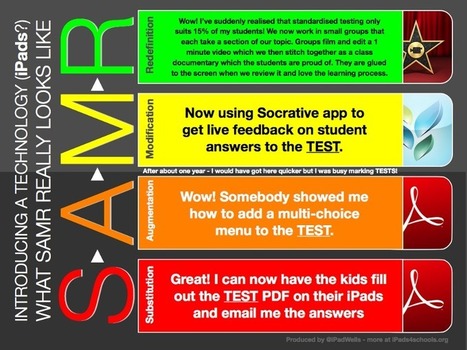
For me, Miguel Guhlin summed it all up best in his own recent reflection on SAMR: Go ahead, tear down your SAMR god…whatever you put in its place will serve for a time then be smashed to the ground. Not because the gods are unworthy, but because you invested them with so much of your understanding that when you grew, you failed to see how the model serves as a springboard for thinking, not a locked room that keeps fresh ideas out.
Scoop.it!

MUNCIE, Ind. — On a typical day in Corey Gilman’s second-grade class, students view and listen to books on a Smart Board, following the text in their hardcover readers; they collaborate in small groups named for colors; and take turns using an iPod to listen to a reading of books they wrote by hand and …
Scoop.it!

verstelle's curator insight,
August 12, 2015 9:44 AM
1) Immersive and interactive learning. Fluid intelligence Assess via ongoing formative assessment
2) Analytics Dashboards, early alert systems.
3) Credentialing Redesign credentials including all you learn during your life
Scoop.it!

When using advanced eLearning authoring tools we are sometimes tempted to follow a mechanistic approach to designing feedback. It is easy to use templates or just to copy and paste automatic feedback comments in quizzes.
However, we should remember that proper feedback can be a very influential mechanism with an ability to improve people’s competencies. To use the full power and potential of feedback in eLearning we need to spend much more time on designing it and just forget about doing simplified work on it Via Gust MEES

Gust MEES's curator insight,
August 19, 2015 9:03 PM
When using advanced eLearning authoring tools we are sometimes tempted to follow a mechanistic approach to designing feedback. It is easy to use templates or just to copy and paste automatic feedback comments in quizzes. However, we should remember that proper feedback can be a very influential mechanism with an ability to improve people’s competencies. To use the full power and potential of feedback in eLearning we need to spend much more time on designing it and just forget about doing simplified work on it.
http://www.scoop.it/t/21st-century-learning-and-teaching/?tag=feedback
Scoop.it!

Rita Chiu is a learning designer with ten years’ experience as a gamer. It’s through gaming that she developed her online facilitation skills.
Scoop.it!

The proliferation of blended/hybrid initiatives and resources is heartening and furthering a delivery model that is reaching maturity. However, there is still much to be examined about what organizations promote as models for designed blended courses and how these models are enacted by practitioners. Research in this area has historically focused on learner traits, grades, faculty/learner levels of satisfaction, and/or levels of learner engagement (see Dzuiban, Hartman, and Moskal 2004 and Nagel 2009). But blended learning is more than a simple "flip" of the classroom because it requires careful planning and cautious implementation and may even be transformative for both learner and instructor. This session will present the findings from a series of studies examining blended best practices, pedagogical practices, and learner preparedness. There is indication that while alignment through an integration of online and face-to-face components is a priority, in actuality courses are location-driven and typically based on pedagogical templates. Most reports advocate a learner-centered approach, yet the variation in approaches indicates that learners must be prepared to adapt to different course designs in ways that acknowledge underlying requirements of the blended format. The presentation topics will include research findings and patterns present and absent across these areas. The session will address mission directly by sharing a range of pedagogical strategies and best practices that are directly aligned with learner success through the axiomatic use of technology to support and facilitate learning.
Scoop.it!

This is one of those posts where I don’t have a firm conclusion, I’m just thinking some stuff through. I’ve been thinking a bit about what the role of personality is in eduction, particularly online and distance ed. In my own institution, The Open University, there has been a long tradition of removing the personal from teaching material. While the course materials we produce are written in an accessible manner, they are not imbued with one person’s personality. Although one academic may write them, they go through multiple reviews, and editing. Course units are often attributed to the “The Module Team”, or “written by X on behalf of the Module Team”. The idea is that this is an objective view, created through collaboration to distill clear teaching material. The trouble with making them based around a personality is that this can be a barrier to accessing the content, if you don’t respond well to that particular personality (but the opposite is also true, it can be a boost if you do like that person). When I joined the OU removing myself from the writing was one of the difficult aspects of learning to write distance ed material, while still keeping it engaging and not too ‘dry’. I mean, who wouldn’t want my personality stamped all over their units on Artificial Intelligence, right? (don’t answer that).
Scoop.it!

Moodle today announced MoodleCloud, a service that allows anyone to deploy the Moodle learning environment for free — with no installation or hosting charges. Intended for individual classes of up to 50 users and other small learning environments, MoodleCloud provides the latest version of Moodle software (2.9.1), including integrated Web conferencing, delivered via Amazon Web Services.

Steve Vaitl's curator insight,
July 17, 2015 10:02 AM
Great open source resource for teachers who either wish to host courses themselves or just have their own private "course playground".
Scoop.it!

The National Broadband Network (NBN) is expanding all around Australia, covering new locations every day. The network delivers dependable internet connectivity at tremendously high speeds.
Scoop.it!

These 9 strategies for blended learning are certain to help you engage students quickly and consistently. Via Dr. Tom D'Amico (@TDOttawa)

Michelle Nimchuk's curator insight,
June 5, 2015 12:53 PM
9 Great strategies to incorporate in a blended learning environment. 
Елена Гончарова's curator insight,
July 29, 2015 7:48 AM
Эти 9 стратегий для смешанного обучения помогут вам заниматься со студентами быстро и последовательно
Scoop.it!

From
www

Virtual reality goggles and mobile learning are just a few ways technology will change education.
|
Scoop.it!

Nicholas Morton is road-testing some unusual ways to get, and keep, students’ attention
My latest idea is to create a series of one-minute “lecture trailers” – these rapidly show the students some of the places to be discussed and ask challenging questions. So, for a lecture on the First Crusade, I might show them some of the key battle sites and ask – in the video – “How did the First Crusade change relations between Western Europe and the Islamic world?” or “How did the Crusaders succeed in crossing thousands of miles of enemy territory before seizing and holding Jerusalem?” I’m not offering the students a replacement for the lecture, or an excuse for not attending (“I watched the video on YouTube, so I’ve already got the key messages”). Rather, I’m attempting to get them excited about what is to come.
Scoop.it!
National Association of State Boards of Accountancy
Scoop.it!

At Arizona State University (ASU), we have a community of about 40 staff members who have the words "Instructional Design" or "Instructional Designer" in their titles. Every few months we get together as a group and talk about the latest trends at ASU and throughout higher education. Via Ana Cristina Pratas

Donna Farren's curator insight,
October 19, 2015 9:34 AM
Great way to share with a campus what you do!
Scoop.it!

The Creative Classrooms Lab project (CCL) brought together teachers and policy-makers in eight countries to design, implement and evaluate 1:1 tablet scenarios in 45 schools. The project produced learning scenarios and activities, guidelines and recommendations to help policy-makers and schools to take informed decisions on optimal strategies for implementing 1:1 initiatives in schools and for the effective integration of tablets into teaching and learning. The project, funded by the European Commission’s Lifelong Learning Programme, was coordinated by European Schoolnet, involved 10 partners and ran from April 2013 to May 2015. Via Gust MEES
Gust MEES's curator insight,
September 3, 2015 9:17 AM
The Creative Classrooms Lab project (CCL) brought together teachers and policy-makers in eight countries to design, implement and evaluate 1:1 tablet scenarios in 45 schools. The project produced learning scenarios and activities, guidelines and recommendations to help policy-makers and schools to take informed decisions on optimal strategies for implementing 1:1 initiatives in schools and for the effective integration of tablets into teaching and learning. The project, funded by the European Commission’s Lifelong Learning Programme, was coordinated by European Schoolnet, involved 10 partners and ran from April 2013 to May 2015.
Scoop.it!

It's time for higher ed to begin preparing for the future, before it's too late.
Scoop.it!

How to make your e-learning work
Seven design tips to make the magic happen: Plan your online program using sticky notes. Use different colours for content chunks, activities, online discussions, and virtual classroom sessions. Think about the learner’s pathway through the program.Write or record your learning materials with the learner in mind. Create a sense of the teacher’s voice reaching out to the student. Avoid using the passive tense and overly informal language.Structure the learning in manageable chunks so that students can feel a sense of achievement and do not feel overwhelmed.Plan opportunities for meaningful collaboration in both synchronous and asynchronous environments at critical stages of the learning.Avoid long lists of PDF readings. Select readings carefully and give students a sense of why this document has been chosen, what they are looking for in the readings and how it relates to the learning activities or assessment. Make them want to read it.Avoid uploading PowerPoint slides unless you can get them narrated by the teacher. In face-to-face sessions PowerPoint presentations should only offer minimal information to support the lecture or teaching moment. It is the stories and narrative that can bring a PowerPoint presentation to life. Slides with a few dot points are not meant to be viewed in isolation from the teacher’s narrative.And lastly, if at all possible, plan for the teacher/tutor/trainer to be online and present throughout the course at significant stages.
Scoop.it!

Much of what passes for an “online course” these days could more accurately be described as the electronic version of class hand-outs. These courses usually consist of a course description, a syllabus, lecture notes, reading lists, and assignment checklists. In other words, whatever materials a student might have viewed on paper in the past are now read onscreen, and whatever presentations a student might have watched in the classroom are now observed on their screen. Read more Five Common Pitfalls of Online Course Design › Via SusanBat
Scoop.it!

Report: The 4 models of blended learning in action
Scoop.it!

This article features 12 concepts for maximizing blended learning engagement with your students.
Teachers and parents are always looking for the right scenarios to promote blended learning engagement. We see the potential in creating forums and using apps, websites and other virtual tools to promote creativity and higher-level learning.
Implementing blended learning takes practice in order to engage students, and allow them to be creative. It requires specific supportive guidelines for the use of technology.
The teacher always has a crucial role to play in blended learning situations. Teachers have the power to control the type and level of blended learning engagement. Here are some great ways to do just that.
Scoop.it!

By Phil HillMore Posts (332) A year ago I wrote about Google Classroom, speculating whether it would affect the institutional LMS market in higher education.
Well today Google announced a new Google Classroom API that directly addresses the limitation in bullet #1 above and indirectly addresses #4.
By using the API, admins will be able to provision and populate classes on behalf of their teachers, set up tools to sync their Student Information Systems with Classroom, and get basic visibility into which classes are being taught in their domain. The Classroom API also allows other apps to integrate with Classroom.
Scoop.it!

Here's a great infographic and video showcasing why teachers should explore the benefits of blended learning.
|






