Your new post is loading...

|
Scooped by
Kim Flintoff
August 10, 2018 1:21 AM
|
MacArthur’s Digital Media and Learning (DML) initiative started in 2005 and focused initially on supporting workshops and projects aimed at exploring how digital media was affecting how young people were learning, the implications of gaming for learning, and to study the creative possibilities enabled by digital media for university learning.
|
|
Scooped by
Kim Flintoff
August 2, 2018 11:44 PM
|
Instructional Design in Higher Education: Defining an Evolving Field
This white paper provides an overview of the growing field of instructional design in higher education, from why the field is growing to how designers are functioning in their role. It explores why there is a growing demand for designers, who is filling these roles, what the responsibilities of designers are, and how instructional designers are addressing the challenges they face.
|
|
Scooped by
Kim Flintoff
July 24, 2018 3:47 AM
|
A new study indicates that students who engage with digital learning tools are dramatically more likely to pass their courses.
The research comes from Blackboard, VitalSource, and the University of Maryland, Baltimore County (UMBC), and is based on UMBC student engagement data across a diverse range of courses, including a variety of course subjects and class sizes. It assessed students’ use of Blackboard Learn and Bookshelf by VitalSource.
|
|
Scooped by
Kim Flintoff
June 20, 2018 7:50 PM
|
In a survey of 1,500 students who are seriously considering, currently enrolled in or recently graduated from a fully online program, most (86 percent) considered the value of their degree equal to or greater than the cost they paid to take it. Among those who have attended face-to-face and online courses, the majority (85 percent) said that online learning is as good as or better than attending courses on campus. In fact, two-thirds of online college students (67 percent) reported that they'd achieved the original goal that motivated them to enroll in their program; graduate students were more likely than undergraduates to feel that way (76 percent vs. 62 percent).
The survey was conducted by Learning House, a company that manages online programs for colleges and universities, and Aslanian Market Research, a research arm of EducationDynamics, which performs student prospecting and enrollment management.
|
|
Scooped by
Kim Flintoff
May 24, 2018 10:46 PM
|
Let The Technology Serve The Curiosity, Not The Other Way Around contributed by Steve Wheeler, Associate Professor in Learning Technology Curiosity killed the cat, but it made each of us who we are today. Without curiosity, none of us would learn very much at all. Learning is based more on curiosity than any other human characteristic. …
|
|
Scooped by
Kim Flintoff
May 24, 2018 9:43 PM
|
Are your students ever surprised when they fail a test? Are you ever surprised that they didn’t seem to notice they’d been struggling with the homework? Or when they did notice but didn’t do anything about it?
Some students haven’t mastered the skills of noticing and understanding the patterns in their schoolwork. Or in knowing what to do if they get stuck.
|
|
Scooped by
Kim Flintoff
May 24, 2018 9:42 PM
|
Do you teach a subject with a lot of skills that build on each other? If so, then some of your students may be struggling—not because they aren’t good at your subject, but because they just didn’t master one particular skill.
That missing skill prevented them from learning all the skills that came afterward. In this kind of situation, skill-based adaptive learning products can help.
|
|
Scooped by
Kim Flintoff
April 28, 2018 7:51 PM
|
Spread the loveTechnology is becoming a significant component of classroom curriculum and education in general. Computers, tablets, and mobile apps all promote learning on a deeper level for students. While this edtech certainly can help to promote better grades and deeper understanding, schools are now facing issues with digital equity. Students from high-income families have far more access to the technology needed to succeed than those from low-income families. The major disparity is both shocking and widespread. One of the most prevalent issues is that children from low-income families are four times more likely to be without internet than their …
|
|
Scooped by
Kim Flintoff
April 25, 2018 11:09 PM
|
In evaluating a learning object with LORI, reviewers can rate and comment with respect to eight items: 1. Content Quality: Accuracy, balanced presentation of ideas, appropriate level of detail, and reusability in varied contexts 2. Learning Goal
|
|
Scooped by
Kim Flintoff
April 21, 2018 4:52 AM
|
Arizona State's report on digital learning draws cheers from online proponents -- and a few raised eyebrows from those who think the future is more complicated and warrants broader research.
|
|
Scooped by
Kim Flintoff
March 31, 2018 12:07 AM
|
Students often explain that they take the courses I teach because they want to learn how to make GIFs, YouTube videos, and HTML/CSS websites. They want to make funny photoshopped pictures of their friends and make their own, personalized GIFs. They also tell me that they see these digital skills as increasingly important for jobs, both summer internships and careers after graduation. Students enter my class convinced that what they will learn to do will be useful in their professional and personal lives.
But, for nearly all students in the classes I teach, all they know of digital making are the template/shortcut platforms that have enabled them to participate in digital culture up until this point. And, perhaps, rightfully so, they assume that the experience of making digital media will be similar to the experience of using Canva and WIX. Students I work with assume that digital media making is:
drag-and-drop;
a series of well-laid out, linear, and standard steps; and
a guaranteed working product at the end with little risk of failure.
Free resource of educational web tools, 21st century skills, tips and tutorials on how teachers and students integrate technology into education
Via Dr. Tom D'Amico (@TDOttawa)
|
|
Scooped by
Kim Flintoff
February 23, 2018 6:24 PM
|
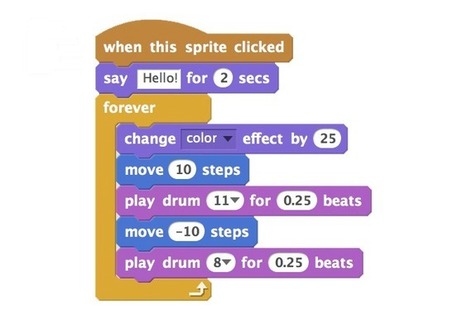
Creative Computing: An Introductory Computing Curriculum Using Scratch
|
|
|
Scooped by
Kim Flintoff
August 10, 2018 1:20 AM
|
CALIFORNIA COMMUNITY COLLEGESCalifornia Community Colleges Chancellor Eloy Ortiz Oakley
California’s online community college will represent a new vision for higher education when it launches next year and the online education field is watching to see whether it succeeds.
The new fully online college draws from a variety of sources, including public universities’ online degree programs, corporate worker training initiatives and programs at for-profit colleges. California plans to blend those existing influences to create something without precedent: A statewide, online-only public college focused on short, career-oriented certificates.
|
|
Scooped by
Kim Flintoff
July 24, 2018 3:48 AM
|
The joint study describes the following major findings:
Early activity in learning tools is a strong predictor of whether a student will pass a class
Patterns of activity differ significantly between courses
Learning activity data is a more powerful predictor of achievement than demographics and educational background
Combining data from multiple learning tools (like Blackboard Learn and VitalSource) improves the accuracy of predictions about student achievement
Students with high levels of activity in multiple learning tools can significantly increase their chances of successfully passing a class
|
|
Scooped by
Kim Flintoff
June 20, 2018 7:51 PM
|
Most colleges and universities are thinking and acting strategically regarding their digital learning initiatives. Most cover digital learning in their school's strategic plan, and a large number have made it a core aspect of their plans. Yet, execution is uneven and digital learning hasn't come close to meeting administrator or faculty expectations.
That summary comes out ofa new report produced by Tyton Partners in collaboration with the Babson Survey Research Group. A similar subject was undertaken in 2014 when Tyton interviewed more than 2,700 postsecondary faculty and administrators on their use and perceptions of digital courseware. The latest report updates that research and examines findings from two fall 2016 surveys of a national sample of 3,500 postsecondary respondents.

|
Scooped by
Peter Mellow
June 16, 2018 5:55 AM
|
HEInnovate is a self-assessment tool for Higher Education Institutions who wish to explore their innovative potential. It guides you through a process of identification, prioritisation and action planning in eight key areas. HEInnovate also diagnoses areas of strengths and weaknesses, opens up discussion and debate on the entrepreneurial / innovative nature of your institution and it allows you to compare and contrast evolution over time. You can have instant access to your results, learning materials and a pool of experts.
|
|
Scooped by
Kim Flintoff
May 24, 2018 9:47 PM
|
Students who don’t succeed struggle for a variety of different reasons. As educators, we owe it to them to understand why. And to see if there are specific problems that we can address.
Perhaps they’re first-generation college students who didn’t have anyone to teach them how to succeed in school. Maybe there are challenges at work or at home. Or they have a specific weakness, like memorization, that affects them in one class, but not all classes. Maybe they just lack confidence and give up on themselves too quickly.
|
|
Scooped by
Kim Flintoff
May 24, 2018 9:43 PM
|
Adaptive Learning is actually not one thing, but takes several forms. Two common types, for example, are skills based and memory based. When you’re choosing courseware for your class, be sure it’s adaptive in the right way for your students.
Take, for example, memory: helping students remember facts and concepts. Some subjects, like Anatomy, require lots of memorization. But even subjects that focus on critical thinking need students to remember facts and concepts to make an argument.
|
|
Rescooped by
Kim Flintoff
from Learning & Technology News
May 10, 2018 10:23 PM
|
As digital learning technologies continue to grow and develop at pace we need to match that development with an ever deeper understanding about how we connect the right tools to the specific learning need. Any money spent on a scalable learning technology that doesn’t meet the learning needs is still money wasted, however ‘cost effective’ the cost-to-learner ratio is.
Via Nik Peachey
|
|
Scooped by
Kim Flintoff
April 28, 2018 9:28 AM
|
Startups require specialized talent, so a new wave of education providers are growing quickly to fill the skills gap with practical courses for every type of job in tech: engineering, data science, design, product management, and even sales.
|
|
Scooped by
Kim Flintoff
April 25, 2018 11:08 PM
|
This article discusses the use of Transmedia Storytelling in blended learning, based on recent research and the need for an effective learning design. The interest in digital storytelling for educational purposes has increased over the last few
|
|
Scooped by
Kim Flintoff
April 18, 2018 1:40 AM
|
Governments see online learning as a means of increasing access to quality learning, enabling flexibility for learners, lowering costs of higher education and a way of enabling collaboration between institutions through co-development of programs, courses and through credit transfer. But online learning creates significant policy challenges – financial arrangements to support part-time, anytime, anywhere learners; quality assurance for online learning; cyber-security for personal information; and completion rates of online versus face-to-face teaching.
|
|
Scooped by
Kim Flintoff
March 30, 2018 8:52 PM
|
A new guide on blended learning reminds school district leaders that blended isn't a goal unto itself; nor is it a specific instructional approach. Blended can be integrated into a "variety of educational models" and serves as the "vehicle" for providing innovative instruction.
The report, "Blending Teaching and Technology: Simple Strategies for Improved Student Learning," was produced by Future Ready Schools, an initiative of the Alliance for Excellent Education. Blended learning, as the guide explained, "refers to a variety of practices and strategies" for enabling students to learn online at least some of the time and maintain a level of control over the "time, place, path or pace of their learning."
|
|
Scooped by
Kim Flintoff
March 7, 2018 6:11 AM
|
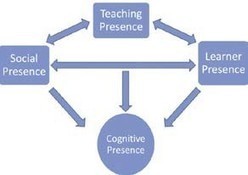
The development of communities of inquiry, highly engaged in the co- creation, discovery and development of knowledge, capabilities and skills, is enabled by learning management systems, collaborative platforms and social-constructivist teaching activities (Garrison, Anderson & Archer, 2000, 2001a, 2001b; Garrison & Anderson, 2003). This paper explores the current state of communities of inquiry (COI) in teaching and learning in the digital age, including the technology to support learner presence (Shea & Bidjerano, 2010) and personal learning environments. It also argues for the communities of inquiry model to evolve into a learning model, that recognizes the importance of motivation, self-efficacy and personal skills in effective communities of inquiry.
|


 Scoop.it!