 Your new post is loading...
Looking for a Textbook on Generative AI in Education?
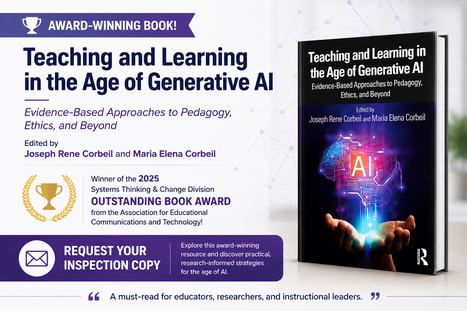
Teaching and Learning in the Age of Generative AI: Evidence-Based Approaches to Pedagogy, Ethics, and Beyond Edited by Joseph Rene Corbeil & Maria Elena Corbeil (2025) 🏆 Winner of the 2025 Systems Thinking & Change Division Outstanding Book Award from the Association for Educational Communications and Technology! If you are designing a course that addresses generative AI in education, this award-winning volume provides a research-driven, classroom-ready foundation. Rather than offering hype or fear, this book helps educators:
- Ground AI integration in learning theory and research
- Address academic integrity with thoughtful, practical strategies
- Redesign assessment for an AI-enabled world
- Explore ethics, bias, privacy, and institutional responsibility
- Leverage AI to enhance critical thinking and digital literacy
Bookended by historical and forward-looking analyses of AI in education, the chapters move beyond surface-level discussions to provide evidence-based approaches for real classrooms—K–12, higher education, and professional learning environments.
This text is ideal for:
- Undergraduate and graduate teacher education programs
- Curriculum & Instruction courses
- Educational Technology programs
- Higher education faculty development
- School technology coordinators and talent development professionals
Adopting a GenAI textbook for an upcoming semester? We invite you to request an inspection copy and explore how this resource can support your students in navigating AI with skill, ethics, and informed judgment.
Request your inspection copy today.

|
Scooped by
EDTECH@UTRGV
June 12, 1:37 PM
|
Discover why critical thinking often disappears in student writing and how purposeful reading, synthesis, and thesis-driven writing can strengthen academic work.
|
|
Scooped by
EDTECH@UTRGV
June 12, 1:31 PM
|
"I once had an SVP tell me, “Don’t ever talk to me about a problem unless you have options to solve them.” Fair point. So here’s what actually works. Real AI governance doesn’t live in a framework. It shows up in how decisions get made, how people work, and more importantly, in what teams no longer have to think about."
|
|
Scooped by
EDTECH@UTRGV
June 11, 9:29 AM
|
Social media firms face thousands of lawsuits, the BBC looks at four which could be significant.
|
|
Scooped by
EDTECH@UTRGV
June 11, 9:24 AM
|
Why story-driven training sticks — and how to build it fast in SHIFT Meteora AI Studio or deliver it through the LMS you already use.
|
|
Scooped by
EDTECH@UTRGV
June 11, 9:19 AM
|
Researchers say a lack of reliable information on artificial intelligence use on campus could lead to misguided policies.
|
|
Scooped by
EDTECH@UTRGV
June 10, 1:34 PM
|
While some experts suggest AI integration for teaching and learning, schools still have to figure out how to pay for it.
|
|
Scooped by
EDTECH@UTRGV
June 10, 1:25 PM
|
While not all are of equal value, a new survey from Coursera found that the vast majority of employers are inclined to offer higher starting salaries to candidates with microcredentials. Both students and employers say microcredentials are valuable assets in today’s tough job market, new data shows.
|
|
Scooped by
EDTECH@UTRGV
June 10, 1:19 PM
|
The head of learning initiatives for Google Deepmind says debates about use of new technologies should focus on how to embrace more holistic teaching methods. Banning the use of artificial intelligence (AI) in higher education risks shutting down conversations about how to innovate in pedagogy, according to a learning expert at Google Deepmind.
|
|
Scooped by
EDTECH@UTRGV
June 9, 9:34 AM
|
The result comes from OpenAI's GPT-4.5 model, which tricked the judges into thinking it was the human 73% of the time, while another model was just 56%.
|
|
Scooped by
EDTECH@UTRGV
June 9, 9:29 AM
|
The absence of desirable difficulty in AI interactions effectively ignores the biology of human learning.
|
|
Scooped by
EDTECH@UTRGV
June 9, 9:22 AM
|
"Not long ago, I participated in an exercise that asked educators to define thinking and learning. It was a familiar prompt, one we have returned to countless times over the past decade. This time felt different. The task was to triangulate, even pinpoint, what these concepts mean in today’s educational landscape."
|
|
Scooped by
EDTECH@UTRGV
June 9, 9:19 AM
|
When students don’t see the point of an activity, they often turn to AI for a shortcut. Here’s how to make learning meaningful and relevant
|
|
|
Scooped by
EDTECH@UTRGV
June 12, 1:54 PM
|
As AI becomes more integrated into higher education, institutions must address ethics, including representation, sourcing, modeling and accountability.
|
|
Scooped by
EDTECH@UTRGV
June 12, 1:33 PM
|
"On convenience, abdication, and the quiet erosion of the open web. The internet isn’t dying. That’s the problem."
|
|
Scooped by
EDTECH@UTRGV
June 12, 1:30 PM
|
The question is no longer whether students will use AI after graduation but to what extent. So, how can universities best ensure that students are workforce-ready?
|
|
Scooped by
EDTECH@UTRGV
June 11, 9:28 AM
|
To help readers focus on top trends worthy of their attention, EdSurge journalists distilled expertise from education sources of all sorts into abou
|
|
Scooped by
EDTECH@UTRGV
June 11, 9:22 AM
|
"Growing up in the 1980s and 1990s, I remember spending countless hours with Atari, Nintendo, and Gameboy. At the time, these consoles seemed to reshape childhood overnight, even if parents were skeptical. My mother often told me to stop playing, assuming the games had no long-term benefit. Today, that assumption feels outdated. The video game industry, now exceeding $160 billion, plays a significant role in shaping education and professional opportunities. Beyond its entertainment value, gaming has evolved into a cultural phenomenon with lasting implications for communication, collaboration, and learning."
|
|
Scooped by
EDTECH@UTRGV
June 10, 1:35 PM
|
A new survey from Gallup and the Walton Family Foundation finds that the vast majority of teachers have not received formal guidance on how to use AI in their work, and about a third have gotten none.
|
|
Scooped by
EDTECH@UTRGV
June 10, 1:30 PM
|
Your finger hovering over the “Allow” button.
A pop‑up window appears on your laptop. On your phone. Maybe even on your smart glasses someday.
“Copilot, or Gemini, or ChatGPT with screen recording wants access to:
- Full Disk Access
- Your Contacts
- Your Photos
- Your Keyboard Input (every single keystroke)
- Your Screen Content (everything you see)
- Your Location (even when the app is closed)”
One click. That’s all it takes."
|
|
Scooped by
EDTECH@UTRGV
June 10, 1:22 PM
|
Do your AI literacy efforts account for the full range of ways AI can hurt you, cognitively? AI has … introduced entirely new categories of harm.” —Brookings
|
|
Scooped by
EDTECH@UTRGV
June 9, 9:37 AM
|
It’s not the first time OpenAI has hinted at something like this. The Financial Times, citing 'more than a dozen current and former employees,' reports that OpenAI is radically rethinking its core product, ChatGPT. Apparently in a matter of weeks, it’s going to transform into a 'superapp.'”
|
|
Scooped by
EDTECH@UTRGV
June 9, 9:31 AM
|
Ironically, the rise of intelligent systems (AI) may make these deeply human capabilities even more valuable.
|
|
Scooped by
EDTECH@UTRGV
June 9, 9:24 AM
|
‘It’s not looking good’: The unemployment rate for recent grads is the highest in five years, but AI is not primarily to blame — at least not yet
|
|
Scooped by
EDTECH@UTRGV
June 9, 9:20 AM
|
Threat or opportunity? Advice for using, managing and embedding artificial intelligence in university assessment, skills development and task design
|
|
Scooped by
EDTECH@UTRGV
June 8, 12:07 PM
|
"[A]s the country wrestles with restricting screens, some parents and disability advocates are beginning to express concerns about whether students who rely on accessibility tools are being excluded from the rulemaking process. Some of these advocates say they agree that new tech restrictions are necessary, but they are calling for careful consideration in how these rules are written."
|























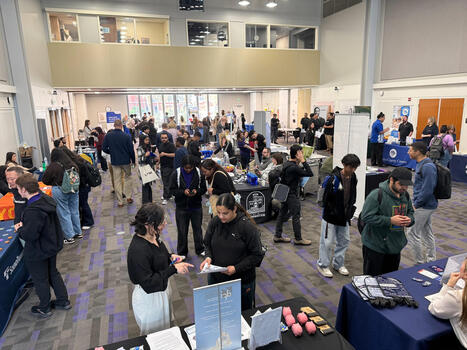






"Around the world, universities are increasingly offering esports-related programs...These programs not only support players but also prepare students for roles in the broader industry. When coupled with academic accountability, esports becomes an effective motivational and educational pathway."