 Your new post is loading...
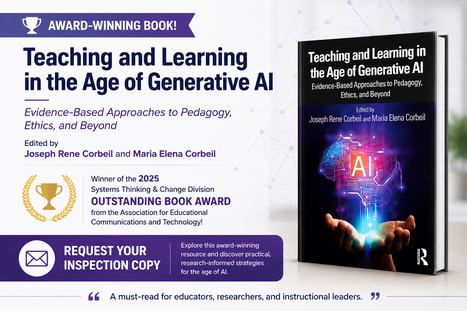
Looking for a Textbook on Generative AI in Education?
Teaching and Learning in the Age of Generative AI: Evidence-Based Approaches to Pedagogy, Ethics, and Beyond Edited by Joseph Rene Corbeil & Maria Elena Corbeil (2025) 🏆 Winner of the 2025 Systems Thinking & Change Division Outstanding Book Award from the Association for Educational Communications and Technology! If you are designing a course that addresses generative AI in education, this award-winning volume provides a research-driven, classroom-ready foundation. Rather than offering hype or fear, this book helps educators:
- Ground AI integration in learning theory and research
- Address academic integrity with thoughtful, practical strategies
- Redesign assessment for an AI-enabled world
- Explore ethics, bias, privacy, and institutional responsibility
- Leverage AI to enhance critical thinking and digital literacy
Bookended by historical and forward-looking analyses of AI in education, the chapters move beyond surface-level discussions to provide evidence-based approaches for real classrooms—K–12, higher education, and professional learning environments.
This text is ideal for:
- Undergraduate and graduate teacher education programs
- Curriculum & Instruction courses
- Educational Technology programs
- Higher education faculty development
- School technology coordinators and talent development professionals
Adopting a GenAI textbook for an upcoming semester? We invite you to request an inspection copy and explore how this resource can support your students in navigating AI with skill, ethics, and informed judgment.
Request your inspection copy today.

|
Scooped by
EDTECH@UTRGV
June 16, 11:30 AM
|
Understand the four stages of competence and how they help in skill development and learning in today's fast-paced workplace.
|
|
Scooped by
EDTECH@UTRGV
June 16, 11:27 AM
|
"By 2030, employers expect nearly 4 in 10 key skills required for the job market to change. As technological progress reshapes work, new data from Coursera (NYSE: COUR), a leading global online learning platform, finds that 92% of US employers are willing to offer higher starting salaries to graduates who have earned industry micro-credentials."
|
|
Scooped by
EDTECH@UTRGV
June 16, 11:21 AM
|
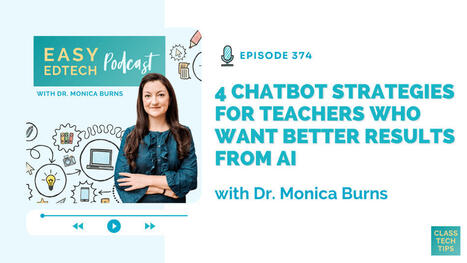
Use these chatbot strategies for teachers to move beyond basic prompts and create stronger classroom resources with AI.
|
|
Scooped by
EDTECH@UTRGV
June 16, 11:16 AM
|
To become proficient in GenAI, educators must move beyond one-off interactions to create workflows that increase efficiency and deepen learning. Learn how
|
|
Scooped by
EDTECH@UTRGV
June 15, 2:59 PM
|
"Pre-service teachers – myself included – often lament that they didn’t really learn to teach until the rubber-meets-the-road experience of student teaching or that first job. This is the challenge of teaching pre-service teachers. I’ve been doing it for a handful of years now, and I see a trend – the TikTok way of knowing in education. It’s got me wondering how we adapt our practices based on my experience during my recent final exams with pre-service teachers."
|
|
Scooped by
EDTECH@UTRGV
June 15, 2:49 PM
|
"Two school days. That’s all it took. In 2024, I chaperoned field trips two days in a row, for two different grade levels, and came back to roughly 450 ungraded assignments. I knew what to do, I’ve done it before, mark them credit or no credit and move on. Students get something out of that. They did the practice. But if any of them were practicing it wrong, nobody catches it, nobody tells them, and the misunderstanding rides along into the next unit. That pile of work led me to build an AI grading assistant. And this past April, I removed its most automated feature: the one that could return an AI-generated grade and comment to a student before I had reviewed it. Building that feature was easy to justify. Removing it taught me which part of grading a teacher can’t hand off."
|
|
Scooped by
EDTECH@UTRGV
June 15, 2:41 PM
|
"Her newest book, Teaching Writing in the Age of AI: Strategies for Teachers of Secondary Students, explores what it means to teach writing in the age of AI. Another forthcoming book, Writing Still Matters, examines why writing instruction remains essential even as technology continues to evolve. For Turner, these questions extend far beyond academic research. They raise deeper questions about the future of learning itself."
|
|
Scooped by
EDTECH@UTRGV
June 15, 2:34 PM
|
"AI often makes me feel like I am having one big, long crisis. Like I’m in limbo or purgatory, or something. Doom and gloom, and WTF are we going to do? But then there’s the other side. When I see things people are creating, or I create in my own work (like when an agent pulls some magic out of what feels like nowhere), that makes me feel unbelievably excited. But no matter what side of that yo-yo I’m on, there are some things that I will always believe."
|
|
Scooped by
EDTECH@UTRGV
June 15, 2:28 PM
|
How do we use GenAI without letting it use us? By mastering the tool, and helping students do so too, its much-feared effects on the humanities cannot come to pass, writes Stuart Christie
|
|
Scooped by
EDTECH@UTRGV
June 12, 1:37 PM
|
Discover why critical thinking often disappears in student writing and how purposeful reading, synthesis, and thesis-driven writing can strengthen academic work.
|
|
Scooped by
EDTECH@UTRGV
June 12, 1:31 PM
|
"I once had an SVP tell me, “Don’t ever talk to me about a problem unless you have options to solve them.” Fair point. So here’s what actually works. Real AI governance doesn’t live in a framework. It shows up in how decisions get made, how people work, and more importantly, in what teams no longer have to think about."
|
|
Scooped by
EDTECH@UTRGV
June 11, 9:29 AM
|
Social media firms face thousands of lawsuits, the BBC looks at four which could be significant.
|
|
|
Scooped by
EDTECH@UTRGV
June 16, 11:32 AM
|
The risk of cognitive outsourcing is real. But there is reason for optimism, if students are taught good AI habits early and often. You have seen it happen: A student opens an AI tool, gets a polished essay outline in minutes, submits the assignment and walks away feeling productive. They do well on the exam. The grade is real. But ask them to explain the same concept three months later, and the room goes quiet.
|
|
Scooped by
EDTECH@UTRGV
June 16, 11:28 AM
|
Conversations with Kevin Hogan: SchoolAI policy analyst Sasha Luks-Morgan breaks down the three pillars every district AI policy needs
|
|
Scooped by
EDTECH@UTRGV
June 16, 11:24 AM
|
"I can usually tell when something was built by AI before I’ve read a word of it. There’s a face it wears: a centered hero with a confident headline and two buttons, rounded cards floating on a soft gradient, a sans-serif working very hard to seem neutral, spacing so even it feels exhaled rather than drawn. I’ve seen that face come out of Claude Design, out of Lovable, out of v0 and Bolt. Different companies. Different models. The same face."
|
|
Scooped by
EDTECH@UTRGV
June 16, 11:17 AM
|
"The FCC announced in April it would be taking a fresh look at all aspects of the Universal Service Fund (USF). The agency recently kicked off this process for the E-Rate program by issuing a combined Notice of Proposed Rulemaking and a Further Notice of Proposed Rulemaking."
|
|
Scooped by
EDTECH@UTRGV
June 16, 11:12 AM
|
Instead of trying to detect students using AI for their work, we need to think differently. Here’s where to start
|
|
Scooped by
EDTECH@UTRGV
June 15, 2:52 PM
|
The question for educators: How to know when AI supports real learning. "Information is more easily accessible than ever before. Anyone anywhere can ask an AI tool a question and receive an answer that seems reasonable, at least on the surface. It’s not surprising, then, to see predictions of the demise of traditional schools and colleges."
|
|
Scooped by
EDTECH@UTRGV
June 15, 2:44 PM
|
How one school principal uses AI to save time on administrative tasks that can be better spent with students and staff
|
|
Scooped by
EDTECH@UTRGV
June 15, 2:37 PM
|
The issue is no longer simply whether colleges and universities are technologically capable or technically compliant. It is whether they are prepared for what comes next.
|
|
Scooped by
EDTECH@UTRGV
June 15, 2:29 PM
|
"A person with no legal training can now take a two-hundred-page policy bill, pull out the clauses that matter, weigh them against each other, and produce a confident, well-argued critique in about five minutes. Extract, digest, calibrate. A decade ago that was a job. Today it is a text box."
|
|
Scooped by
EDTECH@UTRGV
June 12, 1:54 PM
|
As AI becomes more integrated into higher education, institutions must address ethics, including representation, sourcing, modeling and accountability.
|
|
Scooped by
EDTECH@UTRGV
June 12, 1:33 PM
|
"On convenience, abdication, and the quiet erosion of the open web. The internet isn’t dying. That’s the problem."
|
|
Scooped by
EDTECH@UTRGV
June 12, 1:30 PM
|
The question is no longer whether students will use AI after graduation but to what extent. So, how can universities best ensure that students are workforce-ready?
|
|
Scooped by
EDTECH@UTRGV
June 11, 9:28 AM
|
To help readers focus on top trends worthy of their attention, EdSurge journalists distilled expertise from education sources of all sorts into abou
|




























"For generations, schools treated knowledge acquisition as the central hurdle. If students could read closely, recall accurately and write coherently, they were considered prepared. Tasks that once demonstrated understanding now signal access."