 Your new post is loading...

|
Scooped by
EDTECH@UTRGV
February 11, 5:29 PM
|
Looking for a Textbook on Generative AI in Education?
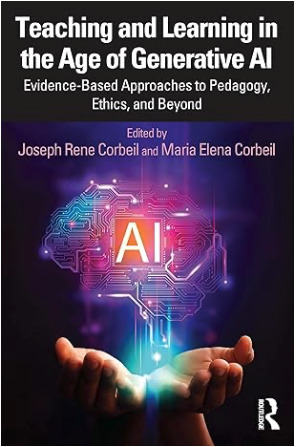
Teaching and Learning in the Age of Generative AI: Evidence-Based Approaches to Pedagogy, Ethics, and Beyond Edited by Joseph Rene Corbeil & Maria Elena Corbeil (2025) 🏆 Winner of the 2025 Systems Thinking & Change Division Outstanding Book Award from the Association for Educational Communications and Technology! If you are designing a course that addresses generative AI in education, this award-winning volume provides a research-driven, classroom-ready foundation. Rather than offering hype or fear, this book helps educators:
- Ground AI integration in learning theory and research
- Address academic integrity with thoughtful, practical strategies
- Redesign assessment for an AI-enabled world
- Explore ethics, bias, privacy, and institutional responsibility
- Leverage AI to enhance critical thinking and digital literacy
Bookended by historical and forward-looking analyses of AI in education, the chapters move beyond surface-level discussions to provide evidence-based approaches for real classrooms—K–12, higher education, and professional learning environments.
This text is ideal for:
- Undergraduate and graduate teacher education programs
- Curriculum & Instruction courses
- Educational Technology programs
- Higher education faculty development
- School technology coordinators and talent development professionals
Adopting a GenAI textbook for an upcoming semester? We invite you to request an inspection copy and explore how this resource can support your students in navigating AI with skill, ethics, and informed judgment.
Request your inspection copy today.
|
|
Scooped by
EDTECH@UTRGV
May 11, 12:43 PM
|
SCHOOL SOFTWARE SCRUTINY: Legislators have pushed back against cellphones in the classroom but are now focused on ensuring school software on device
|
|
Scooped by
EDTECH@UTRGV
May 11, 12:41 PM
|
"Every executive today understands one thing: there is too much information. The internet became a firehose, and it never really stopped. Relentless. High-pressure. Impossible to fully absorb. For years, organizations responded by building learning systems to manage that overload: courses, academies, knowledge bases. Then AI arrived. And suddenly, the problem seemed solved. No more firehose. Just answers. Clean. Fast. Focused. But in solving one problem, we've quietly created another: tunnel vision."
|
|
Scooped by
EDTECH@UTRGV
May 11, 12:36 PM
|
Three ways South Fayette Township School District brings their “Portrait of a Learner” to life.
|
|
Scooped by
EDTECH@UTRGV
May 11, 12:27 PM
|
How provinces approach digital learning and AI literacy will shape to what extent this is grounded in critical thinking and ethical reflection.
|
|
Scooped by
EDTECH@UTRGV
May 8, 4:52 PM
|
"The implications of AI literacy, or lack thereof, are far-reaching. They extend beyond national ambitions to remain “a global leader in this technological revolution” or even prepare an “AI-skilled workforce,” as the executive order states. Without basic literacy, citizens and consumers are not well equipped to understand the algorithmic platforms and decisions that affect so many domains of their lives: government services, privacy, lending, health care, news recommendations and more. And the lack of AI literacy risks ceding important aspects of society’s future to a handful of multinational companies."
|
|
Scooped by
EDTECH@UTRGV
May 8, 4:43 PM
|
"Chromebooks are scattered all around the classrooms of Floyd M. Jewett Elementary School in Mesick, Michigan. Towers of them are teetering atop bookshelves. They’re piled up in corners of classrooms. They’ve even cropped up in one classroom’s dish rack. But there’s one place you won’t find them: in students’ hands. Last month, Mesick Consolidated Schools banned digital devices in its elementary school of about 250 students. The decision wasn’t an agonizing one. The ban came at astonishing speed, almost overnight, after a conversation between Mesick Superintendent Jack Ledford and Jewett Principal Elizabeth Kastl."
|
|
Scooped by
EDTECH@UTRGV
May 8, 4:34 PM
|
"The most advanced artificial intelligence systems in history now ask us to communicate through a blinking cursor in an empty text box. We have, in the most literal sense, gone backwards. For the last forty years, the entire trajectory of interaction design has been a movement away from the command line and toward direct manipulation. We moved from typing instructions to pointing, clicking, dragging, and seeing the results immediately. We built interfaces that showed us what was possible rather than demanding we memorise a syntax. Then, with the touchscreen, we removed even the mouse, the most direct manipulation yet, a finger on glass, the interface collapsing to almost nothing between intention and action."
|
|
Scooped by
EDTECH@UTRGV
May 7, 11:47 AM
|
Generative artificial intelligence has unsettled higher education, raising fears that students will lose the ability to think. Drawing on classroom experience and student feedback, we argue that grounded inquiry sharpens judgement in Earth science teaching by limiting AI to set sources and auditing its claims.
|
|
Scooped by
EDTECH@UTRGV
May 7, 11:40 AM
|
"The debate about AI and human cognition has followed predictable patterns since February of 2025 when the MIT paper dropped. A study appears showing that students who lean on AI show weaker neural engagement, and the headlines declare that ChatGPT is making us dumber. A counter-study appears showing that strategic AI delegation produces deeper learning, and the response is that the doomers were wrong all along. But how do different definitions of learning shape studies and the interpretation of data?"
|
|
Scooped by
EDTECH@UTRGV
May 6, 1:21 PM
|
"Missouri. Utah. LA Unified School District. Bend-La Pine Schools. Medford School District. What do all of these states and school districts have in common? They’re all taking steps to restrict the use of technology and screens in their classrooms, after years of schools increasing their use of laptops."
|
|
Scooped by
EDTECH@UTRGV
May 6, 1:13 PM
|
Two years ago, Josephine Timperman arrived at college with a plan. She declared a major in business analytics, figuring she’d learn niche skills that would stand out on a resume and help land a good job after college.
But the rise of artificial intelligence has scrambled those calculations. The basic skills she was learning in things like statistical analysis and coding can now easily be automated. “Everyone has a fear that entry-level jobs will be taken by AI,” said the 20-year-old at Miami University in Ohio."
|
|
Scooped by
EDTECH@UTRGV
May 6, 1:10 PM
|
"As the push to curb screen time and ed tech in schools gains momentum, district leaders need to be alert and proactive in communicating about the issue with their communities, said Barbara Hunter, executive director of the National School Public Relations Association. With the spotlight on ed tech, Hunter said, now is an opportune moment for districts to show how technology is benefiting students in the classroom. But that requires strategic communication, she added."
|
|
|
Scooped by
EDTECH@UTRGV
May 11, 12:45 PM
|
As universities pilot agentic AI for advising and administrative tasks, its place in teaching and learning remains unclear. Experts say decision-makers will need to look carefully at reliability, risks and partners.
|
|
Scooped by
EDTECH@UTRGV
May 11, 12:42 PM
|
This article explores the AI learning gold rush, blending research with personal anecdote, to show how to truly build capability using AI.
|
|
Scooped by
EDTECH@UTRGV
May 11, 12:38 PM
|
"Meaningful learning should not be about memorization or developing the ability to solve problems for which solutions are already known. Rather, it should focus on doing, experiencing, questioning and deciding, engaging with ideas in context, testing them against reality, and developing the ability to act thoughtfully under conditions of uncertainty. This is the foundation of both a Socratic and a polytechnic education, where the emphasis is not simply on the acquisition of knowledge, but on critical thinking, challenging assumptions, and developing the capacity to use knowledge adaptively, critically, and responsibly."
|
|
Scooped by
EDTECH@UTRGV
May 11, 12:33 PM
|
"At the end of 2025, almost nine in ten organizations surveyed by McKinsey in The state of AI in 2025: Agents, innovation, and transformation reported using AI in at least one business function. Ninety-four percent reported they were not yet seeing significant value from those investments. That gap, examined in “Where AI will create value and where it won’t” in the April 2026 issue of McKinsey Quarterly, is not an adoption problem. It is a framing problem. Most companies are using AI to do their existing work faster, when the durable returns require a different kind of work entirely."
|
|
Scooped by
EDTECH@UTRGV
May 8, 5:01 PM
|
"The SAMR + AI Matrix is a structured learning design tool that aligns the SAMR Model with Bloom's Taxonomy, mapping levels of technological use to cognitive demand to guide instructors in determining how artificial intelligence (AI) could impact student work. This matrix is operationalized through a five-step framework that helps instructors deliberately design for the presence of AI in learning experiences."
|
|
Scooped by
EDTECH@UTRGV
May 8, 4:48 PM
|
"Microlearning works for busy people. And that's probably not the type of insight you came here for, but it's a place to start. The strongest argument for microlearning is their convenience. But can and should everything fit into such bite-size content? That's a question I see more and more organizations struggling with. There is no time (or budget allocation) to allow for long-form training that can plausibly resolve all of the many learning gaps. Given the many concerns everywhere around the globe, there is also direction lacking from executives to really focus on noncritical training."
|
|
Scooped by
EDTECH@UTRGV
May 8, 4:40 PM
|
Generative artificial intelligence has unsettled higher education, raising fears that students will lose the ability to think. Drawing on classroom experience and student feedback, we argue that grounded inquiry sharpens judgement in Earth science teaching by limiting AI to set sources and auditing its claims.
|
|
Scooped by
EDTECH@UTRGV
May 7, 11:49 AM
|
From black box to learning lab: how open, scalable systems can turn AI access into real literacy for students.
|
|
Scooped by
EDTECH@UTRGV
May 7, 11:45 AM
|
"When ChatGPT was launched in November 2022, some universities decided to quickly ban students from using it, not least because they feared that GenAI would kill assessment integrity. Bans like these are now rare, but some universities still ask students to fill in disclosure statements about their GenAI use, and emphasize that some assessment tasks – for instance, asking a GenAI tool to write your BA thesis – are strictly prohibited. Other university administrations suggest that teachers should schedule oral examination moments to check if suspicions about some students’ impermissible GenAI use are true."
|
|
Scooped by
EDTECH@UTRGV
May 7, 11:33 AM
|
What can we learn about screen time limits by closely examining the first round of phone ban impact research?
|
|
Scooped by
EDTECH@UTRGV
May 6, 1:17 PM
|
"Back in January, the viral sensation OpenClaw kicked off the personal AI assistant craze, where you install a team of AI agents on your desktop, give them goals, and set them loose. Fast forward to May and now there’s a new buzzy trend that’s ready to take off: “proactive” AI (i.e., AI agents that go to work without even being asked)."
|
|
Scooped by
EDTECH@UTRGV
May 6, 1:11 PM
|
AI literacy is increasingly seen as fundamental knowledge for students. How can educators set the parameters that ensure proficient use of artificial intelligence across the institution, regardless of discipline? Junghwan Kim offers advice
|
|
Scooped by
EDTECH@UTRGV
May 6, 1:08 PM
|
"When implementing artificial intelligence tools in schools, educators should take a human-centered approach, remaining mindful of “elements that technology can’t replace but can erode or strengthen depending on how it’s used,” says Maddy Sims, a senior fellow at the Center on Reinventing Public Education. Introducing AI without a strategy can create an “efficiency paradox” where legacy school models become more affordable and efficient but aren’t responsive enough to student needs, according to a whitepaper co-written by Sims."
|

































"Used as a scaffold, AI can enable deeper engagement, broader exploration, and iterative individualized learning at scale."