Educational Technology News
220.7K views | +2 today
 
Scooped by EDTECH@UTRGV
onto Educational Technology News
May 6, 1:08 PM
Scoop.it!

Human-centered approach is key in classroom AI implementation

"When implementing artificial intelligence tools in schools, educators should take a human-centered approach, remaining mindful of “elements that technology can’t replace but can erode or strengthen depending on how it’s used,” says Maddy Sims, a senior fellow at the Center on Reinventing Public Education.


Introducing AI without a strategy can create an “efficiency paradox” where legacy school models become more affordable and efficient but aren’t responsive enough to student needs, according to a whitepaper co-written by Sims."

EDTECH@UTRGV's insight:

"Educators must stay aware of what tech can’t replace, and what it can “erode or strengthen” based on use"

No comment yet.
Educational Technology News
The latest news related to the meaningful and effective implementation of educational technology and e-learning in K-12, higher education, corporate and government sectors.
Curated by EDTECH@UTRGV
Your new post is loading...
Scooped by EDTECH@UTRGV
February 11, 5:29 PM
Scoop.it!

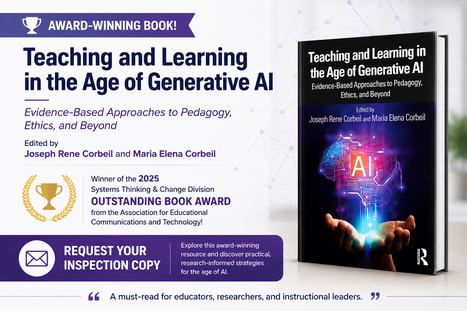
Looking for a Textbook on Generative AI in Education?

Looking for a Textbook on Generative AI in Education? | Educational Technology News | Scoop.it

Teaching and Learning in the Age of Generative AI: Evidence-Based Approaches to Pedagogy, Ethics, and Beyond


Edited by Joseph Rene Corbeil & Maria Elena Corbeil (2025)


🏆 Winner of the 2025 Systems Thinking & Change Division Outstanding Book Award from the Association for Educational Communications and Technology!


If you are designing a course that addresses generative AI in education, this award-winning volume provides a research-driven, classroom-ready foundation. Rather than offering hype or fear, this book helps educators:

  • Ground AI integration in learning theory and research
  • Address academic integrity with thoughtful, practical strategies
  • Redesign assessment for an AI-enabled world
  • Explore ethics, bias, privacy, and institutional responsibility
  • Leverage AI to enhance critical thinking and digital literacy


Bookended by historical and forward-looking analyses of AI in education, the chapters move beyond surface-level discussions to provide evidence-based approaches for real classrooms—K–12, higher education, and professional learning environments.

This text is ideal for:

  • Undergraduate and graduate teacher education programs
  • Curriculum & Instruction courses
  • Educational Technology programs
  • Higher education faculty development
  • School technology coordinators and talent development professionals

Adopting a GenAI textbook for an upcoming semester?

We invite you to request an inspection copy and explore how this resource can support your students in navigating AI with skill, ethics, and informed judgment.

Request your inspection copy today.

EDTECH@UTRGV's insight:

Award-winning "Teaching and Learning in the Age of Generative AI" offers research-based, practical guidance for educators seeking to thoughtfully integrate generative AI into their courses—request an inspection copy: https://www.routledge.com/textbooks/evaluation/9781032688602.

Dong Jiayi (Deyiss)'s curator insight, April 30, 3:09 AM
Technology get advanced.
Scooped by EDTECH@UTRGV
Today, 11:47 AM
Scoop.it!

Teach students to ask better questions with Artificial Intelligence

Generative artificial intelligence has unsettled higher education, raising fears that students will lose the ability to think. Drawing on classroom experience and student feedback, we argue that grounded inquiry sharpens judgement in Earth science teaching by limiting AI to set sources and auditing its claims.
EDTECH@UTRGV's insight:

"The challenge in AI use is therefore not how far students should rely on AI but whether universities can help them ask questions that expose uncertainty rather than conceal it."

No comment yet.
Scooped by EDTECH@UTRGV
Today, 11:40 AM
Scoop.it!

Deescalating the AI Learning Debate - What Do We Actually Mean by Learning?

Deescalating the AI Learning Debate - What Do We Actually Mean by Learning? | Educational Technology News | Scoop.it

"The debate about AI and human cognition has followed predictable patterns since February of 2025 when the MIT paper dropped. A study appears showing that students who lean on AI show weaker neural engagement, and the headlines declare that ChatGPT is making us dumber. A counter-study appears showing that strategic AI delegation produces deeper learning, and the response is that the doomers were wrong all along. But how do different definitions of learning shape studies and the interpretation of data?"

EDTECH@UTRGV's insight:

"[H]ow AI is used matters more than whether it is used."

No comment yet.
Scooped by EDTECH@UTRGV
May 6, 1:21 PM
Scoop.it!

In-class screen time is the next frontier in the school technology debate

In-class screen time is the next frontier in the school technology debate | Educational Technology News | Scoop.it

"Missouri. Utah. LA Unified School District. Bend-La Pine Schools. Medford School District. What do all of these states and school districts have in common? They’re all taking steps to restrict the use of technology and screens in their classrooms, after years of schools increasing their use of laptops."

EDTECH@UTRGV's insight:

"Some worry that the push to remove technology from schools will keep students from being tech literate, or that removing all screens may mean limiting an opportunity for individualized instruction."

No comment yet.
Scooped by EDTECH@UTRGV
May 6, 1:13 PM
Scoop.it!

AI anxiety upends college plans as students scramble for 'AI-proof' majors

AI anxiety upends college plans as students scramble for 'AI-proof' majors | Educational Technology News | Scoop.it

Two years ago, Josephine Timperman arrived at college with a plan. She declared a major in business analytics, figuring she’d learn niche skills that would stand out on a resume and help land a good job after college.

But the rise of artificial intelligence has scrambled those calculations. The basic skills she was learning in things like statistical analysis and coding can now easily be automated. “Everyone has a fear that entry-level jobs will be taken by AI,” said the 20-year-old at Miami University in Ohio."

EDTECH@UTRGV's insight:

"The rise of artificial intelligence is prompting college students to second-guess their career paths."

No comment yet.
Scooped by EDTECH@UTRGV
May 6, 1:10 PM
Scoop.it!

Why districts can no longer ignore the ed tech pushback

"As the push to curb screen time and ed tech in schools gains momentum, district leaders need to be alert and proactive in communicating about the issue with their communities, said Barbara Hunter, executive director of the National School Public Relations Association.  


With the spotlight on ed tech, Hunter said, now is an opportune moment for districts to show how technology is benefiting students in the classroom. But that requires strategic communication, she added."

EDTECH@UTRGV's insight:

"A school communications expert says districts need to be proactive and transparent about the ways ed tech benefits students as challenges mount."

No comment yet.
Scooped by EDTECH@UTRGV
May 6, 1:07 PM
Scoop.it!

School cellphone bans improve discipline over time, but academic impacts are limited, study says

"Schools that required students to keep their cellphones in lockable pouches during the school day saw an uptick in suspension rates and a decrease in student well-being in the first year the cellphone policies were implemented. However, those negative effects dissipate in subsequent years, according to new research from the National Bureau of Economic Research."

EDTECH@UTRGV's insight:

"A National Bureau of Economic Research paper finds such restrictions had little impact on attendance, attention and perceived online bullying."

No comment yet.
Scooped by EDTECH@UTRGV
May 5, 2:50 PM
Scoop.it!

What Colleges Get Wrong About AI Education

What Colleges Get Wrong About AI Education | Educational Technology News | Scoop.it
As AI use becomes common in the workforce, institutions of higher education must train students to be fluent in the technology, so they can evolve with it.
EDTECH@UTRGV's insight:

"Competency means knowing how to operate the tools. Frankly, our students can gain competency quickly through a weekend workshop, YouTube videos or simple trial and error. Fluency, on the other hand, means understanding what the tools can and cannot do. It requires recognizing the assumptions baked into systems trained on imperfect data, asking who benefits and who bears the costs when AI is deployed in a hiring process, a courtroom or a healthcare setting."

No comment yet.
Scooped by EDTECH@UTRGV
May 5, 2:45 PM
Scoop.it!

When AI means something different in every classroom

When AI means something different in every classroom | Educational Technology News | Scoop.it
AI is already in the classroom--will we give it a place that makes sense for teaching and learning as the technology evolves?
EDTECH@UTRGV's insight:

"Teachers are responding in real time, trying to protect their classrooms, their expectations, and their students. But over time, that flexibility creates inconsistency. Students are left to figure out what is acceptable, what is not, and when the rules apply."

No comment yet.
Scooped by EDTECH@UTRGV
May 5, 2:41 PM
Scoop.it!

How AI is Reshaping the Future of Work

How AI is Reshaping the Future of Work | Educational Technology News | Scoop.it
How AI leadership and enterprise AI strategy are transforming the future of work, and how Stanford GSB Executive Education prepares leaders to adapt.
EDTECH@UTRGV's insight:

"Organizations should approach...as an ongoing capability that requires refinement. With technological changes, adaptability will matter more than technical knowledge of any single tool."

No comment yet.
Scooped by EDTECH@UTRGV
May 5, 2:34 PM
Scoop.it!

The psychological fine print of AI

"We have spent decades cataloguing the ways the human mind trips itself up. Confirmation bias. The Dunning-Kruger effect. Anchoring. The list currently stands at over 180 documented cognitive biases, each a small, predictable glitch in our otherwise remarkable thinking apparatus. Most were identified long before a large language model could hold a conversation, draft a legal brief, or talk someone through a difficult evening."

EDTECH@UTRGV's insight:

"What happens when technology starts reshaping the minds using it? Meet the new class of cognitive biases AI is creating."

No comment yet.
Scooped by EDTECH@UTRGV
May 5, 2:30 PM
Scoop.it!

The Learning Loop #5: From Critical Thinking to AI “Slow Drips”

The Learning Loop #5: From Critical Thinking to AI “Slow Drips” | Educational Technology News | Scoop.it

"As AI tools become ubiquitous, the “human” competitive advantage shifts to metacognition and critical inquiry. In this issue, we dive into why “thinking about our thinking” is the ultimate learning power-up and test whether AI can actually handle high-stakes academic writing. You will find frameworks for a “slow drip” of personal insights, a five-minute strategy for mastering new tools, and a refresher on the SIFT method to keep your digital literacy sharp."

EDTECH@UTRGV's insight:

"Instead of just checking if an answer is right, ask students: 'What specific strategy helped you reach this conclusion, and would you use it again?'”

No comment yet.
Scooped by EDTECH@UTRGV
May 4, 12:48 PM
Scoop.it!

In An AI Classroom, Content Knowledge Matters More Than Ever

In An AI Classroom, Content Knowledge Matters More Than Ever | Educational Technology News | Scoop.it

"Artificial intelligence has rapidly shifted the instructional landscape. Tools that can generate explanations, draft essays, and summarize complex topics are now readily available to students. This accessibility has led some to question whether deep instructor content knowledge still holds the same importance. The answer is an unequivocal yes."

EDTECH@UTRGV's insight:

"Strong instruction in an AI-rich classroom depends on strong content knowledge"

No comment yet.
Scooped by EDTECH@UTRGV
Today, 11:49 AM
Scoop.it!

Building the AI-ready graduate

Building the AI-ready graduate | Educational Technology News | Scoop.it
From black box to learning lab: how open, scalable systems can turn AI access into real literacy for students.
EDTECH@UTRGV's insight:

"AI is moving so quickly that for many users, it might as well be magic. And when something feels like magic, people stop asking questions. That’s exactly what students can’t afford to do."

No comment yet.
Scooped by EDTECH@UTRGV
Today, 11:45 AM
Scoop.it!

GenAI and assessment: how fair is it?

GenAI and assessment: how fair is it? | Educational Technology News | Scoop.it

"When ChatGPT was launched in November 2022, some universities decided to quickly ban students from using it, not least because they feared that GenAI would kill assessment integrity. Bans like these are now rare, but some universities still ask students to fill in disclosure statements about their GenAI use, and emphasize that some assessment tasks – for instance, asking a GenAI tool to write your BA thesis – are strictly prohibited. Other university administrations suggest that teachers should schedule oral examination moments to check if suspicions about some students’ impermissible GenAI use are true."

EDTECH@UTRGV's insight:

"What are the burdens and benefits that GenAI technologies and the policies designed around these technologies create, and are these burdens and benefits fairly distributed among students, on the one hand, and teachers, on the other?... [C]an assessment be fair or be made to be more fair in the age of GenAI?"

No comment yet.
Scooped by EDTECH@UTRGV
Today, 11:33 AM
Scoop.it!

Screen Restriction Is Not Pedagogical Reform

Screen Restriction Is Not Pedagogical Reform | Educational Technology News | Scoop.it
What can we learn about screen time limits by closely examining the first round of phone ban impact research?
EDTECH@UTRGV's insight:

"The students who benefit most from phone restrictions are the students who need the most support and have the fewest alternative resources. That is not a reason to dismiss the modest effect sizes. It is a reason to take them seriously on their own terms."

No comment yet.
Scooped by EDTECH@UTRGV
May 6, 1:17 PM
Scoop.it!

Gemini, Claude, and ChatGPT are done waiting for your prompts

Gemini, Claude, and ChatGPT are done waiting for your prompts | Educational Technology News | Scoop.it

"Back in January, the viral sensation OpenClaw kicked off the personal AI assistant craze, where you install a team of AI agents on your desktop, give them goals, and set them loose. Fast forward to May and now there’s a new buzzy trend that’s ready to take off: “proactive” AI (i.e., AI agents that go to work without even being asked)."

EDTECH@UTRGV's insight:

"While agentic AI tools like OpenClaw and Claude Cowork rely on outcomes previously defined by the user, Pulse, Orbit, and Proactive Assistant appear poised to act first, sussing out your interests and intentions based on your chats, connected apps, and other signals."


No comment yet.
Scooped by EDTECH@UTRGV
May 6, 1:11 PM
Scoop.it!

How should universities define AI proficiency?

How should universities define AI proficiency? | Educational Technology News | Scoop.it
AI literacy is increasingly seen as fundamental knowledge for students. How can educators set the parameters that ensure proficient use of artificial intelligence across the institution, regardless of discipline? Junghwan Kim offers advice
EDTECH@UTRGV's insight:

"AI proficiency cannot simply mean “learning the tool”. Students must develop deep knowledge in their field and learn how AI interacts with that knowledge."

No comment yet.
Scooped by EDTECH@UTRGV
May 6, 1:08 PM
Scoop.it!

Human-centered approach is key in classroom AI implementation

"When implementing artificial intelligence tools in schools, educators should take a human-centered approach, remaining mindful of “elements that technology can’t replace but can erode or strengthen depending on how it’s used,” says Maddy Sims, a senior fellow at the Center on Reinventing Public Education.


Introducing AI without a strategy can create an “efficiency paradox” where legacy school models become more affordable and efficient but aren’t responsive enough to student needs, according to a whitepaper co-written by Sims."

EDTECH@UTRGV's insight:

"Educators must stay aware of what tech can’t replace, and what it can “erode or strengthen” based on use"

No comment yet.
Scooped by EDTECH@UTRGV
May 5, 2:53 PM
Scoop.it!

Human-In-The-Loop AI Fails The Real-Time Test

"​Human-in-the-loop (HITL) has emerged as the default answer to concerns about AI trust, safety and governance. The logic is that when AI systems make decisions that affect people, a human should be involved.​"

EDTECH@UTRGV's insight:

"In safety-critical environments, insisting that humans be in every real-time loop does not make systems safer. Designing for reliability does.​"

Alessandro Cerboni's curator insight, May 6, 11:36 AM
Quando gli scenari fisici richiedono una decisione istantanea Con l'intelligenza artificiale applicata alla fisica, il ciclo di feedback è spesso inferiore al secondo. Prendiamo ad esempio la guida nel mondo reale. Un cambio di corsia con un veicolo che si avvicina rapidamente in un punto cieco, una frenata improvvisa o un pedone che scende dal marciapiede: queste situazioni si verificano in frazioni di secondo. Per la formazione del conducente in tempo reale o la prevenzione delle collisioni, un essere umano non può essere "presente" nel momento in cui è richiesta un'azione. Qualsiasi sistema che attenda l'approvazione umana introduce latenza e fragilità proprio quando il determinismo è più importante. I ritardi riducono drasticamente l'efficacia del feedback. Se un conducente viene avvisato immediatamente dopo aver ignorato un segnale di stop, può ricordare il momento esatto, capire cosa è successo e modificare il proprio comportamento. Se lo stesso avviso arriva minuti dopo, quando ci si trova in un contesto di guida completamente diverso, l'opportunità di apprendimento è in gran parte persa. Il contesto in tempo reale è ciò che rende il feedback utilizzabile.
Scooped by EDTECH@UTRGV
May 5, 2:47 PM
Scoop.it!

AI Tunnel Vision: The Hidden Risk In AI-Driven Learning

AI Tunnel Vision: The Hidden Risk In AI-Driven Learning | Educational Technology News | Scoop.it
AI replaces information overload with tunnel vision, creating faster decisions but hidden risks. Organizations must build AI literacy.
EDTECH@UTRGV's insight:

"AI doesn't just filter information. It narrows it. Like blinders on a horse, it blocks out the periphery and presents a single, coherent path forward."

No comment yet.
Scooped by EDTECH@UTRGV
May 5, 2:43 PM
Scoop.it!

Edtech's Big Tobacco Moment Is Here. Schools Can't Afford to Miss the AI Reckoning That Follows

Edtech's Big Tobacco Moment Is Here. Schools Can't Afford to Miss the AI Reckoning That Follows | Educational Technology News | Scoop.it
Conversations with Kevin Hogan: Author and educator Andrew Marcinek argues that the Meta lawsuit is the inevitable outcome of 20 years of algorithmic manipulation — and that schools have a narrow window to get AI right before history repeats itself.
EDTECH@UTRGV's insight:

"Schools that treat AI primarily as a cheating threat, Marcinek contends, are asking the wrong question — and risking the same institutional failure that defined the social media era."

No comment yet.
Scooped by EDTECH@UTRGV
May 5, 2:37 PM
Scoop.it!

Async, Not Absent: Strategies for successful implementation of asynchronous courses

"When students and educators think of asynchronous courses, they envision something akin to a correspondence course, lacking an available professor with disengaged students struggling to understand assignments in isolation, all within a disconnected learning environment. This type of course structure has the potential to leave students with high levels of stress and anxiety, feelings of apathy, and an overabundance of reading materials, without the requisite expertise to guide them through the learning process. However, in a high-functioning, engaging, and rigorous asynchronous learning environment, the instructor’s presence and engagement with students is not only prevalent, but they can create a learning experience which students enjoy and want replicated."

EDTECH@UTRGV's insight:

"In a well-designed, dynamic asynchronous learning environment, the instructor's presence and interaction with students are not only evident but also contribute to a learning experience that students enjoy and wish to replicate"

No comment yet.
Scooped by EDTECH@UTRGV
May 5, 2:33 PM
Scoop.it!

Join #TCEA for #Free #education #teachers

Join #TCEA for #Free #education #teachers | Educational Technology News | Scoop.it
So excited to generate these with AI in response...they were a great test of ChatGPT: All of this was made in response to a need from members so they could share the good word.
EDTECH@UTRGV's insight:

TCEA is an amazing professional organization for technology educators and EdTech professionals in general.

No comment yet.
Scooped by EDTECH@UTRGV
May 4, 12:50 PM
Scoop.it!

Online Classes and Conflicting Desires

Online Classes and Conflicting Desires | Educational Technology News | Scoop.it
Whether students vote with a ballot or with their feet, the outcome of the vote sometimes has unintended consequences. Voting offers limited information, and that’s true whether voting with your ballot or with your feet. When you chose Smith over Jones, was it because of a policy position, a party identity, personal familiarity, or because you liked their name better? And if it was based on a policy position—most votes aren’t, at least directly—did you understand the nuances behind the policy?
EDTECH@UTRGV's insight:

"Conflicting desires play out beyond electoral politics. I’m seeing it in the push-pull of students wanting a more robust on-campus college experience while simultaneously crowding into online classes. The desire for a robust on-campus experience conflicts with the desire for a convenient schedule."

No comment yet.
Scooped by EDTECH@UTRGV
May 4, 12:47 PM
Scoop.it!

4 higher education leaders on AI’s biggest benefits and risks

"Artificial intelligence is rapidly progressing and poised to reshape the workforce in the near future. The higher education sector is in a unique position, as both an employer of millions of workers and a system that prepares students for the labor force.


At the annual ASU+GSV Summit last week, four college leaders talked to Higher Ed Dive to weigh in on two questions: What about AI’s use in higher education are you most excited for? And what has you most concerned?"

EDTECH@UTRGV's insight:

"[P]eople have to be thoughtful about deploying AI. Think of it as an amplifier. The largest amplification capacity for any human being is an AI agent."

No comment yet.