|
|
Scooped by
EDTECH@UTRGV
onto Educational Technology News December 29, 2025 1:14 PM
|
Get Started for FREE
Sign up with Facebook Sign up with X
I don't have a Facebook or a X account
|
|
Scooped by
EDTECH@UTRGV
onto Educational Technology News December 29, 2025 1:14 PM
|
Your new post is loading...
|
|
|
Scooped by
EDTECH@UTRGV
March 12, 10:47 AM
|
A 2025 study shows that an AI-based tutor improves learning when it prompts reasoning and is paired with peer discussion.
"[W]hen AI is designed as a tutor that asks questions instead of simply giving answers – and when students are also required to explain their reasoning to classmates – the technology can support learning rather than replace it."
|
|
Scooped by
EDTECH@UTRGV
March 12, 10:40 AM
|
AI is quickly becoming standard practice in higher education, with students and faculty reporting widespread use.
"75% of employers said they would rather hire a less experienced candidate with a generative AI credential than a more experienced candidate without one."
|
|
Scooped by
EDTECH@UTRGV
March 12, 10:36 AM
|
Face it: students are going to use GenAI whether we ban it or not. Let’s support them to use it purposefully and curiously
"While most students now use GenAI regularly for coursework, far fewer believe it truly deepens their learning or increases their engagement. Many describe it as a shortcut, an efficient way to finish tasks rather than a tool that expands understanding."
|
|
Scooped by
EDTECH@UTRGV
March 11, 1:35 PM
|
"Not long ago, I participated in an exercise that asked educators to define thinking and learning. It was a familiar prompt, one we have returned to countless times over the past decade.
This time felt different. The task was to triangulate, even pinpoint, what these concepts mean in today’s educational landscape."
"If machines can do much of what we once taught students to do, what should learning now require?"
|
|
Scooped by
EDTECH@UTRGV
March 11, 1:28 PM
|
The goal is not to eliminate AI from the classroom; the goal is to ensure that human thinking remains central.
"The more productive question for educators is not, 'How do we prevent AI use?' but rather, 'How do we design assessments that assume AI is present and still measure meaningful learning?'"
|
|
Scooped by
EDTECH@UTRGV
March 11, 1:24 PM
|
"As AI becomes more accessible, experience—not technical skill—becomes the differentiator."
"The leverage in AI doesn’t come from typing prompts quickly; it comes from knowing what matters, what doesn’t, and what consequences might follow."
|
|
Scooped by
EDTECH@UTRGV
March 10, 2:02 PM
|
What to consider when developing a formal AI policy, from an Ohio CIO who has been leading the effort to draft his district’s policy.
“We should find that balance for what we can give them as a safe tool here in the district to learn to get comfortable with AI in all its different iterations beyond just the chatbots and the generative AIs"
|
|
Scooped by
EDTECH@UTRGV
March 10, 1:57 PM
|
Artificial intelligence is causing college instructors to move more meaningful examinations back to the classroom, and connect the dots with students on why learning matters.
"In addition to showing students why learning matters, the professors said it is essential to teach students how to use AI tools to augment their learning, just as they will be expected to use AI tools to augment their work upon graduation."
|
|
Scooped by
EDTECH@UTRGV
March 9, 5:40 PM
|
Students will use AI. Here’s what it takes to ensure it strengthens their thinking instead of replacing it.
"[I]f we integrate AI thoughtfully — anchored in pedagogy, aligned with course content and designed to promote cognitive effort — we can help students build the skills that will matter most in an AI-integrated world: critical thinking, problem-solving and the ability to verify and challenge AI itself."
|
|
Scooped by
EDTECH@UTRGV
March 9, 5:32 PM
|
Identifying vulnerabilities is good for public safety, industry, and the scientists making these models.
"LLMs perpetuate human errors like bias, and they make other human-like errors because they don’t have the intuitive scaffolding that helps us learn not to make those mistakes."
|
|
Scooped by
EDTECH@UTRGV
March 9, 5:28 PM
|
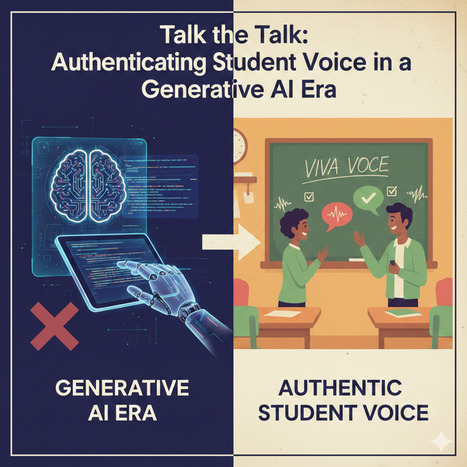
"In an era where generative AI can craft a convincing essay on the French Revolution or a lab report on osmosis in seconds, educators are facing an “authenticity crisis.” We’ve all felt it: that nagging doubt when a student’s written voice doesn’t quite match their classroom persona."
"The VIVA Framework is a structured, two-minute “micro-assessment” designed to confirm that the student who submitted the work is the same student who understands the work."
|
|
Scooped by
EDTECH@UTRGV
March 6, 2:49 PM
|
"Much of the conversation around artificial intelligence (AI) is framed in fear. White-collar professionals are increasingly anxious about AI replacing cognitive work once thought untouchable, a concern captured in The Atlantic’s piece on the worst-case future for white-collar workers. Blue-collar workers have their own version of this fear as employers test automation that shows up in the real world as robots and drones doing physical jobs once reserved for people, including delivery and warehouse work, like Amazon’s reported testing of humanoid delivery robots.
The anxiety is real. But what if we are asking the wrong question?"
"Instead of asking how we preserve jobs as they exist today, what if we ask whether working less might actually be progress?"
|
|
Scooped by
EDTECH@UTRGV
March 12, 10:50 AM
|
How can teachers use AI in practical, low-risk ways that will save them time and reduce their workload – without compromising their professional judgement?
“Your ability to ‘get good outcomes using AI’ tracks with your ability to ‘get good outcomes without AI.' AI does not replace strong teaching; it amplifies it. The educators who benefit most are those who use AI as a second thinker, a teaching assistant, or a proofreader – not as a decision-maker."
|
|
Scooped by
EDTECH@UTRGV
March 12, 10:44 AM
|
Learn how structured think-aloud methodologies help faculty assess higher-order critical thinking, metacognitive skills, and AI use in higher education.
"[I]f AI can generate essays and solutions, the focus of educators needs to shift from evaluating their final products to equipping and assessing students on critical thinking, self-regulation, and motivational skills. Effective assessment techniques need to provide insight into a learner’s thought processes in real time."
|
|
Scooped by
EDTECH@UTRGV
March 12, 10:39 AM
|
"An international survey of university academics and students by Coursera, the massive online learning platform with 375 leading university and industry partners, has revealed highly positive attitudes towards generative AI and that more than 95% make use of AI tools. But a weighty 56% fear that higher education is unprepared to handle AI."
"The report lists four key takeaways for university leaders regarding faculty and AI: prioritise investment in AI tools for faculty; provide targeted AI training; promote best practices; and identify AI champions to lead change."
|
|
Scooped by
EDTECH@UTRGV
March 11, 1:38 PM
|
The country needs an AI policy response that focuses on retooling and continued human development, or else we risk losing the very skills the tech is meant to complement.
"Much of the conversation about AI and work has centered on displacement—which jobs will vanish, which will emerge. A quieter crisis is unfolding alongside it: deskilling. Workers are at risk of losing the very skills that make them employable"
|
|
Scooped by
EDTECH@UTRGV
March 11, 1:31 PM
|
Is there a framework for AI integration in learning design to enhance creativity, accessibility, and effectiveness in your curriculum?
"We have frameworks for teaching with AI, frameworks for teaching about AI, and frameworks for learning using AI. We don't have a systematic approach for using AI in the course development process itself."
|
|
Scooped by
EDTECH@UTRGV
March 11, 1:25 PM
|
Meta, the company behind some of the world’s most popular social media platforms, just scooped up a new site – for bots.
"Meta has acquired Moltbook, the social media network where AI agents interact with one another autonomously"
|
|
Scooped by
EDTECH@UTRGV
March 10, 2:09 PM
|
First, it was no phones in schools. Now, amid the debate around edtech, schools are looking to go screen free.
"Some legislators and advocates are pushing to roll back the reliance on devices, particularly at a younger level when children are more susceptible to distractions."
Will school forbid screens like they banned smartphones? Some movements think so.
|
|
Scooped by
EDTECH@UTRGV
March 10, 1:59 PM
|
Classroom Technology Bans: How Better Learning Design Will Improve Classrooms, Not Removing Devices
"Making technology the scapegoat for declining educational outcomes distracts from the real issue and risks removing one of the most powerful tools students have to explore ideas, create knowledge, and pursue their goals."
|
|
Scooped by
EDTECH@UTRGV
March 10, 1:53 PM
|
When you look closely at the science of learning (constructivism, cognitive psychology, and social learning theory) you realize something that most effective learning experiences were already AI-resistant.
"AI-resistant learning isn’t just a reaction to ChatGPT or generative AI.
It’s actually rooted in decades of research about how people learn best."
|
|
Scooped by
EDTECH@UTRGV
March 9, 5:37 PM
|
"The tension between personalized learning demands and standardized evaluation mechanisms presents a persistent challenge in contemporary education. This study proposes a comprehensive personalized education assessment framework driven by generative artificial intelligence technologies. The framework adopts a five-layer hierarchical architecture integrating data collection, processing, intelligent analysis, assessment generation, and feedback optimization components."
"Experimental participants exhibited significantly higher learning gains (Cohen’s d = 0.56), with particularly pronounced effects among initially lower-performing students. The framework also enhanced learner engagement and satisfaction compared to conventional assessment approaches. These findings suggest that generative AI can effectively operationalize personalized assessment at scale while maintaining pedagogical quality and transparency."
|
|
Scooped by
EDTECH@UTRGV
March 9, 5:29 PM
|
Gen Z teachers grew up in an era of unbridled tech. It shapes how they approach classroom technology.
"Gen Z teachers are the first cohort of classroom educators that entered adolescence just as smartphones became ubiquitous. They grew up with much of their social lives online, shifting in their consumption habits from YouTube to Snapchat to TikTok as platforms rose and fell."
|
|
Scooped by
EDTECH@UTRGV
March 6, 2:55 PM
|
"Dealing with students who plagiarize now seems like a piece of cake compared to ones who use AI to write their papers. I could usually deter students from plagiarizing by demonstrating how easy it is for teachers to find it...However, the rise of AI has completely changed that approach."
"Discouraging students from using AI involves a two-prong approach. First, they should see that it won’t help them pass the course. And second, they must realize they are missing opportunities for the teacher to help them actually improve their writing."
|
|
Scooped by
EDTECH@UTRGV
March 6, 2:47 PM
|
For any student finding their footing in a completely new environment, technology should steady the path--not widen the digital experience gap
"When technology creates barriers, it’s harder for students to succeed–and that technology may undermine an institution’s own mission."
Your new post is loading...
"Ungrading shifts the focus from traditional letter or number grades to more holistic and student-centered methods of assessment. This approach aims to emphasize learning, growth, and mastery over the pressure and stress associated with traditional grading structures"