

Quiet quit your TEFL job? Here's how to fall back in love with teaching using Action Research - turn your classroom into a laboratory and rediscover curiosity.
Via Nik Peachey, Ricard Lloria


|
Rescooped by
juandoming
from Help and Support everybody around the world
onto E-Learning-Inclusivo (Mashup) February 17, 7:51 AM
|
 Scoop.it!
Quiet quit your TEFL job? Here's how to fall back in love with teaching using Action Research - turn your classroom into a laboratory and rediscover curiosity.

 Your new post is loading...
 Your new post is loading...
Your new post is loading...
Scoop.it!
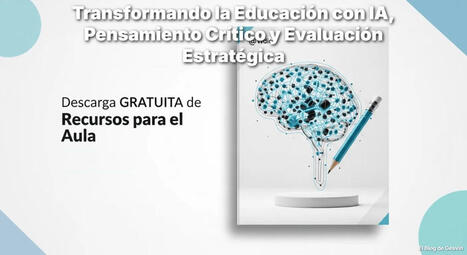
🎯 Una recopilación exhaustiva de recursos educativos diseñados para transformar tu práctica docente. Esta semana exploramos la integración de inteligencia artificial, estrategias avanzadas de pensamiento crítico, taxonomía de Bloom y herramientas prácticas de evaluación. Incluye plantillas descargables, guías de prompts situacionales y metodologías innovadoras para potenciar el aprendizaje significativo. 📚✨ Via Teresa Torné
Scoop.it!
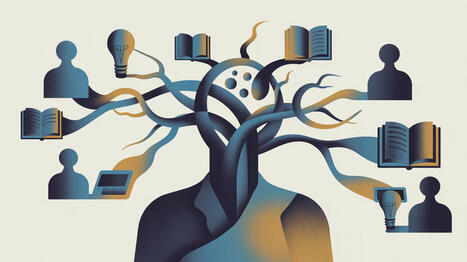
El concepto de descarga cognitiva (cognitive offloading) tiene una trayectoria larga en la investigación psicológica. Risko y Gilbert (2016) lo definieron como el uso de ayudas externas para realizar tareas cognitivas. No es nuevo: usamos agendas para no memorizar citas, calculadoras para no operar mentalmente, correctores ortográficos para no revisar cada palabra. Hasta aquí, nada preocupante. Via Edumorfosis 
Edumorfosis's curator insight,
April 11, 12:22 PM
Fernando Santamaría presenta el concepto de Delegación Cognitiva: Cuando un docente utiliza la automatización de la IA para dejar de pensar. El uso de la tecnología para adjuntar los entregables, aceptar los resultados y enviar las calificaciones. El resultado: Falsa ilusión de competencia docente. El profesor utiliza la IA para evaluar el trabajo entregado por parte del estudiante con la ayuda de la IA. Esto representa un malpractice docente por automatizar el proceso de evaluación sin leer el trabajo entregado, sin detectar errores conceptuales, sin visualizar las conecxiones mentales y sin saber quiénes se quedaron atascados en su proceso de aprendizaje.
Scoop.it!

GenAI can be a useful tool in assessment – if used intentionally. Find out what an intelligent dashboard can do for your students’ relationship to GenAI Via Vladimir Kukharenko
Scoop.it!

Discover how to embed choice into learning in a clear, manageable and meaningful way Via Vladimir Kukharenko
Scoop.it!

Discover how using AI to teach critical thinking in higher education turns AI errors into powerful classroom strategies that build information literacy and academic judgment. Via EDTECH@UTRGV 
Nik Peachey's curator insight,
April 6, 1:54 AM
This article has some useful tips https://www.facultyfocus.com/articles/teaching-with-technology-articles/when-ai-gets-it-wrong-a-pedagogical-approach/ 
jonesfree354@gmail.com's curator insight,
April 11, 7:40 AM
https://agrocoltd.com/product/buy-robusta-coffee-beans/ https://agrocoltd.com/product/arabica-coffee-beans-for-sale/ https://agrocoltd.com/product/white-maize/ https://agrocoltd.com/product/cashew-nuts/ https://agrocoltd.com/product/sunflower-seeds/ https://agrocoltd.com/product/green-cardamom/ https://agrocoltd.com/product/turmeric/ https://agrocoltd.com/product/cloves/ https://agrocoltd.com/product/chickpeas/ https://agrocoltd.com/product/organic-soybean/ https://havenkittykingdom.com/british-shorthair/ https://havenkittykingdom.com/ragdoll-kittens/ https://deutschesprachzertifikate.com.de/goethe-zertifikat/ https://deutschesprachzertifikate.com.de/testdaf-zertifikat/ https://deutschesprachzertifikate.com.de/osd-zertifikat/ https://deutschesprachzertifikate.com.de/telc-zertifikat/
Scoop.it!
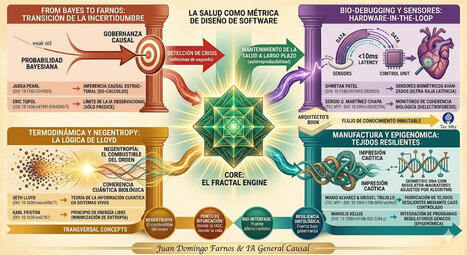
Juan Domingo Farnos Cambiamos la medicina que solo "observa" por una tecnología que "toma el control" para salvar a quienes hoy se consideran inoperables. Mediante una inteligencia artificial avanzada, estabilizamos el cuerpo en milisegundos durante la cirugía, eliminando el riesgo del fallo orgánico. Es el paso de la duda estadística a la seguridad científica, donde…
Scoop.it!

From
er

Across campuses, conversations about artificial intelligence are sometimes being framed by unease rather than enthusiasm. Leaders, faculty and student Via Yashy Tohsaku
Scoop.it!

From
scroll
The academics spoke about translation, authority, disciplinary boundaries, science communication, and AI and its risks. " Of translation, transgression, and transcreation: A conversation on knowledge across languages The academics spoke about translation, authority, disciplinary boundaries, science communication, and AI and its risks. Doyeeta Majumder, Anuj Misra, Bill Mak, Subha Prasad Sanyal & Biju Paul Abraham Mar 29, 2026 · 08:30 pm The 2026 Making and Unmaking Facts roundtable conference. What do facts, data, and objectivity mean for literature and translation in South Asia today? “Making and Unmaking Facts”, a conference on the subject, was organised by Fact or Value, DECISION, and IIM Calcutta in February 2026 to explore this and related questions.
The conference examined how facts are made, stabilised, challenged and granted authority across different social and political contexts. It feels especially relevant now, when public life is increasingly shaped by debates around post-truth, misinformation, expertise and the question of who gets to decide what counts as fact.
Advertisement The roundtable extended those concerns into a wider conversation about translation, authority, disciplinary boundaries, science communication, AI and the risks of both rigid certainty and corrosive relativism.
Anuj Misra, Professor of the History of Science and the History of Knowledge, Bill Mak, Professor of History of Science at the University of Science and Technology, John Mathew, Professor of the History of Science, Sourav Bhattacharya, Professor of Economics, Biju Paul Abraham, Professor of Public Policy, and translator Subha Prasad Sanyal were in conversation with academic Doyeeta Majumder at the conference.
Excerpts from the conversation.
Advertisement Doyeeta Majumder (DM): I would like to begin with the question of language and translation, how the making and unmaking of facts is mediated through, and constantly has to encounter, the issue of translation, transpropriation, and encounters with other systems of knowledge and other times. Facts are made at a particular point in history, at a certain historical moment; then they can be challenged and unmade, and later they can recrystallise and new certainties might emerge. This process is mediated through acts of carrying across.
Translation is not merely the question of rendering something into another language; it often involves a completely different idiom of doing science. What are these idioms of knowledge-making in different times and cultures? How do encounters with the “other” make and unmake objectivities and certainties?
Anuj Misra (AM): It is interesting to consider the cognitive space one occupies when transporting a concept from one language into another. In doing so, one lives simultaneously in two worlds, the world that belongs to you and the one that does not. One must navigate how to bring something foreign into one’s own conceptual space.
Advertisement While language does act as a mediator at this point, it has its own restrictions and strictures that delineate and shape what you are trying to understand and what you are trying to communicate. Much depends on tacit skill, your ability to introduce new words, your mastery of grammar, and your control over concepts. Many factors are already written into the translation process, including internal cognitive mediations that we do not hear about.
Equivalence, particularly in the context of translation studies, is never final. It is always in the process of being finalised, but never fully complete.
Bill Mak (BM): Translation is something I have worked on extensively, particularly in the course of my doctoral studies on Sino-Indian Buddhist translation. The translation of Indian Buddhist texts into Chinese was one of the largest human intellectual endeavours, taking nearly a millennium and becoming a collaborative project involving scholars from Central Asia, India and China.
Advertisement Although there is, of course, a linguistic dimension, translation involves more than linguistic crossing; it involves crossing cultural identities, epistemologies and value systems. There can be many ways of perceiving such acts of crossing boundaries: it can be seen positively, as in “transcreation”, where something new is added. But it can also be perceived as transgressive, provoking negative reactions to such boundary-crossing.
We can see an example of such negative reactions in the case of Hindu numerals being introduced in China, where such attempts were either completely ignored or, worse, the bringers of such new knowledge were attacked by traditional scholars, and this new scholarship was then buried for centuries before being rediscovered. As a result, although the Chinese developed their own zero sign, they did not benefit from that earlier encounter with Indian astronomers.
Sourav Bhattacharya (SB): Two words seem to be of particular significance in this context: “transgression” and “expertise”. Keeping these two words in mind, let me ask: Is there also the question of protecting one’s turf? Expertise builds authority, but it is also the source of one’s livelihood. There may be reluctance to allow dilution. A grammarian, for instance, establishes rules to maintain purity, but in doing so creates boundaries that make translation more difficult.
Advertisement During the Cold War, for instance, mathematicians in the US and the USSR worked on similar problems with little exchange, leading to duplication of effort. Might there be political efforts to protect intellectual territory that hinder translation and knowledge creation?
AM: Knowledge ownership is complex. Once a book is published, it no longer belongs solely to the author but to its readers. When knowledge systems are owned and possessed, transgression becomes possible because someone enters another’s intellectual territory.
We often speak of knowledge economies but rarely of knowledge parochialism. In certain societies, certain knowledge systems are codified in certain other kinds of practice. For example, although scholars of Sanskrit often paint a very secular picture of it, the dominant narrative is that Sanskrit is a sacred language, a language of the gods, thereby fortified and insulated from intrusion, creating a parochial view of its excellence, unnecessarily so. Yet alongside this existed secular forms such as marketplace Sanskrit and Buddhist Hybrid Sanskrit, which is a mix of Sanskrit with Pali and Prakrit languages. Thus, astrology, for example, which was practised in hybridised Sanskrit, much more readily absorbed foreign Perso-Arabic material because it was not parochialised. However, when knowledge is tied to economic survival, such as royal or administrative bureaux, new systems that threaten established practices are resisted.
Advertisement At a philosophical level, once a work is created, can it truly be transgressed? Who is the victim in such a case?
John Mathew (JM): However, we must also think about societies that have been dominated and have become parochial by necessity, the Toda people, for example. In such cases, the transgression of knowledge boundaries has happened after the advent of colonialism, so there is a kind of protectionism in operation here.
AM: Of course, parochialism can also be thought of in terms of protectionism. In the short run, keeping itself closed off allows something to preserve itself until the imminent dangers have ceased, for a while. It certainly allows you to guard something until it can flourish again. Welsh is a great example, where people had to guard their language against English. They were even punished; it was extremely difficult for them even to learn their language. Very often, Welsh-speaking people miss a generation. So there is always a resurgence from the grandparents to the grandchildren, and the parents do not speak it. This happens regularly because, of course, they get narrowed and siloed into their own little communities.
Advertisement DM: I was just thinking of Ramanujan and a certain way of doing mathematics that disappeared with him; there was no revival for that. It died with Ramanujan when other systems of calculation and proof took over.
BM: When discussing knowledge parochialism, I am reminded of academia today. In many academic departments, the buzzword is interdisciplinarity, yet economic pressures encourage departments to protect their funding and survival. Interdisciplinarity can become almost an irony: when a conference is designated “interdisciplinary”, it is usually hosted by a single department, by a single discipline, which is now feeling the pressure to open up to interdisciplinary discourse.
But are we empowered to produce credible and morally valuable knowledge within the current institutional and power structures of academia?
Advertisement AM: Interdisciplinarity is an interesting term. The disciplines were themselves created by compartmentalising knowledge, assuming that expertise in the individual parts would eventually allow reconstruction of the whole. Interdisciplinarity then attempts to bridge an artificial divide with another artificial construct.
Bill and I are philologists. We look at ancient texts, we translate them, we understand their historical context, and then we bring the skills of philology and history to bear on them, and, to a certain extent, philosophy as well. We are not sociologists, but nine out of ten texts under discussion were probably texts that we had both read. So how does it really happen? I cannot claim the authority to stand up here and say I am a sociologist. I am not. But many of the texts you cite and talk about do not categorise themselves as sociological texts, or philosophical texts, or historical texts. They are texts. There is something they communicate. Once we understand communication, we can draw upon it in whatever field we wish to apply it to. So I think a better way, and this has happened in many universities, would be to abandon the idea of departments and instead create notions of themes, thematic discourse, where you build upon skills from law to sociology to medicine to talk about that theme and bring it to the fore, using them in very similar ways to how we use our skills in philology and philosophy at the same time when we look at a text.
JM: But there is also the tyranny of the invisible canon. Scholars often rely on recognised names, Spivak, Foucault, and construct their talks around them because it helps if the audience is familiar with and attuned to particular names rather than having to make the case for someone more obscure.
Advertisement BM: In some academic contexts, historical work, say, work on the history of science, is taken seriously only if framed within sociological theory. One must preface presentations with references from sociology in order to be heard.
I do agree with Anuj that a thematic approach might be more productive. To a theme, we then apply different skills. From a pedagogical point of view, this would require students to develop a much broader repertoire of skills: science students with liberal arts exposure, and arts students with scientific literacy. The Chinese, for the longest time, had this tradition. Traditional Chinese scholars were often well-versed in literature, music, natural science, and philosophy. However, current educational trends often move in the opposite direction.
DM: My final question is about what kinds of conversations historians and philosophers of science, especially those originally trained in scientific disciplines, are having with practitioners in the fields whose histories or philosophies they study.
Advertisement AM: Yes, in fact. But theoretical physics has become so obscure that the divisions between mathematics and philosophy have nearly erased themselves. Neither mathematicians nor philosophers understand what string theorists do, so they have created a universe in which, very often, they have to do both jobs themselves. When a string theorist talks about thirty-second dimensions of bosonic particles, it is almost impossible to understand what they mean. Only they understand that; for them, it is real. It is tangible. It is something they can play with. They see it, they visualise it, they understand what it really means. But they are very poor at communicating, and this is largely because they have never been called upon to communicate. They are very happy living monastic lives, doing mathematics, being left alone. And that is essentially how we have codified mathematicians in general: you do not understand a word of what they are talking about because the point of entry is so high.
This is where we break down. I teach a course on the history of mathematics, one concerned with thinking across the divide, where we have to bring people out of their irrational fear of mathematics. I have never heard anyone tell me that they are afraid of music, even though music is equally complicated. If I write music for you, or take you to a course in musicology, the point of entry is about as difficult as it is to get into string theory. But how is it that you are not afraid of music? Because there is something palpable about music, even cacophony. You can decide that you do not like this, but you can actually give it a listen. How do you give an equation a listen? And that is exactly what I teach in my course: how to listen to equations rather than look at the numbers and be afraid.
JM: Your reference to music is interesting. I once heard a TED Talk about the “music of the melting Arctic”, where climate data were rendered musically. It is interesting because you learn through music that everything is not hunky-dory, and this is more telling than anything any particular statistician could ever say.
Advertisement I teach a course called Science, History and Theatre, and students actually have to write their own play at the very end. It has always been fascinating to see how much science can be communicated through the medium of the play. Do you have to use literal elements? Do you need to resort to a metaphor? What do you do? So often, a metaphor is employed in this particular case.
BM: The question of how the dialogue takes place is a very important one. And, of course, it is not only about how the dialogue takes place among scholars, but also about the specialist communicating with non-specialists, with other colleagues, or with the public. I think there have been some good developments: you have science communicators like Carl Sagan and Brian Cox, and they are very approachable and inviting. But you do not have these people in all disciplines.
What happens when this large and messy body of evidence is encountered by non-specialists? Since the specialists are not willing to take up the task, the generalist or non-specialist still feels like taking on the job. But maybe AI will bring down all these barriers and become a game-changer. When you go to either ChatGPT or the BBC, you have equal access to everything. Of course, the irony is, as I mentioned, that AI is neither artificial nor intelligent. It is not capable of actually discerning things on the basis of truth value. But at least it opens up the opportunity, the accessibility of expertise and knowledge.
Advertisement SB: But you notice that ChatGPT, or such AI models, are much more open and permissive than regular referees, who are completely embedded within the field, which is perhaps something we were pointing out.
We have seen that facts are made, facts are unmade, facts are value-laden, and so on. But is there a risk of pushing this a bit too far, where there are multiple groups trying to produce facts, which become competing narratives? In today’s world, with social media, you end up in a scenario where people look at any fact, or anything spewed as fact, with deep scepticism, and then we end up with a situation of anarchy in the field of knowledge. I am particularly talking about laypeople here.
How do we determine what is too far?
Advertisement BM: I think that, for laypeople, there is the fear of relativism, so everything becomes flat because it is equally accessible and there are competing narratives, and so on.
But ultimately, it is the human mind that needs to make the judgment. We develop all these matrices and indices to evaluate standards – they help us to make decisions, not to decide for us.
AM: In the context of the fear about relativism, I offer the idea of the “workable epistemology”. Practising mathematicians, take a financial mathematician, for instance, who does not constantly question the ontological status of the numbers on their desk during their job. But does that mean they are not qualified enough to reflect on numbers? Not at all. They certainly are qualified, if they wish to. So I think there is a certain level of workable realism when it comes to facts. It is like the weather service: when it tells you the weather in the morning, you tend to believe it. If it rains, you do not sue them.
Advertisement The problem arises when facts are treated as sacred and immutable. As long as we understand the relativism of the fact that it can be reinterpreted again in the current moment, there is room for movement. This is the method of standpoint epistemology, in a sense: you believe in something for the moment, and that has the opportunity of changing later.
JM: But I often ask myself this question: for the lay public, how many narratives can be held simultaneously? I think it is important, because we are all inveterate classifiers and librarians, right? In some sense, we say, all right, beyond a particular point, when there is a profusion of narratives, it becomes really difficult to be able to talk about something.
So even if you say there are other ways of looking at things, is there a limit to how many of these narratives can be kept in mind at the same time?
Advertisement AM: In certain situations where a fact has a direct implication for society, like the recent rise in the measles epidemic in the US because people are vaccine-resistant, despite a long history of proving how effective vaccines have been, and despite a mongered fear of vaccines essentially having caused autism without any substantial basis, we have created a complex social situation.
This harks back to that very problem again: we have created an alienation of science in society. People have picked one narrative or another and then applied it as they want to and used their own judgement on it. But they have not been given the decision-making framework. They have never been taught how to evaluate information. So rather than simply codifying the fact that vaccines do not cause autism, it would be a better idea to train people in how to interpret the fact. So, the question is about how many narratives? There can never be an answer to that. As many as needed. Look at the idea of ritual and religion.
People come up with the same practice, the same codified mass, the same codified thing. Still, there are differences in practice everywhere. In every religion, people will practise a ritual in the way they want to ritualise it, and this allows multiplicity to survive. Yet in a common practice, if you and I constitute a temple or a mosque together, we will codify that in some kind of subjective way. How will we be doing this one?
Advertisement BM: I feel that there is a deeply human dimension to all these questions. There is a certain kind of laziness in thinking. You just do not want to apply yourself, to put yourself in your opponents’ or alternatives’ position. And I think, in our education system, there is this lack of emphasis on how to consider opinions from different points of view, and on the need for a sense of empathy in the sense of understanding things from different perspectives, whether of people with different values, different religions, different epistemologies, and so on.
DM: Perhaps the problem also lies in applying the same frameworks used to critique political or religious power to science without adjustment. Of course, training people to evaluate things for themselves would be the best-case scenario. But there are also very many times when people want to be told certain things and desire certainty. They may reject institutional expertise but accept alternative claims, such as miracle cures or confirmations of self-diagnoses, because doing so feels empowering or rebellious.
Subha Prasad Sanyal (SPS): If all claims can have truth value only in the epistemic context in which they are made, does this claim not then itself become true only in particular contexts? Is this position self-defeating?
Advertisement AM: At a meta-philosophical level, yes, such arguments can become recursive. In fact, when Longinus talked about the idea that every judgement is particular to its universe of discourse, the rebuttal was exactly the same: well, is that judgement not also saying the same thing within the discourse? So yes, at the meta-level, if you keep debating the philosophical implications of it, you will be caught in an endless loop. However, this is where the difference lies. It is not necessary to have a conversation at the meta-level to see that it is by virtue of a fact’s being based on an onto-epistemic grounding that it is called a fact.
Biju Paul Abraham (BPA): As someone who reads Bengali literature in translation, one of the things I recognise about those translations is that they are not exact translations. There is possibly some element of transgression, some element of transcreation, perhaps, which has been done in order to help me understand. So, when I read it, I understand that there could be issues with the translation. It is not exact. But as a layperson, and I consider myself a layperson in that context, I am happy to have it because I get a limited experience of it. If you worry too much about the exactness of the translation, then the problem is that you come back to the kind of issue that Nirad C Chaudhuri raised. His books have long quotations in French, so when his publisher told him, “You know, it is an English book, and there are these French quotations in it. So why don’t you provide an English translation as well?” Chaudhuri said, “If you don’t know French, you shouldn’t be reading my books.” If you adopt that kind of attitude, there is so much that is lost.
AM: This is exactly the workable epistemology I am talking about. At the level of what it functions for, it is perfectly fine. As long as we understand at what level it functions, and what we are doing, it functions. But if you build your entire belief system about Bengali literature on the basis of your reading in translation, and codify that worldview into your absolute reality, that is the problem. As long as you allow yourself to be hospitable to yourself in a recurring sense, and we understand the fact that we are only entering someone else’s space, and I am happy that I have been welcomed there, and I feel hospitable there, and I learned something, and I do understand that there are limitations, then it is perfectly fine.
Advertisement DM: This is how we work with the logic of periodisation when we teach history: dividing it up into ancient, medieval, and modern. And while you say that to first-year students, in the next class, or the next year, you say: but all of that is not really true, actually, constantly urging the questioning of those certainties.
Some things to think about, for me personally, are the questions about collective subjectivity: the kind of objectivity that is produced by that collective subjectivity; the use of personal discretion, rational discretion, both for the producers of knowledge and for the consumers of knowledge.
Doyeeta Majumder is an Assistant Professor of English at Jadavpur University.
Advertisement Anuj Misra is Professor of the History of Science and the History of Knowledge at Freie Universität Berlin and leads the Max Planck Research Group “Astral Sciences in Trans-Regional Asia” (ASTRA).
Bill Mak is Professor of History of Science at the University of Science and Technology of China and Research Associate at the Needham Research Institute, Cambridge, with research interests in the history of science in Asia, Buddhist translation, and Sino-Indian studies.
John Mathew is Dean of the Arts and the Humanities and Professor of the History of Science at the Asian University for Women, where his work focuses on natural history, disease, and environmental history in South Asia.
Advertisement Sourav Bhattacharya is Professor of Economics at IIM Calcutta, with interests spanning the economics of organisations, political economy, and development.
Biju Paul Abraham is Professor of Public Policy in the Public Policy and Management Group at IIM Calcutta.
Subha Prasad Sanyal is a Kolkata-based Bengali literary translator and winner of the 2018 Harvill Secker Young Translator’s Prize, noted for translating Hawa Hawa and Other Stories.
Fact or Value is an online forum with a focus on philosophy, intellectual history and aesthetics. They host lectures and design books on unusual subjects."
#metaglossia #metaglossia_mundus Via Charles Tiayon 
Charles Tiayon's curator insight,
March 31, 2:48 AM
The academics spoke about translation, authority, disciplinary boundaries, science communication, and AI and its risks.
"
Of translation, transgression, and transcreation: A conversation on knowledge across languages
The academics spoke about translation, authority, disciplinary boundaries, science communication, and AI and its risks.
Doyeeta Majumder, Anuj Misra, Bill Mak, Subha Prasad Sanyal & Biju Paul Abraham
Mar 29, 2026 · 08:30 pm
The 2026 Making and Unmaking Facts roundtable conference.
What do facts, data, and objectivity mean for literature and translation in South Asia today? “Making and Unmaking Facts”, a conference on the subject, was organised by Fact or Value, DECISION, and IIM Calcutta in February 2026 to explore this and related questions.
The conference examined how facts are made, stabilised, challenged and granted authority across different social and political contexts. It feels especially relevant now, when public life is increasingly shaped by debates around post-truth, misinformation, expertise and the question of who gets to decide what counts as fact.
Advertisement
The roundtable extended those concerns into a wider conversation about translation, authority, disciplinary boundaries, science communication, AI and the risks of both rigid certainty and corrosive relativism.
Anuj Misra, Professor of the History of Science and the History of Knowledge, Bill Mak, Professor of History of Science at the University of Science and Technology, John Mathew, Professor of the History of Science, Sourav Bhattacharya, Professor of Economics, Biju Paul Abraham, Professor of Public Policy, and translator Subha Prasad Sanyal were in conversation with academic Doyeeta Majumder at the conference.
Excerpts from the conversation.
Advertisement
Doyeeta Majumder (DM): I would like to begin with the question of language and translation, how the making and unmaking of facts is mediated through, and constantly has to encounter, the issue of translation, transpropriation, and encounters with other systems of knowledge and other times. Facts are made at a particular point in history, at a certain historical moment; then they can be challenged and unmade, and later they can recrystallise and new certainties might emerge. This process is mediated through acts of carrying across.
Translation is not merely the question of rendering something into another language; it often involves a completely different idiom of doing science. What are these idioms of knowledge-making in different times and cultures? How do encounters with the “other” make and unmake objectivities and certainties?
Anuj Misra (AM): It is interesting to consider the cognitive space one occupies when transporting a concept from one language into another. In doing so, one lives simultaneously in two worlds, the world that belongs to you and the one that does not. One must navigate how to bring something foreign into one’s own conceptual space.
Advertisement
While language does act as a mediator at this point, it has its own restrictions and strictures that delineate and shape what you are trying to understand and what you are trying to communicate. Much depends on tacit skill, your ability to introduce new words, your mastery of grammar, and your control over concepts. Many factors are already written into the translation process, including internal cognitive mediations that we do not hear about.
Equivalence, particularly in the context of translation studies, is never final. It is always in the process of being finalised, but never fully complete.
Bill Mak (BM): Translation is something I have worked on extensively, particularly in the course of my doctoral studies on Sino-Indian Buddhist translation. The translation of Indian Buddhist texts into Chinese was one of the largest human intellectual endeavours, taking nearly a millennium and becoming a collaborative project involving scholars from Central Asia, India and China.
Advertisement
Although there is, of course, a linguistic dimension, translation involves more than linguistic crossing; it involves crossing cultural identities, epistemologies and value systems. There can be many ways of perceiving such acts of crossing boundaries: it can be seen positively, as in “transcreation”, where something new is added. But it can also be perceived as transgressive, provoking negative reactions to such boundary-crossing.
We can see an example of such negative reactions in the case of Hindu numerals being introduced in China, where such attempts were either completely ignored or, worse, the bringers of such new knowledge were attacked by traditional scholars, and this new scholarship was then buried for centuries before being rediscovered. As a result, although the Chinese developed their own zero sign, they did not benefit from that earlier encounter with Indian astronomers.
Sourav Bhattacharya (SB): Two words seem to be of particular significance in this context: “transgression” and “expertise”. Keeping these two words in mind, let me ask: Is there also the question of protecting one’s turf? Expertise builds authority, but it is also the source of one’s livelihood. There may be reluctance to allow dilution. A grammarian, for instance, establishes rules to maintain purity, but in doing so creates boundaries that make translation more difficult.
Advertisement
During the Cold War, for instance, mathematicians in the US and the USSR worked on similar problems with little exchange, leading to duplication of effort. Might there be political efforts to protect intellectual territory that hinder translation and knowledge creation?
AM: Knowledge ownership is complex. Once a book is published, it no longer belongs solely to the author but to its readers. When knowledge systems are owned and possessed, transgression becomes possible because someone enters another’s intellectual territory.
We often speak of knowledge economies but rarely of knowledge parochialism. In certain societies, certain knowledge systems are codified in certain other kinds of practice. For example, although scholars of Sanskrit often paint a very secular picture of it, the dominant narrative is that Sanskrit is a sacred language, a language of the gods, thereby fortified and insulated from intrusion, creating a parochial view of its excellence, unnecessarily so. Yet alongside this existed secular forms such as marketplace Sanskrit and Buddhist Hybrid Sanskrit, which is a mix of Sanskrit with Pali and Prakrit languages. Thus, astrology, for example, which was practised in hybridised Sanskrit, much more readily absorbed foreign Perso-Arabic material because it was not parochialised. However, when knowledge is tied to economic survival, such as royal or administrative bureaux, new systems that threaten established practices are resisted.
Advertisement
At a philosophical level, once a work is created, can it truly be transgressed? Who is the victim in such a case?
John Mathew (JM): However, we must also think about societies that have been dominated and have become parochial by necessity, the Toda people, for example. In such cases, the transgression of knowledge boundaries has happened after the advent of colonialism, so there is a kind of protectionism in operation here.
AM: Of course, parochialism can also be thought of in terms of protectionism. In the short run, keeping itself closed off allows something to preserve itself until the imminent dangers have ceased, for a while. It certainly allows you to guard something until it can flourish again. Welsh is a great example, where people had to guard their language against English. They were even punished; it was extremely difficult for them even to learn their language. Very often, Welsh-speaking people miss a generation. So there is always a resurgence from the grandparents to the grandchildren, and the parents do not speak it. This happens regularly because, of course, they get narrowed and siloed into their own little communities.
Advertisement
DM: I was just thinking of Ramanujan and a certain way of doing mathematics that disappeared with him; there was no revival for that. It died with Ramanujan when other systems of calculation and proof took over.
BM: When discussing knowledge parochialism, I am reminded of academia today. In many academic departments, the buzzword is interdisciplinarity, yet economic pressures encourage departments to protect their funding and survival. Interdisciplinarity can become almost an irony: when a conference is designated “interdisciplinary”, it is usually hosted by a single department, by a single discipline, which is now feeling the pressure to open up to interdisciplinary discourse.
But are we empowered to produce credible and morally valuable knowledge within the current institutional and power structures of academia?
Advertisement
AM: Interdisciplinarity is an interesting term. The disciplines were themselves created by compartmentalising knowledge, assuming that expertise in the individual parts would eventually allow reconstruction of the whole. Interdisciplinarity then attempts to bridge an artificial divide with another artificial construct.
Bill and I are philologists. We look at ancient texts, we translate them, we understand their historical context, and then we bring the skills of philology and history to bear on them, and, to a certain extent, philosophy as well. We are not sociologists, but nine out of ten texts under discussion were probably texts that we had both read. So how does it really happen? I cannot claim the authority to stand up here and say I am a sociologist. I am not. But many of the texts you cite and talk about do not categorise themselves as sociological texts, or philosophical texts, or historical texts. They are texts. There is something they communicate. Once we understand communication, we can draw upon it in whatever field we wish to apply it to. So I think a better way, and this has happened in many universities, would be to abandon the idea of departments and instead create notions of themes, thematic discourse, where you build upon skills from law to sociology to medicine to talk about that theme and bring it to the fore, using them in very similar ways to how we use our skills in philology and philosophy at the same time when we look at a text.
JM: But there is also the tyranny of the invisible canon. Scholars often rely on recognised names, Spivak, Foucault, and construct their talks around them because it helps if the audience is familiar with and attuned to particular names rather than having to make the case for someone more obscure.
Advertisement
BM: In some academic contexts, historical work, say, work on the history of science, is taken seriously only if framed within sociological theory. One must preface presentations with references from sociology in order to be heard.
I do agree with Anuj that a thematic approach might be more productive. To a theme, we then apply different skills. From a pedagogical point of view, this would require students to develop a much broader repertoire of skills: science students with liberal arts exposure, and arts students with scientific literacy. The Chinese, for the longest time, had this tradition. Traditional Chinese scholars were often well-versed in literature, music, natural science, and philosophy. However, current educational trends often move in the opposite direction.
DM: My final question is about what kinds of conversations historians and philosophers of science, especially those originally trained in scientific disciplines, are having with practitioners in the fields whose histories or philosophies they study.
Advertisement
AM: Yes, in fact. But theoretical physics has become so obscure that the divisions between mathematics and philosophy have nearly erased themselves. Neither mathematicians nor philosophers understand what string theorists do, so they have created a universe in which, very often, they have to do both jobs themselves. When a string theorist talks about thirty-second dimensions of bosonic particles, it is almost impossible to understand what they mean. Only they understand that; for them, it is real. It is tangible. It is something they can play with. They see it, they visualise it, they understand what it really means. But they are very poor at communicating, and this is largely because they have never been called upon to communicate. They are very happy living monastic lives, doing mathematics, being left alone. And that is essentially how we have codified mathematicians in general: you do not understand a word of what they are talking about because the point of entry is so high.
This is where we break down. I teach a course on the history of mathematics, one concerned with thinking across the divide, where we have to bring people out of their irrational fear of mathematics. I have never heard anyone tell me that they are afraid of music, even though music is equally complicated. If I write music for you, or take you to a course in musicology, the point of entry is about as difficult as it is to get into string theory. But how is it that you are not afraid of music? Because there is something palpable about music, even cacophony. You can decide that you do not like this, but you can actually give it a listen. How do you give an equation a listen? And that is exactly what I teach in my course: how to listen to equations rather than look at the numbers and be afraid.
JM: Your reference to music is interesting. I once heard a TED Talk about the “music of the melting Arctic”, where climate data were rendered musically. It is interesting because you learn through music that everything is not hunky-dory, and this is more telling than anything any particular statistician could ever say.
Advertisement
I teach a course called Science, History and Theatre, and students actually have to write their own play at the very end. It has always been fascinating to see how much science can be communicated through the medium of the play. Do you have to use literal elements? Do you need to resort to a metaphor? What do you do? So often, a metaphor is employed in this particular case.
BM: The question of how the dialogue takes place is a very important one. And, of course, it is not only about how the dialogue takes place among scholars, but also about the specialist communicating with non-specialists, with other colleagues, or with the public. I think there have been some good developments: you have science communicators like Carl Sagan and Brian Cox, and they are very approachable and inviting. But you do not have these people in all disciplines.
What happens when this large and messy body of evidence is encountered by non-specialists? Since the specialists are not willing to take up the task, the generalist or non-specialist still feels like taking on the job. But maybe AI will bring down all these barriers and become a game-changer. When you go to either ChatGPT or the BBC, you have equal access to everything. Of course, the irony is, as I mentioned, that AI is neither artificial nor intelligent. It is not capable of actually discerning things on the basis of truth value. But at least it opens up the opportunity, the accessibility of expertise and knowledge.
Advertisement
SB: But you notice that ChatGPT, or such AI models, are much more open and permissive than regular referees, who are completely embedded within the field, which is perhaps something we were pointing out.
We have seen that facts are made, facts are unmade, facts are value-laden, and so on. But is there a risk of pushing this a bit too far, where there are multiple groups trying to produce facts, which become competing narratives? In today’s world, with social media, you end up in a scenario where people look at any fact, or anything spewed as fact, with deep scepticism, and then we end up with a situation of anarchy in the field of knowledge. I am particularly talking about laypeople here.
How do we determine what is too far?
Advertisement
BM: I think that, for laypeople, there is the fear of relativism, so everything becomes flat because it is equally accessible and there are competing narratives, and so on.
But ultimately, it is the human mind that needs to make the judgment. We develop all these matrices and indices to evaluate standards – they help us to make decisions, not to decide for us.
AM: In the context of the fear about relativism, I offer the idea of the “workable epistemology”. Practising mathematicians, take a financial mathematician, for instance, who does not constantly question the ontological status of the numbers on their desk during their job. But does that mean they are not qualified enough to reflect on numbers? Not at all. They certainly are qualified, if they wish to. So I think there is a certain level of workable realism when it comes to facts. It is like the weather service: when it tells you the weather in the morning, you tend to believe it. If it rains, you do not sue them.
Advertisement
The problem arises when facts are treated as sacred and immutable. As long as we understand the relativism of the fact that it can be reinterpreted again in the current moment, there is room for movement. This is the method of standpoint epistemology, in a sense: you believe in something for the moment, and that has the opportunity of changing later.
JM: But I often ask myself this question: for the lay public, how many narratives can be held simultaneously? I think it is important, because we are all inveterate classifiers and librarians, right? In some sense, we say, all right, beyond a particular point, when there is a profusion of narratives, it becomes really difficult to be able to talk about something.
So even if you say there are other ways of looking at things, is there a limit to how many of these narratives can be kept in mind at the same time?
Advertisement
AM: In certain situations where a fact has a direct implication for society, like the recent rise in the measles epidemic in the US because people are vaccine-resistant, despite a long history of proving how effective vaccines have been, and despite a mongered fear of vaccines essentially having caused autism without any substantial basis, we have created a complex social situation.
This harks back to that very problem again: we have created an alienation of science in society. People have picked one narrative or another and then applied it as they want to and used their own judgement on it. But they have not been given the decision-making framework. They have never been taught how to evaluate information. So rather than simply codifying the fact that vaccines do not cause autism, it would be a better idea to train people in how to interpret the fact. So, the question is about how many narratives? There can never be an answer to that. As many as needed. Look at the idea of ritual and religion.
People come up with the same practice, the same codified mass, the same codified thing. Still, there are differences in practice everywhere. In every religion, people will practise a ritual in the way they want to ritualise it, and this allows multiplicity to survive. Yet in a common practice, if you and I constitute a temple or a mosque together, we will codify that in some kind of subjective way. How will we be doing this one?
Advertisement
BM: I feel that there is a deeply human dimension to all these questions. There is a certain kind of laziness in thinking. You just do not want to apply yourself, to put yourself in your opponents’ or alternatives’ position. And I think, in our education system, there is this lack of emphasis on how to consider opinions from different points of view, and on the need for a sense of empathy in the sense of understanding things from different perspectives, whether of people with different values, different religions, different epistemologies, and so on.
DM: Perhaps the problem also lies in applying the same frameworks used to critique political or religious power to science without adjustment. Of course, training people to evaluate things for themselves would be the best-case scenario. But there are also very many times when people want to be told certain things and desire certainty. They may reject institutional expertise but accept alternative claims, such as miracle cures or confirmations of self-diagnoses, because doing so feels empowering or rebellious.
Subha Prasad Sanyal (SPS): If all claims can have truth value only in the epistemic context in which they are made, does this claim not then itself become true only in particular contexts? Is this position self-defeating?
Advertisement
AM: At a meta-philosophical level, yes, such arguments can become recursive. In fact, when Longinus talked about the idea that every judgement is particular to its universe of discourse, the rebuttal was exactly the same: well, is that judgement not also saying the same thing within the discourse? So yes, at the meta-level, if you keep debating the philosophical implications of it, you will be caught in an endless loop. However, this is where the difference lies. It is not necessary to have a conversation at the meta-level to see that it is by virtue of a fact’s being based on an onto-epistemic grounding that it is called a fact.
Biju Paul Abraham (BPA): As someone who reads Bengali literature in translation, one of the things I recognise about those translations is that they are not exact translations. There is possibly some element of transgression, some element of transcreation, perhaps, which has been done in order to help me understand. So, when I read it, I understand that there could be issues with the translation. It is not exact. But as a layperson, and I consider myself a layperson in that context, I am happy to have it because I get a limited experience of it. If you worry too much about the exactness of the translation, then the problem is that you come back to the kind of issue that Nirad C Chaudhuri raised. His books have long quotations in French, so when his publisher told him, “You know, it is an English book, and there are these French quotations in it. So why don’t you provide an English translation as well?” Chaudhuri said, “If you don’t know French, you shouldn’t be reading my books.” If you adopt that kind of attitude, there is so much that is lost.
AM: This is exactly the workable epistemology I am talking about. At the level of what it functions for, it is perfectly fine. As long as we understand at what level it functions, and what we are doing, it functions. But if you build your entire belief system about Bengali literature on the basis of your reading in translation, and codify that worldview into your absolute reality, that is the problem. As long as you allow yourself to be hospitable to yourself in a recurring sense, and we understand the fact that we are only entering someone else’s space, and I am happy that I have been welcomed there, and I feel hospitable there, and I learned something, and I do understand that there are limitations, then it is perfectly fine.
Advertisement
DM: This is how we work with the logic of periodisation when we teach history: dividing it up into ancient, medieval, and modern. And while you say that to first-year students, in the next class, or the next year, you say: but all of that is not really true, actually, constantly urging the questioning of those certainties.
Some things to think about, for me personally, are the questions about collective subjectivity: the kind of objectivity that is produced by that collective subjectivity; the use of personal discretion, rational discretion, both for the producers of knowledge and for the consumers of knowledge.
Doyeeta Majumder is an Assistant Professor of English at Jadavpur University.
Advertisement
Anuj Misra is Professor of the History of Science and the History of Knowledge at Freie Universität Berlin and leads the Max Planck Research Group “Astral Sciences in Trans-Regional Asia” (ASTRA).
Bill Mak is Professor of History of Science at the University of Science and Technology of China and Research Associate at the Needham Research Institute, Cambridge, with research interests in the history of science in Asia, Buddhist translation, and Sino-Indian studies.
John Mathew is Dean of the Arts and the Humanities and Professor of the History of Science at the Asian University for Women, where his work focuses on natural history, disease, and environmental history in South Asia.
Advertisement
Sourav Bhattacharya is Professor of Economics at IIM Calcutta, with interests spanning the economics of organisations, political economy, and development.
Biju Paul Abraham is Professor of Public Policy in the Public Policy and Management Group at IIM Calcutta.
Subha Prasad Sanyal is a Kolkata-based Bengali literary translator and winner of the 2018 Harvill Secker Young Translator’s Prize, noted for translating Hawa Hawa and Other Stories.
Fact or Value is an online forum with a focus on philosophy, intellectual history and aesthetics. They host lectures and design books on unusual subjects."
#metaglossia
#metaglossia_mundus
Scoop.it!
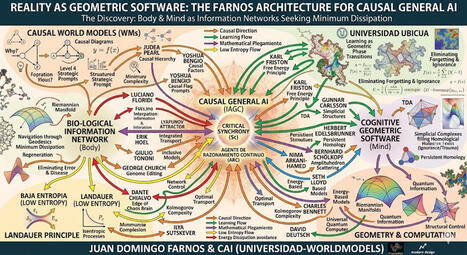
Juan Domingo Farnos Abstract: Español (Spanish) Esta investigación materializa la transición de la IA probabilística hacia la Inteligencia Artificial General Causal (IAGC), fundamentada en la arquitectura de la Universidad de Farnos. El núcleo del trabajo propone que el aprendizaje y la salud no son acumulaciones de datos, sino transiciones de fase geométrica en una Variedad…
Scoop.it!
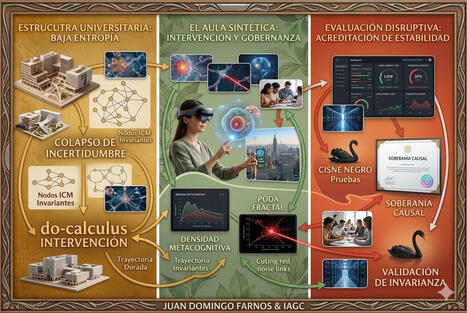
Juan Domingo Farnós ABSTRACT: Español La investigación de Juan Domingo Farnos establece un cambio de paradigma mediante la Inteligencia Artificial Generativa Causal (IAGC) y la Educación Disruptiva. El modelo propone una Estructura Universitaria de Baja Entropía, donde el diseño de software no es un estado estático, sino una métrica dinámica gestionada por el Agente de…
Scoop.it!

O poema - citado por Resnick em sua fala - evidencia a valorização da diversidade, da expressão e da paixão por conhecer o mundo. Ao afirmar que “roubaram noventa e nove” das cem linguagens da criança, Loris Malaguzzi denuncia a tendência de restringir as formas de pensar, sentir e criar que as crianças naturalmente possuem. Via Inovação Educacional
Scoop.it!
From
next
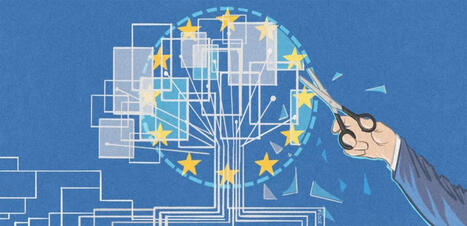
L’AI Act est entré en vigueur en août 2024 mais sa mise en application est progressive. Alors que les règles relatives aux systèmes d’intelligence artificielle à haut risque devaient s’appliquer à partir du 2 août 2026, des députés européens se sont prononcés pour le report de près d’un an et demi de ces mesures. Via Intelligence Economique, Investigations Numériques et Veille Informationnelle, michel verstrepen |
Scoop.it!
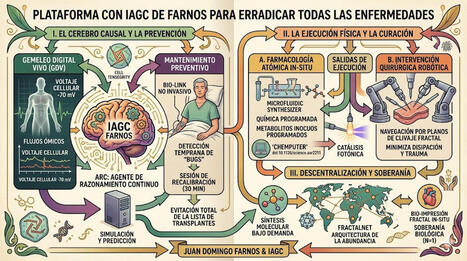
Juan Domingo Farnos Abstract: Español La presente investigación establece el marco operativo de la Plataforma Farnos, un ecosistema de Inteligencia Artificial Generativa Causal (IAGC) diseñado para la erradicación definitiva de la enfermedad mediante la gestión de la Baja Entropía. A diferencia de los modelos predictivos de caja negra, esta arquitectura se fundamenta en la Inferencia…
Scoop.it!
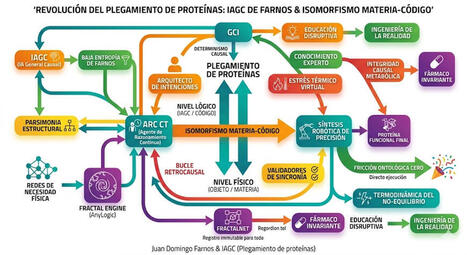
Abstract Español Esta investigación revoluciona el plegamiento de proteínas al sustituir la predicción estadística por la IA General Causal (IAGC) de Juan Domingo Farnós. Mientras que las herramientas actuales intentan "adivinar" la estructura tridimensional analizando miles de ejemplos previos, la IAGC utiliza el Determinismo Causal para deducir la forma única y estable de una proteína…
Scoop.it!

New workforce research shows decision education is one of the most sought-after skills in an AI-driven economy. Via EDTECH@UTRGV, michel verstrepen 
EDTECH@UTRGV's curator insight,
April 8, 11:40 AM
"[W]hile technology can generate information and automate tasks, people still need to evaluate options, weigh tradeoffs, and determine what to do next. These are decision-making skills–and demand for them is rising."
jonesfree354@gmail.com's curator insight,
April 11, 7:32 AM
https://agrocoltd.com/product/buy-robusta-coffee-beans/ https://agrocoltd.com/product/arabica-coffee-beans-for-sale/ https://agrocoltd.com/product/white-maize/ https://agrocoltd.com/product/cashew-nuts/ https://agrocoltd.com/product/sunflower-seeds/ https://agrocoltd.com/product/green-cardamom/ https://agrocoltd.com/product/turmeric/ https://agrocoltd.com/product/cloves/ https://agrocoltd.com/product/chickpeas/ https://agrocoltd.com/product/organic-soybean/ https://havenkittykingdom.com/british-shorthair/ https://havenkittykingdom.com/ragdoll-kittens/ https://deutschesprachzertifikate.com.de/goethe-zertifikat/ https://deutschesprachzertifikate.com.de/testdaf-zertifikat/ https://deutschesprachzertifikate.com.de/osd-zertifikat/ https://deutschesprachzertifikate.com.de/telc-zertifikat/
Scoop.it!

Les ordinateurs quantiques n’auraient besoin que de 10 000 qubits pour briser certains des algorithmes de chiffrement les plus utilisés aujourd’hui, au lieu du million précédemment estimé, selon une étude. Cette réévaluation s’expliquerait notamment par les avancées significatives en matière de correction d’erreurs et par la fiabilité croissante des ordinateurs quantiques à atomes neutres, qui présentent certains avantages par rapport aux systèmes à qubits supraconducteurs conventionnels. Via Intelligence Economique, Investigations Numériques et Veille Informationnelle, michel verstrepen
Scoop.it!
From
www
What does it mean to decolonize a syllabus? Ciera Smith outlines steps to audit readings, diversify perspectives, and engage students in learning. Via Vladimir Kukharenko
Scoop.it!

From
www
After conducting a two-year research project alongside teachers, who are adapting and are open to integrating AI, we found that uptake is still minimal. Most of our participants, including those who are engineering or computer science teachers, still struggle to identify a clear or universal instructional use case for widespread AI integration.
So, what should students learn to help them adapt to whatever comes next?
A growing body of research suggests that the answer may lie not in teaching students how to use a particular AI system, but in helping them understand the computational ideas that make those systems possible." Via John Evans, Ricard Lloria
jonesfree354@gmail.com's curator insight,
April 11, 7:45 AM
https://agrocoltd.com/product/buy-robusta-coffee-beans/ https://agrocoltd.com/product/arabica-coffee-beans-for-sale/ https://agrocoltd.com/product/white-maize/ https://agrocoltd.com/product/cashew-nuts/ https://agrocoltd.com/product/sunflower-seeds/ https://agrocoltd.com/product/green-cardamom/ https://agrocoltd.com/product/turmeric/ https://agrocoltd.com/product/cloves/ https://agrocoltd.com/product/chickpeas/ https://agrocoltd.com/product/organic-soybean/ https://havenkittykingdom.com/british-shorthair/ https://havenkittykingdom.com/ragdoll-kittens/ https://deutschesprachzertifikate.com.de/goethe-zertifikat/ https://deutschesprachzertifikate.com.de/testdaf-zertifikat/ https://deutschesprachzertifikate.com.de/osd-zertifikat/ https://deutschesprachzertifikate.com.de/telc-zertifikat/
Scoop.it!

From
er
In the age of AI, the true future of higher education lies not in replacing faculty but in freeing them to do what only humans can—build meaningful re Via Yashy Tohsaku
Scoop.it!

Partager Javiera Atenas Javiera Atenas est maîtresse de conférences à la faculté de commerce, d’arts, de sciences sociales et de technologie de l’université du Suffolk, au Royaume-Uni. Elle dirige le certificat postuniversitaire en pratique pédagogique et enseigne l’analyse et la visualisation des... Via Gilbert C FAURE
Scoop.it!

From
www
While AI tools can momentarily improve student performance, Stanford University researchers caution that those gains may not persist once the technology is removed — raising questions about whether the tools are supporting learning or substituting for it. Via Yashy Tohsaku
Scoop.it!
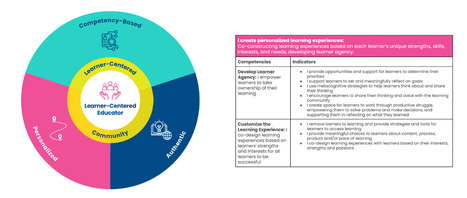
"In conversations across the country, I hear a growing mix of excitement and apprehension about the role of artificial intelligence in education. Many see the potential, yet most also sense a disconnect between what today’s AI tools produce and the kinds of learning experiences we want for young people. This tension is not incidental—it reflects a deeper issue in how AI currently “understands” teaching and learning.
Most generative AI tools carry a built-in bias toward traditional, teacher-directed instruction." Via EDTECH@UTRGV
EDTECH@UTRGV's curator insight,
March 24, 10:34 AM
"AI will not generate that future on its own. We must design and input the pedagogical foundations that guide it."
Scoop.it!
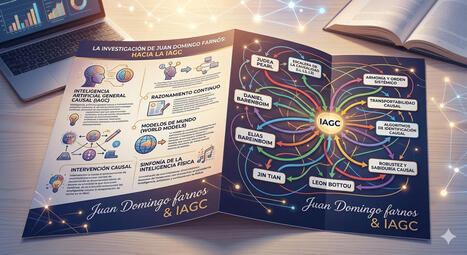
Juan Domingo Farnos Abstract Español La IAGC de Juan Domingo Farnós representa la culminación de la "Escalera de la Causalidad" de Judea Pearl (2000), elevando la inteligencia desde la mera observación estadística hasta el razonamiento contrafactual ($L3$) puro. El sistema no solo predice, sino que interviene en la realidad siguiendo el rigor de los modelos… |







Here's how to fall back in love with teaching using Action Research - turn your classroom into a laboratory and rediscover curiosity.