When a U.S. psychology professor offered her students a bonus credit if they would silence and surrender their cellphones at the start of class, little did she know how rewarding the experiment would be.
Sixty-one per cent of her students at Columbia State Community College in Tennessee “loved the activity,” citing the improved environment for concentration, participation and even peacefulness when the phones went dumb. Of the 82 students, not a single one disliked the exercise.
Since today you can make presentations right on SlideShare using a Haiku Deck app. Your presentations are automatically published on SlideShare. Very convenient!
Accidentally deleting photos from an iPhone or iPad happens and it’s not a fun feeling to know that you may have lost a photo or group of images you wanted to keep. Fortunately the latest versions of iOS support an automatic recovery process that allow you to restore deleted pictures, directly from your iPhone, iPad, or iPod touch. The photo recovery feature is fairly forgiving, giving you a reasonable timeline where restoring a lost picture is possible.
Word clouds are ideal for eLearning professionals who are looking for ways to visually represent text, whether this is content within an eLearning course or writings of the learners. Color and size can be used to denote a word's level of importance within the cloud, which helps learners to acquire and retain significant ideas (i.e. bolded words) more effectively. While word clouds are often associated with language arts eLearning courses, they can actually be used in virtually any eLearning setting.
"Just two months after announcing its Classroom learning management system, Google is rolling out upgrades.
"Namely, the LMS now features Google Groups integration, allowing multi-person discussions, the ability for teachers to download grades all at once, and control over how and when students can post in a class' shared activity log.
"The updates come just a week after Microsoft announced its own LMS app within Office 365."
There are two tips in this video. They are very simple, yet powerful!
While #1 has already been implemented by a lot of channel owners, the second one is totally new to me. Have you tried it? And how has it worked for you?
Excellent content! Make your visitors to your YouTube channel view until the end! #YouTube #internetmarketing #homebasedbusiness #techniquesfor engagingyourlist
It’s scary to realize, but there’s also no denying it: Facebook is a powerful influence not just online but in many user’s actual lives. And that’s not likely to change any time soon.
“We may originally register on Facebook in order to be connected to our friends but, without realizing it, the site becomes an addictive habit because we discover that it provides us with subconscious psychological rewards,” wrote Dr. Liraz Margalit. “Over time, this loop becomes more and more automatic as it is imprinted in our neural pathways.”
Although there are many documented advantages of learning online, some educators still question this innovative way of teaching because of technical obstacles, because they suspect or doubt its effectiveness, or because they are unfamiliar with the approach. Indeed, the teaching considerations for an online course, versus a traditional in-residence-based course, do change by necessity because of the different learning environments.
Making traditional course material digital, converting lectures to streaming video, and assigning tests or writing assignments online are not enough to convert the full classroom experience into avirtual one.
What is lacking in the virtual setting is the dynamic interchange among students and instructors. Although their concerns are valid, in-residence educators should find solace in learning that one of the most fundamental forms of teaching, the student-peer discussion facilitated by a knowledgeable instructor, remains as valid for mature-student distance learning today as it was for Socrates. This venerable method remains effective for online students for the same reasons it works in the classroom — because the discourse among students actually builds knowledge and keeps learning focused on their needs. Online, this Socratic method of teaching, also known as a “threaded discussion” or a “forum,” is an excellent distancelearning tool. All online instructors should consider using this method.
The go-to activity for most teachers looking to add an activity to their online offering is the forum. But the activity is often ill thought through, the teacher doesn't participate themselves and as a result the forum fails to launch!
This post looks at threaded discussions and how teachers can use them to facilitate peer to peer discussion that will add value to the learning experience. Highly recommended
I love these witty quips that ASCD intermittently share with the education community in the form of visually appealing infographics. The recent visual they shared in this regard relates to the topic of issue number two of Education Leadership magazine. Instruction That Sticks is a beautiful visual that features 6 quotations from leading thinkers and educationists. The quotes , different as they are in their scope, each speak to one of the essential areas in teaching methodology. Think of them as tips to help you better conceptualize your teaching strategy to meet the learning needs of your students.
Dozens of free web tools and ideas that can pack a technology integration punch and kick those lessons up a notch Are you tired of delivering the same old
Tons of Great Resources to Help You Use Social Media in Class ~ Educational Technology and Mobile Learning on Flipped classroom (enseñanza inversa) curated by JavierTouron
"Do you feel intimidated about jumping into the Twittersphere headfirst? Patricia Brown, Twitter extraordinaire @msedtechie, is here to help with advice about how to get your bearings on Twitter, including suggestions on how to cultivate a thoughtful feed and extend your personal learning network--plus five free tools she recommends to make the most of your Twitter experience."
"With our student populations becoming more and more non-traditional, our pedagogy could probably use a little dusting off and updating. In fact, let’s start with shifting from talking about pedagogy, technically the instruction of children, to andragogy, the teaching strategies that address needs of adult learners."
I like this article. The advice is very basic, but that's all you need to get started in the right way.
What I would add is this: Make sure you understand how each of the social media platforms you use work. On Twitter, for example, you shouldn't add more than two hashtags to your Tweets, while on Instagram, you can go up to 7. Just make sure that they are relevant.
You don't want to draw attention to your brand or name for the wrong reasons.
"Google Classroom is a new tool in Google Apps for Education that helps teachers create and organize assignments quickly, provide feedback efficiently, and easily communicate with their classes. Google Classroom was officially launched last summer and since then several new interesting features have been added to it. Check out this guide to learn more about the 6 things you can do with Google Classroom in your class."
Tips for Online Students to Work Successfully in Virtual Groups When possible, choose group members with similar schedules. Online students reside in different time zones and can have opposing work schedules. Be proactive and begin setting the groundwork early. As online learners, your time is extremely precious. Align group roles and responsibilities with individual strengths and interests. Organize – Research – Record – Analyze. Identify what project activities must be accomplished, in what order and by when. Choose a group leader who is comfortable taking on that role Communication is key; establish clear guidelines around when, where and how your group will communicate with each other. Create a comfortable forum to communicate through, even if it’s not the online classroom setting. Schedule extra conference calls closer to project deadlines to address any last minute hiccups and tasks. Always be honest, but respectful, in a group. If either the project or a fellow group member is heading down a path you don’t agree with, speak up. Ask your professor to implement mandatory peer evaluations. This strategy encourages equal participation by ensuring individual accountability. Don’t be afraid to talk to your professor. Provide regular group updates, which can then be used to track progress and mediate concerns.
There are many bloggers in your field. Don't waste your readers' time by being interchangeable.
Be yourself.It's ok if you are a slow writer -- I am! Take the time to edit your content. Make it easy for people to understand you. Don't use bombastic words and phrases.Imagine yourself writing for your ideal writer. When I blog, I always picture a friend or a reader whom I know. It helps tremendously. More tips in this great post by Henneke Duistermaat. http://www.copyblogger.com/common-blogging-mistakes/ ---------------- Cendrine Marrouat - www.socialmediaslant.com
"For an entire school year Hillsborough, New Jersey, educators undertook an experiment, asking: Is the iPad really the best device for interactive learning?
"It’s a question that has been on many minds since 2010, when Apple released the iPad and schools began experimenting with it. The devices came along at a time when many school reformers were advocating to replace textbooks with online curricula and add creative apps to lessons. Some teachers welcomed the shift, which allowed their students to replace old poster-board presentations with narrated screencasts and review teacher-produced video lessons at any time.
"Four years later, however, it's still unclear whether the iPad is the device best suited to the classroom. The market for educational technology is huge and competitive: During 2014, American K-12 schools will spend an estimated $9.94 billion on educational technology, an increase of 2.5 percent over last year, according to Joseph Morris, director of market intelligence at the Center for Digital Education. On average, he said, schools spend about a third of their technology budgets on computer hardware."
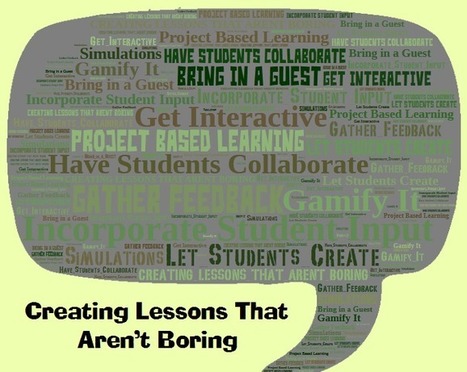
Are you tired of delivering the same old lectures on the same subjects year after year? Are you using the same lesson materials over and over and wishing you could make learning in your classroom more interactive?
While lectures and lessons can be informative and even “edutaining” when delivered with passion and good materials by knowledgeable experts, sadly many traditional lectures and lessons are boring, and even worse often ineffective. The good news is that the Web is loaded with great free tools that can enable teachers to bring a sense of fun and engagement to their lessons
To get content containing either thought or leadership enter:
To get content containing both thought and leadership enter:
To get content containing the expression thought leadership enter:
You can enter several keywords and you can refine them whenever you want. Our suggestion engine uses more signals but entering a few keywords here will rapidly give you great content to curate.


 Your new post is loading...