


Free resource of educational web tools, 21st century skills, tips and tutorials on how teachers and students integrate technology into education
Via Dr. Tom D'Amico (@TDOttawa)

 Your new post is loading...
 Scoop.it! Free resource of educational web tools, 21st century skills, tips and tutorials on how teachers and students integrate technology into education Via Dr. Tom D'Amico (@TDOttawa) No comment yet.
Sign up to comment
Scoop.it!
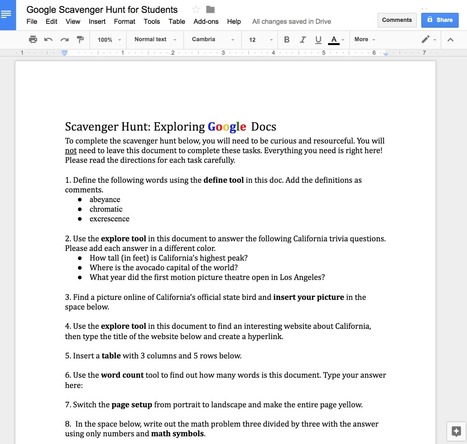
With the new school year, comes new students and a steep technology learning curve. My goal is to make learning how to use technology fun and engaging. Given how many tools we use, that's no small feat! Many of my Via Dr. Tom D'Amico (@TDOttawa) 
GwynethJones's curator insight,
August 4, 2017 10:53 AM
LOVE this Scavenger Hunt! Thanks, @Catlin_Tucker !!!
Nancy Jones's curator insight,
August 6, 2017 10:40 AM
clever idea to start the school year, especially with those who have school provided devices. They would have either an introduction or a refresher course. The game aspect of it would be particularly attractive .
Scoop.it!

Scoop.it!


Rosemarri Klamn's curator insight,
August 8, 2017 1:56 PM
Thanks for the tip Tom; it is always a challenge to find good stock photos to add variety to infographics/assignments/presentations, etc.
Scoop.it!
Flip Anim provides possibly the easiest way draw and create an animated GIF. Within minutes of learning about Flip Anim on Larr Via Dr. Tom D'Amico (@TDOttawa)
Scoop.it!

By strategically managing the learning content within your PLN, you’ll learn more in less time and will minimize the dangers of getting overwhelmed!
Scoop.it!

Slides features beautiful, modern templates and dazzling designs, with a dash of PowToon’s quirky, animatedly entertaining style. You can also fully customize your #Slides presentation within the PowToon Studio. Via Nik Peachey 
Nik Peachey's curator insight,
July 17, 2017 12:51 AM
A nice free tool for creating presentations. Good for younger learners. 
Jeff Domansky's curator insight,
July 24, 2017 1:20 PM
Powtoon is a basic video tool that can be useful for marketing and PR depending on the topic and market.
Scoop.it!
Build your game from the Game Manager on our website and add the missions your participants will complete to earn points.
Scoop.it!

OpenupEd offers high-quality learner-centered courses that are designed for self-learning, to be studied independent of time, place, and ideally also of pace, and to be taken by either informal learners or formal students in a language that suits them.
Scoop.it!

A lot of e-learning starts with existing PowerPoint content. However, that isn't very interactive. In this post, we explore ways to convert the static.
Scoop.it!
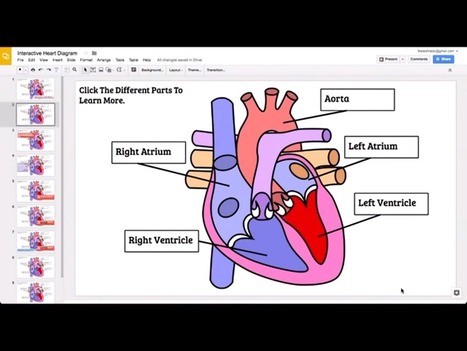
I love taking Google Apps to the next level. Here is a short video to get you up and running for the start of the school year. Learn to create interactive diagrams, maps, or photos in Google Slides that will engage students and inspire them to create their own! Via paul rayner
Scoop.it!
Continuous Professional Development Presentation given to my colleagues working at the Health Promotion and Disease Prevention Directorate on the potential of … Via Plus91
Scoop.it!
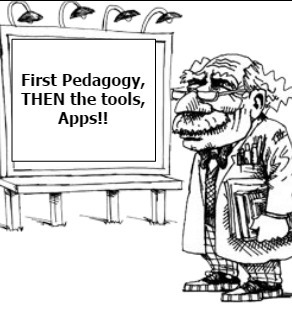
Technology is bringing a holistic, radical change to the new generations’ life. The learners that we currently have in schools are those who Snapchat their daily life experiences, YouTube their practices and share their voices by tweeting; they have the world at the tips of their fingers.“The fear is that digital natives will start perceiving school as non-authentic.” In minutes, they can change a thought to a video, a live stream or a podcast that they can share globally. As mentioned earlier, technology integration is a process that is incorporated in lesson planning. It is not about picking up an app and forcing it into teaching to make it more attractive. With pedagogy steering the process, the first step is to identify the learning objectives. Typically, the teacher will then decide on the methods and assessment tools to achieve learning objectives in a student-centered learning environment.
Learn more / En savoir plus / Mehr erfahren:
http://www.scoop.it/t/21st-century-learning-and-teaching/?&tag=Growth+Mindset
http://www.scoop.it/t/21st-century-learning-and-teaching/?&tag=Rise+of+the+Professional+Educator
http://www.scoop.it/t/21st-century-learning-and-teaching/?&tag=modern-education
Via Gust MEES 
Gust MEES's curator insight,
July 30, 2017 3:07 PM
Technology is bringing a holistic, radical change to the new generations’ life. The learners that we currently have in schools are those who Snapchat their daily life experiences, YouTube their practices and share their voices by tweeting; they have the world at the tips of their fingers.“The fear is that digital natives will start perceiving school as non-authentic.” In minutes, they can change a thought to a video, a live stream or a podcast that they can share globally. Technology integration as a process As mentioned earlier, technology integration is a process that is incorporated in lesson planning. It is not about picking up an app and forcing it into teaching to make it more attractive. With pedagogy steering the process, the first step is to identify the learning objectives. Typically, the teacher will then decide on the methods and assessment tools to achieve learning objectives in a student-centered learning environment.
Learn more / En savoir plus / Mehr erfahren:
http://www.scoop.it/t/21st-century-learning-and-teaching/?&tag=Growth+Mindset
http://www.scoop.it/t/21st-century-learning-and-teaching/?&tag=Rise+of+the+Professional+Educator
http://www.scoop.it/t/21st-century-learning-and-teaching/?&tag=modern-education
|
Scoop.it!
Scoop.it!

From
zapier

Take a screenshot of the entire web page instantly with this hidden Google Chrome shortcut–no need to install a screenshot tool Via Dr. Tom D'Amico (@TDOttawa)
Scoop.it!
Digital Tools Transform K–12 Classrooms and Fuel Collaboration and Culture by Meghan Bogardus Cortez
Technology is forcing education leaders to rethink everything from floor plans to curriculum. Via Dr. Tom D'Amico (@TDOttawa)
Scoop.it!

Scoop.it!

The ADDIE Model Infographic Although there are many different models and methodologies for the creation of training materials in the eLearning world, the ADDIE model is, undoubtedly, the most popular of all. If you are a veteran, you certainly know what ADDIE is and how to create in line with... http://elearninginfographics.com/the-addie-model-infographic/
Via elearninginfographic
Scoop.it!

From in the trenches classroom teachers and principals to highly respected educational institutions, these are the best teacher facebook pages to follow!
Scoop.it!

From
mylampa
MyLAMPA is a platform for language teachers and schools. It is the evolution of the learning management system developed developed by language teachers and it helps to support other worthy education initiatives around the world as well! Via Nik Peachey
Nik Peachey's curator insight,
July 26, 2017 1:28 AM
This is a great tool and resource for language teachers. 
Claudia Cardona Naranjo's curator insight,
September 7, 2017 11:50 AM
This is a great tools for us as Teaching English students since it allows us to plan our lessons, to share information with others, to do peer coaching, and to have organized our schedule. It is very useful having in mind that we are not only students, but also workers and parents.
Scoop.it!

Back in May I shared how Tom Richey was using YouTube Live to host AP World History review sessions for students. That's one way to us Via malek 
malek's curator insight,
July 13, 2017 9:51 AM
. Get a cheap tripod for your phone and point it in the direction of where you're standing to give a short lesson.
Scoop.it!

Uncover what's new to Twitter -- from the Explore tab to live video -- that you may have missed.
Scoop.it!

Over the years I've used a lot of Google tools in my social studies classes. Here are my five go-to Google tools for social studies classrooms. How to videos accompany each tool featured below. Via paul rayner
Scoop.it!

Today’s brave new world of digital technology has both enhanced and compromised the day-to-day operational efficiency of ultrabusy oncologists who are struggling to balance patient care with the rapid evolution of technology. Like all scientific advances, health-care technology is a double-edged sword, and it is moving forward at breakneck speed. So there is a virtual unmet need to address and adapt to heretofore-unthinkable issues for doctors of the past, such as one’s online reputation. Physicians are increasingly counted among Facebook’s 1 billion users and Twitter’s 500 million members. Social media content is brief, characterized as a “many-to-many” communication medium, and able to spread quickly across the Internet beyond a physician’s control or wishes. It’s a powerful tool for medicine, but it has its clear and present dangers, too. A new book titled Establishing, Managing, and Protecting Your Online Reputation: A Social Media Guide for Physicians and Medical Practices explores our emerging medical digital health-care world and offers practical solutions to these new challenges. In the end, the reader will probably come away feeling the benefits of social media and other technologies far outweigh the hazards for both doctors and their patients. The authors, Kevin Pho, MD, founder of the social media website KevinMD.com, and Susan Gay, a medical publisher and content strategist in medical publishing, are well schooled in the medical technology field, and they have constructed a thoughtful book to that end. New Generation of Patients Arranged in eight chapters with an informative appendix, Establishing, Managing, and Protecting Your Online Reputation is jam-packed with valuable information about a technology that is rapidly disrupting the health-care landscape. In chapter 1, the authors lay out the digital landscape, noting that a 2012 PricewaterhouseCoopers report showed a whopping one-third of consumers are using social media; they are not simply seeking medical information about a disease or possible symptoms but increasingly are looking for information about physicians and hospitals. The availability of massive amounts of online information has also created a new generation of patients the authors call “e-patients,” which they say has given patients a voice in their own care they never had before. Another phenomenon arising in social media is the rapid growth of online medical support groups. This offers an opportunity for housebound cancer patients, for instance, to engage with others on a 24/7 basis, creating a much-needed social comfort zone in which they can share their stories and ask advice. Although some doctors fear an erosion of the sacred doctor-patient relationship, the authors make a solid case that social media will never replace the underlying need for face-to-face interaction between doctor and patient. Another understandable finding presented by the authors is a survey showing that many physicians intentionally choose to avoid online social networking websites to maintain their privacy. This same group considers it unprofessional for physicians to have their patients “finding” them on well-traveled public sites. Step-by-Step Guide for Early Adopters After the introductory chapters, much of the book is a step-by-step guide for early adopters, and it is delivered in crisp, reader-friendly language. The section on learning how to create an online profile is quickly followed by an incisive discussion on managing and protecting one’s online reputation. The authors take pains to walk the reader through this invaluable content. They wisely integrate patient satisfaction into the fabric of the bigger message; they refer to a study that found 72% of consumer patients ranked the reputation of the health-care provider and personal experience as the top driver for choosing a physician. The final chapter, “Connect and Be Heard: My Journey From Social to Mainstream Media,” is a compelling first-person account by Dr. Pho of his maturation in the world of tech and social media. It makes a great case, even for the timid and skeptical, that social media has the potential to fundamentally change the lives of physicians. For the interested but skeptical reader, who might think social media is more fluff than substance, reading the last chapter first might be a good idea. This highly informative book is recommended for The ASCO Post readers. ■ Via Plus91
Scoop.it!
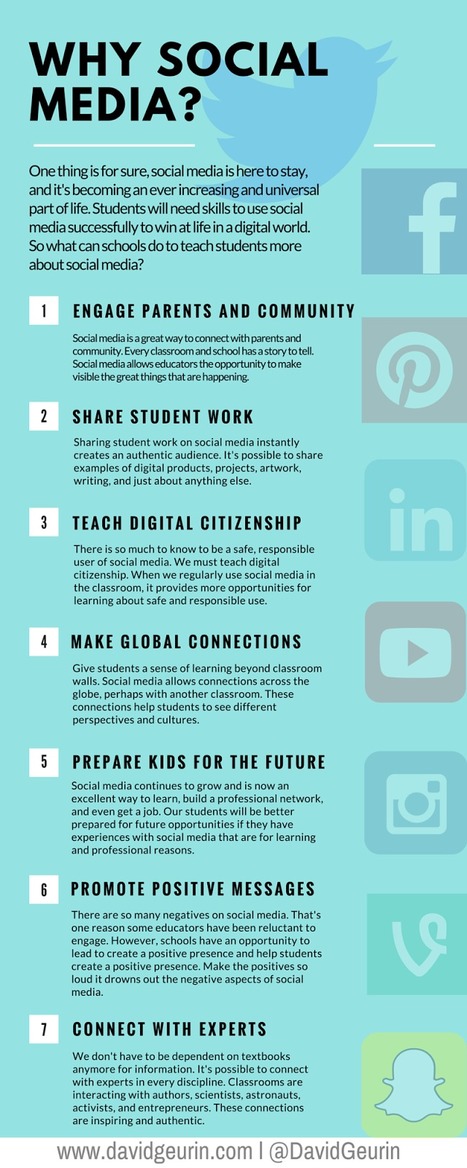
One thing is for sure, social media is here to stay. Never before have people been able to connect, share, and learn from one another as we do now. I can only imagine what might be next! As a result, our students need skills to win at life in a digital world. The ability to use social media to support life goals and possibilities can be a game-changer. I know it has been very powerful for me in my professional life.
Learn more / En savoir plus / Mehr erfahren:
http://www.scoop.it/t/21st-century-learning-and-teaching/?&tag=Social+Media
http://www.scoop.it/t/social-media-and-its-influence
Via Gust MEES
Rosemarri Klamn's curator insight,
July 31, 2017 7:56 AM
These are compelling reasons to practice social media in schools as it helps engage parents, the community, and the world. Teaching digital citizenship is another key aspect of responsible use of social media for students and parents! 
La French witch's curator insight,
August 13, 2017 9:24 PM
7 bonnes raisons d'utiliser les médias sociaux dans ses pratiques d'enseignement, pour une expérience d'apprentissage alliant l'engagement, le partage, le lien entre les acteurs de l'apprentissage, l'ouverture au monde et l'exploitation stratégique (après un tri sélectif) de tout ce que le numérique a de mieux à offrir à l’apprenant. Pour une expérience d'apprentissage stimulante, interactive et moderne, oui au multimédia dans l'enseignement !

Diamond Garcia's curator insight,
May 14, 2024 7:28 PM
Although this was published almost 10 years ago, the information found in this article still remains true. With social media continuing to be on the rise, it is time that we embrace it. I really enjoy the idea of utilizing social media to connect with experts rather than depend on textbooks (point #7).
|






