Coursera has announced that 12 universities — including three international institutions — will be joining Princeton University, Stanford University, University of Michigan, and University of Pennsylvania in offering Coursera classes, according to the Coursera Blog.
On Coursera, you will now be able to access world-class courses from:
California Institute of TechnologyDuke UniversityÉcole Polytechnique Federale de LausanneGeorgia Institute of TechnologyJohns Hopkins UniversityPrinceton UniversityRice UniversityStanford UniversityUniversity of California, San FranciscoUniversity of EdinburghUniversity of Illinois at Urbana-ChampaignUniversity of MichiganUniversity of PennsylvaniaUniversity of TorontoUniversity of VirginiaUniversity of Washington
You’ll be able to choose from more than 100 courses, from Professor Dan Ariely’s course on irrational behavior, to learning how to program in Scala (taught from the creator of Scala, Professor Martin Odersky from EPFL), to the legendary UVA course “How Things Work” with Professor Louis Bloomfield.
You can check out the most current course list here — keep in mind you can enroll in a class even if the start date is TBA.
To date, 700,000 students from 190 countries have participated in classes on Coursera, with more than 1.55 million course enrollments total.
List of EdX free online courses/MOOCs aggregated by Class Central. Courses are categorized according to start dates into Recently Started, Just Announced, Upcoming, Self Paced, Ongoing, and Finished
Missed lectures or hate teachers? Or want to study computer science courses without going to university? … You can study anytime anywhere because there are number of free online computer science courses available on internet that are very interactive.
For the past ten years, we’ve been busy rummaging around the internet and adding courses to an ever-growing list of Free Online Courses, which now features 1,200+ courses from top universities.
Let’s give you the quick overview: The list lets you download audio & video lectures from schools like Stanford, Yale, MIT, Oxfordand Harvard. Generally, the courses can be accessed via YouTube, iTunes or university web sites, and you can listen to the lectures anytime, anywhere, on your computer or smart phone. We haven’t done a precise calculation, but there’s about 40,000 hours of free audio & video lectures here. Enough to keep you busy for a very long time.
Right now you’ll find 146 free philosophy courses, 88 free history courses, 125 free computer science courses, 78 free physics courses and 55 Free Literature Courses in the collection, and that’s just beginning to scratch the surface. You can peruse sections covering Astronomy, Biology, Business, Chemistry, Economics,Engineering, Math, Political Science, Psychology and Religion.
How To Import A Quiz from Word To Moodle With Multiple Correct Answers FORMATTING THE QUESTIONS IN WORD DOCUMENT CORRECTLY Steps: 1. Remove any headers an
By adding blogs to a flipped ELA class, teachers present literacy as a design challenge where words, images, and format serve to express students' ideas.
Buzzwords fill the air. Key notes fly around our ears. But developments do not take place. Because the education system does not change, it will be replaced step by step. Why do schools and universities not embrace the digital change? Because their two main characteristics are no longer in demand: pedagogy and didactics. These are bad news - explained in detail elsewhere. Now I'm thinking about the question: What comes to us?
I am asked again and again: „How do education and school look like in the future?" Well: On the one hand alternatives already exist. They are digital (udacity, coursera, edX & consorts), and they are analogous. On the other hand alternative learning projects spring up like mushrooms, as recently read again: Free schools are on the upswing. Even in Switzerland.
In this article I will now show you what successful education is going to be in the future. And again, it is not a question of whether we want it or not. It is only a matter of how we shape it.
Assessment is at the crux of educational evaluation. It’s a major factor in designating student success, and it’s a vital skill that every educator needs to have firm hold of. Succinctly, grades represent the extent to which the learner has met the defined objectives. Teachers generally define these objectives at the beginning of the year, aided by benchmarks, such as statewide academic achievement standards. Assessment is an emotionally laden procedure that implies more than the degree of compliance with the goals. Before beginning a learning activity, teachers should think of and choose the assessment criteria; students appreciate a grading system …
Students who take online education courses must have strong organization skills, self-motivation, and maintain flexibility. Teachers must also have many traits to successfully serve their students. Online teaching and learning isn’t for everyone.
According to a University of Phoenix College of Education survey, nearly all K-12 teachers said educational technology like laptops, SMART Boards and apps, are being used in schools. Unfortunately, the survey also found that nearly one in five of those surveyed feel intimidated by students’ knowledge of tech devices, and only one in four have had significant training in integrating technology into the classroom.
I think online teaching has a brighter future than teaching in the classroom. Learners want flexibility and an individualized approach classrooms can’t provide. Our lifestyle and workplace are changing and the demands for developing necessary skills and knowledge within a short period of time are growing.
This is post is a wake-up call for 21st Century teachers! As Wright mentioned, the world is changing, education is changing and as a teachers have to change as well. Traditional classrooms are demanded to face new challenges and as we could see from the founder of ESL teacher's notebook answers, technology is taking traditional classrooms place. For me, is not something that is going to happen too soon; however, we need to be prepared to adapt ourselves to any teaching context.
I also consider important to take into account the interviewee reasoning about the interaction between teacher and student. The way virtual education is facing the new world's demands has pushed it to create better ways of communication between teachers and learners and have lead to a more learner centered view of the process.
The relevance of this contribution, for me, lays on the fact we as Colombian teacher should take a wider look to the global necessities and use them as a tool to see technology not only as a material resource but also as a mean of high-quality education, and why not as a labor market
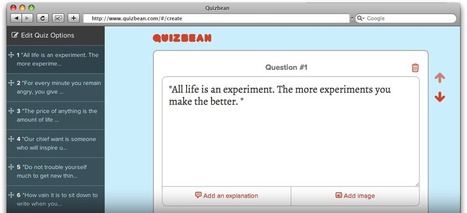
QuizBean is the easiest way to create and share online quizzes with your friends. It's totally free, so what are you waiting for? Make your first quiz!
List of Coursera free online courses/MOOCs aggregated by Class Central. Courses are categorized according to start dates into Recently Started, Just Announced, Upcoming, Self Paced, Ongoing, and Finished
List of Udacity free online courses/MOOCs aggregated by Class Central. Courses are categorized according to start dates into Recently Started, Just Announced, Upcoming, Self Paced, Ongoing, and Finished
Discover 800 Massive Open Online Courses (MOOCs) from great universities. Most offer “certificates” or “statements of completion,” though typically not university credit. (See the key below to understand the credentials offered by each course, and see our MOOC FAQ if you have general questions.) Courses are arranged by start date, while evergreen courses, which can begin whenever you wish, are found at the bottom.
eLearning is an essential part of our life and is an efficient tool for knowledge transfer utilized by educational institutions, individuals, and companies. The technological boom and swift evolution of smart phones, tablets and other mobile devices contributed to the better positioning of the industry and lead to coining terms such as mobile learning, micro-learning, gamification, etc. Online training has been adopted by companies as one of the most efficient ways to train their employees based at different locations. The globalization of the market and the attempt to present the best content in the mother language of the learner made e-learning localization a service often associated with online learning.
The importance of both e-learning and its proper localization is significant so we compiled this simple guide to answer some of the most popular questions related to these two notions.
The flipped classroom doesn't require a lot of technology. It's about involving students in the process of learning. Here are three activities to consider.
Don't wait for PD sessions. This article talks about how to take learning into your own hands and how you can do it 24/7. Following hashtags and edchats is a starting point and you can do that even without a Twitter account. Connecting with a network is enormously underutilized.
Kui Xie, The Ohio State University and Nicole Luthy, The Ohio State University For decades, textbooks were seen as the foundation for instruction in American schools. These discipline-specific tomes were a fundamental part of the educational infrastructure, assigned to students for each subject and carried in heavy backpacks every day – from home to school and back again. The experience of students is much different today. As a scholar of learning technologies and a director for outreach and engagement at Ohio State’s College of Education and Human Ecology, we’ve seen how technological advances and an increase in digital curriculum materials …
Are you going to be teaching a new skill to your learners in your online course? Online teaching requires very different approaches to teaching face-to-face for obvious reasons. But from my experience working with online instructors, it is not so obvious HOW to do it differently.
Future Bright for Online Education The arguments offered in Jing Liu’s essay run counter to the validation online programs receive from regional accreditation, the U.S. Department of Education and the success students experience as graduates. As someone who has taught online classes since 1999 and managed the online program administration at my campus for 16 years, I am personally aware of the progress we have made, the quality of instruction we do achieve, the access door we have opened wider and the difference we have made in the lives of our students.
To get content containing either thought or leadership enter:
To get content containing both thought and leadership enter:
To get content containing the expression thought leadership enter:
You can enter several keywords and you can refine them whenever you want. Our suggestion engine uses more signals but entering a few keywords here will rapidly give you great content to curate.


 Your new post is loading...




















Your self help program