Your new post is loading...
Presentations - whether they are made with Powerpoint or other applications, are a great way to support a speech, visualize complicated concepts or focus a
Via Peter Mellow
Adding visuals to step-by-step instructions can focus your readers into details that may otherwise not have been communicated with text alone.
Via Peter Mellow
Bored students is the least of it – the bullet point-ization of information is making us stupid and irresponsible
Via Peter Mellow

|
Rescooped by
Dennis Swender
from vShare
June 21, 2018 10:40 PM
|
Students often explain that they take the courses I teach because they want to learn how to make GIFs, YouTube videos, and HTML/CSS websites. They want to make funny photoshopped pictures of their friends and make their own, personalized GIFs. They also tell me that they see these digital skills as increasingly important for jobs, both summer internships and careers after graduation. Students enter my class convinced that what they will learn to do will be useful in their professional and personal lives.
But, for nearly all students in the classes I teach, all they know of digital making are the template/shortcut platforms that have enabled them to participate in digital culture up until this point. And, perhaps, rightfully so, they assume that the experience of making digital media will be similar to the experience of using Canva and WIX. Students I work with assume that digital media making is:
drag-and-drop;
a series of well-laid out, linear, and standard steps; and
a guaranteed working product at the end with little risk of failure.
Via Kim Flintoff
Most colleges and universities are thinking and acting strategically regarding their digital learning initiatives. Most cover digital learning in their school's strategic plan, and a large number have made it a core aspect of their plans. Yet, execution is uneven and digital learning hasn't come close to meeting administrator or faculty expectations.
That summary comes out ofa new report produced by Tyton Partners in collaboration with the Babson Survey Research Group. A similar subject was undertaken in 2014 when Tyton interviewed more than 2,700 postsecondary faculty and administrators on their use and perceptions of digital courseware. The latest report updates that research and examines findings from two fall 2016 surveys of a national sample of 3,500 postsecondary respondents.
Via Kim Flintoff
have put together a Google Chrome App and Extension Database for Teachers hat is loaded with apps and extensions for productivity and classroom integration. In this post, you will find 160+ Chrome Apps and Extensions for Teachers and Students! This database is searchable and filterable by category, subject area, and grade level!
Via John Evans
Last year I met an inspiring educator with a passion for high-quality, literacy instruction. Dr. Molly Ness is the author of Think Big With Think Alouds, Grades K-5: A Three-Step Planning Process That Develops Strategic Readers. She offers lots of tips for think alouds, and I'm excited to share some with you today!
Via Dr. Tom D'Amico (@TDOttawa)
|
|
Rescooped by
Dennis Swender
from Edumorfosis.it
June 21, 2018 2:21 PM
|
We hear them so often: Creativity, Collaboration, Communication and Critical Thinking, that they can become a slightly redundant refrain, muffled by an already crammed education discourse.
Some organisations, P21 in particular, are determined that teaching and learning 21st century skills (the 4Cs) are the key to a successful future for individuals, as well as society. The P21 site is saturated with idealistic terminology blended with an exhaustive and impressive list of skills they believe students should have in order to “navigate the complexities of the 21st Century”. From mastering what they call “fundamental” subjects such as Math, Science, Geography and English Literacy, students should also be taught: health literacy, environmental literacy, global awareness, financial literacy, media literacy and citizenship to name a few — not to mention of course creativity, collaboration, communication and critical thinking.
Phew! That’s quite a list of learning objectives. To their credit P21 offers a number of guidelines and resources to achieve them.
Via Edumorfosis
|
|
Rescooped by
Dennis Swender
from Daily Magazine
June 21, 2018 2:20 PM
|
“The video discussion platform Flipgrid, has been bought by Microsoft, who immediately announced that the tool will now be free to all educators.”
Via T@T lab, THE OFFICIAL ANDREASCY
|
|
Rescooped by
Dennis Swender
from Edumorfosis.it
June 20, 2018 11:15 AM
|
The number of smartphones is projected to reach the 5 billion dollar mark in 2019, which means that 67% of the world’s population will own a mobile phone. There is an impressive data[1] on the penetration of mobile internet-usage worldwide, and it will not be incorrect to assume that learning is happening formally/ informally through mobile devices already. Since the reach of mobiles phones is increasing each day, it is essential that educational technologies be oriented to embrace the new conduit of learning and teaching.
With apps and other available LMS Software, the usage of mobile phones for live face-to-face interaction between instructor and learner is not an issue any-more. Students who now opt for online distance courses stand to benefit and learn just by opening up specific mobile apps to consume learning material.
Distance education has evolved with the advent of distance learning platform. There are two types of course formats that online distance education has adopted. One model is asynchronous, and the other is synchronous.
Via Edumorfosis
|
|
Rescooped by
Dennis Swender
from Business Improvement
June 19, 2018 2:29 PM
|
With the shift in social media in the recent years, closed communities such as LinkedIn Groups might be the next best way to engage your audience. Here's why you should consider LinkedIn Groups and how to build a professional community with one.
Via Daniel Watson
|
|
Rescooped by
Dennis Swender
from Business Improvement
June 19, 2018 2:25 PM
|
I reviewed 188 SEO tools. See the best free and paid tools for 2018 right here.
Via Daniel Watson
|
Color selection in eLearning is a key way that designers can influence learners’ moods, drive engagement, and show hierarchies of information.
Via Peter Mellow
The Internet is full of stock photos, and it’s never been easier finding a good-looking image that goes well with the topic of your learning content.
However, there’s a huge leap from good to great. Content deserves great images. If you’re a bit picky (and here’s why you should be), searching for a perfect image can easily take you more time than writing the content itself (read about writing e-learning content in our LearnHack #3). On top of that, the best images are usually copyrighted or at the very least come with a price tag.
Fortunately, there are some websites that are packed with high-quality creative photos that can be used free of charge.
Before you rush to the list below, don’t forget to bookmark this page; sooner or later it will prove to have been a great—not just good—idea.
Via Peter Mellow
|
|
Rescooped by
Dennis Swender
from vShare
June 21, 2018 10:41 PM
|
vShare Download for your Apple iPhone,iPad,iPod and Android device. vShare app ready with PC, Install Now within few clicks.
Via vShare
Arizona State's report on digital learning draws cheers from online proponents -- and a few raised eyebrows from those who think the future is more complicated and warrants broader research.
Via Kim Flintoff
In a survey of 1,500 students who are seriously considering, currently enrolled in or recently graduated from a fully online program, most (86 percent) considered the value of their degree equal to or greater than the cost they paid to take it. Among those who have attended face-to-face and online courses, the majority (85 percent) said that online learning is as good as or better than attending courses on campus. In fact, two-thirds of online college students (67 percent) reported that they'd achieved the original goal that motivated them to enroll in their program; graduate students were more likely than undergraduates to feel that way (76 percent vs. 62 percent).
The survey was conducted by Learning House, a company that manages online programs for colleges and universities, and Aslanian Market Research, a research arm of EducationDynamics, which performs student prospecting and enrollment management.
Via Kim Flintoff
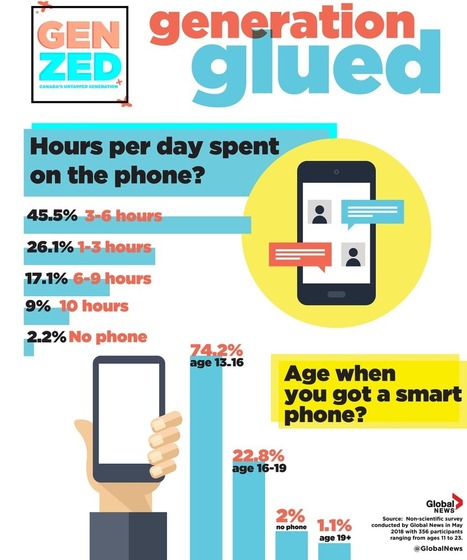
It’s hardly fair to point a finger at the young cohort of 13- to 23-year-olds known as generation Z and accuse them of being “addicted” to their phones. After all, you’d be hard-pressed to find an adult these days who isn’t constantly Googling during a conversation or checking the news during dinner.
Yet, generation Z is often on the receiving end of criticism for the amount of time they spend using technology. Some of this is fair — it’s estimated that they log about 10 hours a day online (an informal Global News survey found that number to be closer to six hours) and a whopping 96 per cent own a smartphone — but this is less an “addiction” than it is a way of life, experts argue.
Via John Evans
Word, OneNote, and PowerPoint users have a new speech-to-text option . A new dictation option has been added to Office 365. The dictatio
Via Dr. Tom D'Amico (@TDOttawa)
|
|
Rescooped by
Dennis Swender
from Daily Magazine
June 21, 2018 2:20 PM
|
I publish a regular series called Ed Tech Digest, and I thought it would useful to readers and to me to review them and highlight the ones I think are the best of the year.
Via T@T lab, THE OFFICIAL ANDREASCY
|
|
Rescooped by
Dennis Swender
from Edumorfosis.it
June 20, 2018 11:17 AM
|
Closing the achievement gap has been a focus of those looking to improve education for decades. The term “achievement gap” refers to the gap between the test scores of low-income students (or students of color) and their wealthier (or white) peers. There are dozens of theories on why this gap continues to exist and what we can do to bring low-income students’ achievement levels up. In recent years, one idea has come to light that has promise—using digital equity to close the achievement gap.
Via Edumorfosis
|
|
Rescooped by
Dennis Swender
from Edumorfosis.it
June 20, 2018 11:14 AM
|
Like any other function, learning and development (L&D) must assess the impact technology is having on its role within the workplace. For years, the use of technology within corporate learning centered around a single platform: the learning management system (LMS). Now, as the tech landscape becomes more diverse and integrated into the workflow, “digital learning” is starting to replace “eLearning” as a main point of conversation.
But what does “digital learning” mean?
What tools play a role in digital learning?
How should this technological evolution shape future workplace learning strategies?
My August curated insights explore the concept of digital learning, and how technology is transforming the role of L&D:
Via Edumorfosis
|
|
Rescooped by
Dennis Swender
from Business Improvement
June 19, 2018 2:26 PM
|
|