Your new post is loading...

|
Scooped by
Dr. Stefan Gruenwald
August 11, 2017 5:37 PM
|
For the supermassive black hole at the center of our Milky Way galaxy, it’s been a long time between dinners. NASA’s Hubble Space Telescope has found that the black hole ate its last big meal about 6 million years ago, when it consumed a large clump of infalling gas. After the meal, the engorged black hole burped out a colossal bubble of gas weighing the equivalent of millions of Suns, which now billows above and below our galaxy’s center. The immense structures, dubbed the Fermi Bubbles, were first discovered in 2010 by NASA’s Fermi Gamma-ray Space Telescope. But recent Hubble observations of the northern bubble have helped astronomers determine a more accurate age for the bubbles and how they came to be. “For the first time, we have traced the motion of cool gas throughout one of the bubbles, which allowed us to map the velocity of the gas and calculate when the bubbles formed,” said lead researcher Rongmon Bordoloi of the Massachusetts Institute of Technology in Cambridge. “What we find is that a very strong, energetic event happened 6 million to 9 million years ago. It may have been a cloud of gas flowing into the black hole, which fired off jets of matter, forming the twin lobes of hot gas seen in X-ray and gamma-ray observations. Ever since then, the black hole has just been eating snacks.” The new study is a follow-on to previous Hubble observations that placed the age of the bubbles at 2 million years old. A black hole is a dense, compact region of space with a gravitational field so intense that neither matter nor light can escape. The supermassive black hole at the center of our galaxy has compressed the mass of 4.5 million Sun-like stars into a very small region of space. Material that gets too close to a black hole is caught in its powerful gravity and swirls around the compact powerhouse until it eventually falls in. Some of the matter, however, gets so hot it escapes along the black hole’s spin axis, creating an outflow that extends far above and below the plane of a galaxy. The team’s conclusions are based on observations by Hubble’s Cosmic Origins Spectrograph (COS), which analyzed ultraviolet light from 47 distant quasars. Quasars are bright cores of distant active galaxies. Imprinted on the quasars’ light as it passes through the Milky Way bubble is information about the speed, composition, and temperature of the gas inside the expanding bubble. The COS observations measured the temperature of the gas in the bubble at approximately 17,700 degrees Fahrenheit. Even at those sizzling temperatures, this gas is much cooler than most of the super-hot gas in the outflow, which is 18 million degrees Fahrenheit, seen in gamma rays. The cooler gas seen by COS could be interstellar gas from our galaxy’s disk that is being swept up and entrained into the super-hot outflow. COS also identified silicon and carbon as two of the elements being swept up in the gaseous cloud. These common elements are found in most galaxies and represent the fossil remnants of stellar evolution.
|
|
Scooped by
Dr. Stefan Gruenwald
August 11, 2017 5:24 PM
|
NASA’s Cassini spacecraft will enter new territory in its final mission phase, the Grand Finale, as it prepares to embark on a set of ultra-close passes through Saturn’s upper atmosphere with its final five orbits around the planet. Cassini will make the first of these five passes over Saturn at 12:22 a.m. EDT Monday, Aug. 14, 2017. The spacecraft’s point of closest approach to Saturn during these passes will be between about 1,010 and 1,060 miles (1,630 and 1,710 kilometers) above Saturn’s cloud tops. The spacecraft is expected to encounter atmosphere dense enough to require the use of its small rocket thrusters to maintain stability – conditions similar to those encountered during many of Cassini’s close flybys of Saturn’s moon Titan, which has its own dense atmosphere. “Cassini’s Titan flybys prepared us for these rapid passes through Saturn’s upper atmosphere,” said Earl Maize, Cassini project manager at NASA’s Jet Propulsion Laboratory (JPL) in California. “Thanks to our past experience, the team is confident that we understand how the spacecraft will behave at the atmospheric densities our models predict.” Maize said the team will consider the Aug. 14 pass nominal if the thrusters operate between 10 and 60 percent of their capability. If the thrusters are forced to work harder – meaning the atmosphere is denser than models predict – engineers will increase the altitude of subsequent orbits. Referred to as a “pop-up maneuver,” thrusters will be used to raise the altitude of closest approach on the next passes, likely by about 120 miles (200 kilometers). If the pop-up maneuver is not needed, and the atmosphere is less dense than expected during the first three passes, engineers may alternately use the “pop-down” option to lower the closest approach altitude of the last two orbits, also likely by about 120 miles (200 kilometers). Doing so would enable Cassini’s science instruments, especially the ion and neutral mass spectrometer (INMS), to obtain data on the atmosphere even closer to the planet’s cloud tops. “As it makes these five dips into Saturn, followed by its final plunge, Cassini will become the first Saturn atmospheric probe,” said Linda Spilker, Cassini project scientist at JPL. “It’s long been a goal in planetary exploration to send a dedicated probe into the atmosphere of Saturn, and we’re laying the groundwork for future exploration with this first foray.” Other Cassini instruments will make detailed, high-resolution observations of Saturn’s auroras, temperature, and the vortexes at the planet’s poles. Its radar will peer deep into the atmosphere to reveal small-scale features as fine as 16 miles (25 kilometers) wide – nearly 100 times smaller than the spacecraft could observe prior to the Grand Finale.
|
|
Scooped by
Dr. Stefan Gruenwald
August 11, 2017 5:19 PM
|
It’s hard to see underwater, and not just because of the chlorine. The image-producing light rays that enter our eyes have trouble bending and focusing when the water’s density is almost same as that of eye fluid. Sea creatures experience the same problem, but squid use a type of lens notorious for blurry images to correct that, researchers report in Science. Spherical lenses, like the squids’, usually can’t focus the incoming light to one point as it passes through the curved surface, which causes an unclear image. The only way to correct this is by bending each ray of light differently as it falls on each location of the lens’s surface. S-crystallin, the main protein in squid lenses, evolved the ability to do this by behaving as patchy colloids—small molecules that have spots of molecular glue that they use to stick together in clusters. The S-crystallins feature a pair of loops that act as the proteins’ sticky patches and attract the loops of other S-crystallins. Globs of six proteins link together during the squid’s larval stage and form a gel that eventually becomes the center of the lens. As the gel becomes too dense with protein clumps, smaller particles struggle to diffuse through, and a new layer of protein packages forms with just under six S-crystallins in each clump. The process continues until the outer edge of the lens is formed with pairs of S-crystallins. This allows light rays to bend a little differently in each region of the lens, which yields a clearer image. Some fish eyes are nearly identical to squids’, but it’s unknown whether their eye proteins exhibit patchy colloid-like behavior. Other cephalopods, like octopuses and nautiluses, lack S-crystallin lens proteins. So they, unlike squid, likely have blurry vision.
|
|
Scooped by
Dr. Stefan Gruenwald
August 11, 2017 2:36 PM
|
Geneticists have created piglets free of retroviruses, an important step toward creating a new supply of organs for transplant patients. Xenotransplantation is a promising strategy to alleviate the shortage of organs for human transplantation. In addition to the concern on pig-to-human immunological compatibility, the risk of cross-species transmission of porcine endogenous retroviruses (PERVs) has impeded the clinical application of this approach. Earlier, a group of scientists demonstrated the feasibility of inactivating PERV activity in an immortalized pig cell line. Now, they confirmed that PERVs infect human cells, and observed the horizontal transfer of PERVs among human cells. Using CRISPR-Cas9, they inactivated all the PERVs in a porcine primary cell line and generated PERV-inactivated pigs via somatic cell nuclear transfer. This study clearly highlights the value of PERV inactivation to prevent cross-species viral transmission and demonstrated the successful production of PERV-inactivated animals to address the safety concern in clinical xenotransplantation.
|
|
Scooped by
Dr. Stefan Gruenwald
August 10, 2017 10:30 PM
|
A storm complex nearly the size of Earth has been seen in a usually quiet area of Neptune. Ned Molter from the University of California, Berkeley in the US spotted the storm while performing a test run of twilight observing at the W M Keck Observatory in Hawaii. The storm system appears as a very bright region about 9000 km in length and spans at least 30° in both latitude and longitude. "Seeing a storm this bright at such a low latitude is extremely surprising," explains Molter. "Normally, this area is really quiet and we only see bright clouds in the mid-latitude bands, so to have such an enormous cloud sitting right at the equator is spectacular." As on all planets, Neptune's atmospheric winds vary greatly with latitude. For the storm system to span so many degrees, there therefore has to be something holding it together. A possible explanation is a huge, high-pressure vortex system anchored deep in the planet's atmosphere. Just like water-vapour-forming clouds on Earth, methane gas on Neptune would cool and condense into clouds as it rises up the vortex. Alternatively, the bright system could be a huge convective cloud, as seen on other planets such as Saturn. With this scenario, however, Neptune's storm would likely have smeared out over the course of a week, but Molter observed it getting brighter between 26 June and 2 July. "This shows that there are extremely drastic changes in the dynamics of Neptune's atmosphere, and perhaps this is a seasonal weather event that may happen every few decades or so," says Imke de Pater, also from the University of California, Berkeley. Understanding Neptune's atmosphere is becoming increasingly important with regards to exoplanets, as the majority resemble the ice giant. Molter and de Pater hope to investigate the storm system further with more twilight observation runs at the Keck Observatory.
|
|
Rescooped by
Dr. Stefan Gruenwald
from SciFrye Home & Garden
August 10, 2017 12:39 AM
|
Researchers at the University of Melbourne have demonstrated a way to detect nuclear spins in molecules non-invasively, providing a new tool for biotechnology and materials science.
Important research in medicine and biology relies on nuclear magnetic resonance (NMR) spectroscopy, but until now, it has been limited in spatial resolution and typically requires powerful microwave fields. A team led by Professor Lloyd Hollenberg at the University of Melbourne has used a quantum probe to perform microwave-free NMR at the nanoscale. The results were published today in Nature Communications.
"This quantum probe delivers a dramatic improvement in NMR technology. In addition to being able to detect NMR in far smaller samples than conventional machines, our technique does not require the application of microwave fields that might disrupt biological samples" said Hollenberg, who is Deputy Director of the Centre for Quantum Computation and Communication Technology (CQC2T) and Thomas Baker Chair at the University of Melbourne.
Via Mariaschnee, Kim Frye
|
|
Rescooped by
Dr. Stefan Gruenwald
from SciFrye
August 10, 2017 12:35 AM
|
Researchers from the Technion-Israel Institute of Technology and Germany have demonstrated for the first time the phenomena of shape memory and self-healing in gold microparticles. Achieved through defects-mediated diffusion in the particle, the discovery could one day lead to the development of micro- and nano-robots capable of self-repair; mechanically stable and damage-tolerant components and devices; and targeted drug delivery.
The study, published in the journal Advanced Science, was conducted by doctoral student Oleg Kovalenko and Dr. Leonid Klinger, led by Prof. Eugen Rabkin of the Technion Department of Materials Science and Engineering, together with Dr. Christian Brandl of Karlsruhe Institute of Technology, Germany (KIT).
Shape-memory materials are characterized by the ability to repair the damage caused to them (such as plastic deformation) and to recover their original shape. These materials can exist in two stable crystalline forms, or phases: austenite, which is the more symmetrical primary form stable at elevated temperatures; and martensite, which is a phase characterized by lower symmetry, but also by greater strength. A well-known example of transition between the two phases is the quenching of steel.
Via Mariaschnee, Kim Frye
|
|
Scooped by
Dr. Stefan Gruenwald
August 9, 2017 9:18 PM
|
In 2004, astronomers examining a map of the radiation leftover from the Big Bang (the cosmic microwave background, or CMB) discovered the Cold Spot, a larger-than-expected unusually cold area of the sky. The physics surrounding the Big Bang theory predicts warmer and cooler spots of various sizes in the infant universe, but a spot this large and this cold was unexpected. Now, a team of astronomers led by Dr. István Szapudi of the Institute for Astronomy at the University of Hawaii at Manoa may have found an explanation for the existence of the Cold Spot, which Szapudi says may be “the largest individual structure ever identified by humanity.” Using data from Hawaii’s Pan-STARRS1 (PS1) telescope located on Haleakala, Maui, and NASA’s Wide Field Survey Explorer (WISE) satellite, Szapudi’s team discovered a large supervoid, a vast region 1.8 billion light-years across, in which the density of galaxies is much lower than usual in the known universe. This void was found by combining observations taken by PS1 at optical wavelengths with observations taken by WISE at infrared wavelengths to estimate the distance to and position of each galaxy in that part of the sky. Earlier studies, also done in Hawaii, observed a much smaller area in the direction of the Cold Spot, but they could establish only that no very distant structure is in that part of the sky. Paradoxically, identifying nearby large structures is harder than finding distant ones, since we must map larger portions of the sky to see the closer structures. The large three-dimensional sky maps created from PS1 and WISE by Dr. András Kovács (Eötvös Loránd University, Budapest, Hungary) were thus essential for this study. The supervoid is only about 3 billion light-years away from us, a relatively short distance in the cosmic scheme of things. Imagine there is a huge void with very little matter between you (the observer) and the CMB. Now think of the void as a hill. As the light enters the void, it must climb this hill. If the universe were not undergoing accelerating expansion, then the void would not evolve significantly, and light would descend the hill and regain the energy it lost as it exits the void. But with the accelerating expansion, the hill is measurably stretched as the light is traveling over it. By the time the light descends the hill, the hill has gotten flatter than when the light entered, so the light cannot pick up all the energy it lost upon entering the void. The light exits the void with less energy, and therefore at a longer wavelength, which corresponds to a colder temperature. Getting through a supervoid can take millions of years, even at the speed of light, so this measurable effect, known as the Integrated Sachs-Wolfe (ISW) effect, might provide the first explanation one of the most significant anomalies found to date in the CMB, first by a NASA satellite called the Wilkinson Microwave Anisotropy Probe (WMAP), and more recently, by Planck, a satellite launched by the European Space Agency. While the existence of the supervoid and its expected effect on the CMB do not fully explain the Cold Spot, it is very unlikely that the supervoid and the Cold Spot at the same location are a coincidence. The team will continue its work using improved data from PS1 and from the Dark Energy Survey being conducted with a telescope in Chile to study the Cold Spot and supervoid, as well as another large void located near the constellation Draco. The study is published online in Monthly Notices of the Royal Astronomical Society by the Oxford University Press.
|
|
Scooped by
Dr. Stefan Gruenwald
August 9, 2017 8:30 PM
|
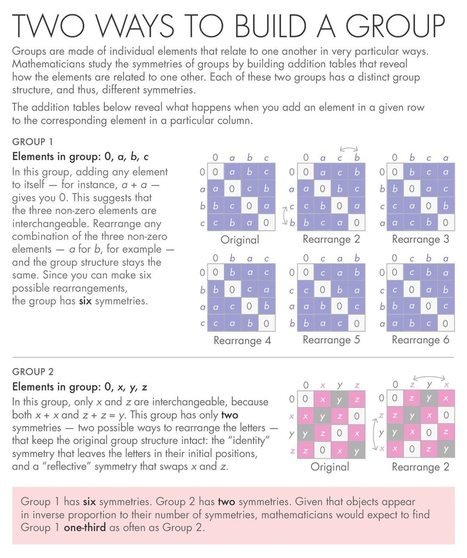
For centuries mathematicians tried to solve problems by adding new values to the usual numbers. Now they’re investigating the unintended consequences of that tinkering
|
|
Scooped by
Dr. Stefan Gruenwald
August 9, 2017 8:16 PM
|
Two “rare jewels” have illuminated a mysterious object that’s at the center of many mathematical questions. Strike a billiard ball on a frictionless table with no pockets so that it never stops bouncing off the table walls. If you returned years later, what would you find? Would the ball have settled into some repeating orbit, like a planet circling the sun, or would it be continually tracing new paths in a ceaseless exploration of its felt-covered plane? These kinds of questions occurred to mathematical minds centuries ago, in relation to the long-term trajectories of real objects in outer space, and for nearly that long they’ve seemed impossible to determine exactly. What will a bouncing ball be up to a billion years from now? It’s as hard to answer as it sounds. More recently, though, mathematicians have achieved a succession of stunning breakthroughs. One of the latest results, yet to be published, describes a new category of what are known as “optimal” billiard tables — shapes whose particular angles make it possible to understand every billiard path that could occur within them. The newfound shapes are among a handful of optimal billiard tables ever discovered, and part of an even more select group of quadrilaterals with that property. “They are like these rare jewels,” said Curt McMullen, a mathematician at Harvard University and a co-author of the work along with Alex Wright of Stanford University, Ronen Mukamel of Rice University and Alex Eskin of the University of Chicago. To find these jewels, these four mathematicians used an elegant set of methods that allow mathematicians to reimagine the claustrophobic, rebounding world of a billiard table as an elegant universe of smooth curves arcing unimpeded through space. There, the far-out future of the billiard path can be apprehended at a glance — while at the same time, perfect billiard tables end up serving as clues about the nature of the exotic higher-dimensional space in which they appear.
|
|
Scooped by
Dr. Stefan Gruenwald
August 9, 2017 3:19 PM
|
Using no moving parts, ion thrusters could propel tiny robots for long periods. Engines powered by ions are currently carrying satellites outsides of our solar system, but here on Earth, this futuristic propulsion could power miniature robots. Daniel Drew, an engineering student at the University of California, Berkeley, found himself inspired to study miniature robots from the science fiction he devoured as a child. Miniature robots inspired by insects could someday be used to search confined spaces for survivors after a disaster, monitor air quality and even fill in as pollinators for real-life insects that have been wiped out of an area. "Imagine a world where we could tap into the sensory input of every single insect on Earth," Drew said. "That's the kind of high-resolution data we can get." But as well as these bioinspired prototypes seemed likely to work, Drew said, they ran into a problem that their real-life inspirations didn't face—energy. Unlike an insect, a miniature robot needs a source of power, and that usually means a battery of some kind. But batteries can only get so small, and putting a larger, more powerful battery on a microrobot means the entire robot needs to get larger, defeating the purpose. Drew said his adviser, however, thought a vintage solution might solve this modern dilemma—ion thrusters. Dating back to the experiments of rocket pioneer Robert Goddard, these engines exploit the simple electrostatic effect familiar to most people who’ve pulled socks stuck together out of the dryer. In essence, ion propulsion works by shooting an electron into a chamber filled with a gas of some kind. When it hits an atom of the gas, that electron knocks an electron off the atom, making it positively charged. A negatively charged grid near the end of the chamber then draws that atom out of the thruster. The force of that atom flying out the thruster propels its craft forward.
|
|
Scooped by
Dr. Stefan Gruenwald
August 7, 2017 10:50 PM
|
Ben Vigoda, Gamalon’s CEO, spoke recently at MIT Technology Review EmTech along with Pedro Domingos from University of Washington, Noah Goodman from Stanford, Ruslan Salakhutdinov from Apple/CMU, Ilya Sutskever from OpenAI, Maya Gupta from Google, and Eric Horvitz from Microsoft. He describes how deep learning and other state-of-the art machine learning is like training a dog to provide a desired response to a stimulus – ‘ring the bell, give some food’ , ‘ring the bell, give some food’, and so forth, except that with today’s machine learning you typically need to repeat this kind of labeled input/output pair 10,000 times. By contrast, to teach a human we would just say, ‘This is a dinner bell, when I ring it I am going to serve you some food’ – you would insert that idea directly into their mind in between where the stimulus comes in and the response goes out – by talking to them. The person can still learn from stimulus-response experiences, but you can also teach them by communicating ideas to them. This is how Gamalon’s Idea Learning works. TED video is here Astronomers shared stories through the ages, enabling them to contradict and learn from each other. They broke stories apart and put them together in better ways—readjusting and reconsidering beliefs—to present new ideas that are more compelling and more accurate. Machines can do that too. "When we build stories into machine intelligence systems, we should enable them to attach probabilities to their stories" says Ben Vigoda.
Ben Vigoda is Founder, CEO/CTO of Gamalon Machine Intelligence. Before founding Gamalon, Ben was technical co-founder and CEO of Lyric Semiconductor, a startup that created the first integrated circuits and processor architectures for statistical machine learning and signal processing. He currently serves on the DARPA Information Science and Technology (ISAT) steering committee. Ben also co-founded Design That Matters, a not-for-profit that for the past decade has helped solve engineering and design problems in under-served communities and has saved thousands of infant lives by developing low-cost, easy-to-use medical technology such as infant incubators, UV therapy, pulse oximeters, and IV drip systems that have been fielded in 20 countries. Ben completed his PhD at MIT developing circuits for implementing machine learning algorithms natively in hardware.
|
|
Rescooped by
Dr. Stefan Gruenwald
from Nostri Orbis
August 6, 2017 9:57 PM
|
The thatched roof held back the sun’s rays, but it could not keep the tropical heat at bay. As everyone at the research workshop headed outside for a break, small groups splintered off to gather in the shade of coconut trees and enjoy a breeze. I wandered from group to group, joining in the discussions. Each time, I noticed that the language of the conversation would change from an indigenous language to something they knew I could understand, Bislama or English. I was amazed by the ease with which the meeting’s participants switched between languages, but I was even more astonished by the number of different indigenous languages. Thirty people had gathered for the workshop on this island in the South Pacific, and all except for me came from the island, called Makelua, in the nation of Vanuatu. They lived in 16 different communities and spoke 16 distinct languages. In many cases, you could stand at the edge of one village and see the outskirts of the next community. Yet the residents of each village spoke completely different languages. According to recent work by my colleagues at the Max Planck Institute for the Science of Human History, this island, just 100 kilometers long and 20 kilometers wide, is home to speakers of perhaps 40 different indigenous languages. Why so many? We could ask this same question of the entire globe. People don’t speak one universal language, or even a handful. Instead, today our species collectively speaks over 7,000 distinct languages. And these languages are not spread randomly across the planet. For example, far more languages are found in tropical regions than in the temperate zones. The tropical island of New Guinea is home to over 900 languages. Russia, 20 times larger, has 105 indigenous languages. Even within the tropics, language diversity varies widely. For example, the 250,000 people who live on Vanuatu’s 80 islands speak 110 different languages, but in Bangladesh, a population 600 times greater speaks only 41 languages. Why is it that humans speak so many languages? And why are they so unevenly spread across the planet? As it turns out, we have few clear answers to these fundamental questions about how humanity communicates.
Via Fernando Gil
|
|
|
Scooped by
Dr. Stefan Gruenwald
August 11, 2017 5:30 PM
|
Researchers uncover the evolved ability of goldfish to generate alcohol when deprived of oxygen. Without oxygen, most vertebrates die within minutes as they cannot meet cellular energy demands with anaerobic metabolism. However, fish of the genus Carassius (carp and goldfish) have evolved a specialized metabolic system that allows them to survive prolonged periods without oxygen by producing ethanol as their metabolic end-product. Now, scientists show that this has been made possible by the evolution of a pyruvate decarboxylase, analogous to that in brewer’s yeast and the first described in vertebrates, in addition to a specialized alcohol dehydrogenase. Whole-genome duplication events have provided additional gene copies of the pyruvate dehydrogenase multienzyme complex that have evolved into a pyruvate decarboxylase, while other copies retained the essential function of the parent enzymes. The researchers reveal the key molecular substitution in duplicated pyruvate dehydrogenase genes that underpins one of the most extreme hypoxic survival strategies among vertebrates and that is highly deleterious in humans.
|
|
Scooped by
Dr. Stefan Gruenwald
August 11, 2017 5:21 PM
|
When Dutch archaeologist D. A. Hooijer first saw a pair of weathered teeth recovered from a remote cave on the Indonesian island of Sumatra, he noted that they were about the right size and shape to belong to modern humans. But in 1948, he couldn’t be sure of their identity or their age. Now, harnessing cutting-edge science, a group of researchers has confirmed what Hooijer had suspected: Modern humans lived in Southeast Asia as far back as 73,000 years ago—about 20,000 years earlier than previously thought. The earlier timeline helps fill in the blanks on the migration routes of our early ancestors and bolsters an emerging theory that humans may have dwelled in rain forests much sooner than researchers had assumed. Previous studies suggested that after evolving in Africa, modern humans eventually made their way to Southeast Asia, but researchers have argued whether they arrived about 50,000 years ago or earlier. Recent studies put modern humans in Australia by about 65,000 years ago, but there has been little direct evidence of an early presence in Southeast Asia. To unravel the mystery, researchers led by geochronologist Kira Westaway of Macquarie University in Sydney, Australia, decided in 2008 to give the Sumatran teeth another look. She and her team used new techniques, including micro–computed tomography scanning to precisely measure the thickness of the enamel, and luminescence dating to determine when minerals in the rock surrounding the teeth were last exposed to sunlight. They found thick enamel, confirming that the teeth are from modern humans, and pegged the date to between 63,000 and 73,000 years ago, they report today in Nature.
|
|
Scooped by
Dr. Stefan Gruenwald
August 11, 2017 5:17 PM
|
Study suggests disease was more prevalent than previously believed. Some 2,250 years ago in Egypt, a man known today only as M1 struggled with a long, painful, progressive illness. A dull pain throbbed in his lower back, then spread to other parts of his body, making most movements a misery. When M1 finally succumbed to the mysterious ailment between the ages of 51 and 60, his family paid for him to be mummified so that he could be reborn and relish the pleasures of the afterworld. A few years ago, an international research team has diagnozed what ailed M1: The oldest known case of prostate cancer in ancient Egypt and the second oldest case in the world. The earliest diagnosis of prostate cancer came from the 2700-year-old skeleton of a Scythian king in Russia. Moreover, this study published in the International Journal of Paleopathology, suggests that earlier investigators may have underestimated the prevalence of cancer in ancient populations because high-resolution computerized tomography (CT) scanners capable of finding tumors measuring just 1 to 2 millimeters in diameter only became available in 2005. "I think earlier researchers probably missed a lot without this technology," says team leader Carlos Prates, a radiologist in private practice at Imagens Médicas Integradas in Lisbon. Prostate cancer begins in the walnut-sized prostate gland, an integral part of the male reproductive system. The gland produces a milky fluid that is part of semen and it sits underneath a man's bladder. In aggressive cases of the disease, prostate cancer cells can metastasize, or spread, entering the bloodstream and invading the bones. After performing high-resolution scans on three Egyptian mummies in the collection of the National Archaeological Museum in Lisbon, Prates and colleagues detected many small, round, dense tumors in M1's pelvis and lumbar spine, as well as in his upper arm and leg bones. These are the areas most commonly affected by metastatic prostate cancer. "We could not find any evidence to challenge this diagnosis," Prates says.
|
|
Scooped by
Dr. Stefan Gruenwald
August 10, 2017 10:32 PM
|
The strongest evidence to date for an exoplanet stratosphere has been identified by scientists using NASA's Hubble Space Telescope. Spectra of WASP-121b's atmosphere are the first to show the resolved signature of hot-water molecules for a planet outside the solar system. A planet's stratosphere is a layer of atmosphere where temperatures increase with altitude. For example, Earth's stratosphere contains ozone gas that traps ultraviolet radiation from the Sun, raising the temperature within the layer. Meanwhile, on Jupiter and Saturn's moon, Titan, methane is behind the temperature increase. WASP-121b is a "hot Jupiter" – a gas giant with 1.2 times the mass of Jupiter and 1.9 times the radius and a much higher temperature. Located about 900 light-years away, it orbits the star WASP-121 in just 1.3 days, and the planet's close proximity to the star means the top of its atmosphere reaches 2500 °C – so hot that some metals can boil. While previous research has found possible signs of stratospheres on other exoplanets, the evidence of water on WASP-121b is the best to date. Thomas Evans from the University of Exeter in the UK and colleagues identified the water because it has a very distinct and predictable interaction with light, depending on its temperature. If there is cool water at the top of the atmosphere, the molecules will prevent certain wavelengths of light (typically infrared due to heating) from escaping the planet. On the other hand, if the water is hot, the molecules will "glow" at the same infrared wavelength. "When we pointed Hubble at WASP-121b," says Evans, "we saw glowing water molecules, implying that the planet has a strong stratosphere." The temperature change within stratospheres of solar-system planets is typically around 56 °C, but on WASP-121b the temperature rises by 560 °C. The researchers do not know what chemicals are causing this rise in temperature, but possible candidates include vanadium oxide and titanium oxide because they are gaseous under such high temperatures and are commonly seen in brown-dwarf stars, which have similarities to some exoplanets. "This result is exciting because it shows that a common trait of most of the atmospheres in our solar system – a warm stratosphere – also can be found in exoplanet atmospheres," says team member Mark Marley at NASA's Ames Research Center in the US. "We can now compare processes in exoplanet atmospheres with the same processes that happen under different sets of conditions in our own solar system."
|
|
Scooped by
Dr. Stefan Gruenwald
August 10, 2017 10:27 PM
|
Until now, insects have been too wriggly to make good subjects for scientists wanting to understand more about insect innards. But an interdisciplinary team of biologists and imaging specialist. Living insects can now be scanned in unprecedented 3D detail without being harmed. The scanning method developed by scientists at Western University in Canada relies on an insect's ability to survive low-oxygen environments and high-ionizing radiation doses. Standard methods for looking inside insects involve using dead specimens or killing the bug during the imaging process. "We essentially had snapshots, moments in time, when what we needed were dynamic images of insects' internal development," says biologist Joanna Konopka. "We thought, what would happen if we tried to image them live?" Konopka therefore teamed up with biophysicist Danny Poinapen to develop a non-invasive technique. Using a steady flow of carbon dioxide, they temporarily immobilized living insects – including Colorado potato beetles and true army worms – for up to seven hours. As the bugs were no longer wiggling around, the team could use X-ray micro-computed tomography (micro-CT) to clearly see the insects' internal workings in 3D. The bugs were then remobilized and the process repeated again days later, with no effect on the insects' longevity, behaviour or ability to reproduce. The live-scanning method, presented in BMC Zoology, allowed the team to thoroughly examine how insects develop throughout their lifetime. It could therefore be useful in studying parasites or how insects impact human health.
|
|
Rescooped by
Dr. Stefan Gruenwald
from SciFrye
August 10, 2017 12:38 AM
|
Cameras in drones and robots have trouble dealing with detecting color when the light is changing. But bees, it turns out, have a mechanism that solves this problem and that can be used to improve cameras. New research into the way that honeybees see color could pave the way for more accurate cameras in phones, drones and robots. Identifying color in complex outdoor environments is extremely difficult because the color of light is continuously changing. Researchers in Melbourne, Australia, looked to see how honeybees solve this problem and discovered a totally new mechanism for processing color information. The results of the work by academics at RMIT University, Monash University, University of Melbourne and Deakin University were published today in the journal, Proceedings of the National Academy of Sciences of the United States of America (PNAS). The project, supported by an Australian Research Council (ARC) grant, was coordinated by Associate Professor Adrian Dyer at RMIT, who has been working with Professor Marcello Rosa at Monash University and the ARC Centre of Excellence for Integrative Brain Function to solve this classic problem of how color vision works.
Via Mariaschnee, Kim Frye
|
|
Rescooped by
Dr. Stefan Gruenwald
from Love
August 10, 2017 12:34 AM
|
Their genes enable birds to recognize – and learn – the musical call of their own species; conclude a group of researchers from Uppsala University. Their genes enable birds to recognize – and learn – the musical call of their own species; conclude a group of researchers from Uppsala University. The researchers appear to have found conclusive evidence in the mystery of songbird preference for the melodies of their species. Their study, which was recently published in Nature Ecology & Evolution, shows that rather than social learning it must be their genes that make songbirds call in a particular way. “The difference in songs between different species is vital to the birds’ sexual selection,” says Behavioral Ecologist David Wheatcroft to ScienceNordic’s Swedish partner forskning.se. Birds also use their songs in other social relationships. Many scientists who research birds have believed that juveniles learn the songs of their species by listening to their mothers, fathers and others. If they are thus open to such social influence the critical question which arises then is why the juveniles are not more influenced than they are by the songs of other species? Ornithologists have been pondering that question for decades.
Via Mariaschnee, ♥ princess leia ♥
|
|
Scooped by
Dr. Stefan Gruenwald
August 9, 2017 8:51 PM
|
Mark Weiser predicted the Internet of Things in a seminal article in 1991 about how people would interact with networked computation distributed into the environments and artifacts around them. The Internet of Things assumes ubiquitous sensate environments. Without these, the cognitive engines of this everywhere-enabled world are deaf, dumb, and blind, and cannot respond relevantly to the real-world events that they aim to augment. And the last decade has seen a huge expansion in wireless sensing, which is having a deep impact in ubiquitous computing. Advances have been rampant and sensors of all sorts now seem to be increasingly in everything. A myriad of commercial products are appearing for collecting athletic data for a variety of sports that range from baseball to tennis, and even the amateur athlete of the future will be instrumented with wearables that will aid in automatic/self/augmented coaching. Sensors of various sorts have also crept into fabric and clothing and going beyond wearable systems are electronics that are attached directly to or even painted onto the skin.
|
|
Scooped by
Dr. Stefan Gruenwald
August 9, 2017 8:25 PM
|
Species gain and shed startling amounts of DNA as they evolve, and even genomes that look stable churn furiously. What does it mean? The amount of DNA in animal's cells bears no obvious relationship to their size, complexity or ancestry. Bats have half of the DNA of elephants, but a viscacha rats have twice as much. Researchers now speculate that birds and bats may need small genomes to handle the metabolic demands of flight, but no one knows for sure. In 2017, a tantalizing clue arose from research led by Aurélie Kapusta while she was a postdoctoral fellow working with Cedric Feschotte, a geneticist then at the University of Utah, along with Alexander Suh, an evolutionary biologist at Uppsala University in Sweden. The study, one of the first of its kind, compared genome sequences across diverse lineages of mammals and birds. It showed that as species evolved, they gained and shed astonishing amounts of DNA, although the average size of their genomes stayed relatively constant. “We see the genome is very dynamic, very elastic,” said Feschotte, who is now at Cornell University. To explain this tremendous DNA turnover, Feschotte proposes an “accordion model” of evolution, whereby genomes expand and contract, forever gathering up new base pairs and dumping old ones. These molecular gymnastics represent more than a curiosity. They hint at hidden forces shaping the genome — and the organisms that genomes beget.
|
|
Scooped by
Dr. Stefan Gruenwald
August 9, 2017 3:20 PM
|
Researchers funded by the National Science Foundation (NSF) have publicly released high-resolution maps of Antarctica's McMurdo Dry Valleys, a globally unique polar desert. The high-resolution maps cover 3,564 square kilometers of the McMurdo Dry Valleys and allow researchers to compare present-day conditions with lower-resolution LIDAR surveys conducted almost 13 years ago. Scientists from Portland State University led the new research project, which mapped the area using more sophisticated LIDAR, a remote-sensing method that uses laser beam pulses to measure the distance from the detector to the Earth's surface. Two NSF-funded facilities, the Open Topography Facility and the Polar Geospatial Center, made the LIDAR data publicly available. A paper about the work was published in the journal Earth System Science Data. The data, collected by aerial survey missions flown in the Southern Hemisphere in the summer of 2014-2015, provide detailed topography of the perpetually ice-free region, where surprising landscape changes, such as rapid erosion along some streams, have been observed in recent years. The freely available datasets will allow scientists to get a handle on how widespread and how significant changes to the frozen landscape might be in this ecologically sensitive region. The National Center for Airborne Laser Mapping and the Portland State University team carried out the mapping during an eight-week field season, beginning in December 2015. They flew instruments aboard a Twin Otter aircraft operated by Kenn Borek Air, Ltd., under contract to NSF.
|
|
Scooped by
Dr. Stefan Gruenwald
August 8, 2017 1:11 PM
|
Genome editing has potential for the targeted correction of germline mutations. Scientists now describe the correction of the heterozygous MYBPC3 mutation in human preimplantation embryos with precise CRISPR–Cas9-based targeting accuracy and high homology-directed repair efficiency by activating an endogenous, germline-specific DNA repair response. Induced double-strand breaks (DSBs) at the mutant paternal allele were predominantly repaired using the homologous wild-type maternal gene instead of a synthetic DNA template. By modulating the cell cycle stage at which the DSB was induced, the researchers were able to avoid mosaicism in cleaving embryos and achieve a high yield of homozygous embryos carrying the wild-type MYBPC3 gene without evidence of off-target mutations. The efficiency, accuracy and safety of the approach presented suggest that it has potential to be used for the correction of heritable mutations in human embryos by complementing preimplantation genetic diagnosis. However, much remains to be considered before clinical applications, including the reproducibility of the technique with other heterozygous mutations.
|
|
Rescooped by
Dr. Stefan Gruenwald
from Papers
August 6, 2017 9:59 PM
|
Topological effects might be hiding inside perfectly ordinary materials, waiting to reveal bizarre new particles or bolster quantum computing.
Via Complexity Digest
|