Education 2.0 & 3.0
183.8K views | +8 today
Education 2.0 & 3.0
All about learning and technology
Curated by Yashy Tohsaku
Your new post is loading...
Scooped by Yashy Tohsaku
August 14, 6:27 PM
Scoop.it!

Turn Literature Study into an Investigation with PlotPoint –

Turn Literature Study into an Investigation with PlotPoint – | Education 2.0 & 3.0 | Scoop.it
Looking for a way to engage students with literature? Consider PlotPoint, a literature learning arcade featuring 100 titles. The goal of PlotPoint is to Explore this and more at TCEA TechNotes Blog, your go-to source for educational technology and teaching innovation.
No comment yet.
Rescooped by Yashy Tohsaku from e-learning-ukr
August 7, 8:56 PM
Scoop.it!

How to make your academic work visible to AI

How to make your academic work visible to AI | Education 2.0 & 3.0 | Scoop.it
If you want the robots and LLMs to find your scholarly publications, you need to make your outputs legible, connected and repeatedly encountered

Via Vladimir Kukharenko
No comment yet.
Rescooped by Yashy Tohsaku from Educational Technology News
August 7, 8:55 PM
Scoop.it!

First AI-native class arrives on campus. What now?

First AI-native class arrives on campus. What now? | Education 2.0 & 3.0 | Scoop.it
The first AI-native class is not waiting for universities to decide whether AI belongs in higher education.

Via EDTECH@UTRGV
EDTECH@UTRGV's curator insight, August 6, 10:15 AM

"This fall, North American colleges and universities will welcome a new freshman class...They are the first generation to complete much of their secondary education with generative AI constantly available."

Rescooped by Yashy Tohsaku from Learning & Technology News
August 7, 8:54 PM
Scoop.it!

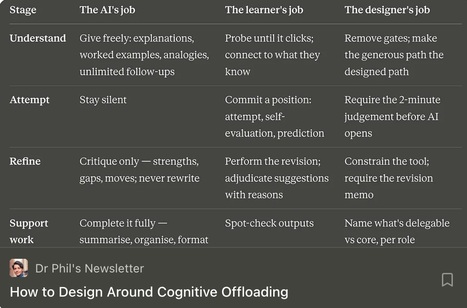
How to Design Around Cognitive Offloading

How to Design Around Cognitive Offloading | Education 2.0 & 3.0 | Scoop.it
Three new studies shed light on when offloading to AI harms learning, when it helps — and how to design for the difference

Via Nik Peachey
Nik Peachey's curator insight, August 7, 4:26 AM

How to Design Around Cognitive Offloading - Well worth reading if you want to understand how to use AI wisely https://drphilippahardman.substack.com/p/how-to-design-around-cognitive-offloading

Rescooped by Yashy Tohsaku from e-learning-ukr
August 7, 8:53 PM
Scoop.it!

Design The Meeting

Design The Meeting | Education 2.0 & 3.0 | Scoop.it
A mantra to value our time and leverage our moments of impact

Via Vladimir Kukharenko
No comment yet.
Rescooped by Yashy Tohsaku from iGeneration - Humane Use of Technology in an AI world (Pedagogy & Digital Innovation)
August 7, 8:52 PM
Scoop.it!

World Development Report 2026: The Promise of Artificial Intelligence - Adopt - Adapt - Advance (released Aug. 2026)

World Development Report 2026: The Promise of Artificial Intelligence - Adopt - Adapt - Advance (released Aug. 2026) | Education 2.0 & 3.0 | Scoop.it

The World Development Report 2026 explores how artificial intelligence is reshaping development as a general‑purpose technology.


Via Dr. Tom D'Amico (@TDOttawa)
No comment yet.
Rescooped by Yashy Tohsaku from e-learning-ukr
August 7, 8:51 PM
Scoop.it!

Will China’s push to bring higher education closer to industry fix its skills mismatch?

Will China’s push to bring higher education closer to industry fix its skills mismatch? | Education 2.0 & 3.0 | Scoop.it
Despite 12 million graduates entering the job market, Chinese companies still lack highly skilled candidates, writes Gerard A. Postiglione. Here, he looks at how the country’s universities are addressing employment and what its strategies can offer other higher education systems

Via Vladimir Kukharenko
No comment yet.
Rescooped by Yashy Tohsaku from Educational Technology News
August 7, 8:12 PM
Scoop.it!

'Used right, AI is a patient tutor. Used wrong, it's a shortcut around the learning'

'Used right, AI is a patient tutor. Used wrong, it's a shortcut around the learning' | Education 2.0 & 3.0 | Scoop.it

"With the continued evolution of AI tools, teachers and students alike have been using them to assist them in their everyday learning. While it’s disappointing to hear stories about students producing their work entirely with AI, it’s equally satisfying to see AI tools such as Gemini Notebooks, Perplexity, and ChatGPT offer educational-themed features that don’t encourage cheating."


Via EDTECH@UTRGV
EDTECH@UTRGV's curator insight, August 7, 11:33 AM

"Students who use AI to get answers lose problem-solving ability over time. Students who use it for hints keep it. So the whole design is built around productive struggle"

Rescooped by Yashy Tohsaku from e-learning-ukr
August 6, 6:07 AM
Scoop.it!

Choosing What’s Next: National Priorities for Open Education —

Choosing What’s Next: National Priorities for Open Education — | Education 2.0 & 3.0 | Scoop.it
This fall, the Open Education Association invites the open education field to collaborate on a process to select national priorities and develop shared plans to advance them. 

Via Vladimir Kukharenko
No comment yet.
Rescooped by Yashy Tohsaku from Learning & Technology News
August 6, 6:06 AM
Scoop.it!

Beyond the technology: what AI integration really requires from Higher Education

Beyond the technology: what AI integration really requires from Higher Education | Education 2.0 & 3.0 | Scoop.it

As universities consider how best to integrate artificial intelligence into higher education, one message is becoming increasingly clear: the challenge extends far beyond adopting new technologies. The more important question is how institutions, teachers and students can make sense of AI and use it in ways that support meaningful learning, critical thinking and responsible knowledge production.


Via Nik Peachey
Nik Peachey's curator insight, August 6, 5:13 AM

Beyond the technology: what AI integration really requires from Higher Education https://media-and-learning.eu/subject/artificial-intelligence/beyond-the-technology-what-ai-integration-really-requires-from-higher-education/ Taken together, the findings suggest that meaningful AI integration cannot be measured simply by how many tools universities adopt. Its success depends on whether institutions can use AI to strengthen learning, critical judgement and human agency while addressing the ethical, economic and infrastructural conditions surrounding these technologies.

Scooped by Yashy Tohsaku
August 5, 9:55 PM
Scoop.it!

ChatGPT Voice to Assist in German Language Conversation

ChatGPT Voice to Assist in German Language Conversation | Education 2.0 & 3.0 | Scoop.it
By Mike Dettinger, PhD, Louisiana State University DOI: https://www.doi.org/10.69732/KXKM2998 Introduction Since the spring semester 2024, our Department of World Languages, Literatures & Cultures (WLLC) at Louisiana State University (LSU) has embraced the integration of Artificial Intelligence (AI) into our language
No comment yet.
Scooped by Yashy Tohsaku
August 5, 8:47 PM
Scoop.it!

Designing safe AI systems for education

Designing safe AI systems for education | Education 2.0 & 3.0 | Scoop.it
With generative AI reshaping the educational landscape,  Teacher columnist and OECD Director of Education and Skills Andreas Schleicher discusses the…
No comment yet.
Scooped by Yashy Tohsaku
August 5, 8:46 PM
Scoop.it!

Expert insights – AI as a tool for assessment feedback

Expert insights – AI as a tool for assessment feedback | Education 2.0 & 3.0 | Scoop.it
In assessment, AI tools offer new possibilities for feedback while also raising important questions about quality, accuracy, teacher oversight and,…
No comment yet.
Scooped by Yashy Tohsaku
August 14, 6:24 PM
Scoop.it!

College Kids Are Using AI Agents to "Take" Entire Online Classes for Them by Logging Directly Into the Course Management Software

College Kids Are Using AI Agents to "Take" Entire Online Classes for Them by Logging Directly Into the Course Management Software | Education 2.0 & 3.0 | Scoop.it
AI agents can log into learning platforms like Canvas and take quizzes, write essays, and reply to discussions on a student's behalf.
No comment yet.
Rescooped by Yashy Tohsaku from Educational Technology News
August 7, 8:56 PM
Scoop.it!

AI in admissions outreach creates a paradox

AI in admissions outreach creates a paradox | Education 2.0 & 3.0 | Scoop.it
Here is the uncomfortable truth about AI in admissions outreach: the technology is not the problem. The way institutions are deploying it is.

Via EDTECH@UTRGV
EDTECH@UTRGV's curator insight, August 6, 10:12 AM

"Colleges racing to automate student communication are solving a capacity problem while quietly creating a trust problem—and trust is the only currency that matters in a decision as personal as where to spend four years of your life."

Scooped by Yashy Tohsaku
August 7, 8:55 PM
Scoop.it!

How to advance collaboration across higher education

How to advance collaboration across higher education | Education 2.0 & 3.0 | Scoop.it
Practical insights to support effective collaboration across research, teaching and the running of an institution
No comment yet.
Rescooped by Yashy Tohsaku from Learning & Technology News
August 7, 8:53 PM
Scoop.it!

What Is Slop? - The Human Playbook

What Is Slop? - The Human Playbook | Education 2.0 & 3.0 | Scoop.it
A short exploration of how AI is changing the signals of value in work and culture.

Via Nik Peachey
Nik Peachey's curator insight, August 7, 4:53 AM

Just reading this. Really nice thought experiment.

https://thehumanplaybook.substack.com/p/what-is-slop?

Rescooped by Yashy Tohsaku from e-learning-ukr
August 7, 8:52 PM
Scoop.it!

How to Design Around Cognitive Offloading

Three new studies shed light on when offloading to AI harms learning, when it helps — and how to design for the difference

Via Vladimir Kukharenko
No comment yet.
Rescooped by Yashy Tohsaku from iGeneration - Humane Use of Technology in an AI world (Pedagogy & Digital Innovation)
August 7, 8:52 PM
Scoop.it!

World Development Report 2026: The Promise of Artificial Intelligence - Adopt - Adapt - Advance (released Aug. 2026)

World Development Report 2026: The Promise of Artificial Intelligence - Adopt - Adapt - Advance (released Aug. 2026) | Education 2.0 & 3.0 | Scoop.it

The World Development Report 2026 explores how artificial intelligence is reshaping development as a general‑purpose technology.


Via Dr. Tom D'Amico (@TDOttawa)
No comment yet.
Rescooped by Yashy Tohsaku from Educational Technology News
August 7, 8:51 PM
Scoop.it!

The grading paradox: Better data is key to understanding real subject mastery

The grading paradox: Better data is key to understanding real subject mastery | Education 2.0 & 3.0 | Scoop.it
A unified data system offers a shared roadmap where every stakeholder has the clarity to understand subject mastery.

Via EDTECH@UTRGV
EDTECH@UTRGV's curator insight, August 7, 11:28 AM

"While national test scores have dropped to levels not seen in decades, average high school GPAs are actually climbing. Grading systems vary heavily from classroom to classroom and teacher to teacher. A student who receives a B+ could be proficient in a subject, but it may just mean they consistently turned their homework in on time. These inconsistencies suggest the traditional grading system is increasingly disconnected from the skills students have truly mastered."

Rescooped by Yashy Tohsaku from Digital Delights for Learners
August 7, 8:13 PM
Scoop.it!

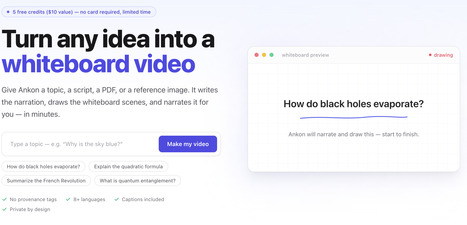
Turn any idea into a whiteboard explainer video

Turn any idea into a whiteboard explainer video | Education 2.0 & 3.0 | Scoop.it
Ankon AI turns a topic, script, PDF, or reference image into a narrated whiteboard explainer video with captions, in minutes. 5 free credits, no card.

Via Ana Cristina Pratas
No comment yet.
Rescooped by Yashy Tohsaku from e-learning-ukr
August 6, 6:07 AM
Scoop.it!

[2607.25220v1] Preprints Without Curation Are Increasingly Cited by Journals

[2607.25220v1] Preprints Without Curation Are Increasingly Cited by Journals | Education 2.0 & 3.0 | Scoop.it
The recent strain on peer review systems necessitates the publish-review-curate model, where the public dissemination of manuscripts is decoupled from formal peer review and later editorial processes. Citation norms traditionally pointed to the curated version; those that subsequently appear in peer-reviewed journals. Citations to preprints are therefore generally expected to occur only to those eventually curated. Using metadata from six major preprint servers linked to the world's largest bibliographic reference database, and focusing on citations from long-established journals with rigorous editorial workflows, we compare observed citation rates with a null model reflecting the expected rate if authors were indifferent between preprints and journal articles. The growth is evident in both citation intensity and the breadth of adoption: at its peak in 2021, nearly one in five journal articles cited at least one preprint. The preference to cite preprints has grown exponentially since the mid-2010s, with key inflection points coinciding with the launch of bioRxiv (2013) and the introduction of a preprint content type in Crossref's DOI system (2016). An increasing share of these citations refer to non-curated preprints and this shift cannot be explained by confounding factors: the growing stock of preprints, faster publishing cycles, or the outsized influence of a small set of highly cited preprints. These findings reveal a structural shift in citing behavior: preprints are increasingly treated as legitimate, autonomous objects of citation, independent of their later publication status, motivating renewed attention to how citation conventions and journal policies should accommodate the expanding role of preprints in scholarly communication. The COVID-19 pandemic did not amplify this trend but instead coincided with a deceleration in preprint citation growth.

Via Vladimir Kukharenko
No comment yet.
Scooped by Yashy Tohsaku
August 6, 6:05 AM
Scoop.it!

The modern library

The modern library | Education 2.0 & 3.0 | Scoop.it
Is this where books go to die? There are about 7500 public libraries in the US, and until recently, more than a third of their transactions were for DVDs. What’s a library for? The media has …
No comment yet.
Scooped by Yashy Tohsaku
August 5, 8:48 PM
Scoop.it!

AI in the classroom – ‘master prompting’ as a crucial skill

AI in the classroom – ‘master prompting’ as a crucial skill | Education 2.0 & 3.0 | Scoop.it
Latest data show teachers in Australia use artificial intelligence more than their international counterparts, but they have concerns about their own…
No comment yet.
Scooped by Yashy Tohsaku
August 5, 8:46 PM
Scoop.it!

Research news: Student AI use for school and homework

Research news: Student AI use for school and homework | Education 2.0 & 3.0 | Scoop.it
New research involving almost 4,000 students aged 13-18 in the UK has found many are divided over appropriate use of AI in their homework and a majority…
No comment yet.