Carol Barash, PhD, is the founder and CEO of Story2, a web platform that helps students tap into the power of storytelling by using a step-by-step process to transform spoken stories into authentic college admission essays. Story2 wonGoldman Sachs’ 10,000 Small Businesses competition, completed the Kaplan TechStars accelerator, was included in Forbes 10 EdTech Companies You Need to Know About in 2015 and 14 NY Tech Companies to Watch in 2016. Barash has taught at Princeton University, the University of Michigan, and Rutgers University, where she served as faculty advisor to the admissions committee. She graduated summa cum laude from Yale University, completed her M.A. at the University of Virginia, and Ph.D. at Princeton University.
Child psychologists have long argued that changing the approach we take to education would help many children learn to love school rather than hate it. We’ve all heard pre-schoolers talk about how they can’t wait to sit at their school desk and run to their next lesson with their rucksack over their shoulder. In fact, we probably remember that feeling of excitement ourselves the first time we went. But right from the first days of school, many children feel a huge sense of disappointment with what they encounter.
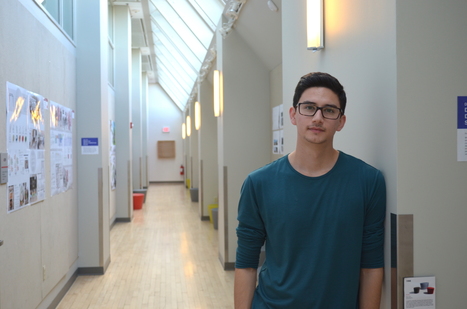
"At the Saunalahti school in the city of Espoo, Finland, they’ve found a brilliant way to overcome this problem. Starting just with the school building itself, you’d look at it and never think it was a school. Instead, it’s more a like modern art museum — wonderfully light and airy. Experts from VERSTAS Architects made sure they moved well away from the typical dour design for a public school which we all can’t stand:"
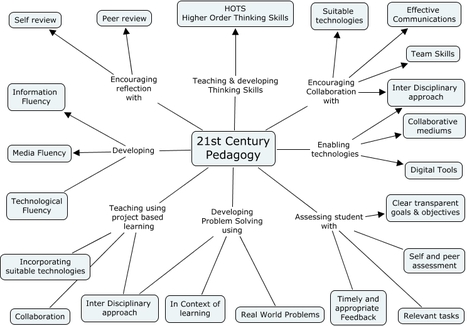
A Diagram Of 21st Century Pedagogy by TeachThought Staff The modern learner has to sift through a lot of information. That means higher level thinking skills like analysis and evaluation...
How do we teach to foster the 21st century learner?
As young people move from the structured learning environment of school into further study, employment and the big wide world, it is important that they are equipped with as many relevant skills as possible. This means the teacher's job is equally more important and difficult than perhaps it has ever been. The competitive nature of the world as it is at present, coupled with the importance of technological skills has led to a change in approaches to teaching. This means that we, as educators, need to implicitly teach more skills like higher order thinking and make our teaching more relevant to the real world.
At first, the attached mind-map just made me frightful. Teaching has evolved dramatically in the time I have been in the profession and sometimes I struggle to incorporate all the pedagogy to ensure students are adequately prepared for life in the 21st century. However, seeing this infographic makes it feel a little less daunting and somewhat excited thinking about which skills I can incorporate into my teaching, especially in the context of the new Geography curriculum.
If it’s getting harder and harder to get noticed in a sea of talent, yet it’s easier than ever to reach people, how do we get more attention, more of the time? There are a few ways, including paying for advertising and getting someone famous to endorse your work. These might work in the short term. But in the interest of genuine, organic and long-term attraction and attention, you simply must create in high quality AND in high volume AND with consistency.
The Rennie Center’s report, Social and Emotional Learning: Opportunities for Massachusetts, Lessons for the Nation, finds that while Massachusetts has several SEL-relevant programs and policies, more work is needed to align efforts, create a common focus, and provide all districts with support to further their work in this area. The research looks at how SEL policy, practice, and measurements are being effectively implemented in states and districts across the nation, including in three Massachusetts school districts—Fall River, Gardner, and Reading.
Using lessons learned from these districts, the report offers a blueprint for all Massachusetts school districts on ways to foster social and emotional development. This blueprint offers suggestions on how to prioritize, operationalize, and integrate SEL in school districts.
It took 200,000 years for our human population to reach 1 billion—and only 200 years to reach 7 billion. But growth has begun slowing, as women have fewe
If we want to develop a healthy democracy, we need a diverse and highly connected social fabric. This requires creating contexts in which the American public voluntarily struggles with the challenges of diversity to build bonds that will last a lifetime. We have been systematically undoing this, and the public has used new technological advances to make their lives easier by self-segregating. This has increased polarization, and we’re going to pay a heavy price for this going forward. Rather than focusing on what media enterprises can and should do, we need to focus instead on building new infrastructures for connection where people have a purpose for coming together across divisions. We need that social infrastructure just as much as we need bridges and roads.
"In 1607, a group of 104 male settlers, led by Captain John Smith, established Fort James in what is now modern day Virginia. Today, the Jamestowne Rediscovery Society, a project of the Association for the Preservation of Virginia Antiquities, is dedicated to researching the first permanent English settlement in North America and to educating the public about the "dramatic story" of Jamestown's establishment and demise. Visitors will find a number of resources for teaching and learning about Jamestown on this page. Nine lesson plans have been designed to engage elementary, middle, and high school students with the story of Jamestown, while encouraging student interest in the practice of historical and archeological inquiry. For example, How to Think Like an Archeologist, a lesson aimed at upper elementary school students, facilitates an introduction to the field of archeology via an examination of grocery store receipts. While some of these lesson plans are designed to prepare students for a visit to the settlement, many of these lessons may be implemented in classrooms around the world without an accompanying field trip. Readers will also find a link to the organization's YouTube page, which features a number of short videos about ongoing archeology efforts at the site of the former settlement."
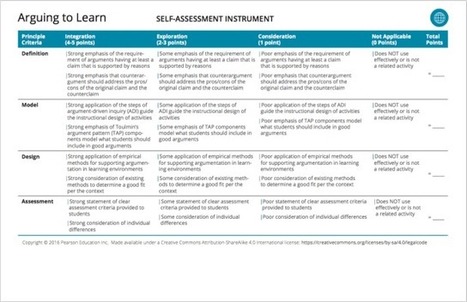
Last week, Pearson announced the release of some resources they have created around science-based learning design. (Full disclosure: Pearson is a client of our consulting company, although we have not consulted with them on the subject of this post.) The resources in the release include the following:
A 102-page rubric the company has started using for evaulating curricular products based on their effective use of learning design principles—released under a Creative Commons license A white paper describing how they are beginning to apply these principles to their own product designs A few links to descriptions of early examples of these principles as they have been applied in released products. A blog post providing some more background and perspective by David Porcaro, Pearson’s Director of Learning Design, whose team is behind this effort.
"When people wonder “how in the world are policymakers and schools providing benefits and aid to people in these [higher] income groups, it’s because they’re getting nailed, too,” said Jason Delisle, director of the Federal Education Budget Project at the nonpartisan think tank New America.
"The surprising amount of assistance they’re receiving, however, is flowing to them at a time when a new report from the University of Pennsylvania shows the proportion of wealthier students earning degrees continues to rise, while the proportion of lower-income degree recipients is falling. And a study by researchers at Stanford and the University of California, Santa Cruz, found that higher-income parents would send their kids to college even without help from such things as federal tax credits.
"Proposals to reform these programs have had scant success."
States have cut spending on higher education since the last recession by a collective $8.7 billion a year, according to the Center on Budget and Policy Priorities, or CBPP. That will come as no surprise to students and families who have seen their tuition at four-year colleges and universities rise as a result by an average of 33 percent during that time.
But the cuts have been uneven. A closer look shows they’re taking a greater toll on colleges and universities such as Chicago State that serve low-income and nonwhite students while flagships that enroll larger proportions of whites from higher-income families have been less affected.
"Half of young people have so many emotional problems they cannot focus at school, a study has found.
"Some 48 per cent of youngsters said that they experienced problems during their school years that prevented them from concentrating on their academic work.
"Of these, 46 per cent did not talk to anyone about their problems, mainly because they did not want other people to know that they were struggling.
"The latest report from the Youth Index, which gauges how students feel about a range of topics from home life to health, showed that mental health is at its lowest level since the Index was first commissioned."
Here are new additions to The Best Resources For Helping Teens Learn About The Importance Of Sleep (you can also find ideas there on how I use this kind of research in lessons): Starting school lat…
Her new university is among a number of recent initiatives to change the way American students learn and the values they take away with them. Ivy League universities are now particularly keen to shake up their admission process and focus less on students with great grades and a set of extra-curricular activities, and prioritize meaningful experience instead.
Technology can be amazingly empowering. But only when it is implemented in a responsible manner. Code doesn’t create magic. Without the right checks and balances, it can easily be misused. In the world of civic tech, we need to conscientiously think about the social and environmental costs, just as urban planners do.
"The tech industry played an influential role in the outcome of the US Presidential election. Not just in providing the medium for Fake News and propaganda.
"The root cause is job destruction by Automation — that drove a base of dissatisfied rust-belt voters to support Trump. Job destruction is accelerating, and if Tech doesn’t get ahead of this problem, there will be a significant populist backlash against the industry and its ability to progress."
A future in which human workers are replaced by machines is about to become a reality at an insurance firm in Japan, where more than 30 employees are being laid off and replaced with an artificial intelligence system that can calculate payouts to policyholders.
Fukoku Mutual Life Insurance believes it will increase productivity by 30% and see a return on its investment in less than two years. The firm said it would save about 140m yen (£1m) a year after the 200m yen (£1.4m) AI system is installed this month. Maintaining it will cost about 15m yen (£100k) a year.
The move is unlikely to be welcomed, however, by 34 employees who will be made redundant by the end of March.
"An increasing number of educational resources are available via the public domain, providing instructors with unpreceded opportunities to incorporate a diverse range of primary source material, textbooks, open courses, and more into their classrooms. This abundance of materials, however, can present instructors and librarians with a new challenge: how to discern what materials will be relevant and useful in their classroom or educational institution. The University of Massachusetts Dartmouth has created this guide to Open Educational Resources to help. Here, visitors will find an extensive list of resources organized into five categories, including For Educators, For Learners, and Image and Video Resources. Lists are accompanied by short video tutorials designed to familiarize visitors with open educational resources and the role of these resources in both the classroom and in the broader academic community. One video in the For Educators section depicts faculty perspectives on the specific distinction between Open Education Resources and Open Access. While aimed specifically at those working in higher education, instructors and librarians in all settings will find material of use in this research guide. "
Once acclaimed as the equal-opportunity stepping stone to the middle class, and a way of closing that divide, higher education has instead become more segregated than ever by wealth and race as state funding has fallen and colleges and universities — and even states and the federal government — are shifting financial aid from lower-income to higher-income students. This has created a system that spends the least on those who need the most help and the most on those who arguably need the least. While almost all the students who go to selective institutions such as Trinity graduate and get good jobs, many students from the poorest families end up even worse off than they started out, struggling to repay loans they took out to pay for degrees they never get.
To get content containing either thought or leadership enter:
To get content containing both thought and leadership enter:
To get content containing the expression thought leadership enter:
You can enter several keywords and you can refine them whenever you want. Our suggestion engine uses more signals but entering a few keywords here will rapidly give you great content to curate.


 Your new post is loading...