Clayton Christensen is a leading professor at the Harvard Business School. A generation ago, he wrote a book and advanced the cause of case study in learning. More recently he has advanced the idea of Disruptive Innovation in several fields. In educational circles, he became well known as the lead author of 2010's blockbuster book "Disrupting Class."
To put it bluntly, Clayton Christensen is Very Establishment.
For him to say that the pursuit of profit is killing the US economy is earthshaking. For it to be reported in Forbes magazine is most remarkable.
Can it be that thoughtful discourse still has a place in the marketplace of contemporary ideas? -JL
Under the banner of high-tech progress, corporate lobbyists have rammed through legislation privatizing K-12 education across the country—with help from all the key right-wing players.
Cathy Davidson has a few ideas. The author of Now You See It: How the Brain Science of Attention Will Transform the Way We Live, Work, and Learn (Viking), who’s also a professor at Duke University, believes that, in light of the fact that “65 percent of today’s grade-school kids may end up doing work that hasn’t been invented yet,” we should cast aside our fear of technology, and prepare our school-aged kids with important skills, both in technical ways and other less tangible ways.
The conflict between computers and schools is really a conflict between educational paradigms. The traditional and dominant paradigm is rooted in the book and the pedagogy is one of transmission. Teachers, who have presumably read more books than their students and listened to more scholarly lectures, transmit what they’ve learned to their students in a similar fashion.
The pedagogy that’s emerging to deliver 21st-century skills is student-centered and inquiry-based. In the inquiry-based approach, student interest drives the learning process and the teacher shifts from the sage on the stage into more of a coaching role. Within this system of learning, there is real value in having the widest range of technological tools for not only consuming information in all its multimodal forms, but for creatively demonstrating what one has learned.
Marion Brady's excellent work dealing with the creation of a more meaningful school experience for secondary students. -JL
Connections: Investigating Reality is a free course of study designed primarily for adolescents and older students, working in small, cooperative groups.
The program's overarching aim is expanding learner ability to "make sense" of reality, an aim we consider essential to the achievement of all other legitimate aims of a general education.
Connections isn't a supplement to the traditional core curriculum. Used optimally, it's a replacement for the core for at least a year of an adolescent learner's schooling.
The activities in Connections rely heavily on ordinary, first-hand user experience, require the use of all thought processes, progress slowly through increasing levels of conceptual (as distinct from textual) complexity, and, as is true in all attempts to make sense of experience, move constantly across and beyond arbitrary disciplinary boundaries.
Great 6 min. TED talk about a new group of high schools, called Studio Schools, starting to sprout in Great Britain. The schools strive to be 80% project-based and have a great early track record. -JL
[Editor's Note] This entry is written as part of the Analytics Blogarama hosted by SmartData Collective. The subject prompt was: "The Emerging Role of the Analyst." *** Snarky and informative piece. -JL
Urbanization is now good news. Expert opinion has shifted profoundly in the past decade or two. Though slums as appalling as Victorian London's are now widespread, and the Victorian fear of cities lives on, cancer no longer seems the right metaphor. On the contrary: With Earth's population headed toward nine or ten billion, dense cities are looking more like a cure—the best hope for lifting people out of poverty without wrecking the planet.
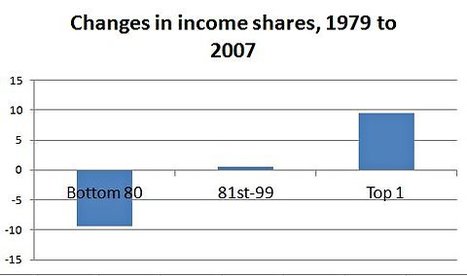
Just an addendum on the role of the top 1 percent versus the college-noncollege differential. Here, from the Congressional Budget Office report, are the changes, in percentage points, of the shares of income going to three groups. The top quintile excluding the top 1 percent – which is basically the abode of the well-educated who aren’t among the very lucky few – has only kept pace with the overall growth in incomes. Just about all of the redistribution has taken place from the bottom 80 to the top 1 (and we know that most of that has actually gone to the top 0.1).
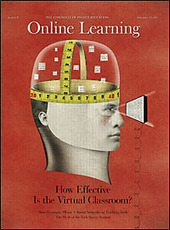
2011 special issue about Online Learning by the Chronicle of Higher Education. I like these articles: Scholars' Favorite Online Tools, Art Program Build Models for Online Instruction, A Social Network Is a Learning Network, The Myth of the Tech-Savvy Student, and the Charts of 6 Online Learning Trends.
A pedagogical framework for mobile learning: Categorizing educational applications of mobile technologies into four types. Deep philosophical analysis of mobile learning. Great work, if this is your cup of tea. -JL
A first-of-its kind resource for the future of education: a comprehensive guide to learning online and charting a personalized path to an affordable credential using the latest innovative tools and organizations.
A reader of this piece could use a program to identify who are the good guys and the bad guys. Wouldn't it be good for Tough to identify who the "reformers" are that he is talking about? There are a lot of people who have been saying all along what he and the "reformers" are just beginning to realize...that "successfully educating large numbers of low-income kids is very, very hard." - JL
When Fort Collins, Colorado, could not afford to hire out to craft a master plan, it looked inward, moving through a highly more organic process that resulted in an environmentally-centered blueprint.
RSCON3 took place from Friday, July 29 to Sunday, July 31*, 2011 and was our biggest yet global online conference for everyone concerned with education. With 80 presenters and 12 keynote speakers it was an absolutely incredible event! Organised by educators for educators, it was FREE but offered more valuable and inspiring Professional Development than money could buy! If you didn’t manage to attend you can catch up by viewing the Elluminate Recordings. Additional recordings for RSCON2 and RSCON1 also available here.
Beautiful Brains: Moody. Impulsive. Maddening. Why do teenagers act the way they do? Viewed through the eyes of evolution, their most exasperating traits may be the key to success as adults.
Unlike the many doom-and-gloom books of recent years, this work offers a hopeful analysis of the university and its traditions and how it must find new models for the future
Ray Kurzweil is an expert at predicting the future. Some of his career highlights include foreseeing the fall of the Soviet Union, the invention of the Internet and a computer beating a man at chess.
So what will the coming decades hold for us? In tracking our progress in the technological-evolutionary journey, Kurzweil has identifies six epochs, each of which is characterized by a major paradigm shift.
Kurzweil describes where we came from, where we are today, and where we're going, in this video below:
To get content containing either thought or leadership enter:
To get content containing both thought and leadership enter:
To get content containing the expression thought leadership enter:
You can enter several keywords and you can refine them whenever you want. Our suggestion engine uses more signals but entering a few keywords here will rapidly give you great content to curate.


 Your new post is loading...