 Your new post is loading...

|
Rescooped by
Loïc Lepiniec
from lignocellulosic biomass
August 30, 2019 4:25 PM
|
De mieux en mieux.. sur la page du ministère! ... .. ils ajoutent quand même "A noter : ces labels sont commerciaux et permettent d'éclairer le choix des consommateurs, ce ne sont pas des signes officiels de la qualité et de l'origine"...!
Via Herman Höfte
|
|
Scooped by
Loïc Lepiniec
July 7, 2019 4:26 AM
|
Enhancer elements can control spatial and temporal patterns of gene expression. Here the authors profile chromatin accessibility, histone modifications and gene expression during Arabidopsis flower development providing evidence for sets of distal enhancers acting in a highly stage-specific manner.
|
|
Scooped by
Loïc Lepiniec
June 9, 2019 2:43 AM
|
Authors: Dawei Dai, Hongyang Tong, Lijun Cheng, Fei Peng, Tingting Zhang, Weiwei Qi and Rentao Song.
Journal of Experimental Botany (2019)
Abstract: "The maize (Zea mays) classic kernel mutant defective kernel 33 (dek33) produced defective and occasionally viviparous kernel phenotype. In this study, we cloned Dek33 by positional cloning and found that it encodes the pyrimidine reductase in riboflavin biosynthesis. In dek33, a single base mutation (G-to-A) in the C-terminal COG3236 domain caused a premature stop codon (TGA), producing a weak mutant allele with significant reduction of truncated DEK33 protein and riboflavin content. The dek33 mutation significantly affected oilbody formation and suppressed endoreduplication. The dek33 mutation also disrupted ABA biosynthesis, resulting in less ABA content, which might be responsible for the viviparous embryo. In addition, our results indicated that the COG3236 domain is important for the protein stability of DEK33. The yeast two-hybrid experiment identified several proteins that interact with DEK33, including RGLG2 and SnRK1, suggesting possible post-translational regulation to DEK33 stability. The interaction between DEK33 and these proteins was further confirmed by luciferase complementation image assay. This study provided a weak mutant allele to explore cellular responses due to impaired riboflavin biosynthesis during seed development. Our findings indicated that the COG3236 domain might be an essential regulatory structure for DEK33 stability in maize."
|
|
Scooped by
Loïc Lepiniec
May 30, 2019 12:11 PM
|
Highlights
Complete growth and fate maps are made for C. hirsuta and A. thaliana leaf surfaces
Patterning of the leaf margin modifies organ-wide growth pattern to produce leaf shape
Altering growth relative to patterning generates leaf shape diversity
Reconstructing dissected leaf shape by combining STM and RCO in A. thaliana leaves
|
|
Scooped by
Loïc Lepiniec
May 27, 2019 2:13 AM
|
Authors: Mengjuan Bai, Jingjing Sun, Jinyi Liu, Haoran Ren, Kang Wang, Yanling Wang, Changquan Wang and Katayoon Dehesh.
The Plant Journal (2019)
Abstract: "Seed germination is a fundamental process in plant life cycle regulated by functionally opposing internal and external inputs. Here, we explored the role of a negative regulator of photomorphogenesis, a B‐box containing protein (BBX19), as a molecular link between the inhibitory action of the phytohormone abscisic acid (ABA) and promoting role of light in germination. We show that seeds of BBX19 overexpressing lines, in contrast to those of BBX19 RNAi, display ABA hypersensitivity, albeit independently of elongated hypocotyl 5 (HY5). Moreover, we establish that BBX19 function is neither via perturbation of the GA signaling, the ABA antagonistic phytohormone, nor through interference with the germination repressors, DELLA proteins. Rather, BBX19 functions as an inducer of ABA INSENSITIVE5 (ABI5) by binding to the light‐responsive GT1‐motifs in the gene promoter. In summary, we identify BBX19 as a regulatory checkpoint directing diverse developmental processes, and tailoring adaptive responses to distinct endogenous and exogenous signals."
|
|
Rescooped by
Loïc Lepiniec
from Plant Sciences
May 17, 2019 4:54 AM
|
Russia is embracing gene-editing. A 111-billion-rouble (US$1.7-billion) federal programme aims to create 10 new varieties of gene-edited crops and animals by 2020 — and another 20 by 2027. Alexey Kochetov, director of the Siberian Branch of the Russian Academy of Sciences (RAS) Institute of Cytology and Genetics in Novosibirsk, welcomed the research programme, noting that genetics in Russia has been “chronically underfinanced” for decades. Funding for science plummeted in the 1990s following the break-up of the Soviet Union, and Russia still lags behind other major powers: in 2017, it spent 1.11% of its gross domestic product on research, compared with 2.13% in China and 2.79% in the United States. But some researchers doubt that the goals can be met on time, and worry that the initiative does not address the other issues they face, such as excessive bureaucracy. It is also not clear whether the 111 billion roubles is included in the existing federal civilian-science budget — which in 2018 was 364 billion roubles, with 22 billion roubles spent on genetics research — or whether it comes in addition to that budget. The programme, which was announced in April, has also attracted interest because it suggests that some gene-edited products will now be exempt from a law passed in 2016 that prohibits the cultivation of genetically modified (GM) organisms in Russia, except for research purposes. Previously, it was not clear whether gene-edited organisms were included in the ban.
Via Saclay Plant Sciences
|
|
Scooped by
Loïc Lepiniec
May 11, 2019 5:31 AM
|
MicroRNAs (miRNAs) are short non-coding RNAs that mediate the repression of target transcripts in plants and animals. Although miRNAs are required throughout plant development, relatively little is known regarding their embryonic functions. To systematically characterize embryonic miRNAs in Arabidopsis thaliana, we developed or applied high-throughput sequencing based methods to profile hundreds of miRNAs and associated targets throughout embryogenesis. We discovered dozens of miRNAs that dynamically cleave and repress target transcripts including 30 that encode transcription factors. Transcriptome analyses indicated that these miRNA:target interactions have a profound impact on embryonic gene expression programs, and we further demonstrated that the miRNA-mediated repression of six transcription factors were individually required for embryo morphogenesis. These data indicate that the miRNA-directed repression of multiple transcription factors is critically important for the establishment of the plant body plan, and provide a foundation to further investigate how miRNAs contribute to these initial cellular differentiation events.
|
|
Scooped by
Loïc Lepiniec
May 9, 2019 10:42 AM
|
High genotype-dependent variation in friable embryogenic callus (FEC) induction and subsequent somaclonal variation constitute bottlenecks for the application and scaling of genetic transformation (GT) technology to more farmer- and industry-preferred cassava varieties. The understanding and identification of molecular factors underlying embryogenic development in cassava may help to overcome these constraints. Here, we described the Arabidopsis thaliana LEAFY COTYLEDON (LEC) LEC1 and LEC2 orthologous genes in cassava, designated as MeLEC1 and MeLEC2, respectively. Expression analyses showed that both, MeLEC1 and MeLEC2, are expressed at higher levels in somatic embryogenic (SE) tissues in contrast with differentiated mature tissues. The rapid expression increase of MeLEC genes at early SE induction times strongly suggests that they are involved in the transition from a somatic to an embryonic state, and probably, in the competence acquisition for SE development in cassava. The independent overexpression of the MeLEC genes resulted in different regenerated events with embryogenic characteristics such as MeLEC1OE plants with cotyledon-like leaves and MeLEC2OE plants with somatic-like embryos that emerged over the surface of mature leaves. Transcript increases of other embryo-specific regulating factors were also detected in MeLECOE plants, supporting their mutual interaction in the embryo development coordination. The single overexpression of MeLEC2 was enough to reprogra
|
|
Scooped by
Loïc Lepiniec
April 8, 2019 4:40 AM
|
Flavonoids play critical roles in plant responses to various stresses. Few studies have been reported on what the mechanism of activating flavonoid biosynthesis in plant responses to wounding and oxidation is. In this study, flavonoids metabolites and many MYB transcript factors from Rosa rugosa were verified to be induced by wounding and oxidation. RrMYB5 and RrMYB10, which belong to PA1‐ and TT2‐type MYB TFs, respectively, showed extremely high induction. Overexpression of RrMYB5 and RrMYB10resulted in an increased accumulation of proanthocyanidins in R. rugosa and tobacco by promoting the expression of flavonoid structural genes. Transcriptomic analysis of the transgenic plants showed that most genes, involved in wounding and oxidation response and ABA signaling modulation, were upregulated by the overexpression of RrMYB10, which was very much similar to that observed in RrANR and RrDFR overexpression transgenics. RrMYB5 and RrMYB10 physically interacted and mutually activated each other's expressions. They solely or synergistically activated the different sets of flavonoid pathway genes in a bHLH TF EGL3‐independent manner. Eventually, the accumulation of proanthocyanidins enhanced plant tolerance to wounding and oxidative stresses. Therefore, RrMYB5 and RrMYB10 regulated flavonoid synthesis in feedback loop responding to wounding and oxidation in R. rugosa. Our study provides new insights into the regulatory mechanisms of flavonoid biosynthesis by MYB TFs and their essential physiological functions in plant responses to wounding and oxidative stresses.
|
|
Scooped by
Loïc Lepiniec
April 8, 2019 2:15 AM
|
animal consumers. Understanding why domesticated crops have altered pigmentation patterns and unraveling the underlying molecular/genetic mechanisms will facilitate the breeding of new (healthier) varieties. We present an overview of changes in flavonoid pigmentation patterns during crop domestication and link it, where possible, to the molecular changes that brought about the new phenotypes. We report about species that lost flavonoid pigmentation in the edible part of the plant at some point during domestication (like cereals). Eggplant instead gained strong anthocyanin accumulation in the skin of the fruit during domestication, and some varieties of citrus and apple acquired anthocyanin in the fruit flesh. Interestingly, the genes responsible for such changes are sometimes closely linked to, or have pleiotropic effects on important domestication genes, suggesting accidental and perhaps inevitable changes of anthocyanin patterning during domestication. In other cases, flavonoid pigmentation patterns in domesticated crops are the result of cultural preferences. Examples are found back in varieties of citrus, barley, wheat and maize. Finally, and more recently, in some species, anthocyanins seem to have been the direct target of selection in a second wave of domestication that followed the introduction of industrial food processing.
Poplar trees synthesize flavan‐3‐ols (catechin and proanthocyanidins) as a defense against foliar rust fungi, but the regulation of this defense response is poorly understood. Here, we investigated the role of hormones in regulating flavan‐3‐ol accumulation in poplar during rust infection.
We profiled levels of defense hormones, signaling genes, and flavan‐3‐ol metabolites in black poplar leaves at different stages of rust infection. Hormone levels were manipulated by external sprays, genetic engineering, and drought to reveal their role in rust fungal defenses.
Levels of salicylic acid (SA), jasmonic acid, and abscisic acid increased in rust‐infected leaves and activated downstream signaling, with SA levels correlating closely with those of flavan‐3‐ols. Pretreatment with the SA analog benzothiadiazole increased flavan‐3‐ol accumulation by activating the MYB–bHLH–WD40 complex and reduced rust proliferation. Furthermore, transgenic poplar lines overproducing SA exhibited higher amounts of flavan‐3‐ols constitutively via the same transcriptional activation mechanism. These findings suggest a strong association among SA, flavan‐3‐ol biosynthesis, and rust resistance in poplars. Abscisic acid also promoted poplar defense against rust infection, but likely through stomatal immunity independent of flavan‐3‐ols. Jasmonic acid did not confer any apparent defense responses to the fungal pathogen.
We conclude that SA activates flavan‐3‐ol biosynthesis in poplar against rust infection.
Via Christophe Jacquet
|
|
Scooped by
Loïc Lepiniec
January 10, 2019 2:14 AM
|
Apical growth in plants initiates upon seed germination, whereas radial growth is primed only during early ontogenesis in procambium cells and activated later by the vascular cambium1. Although it is not known how radial growth is organized and regulated in plants, this system resembles the developmental competence observed in some animal systems, in which pre-existing patterns of developmental potential are established early on2,3. Here we show that in Arabidopsis the initiation of radial growth occurs around early protophloem-sieve-element cell files of the root procambial tissue. In this domain, cytokinin signalling promotes the expression of a pair of mobile transcription factors—PHLOEM EARLY DOF 1 (PEAR1) and PHLOEM EARLY DOF 2 (PEAR2)—and their four homologues (DOF6, TMO6, OBP2 and HCA2), which we collectively name PEAR proteins. The PEAR proteins form a short-range concentration gradient that peaks at protophloem sieve elements, and activates gene expression that promotes radial growth. The expression and function of PEAR proteins are antagonized by the HD-ZIP III proteins, well-known polarity transcription factors4—the expression of which is concentrated in the more-internal domain of radially non-dividing procambial cells by the function of auxin, and mobile miR165 and miR166 microRNAs. The PEAR proteins locally promote transcription of their inhibitory HD-ZIP III genes, and thereby establish a negative-feedback loop that forms a robust boundary that demarks the zone of cell division. Taken together, our data establish that during root procambial development there exists a network in which a module that links PEAR and HD-ZIP III transcription factors integrates spatial information of the hormonal domains and miRNA gradients to provide adjacent zones of dividing and more-quiescent cells, which forms a foundation for further radial growth.
|
|
Scooped by
Loïc Lepiniec
January 8, 2019 11:38 AM
|
Effective research, education, and outreach efforts by the Arabidopsis thaliana community, as well as other scientific communities that depend on Arabidopsis resources, depend vitally on easily available and publicly‐shared resources. These resources include reference genome sequence data and an ever‐increasing number of diverse data sets and data types. TAIR (The Arabidopsis Information Resource) and Araport (originally named the Arabidopsis Information Portal) are community informatics resources that provide tools, data, and applications to the more than 30,000 researchers worldwide that use in their work either Arabidopsis as a primary system of study or data derived from Arabidopsis. Four years after Araport's establishment, the IAIC held another workshop to evaluate the current status of Arabidopsis Informatics and chart a course for future research and development. The workshop focused on several challenges, including the need for reliable and current annotation, community‐defined common standards for data and metadata, and accessible and user‐friendly repositories/tools/methods for data integration and visualization. Solutions envisioned included (a) a centralized annotation authority to coalesce annotation from new groups, establish a consistent naming scheme, distribute this format regularly and frequently, and encourage and enforce its adoption. (b) Standards for data and metadata formats, which are essential, but challenging when comparing across diverse genotypes and in areas with less‐established standards (e.g., phenomics, metabolomics). Community‐established guidelines need to be developed. (c) A searchable, central repository for analysis and visualization tools. Improved versioning and user access would make tools more accessible. Workshop participants proposed a “one‐stop shop” website, an Arabidopsis “Super‐Portal” to link tools, data resources, programmatic standards, and best practice descriptions for each data type. This must have community buy‐in and participation in its establishment and development to encourage adoption.
|
|
|
Scooped by
Loïc Lepiniec
August 25, 2019 1:25 PM
|
The brassinosteroid receptor kinase, BRI1, plays a role in seed germination and the release of dormancy by cold stratiSeed dormancy is a critical mechanism that delays germination until environmental conditions are favorable for growth. Plant hormones gibberellin (GA) and abscisic acid (ABA) have long been recognized as key players in regulating dormancy and germination. Recent data have increased interest in brassinosteroid (BR) hormones that promote germination by activating GA downstream genes and inactivating ABA signaling. Exposure of imbibed seeds to low temperature (cold stratification) is widely used to release seed dormancy and to improve germination frequency. However, the mechanism by which cold stratification overcomes the inhibitory role of ABA is not completely understood. In the present study, we show delayed germination of seeds of the BR insensitive mutant, bri1-5, that was largely reversed by treatment with fluridone, an inhibitor of ABA biosynthesis. In addition, the bri1-5 seeds were markedly less sensitive to the cold stratification release of dormancy. These results suggest that BR locates upstream of ABA signaling and downstream of cold stratification signaling in dormancy and germination pathways. Consistent with this notion, BR biosynthetic genes, DWF4 and DET2, were upregulated by cold stratification. The transcripts of the GA biosynthesis gene, GA3ox1, and cold responsive genes, CBF1 and CBF2, increased in response to cold stratification in wild type seeds but not in bri1-5 seeds. Conversely, transgenic seeds overexpressing BRI1 germinated more rapidly than wild type in the absence of cold stratification. Thus, we propose that BR signaling plays a previously unrecognized role in the cold stratification pathway for seed dormancy and germination.fication
|
|
Scooped by
Loïc Lepiniec
July 4, 2019 3:52 AM
|
The accumulation of secondary metabolites and the regulation of tissue acidity contribute to the important traits of grape berry and influence plant performance in response to abiotic and biotic factors. In several plant species a highly conserved MYB–bHLH–WD (MBW) transcriptional regulatory complex controls flavonoid pigment synthesis and transport, and vacuolar acidification in epidermal cells. An additional component, represented by a WRKY‐type transcription factor, physically interacts with the complex increasing the expression of some target genes and adding specificity for other targets. Here we investigated the function of MBW(W) complexes involving two MYBs (VvMYB5a and VvMYB5b) and the WRKY factor VvWRKY26 in grapevine (Vitis vinifera L.). Using transgenic grapevine plants we showed that these complexes affected different aspects of morphology, plant development, pH regulation, and pigment accumulation. Transcriptomic analysis identified a core set of putative target genes controlled by VvMYB5a, VvMYB5b, and VvWRKY26 in different tissues. Our data indicated that VvWRKY26 enhances the expression of selected target genes induced by VvMYB5a/b. Among these targets are genes involved in vacuolar hyper‐acidification, such as the P‐type ATPases VvPH5 and VvPH1, and trafficking, and genes involved in the biosynthesis of flavonoids. In addition, VvWRKY26 is recruited specifically by VvMYB5a, reflecting the functional diversification of VvMYB5a and VvMYB5b. The expression of MBWW complexes in vegetative organs, such as leaves, indicates a possible function of vacuolar hyper‐acidification in the repulsion of herbivores and/or in developmental processes, as shown by defects in transgenic grape plants where the complex is inactivated.
|
|
Scooped by
Loïc Lepiniec
May 31, 2019 2:52 AM
|
Authors: Joaquin Felipe Roca Paixão, François-Xavier Gillet, Thuanne Pires Ribeiro, Caroline Bournaud, Isabela Tristan Lourenço-Tessutti, Daniel D. Noriega, Bruno Paes de Melo, Janice de Almeida-Engler and Maria Fatima Grossi-de-Sa.
Scientific Reports (2019)
Abstract: "Drought episodes decrease plant growth and productivity, which in turn cause high economic losses. Plants naturally sense and respond to water stress by activating specific signalling pathways leading to physiological and developmental adaptations. Genetically engineering genes that belong to these pathways might improve the drought tolerance of plants. The abscisic acid (ABA)-responsive element binding protein 1/ABRE binding factor (AREB1/ABF2) is a key positive regulator of the drought stress response. We investigated whether the CRISPR activation (CRISPRa) system that targets AREB1 might contribute to improve drought stress tolerance in Arabidopsis. Arabidopsis histone acetyltransferase 1 (AtHAT1) promotes gene expression activation by switching chromatin to a relaxed state. Stable transgenic plants expressing chimeric dCas9HAT were first generated. Then, we showed that the CRISPRa dCas9HAT mechanism increased the promoter activity controlling the β-glucuronidase (GUS) reporter gene. To activate the endogenous promoter of AREB1, the CRISPRa dCas9HAT system was set up, and resultant plants showed a dwarf phenotype. Our qRT-PCR experiments indicated that both AREB1 and RD29A, a gene positively regulated by AREB1, exhibited higher gene expression than the control plants. The plants generated here showed higher chlorophyll content and faster stomatal aperture under water deficit, in addition to a better survival rate after drought stress. Altogether, we report that CRISPRa dCas9HAT is a valuable biotechnological tool to improve drought stress tolerance through the positive regulation of AREB1.
|
|
Scooped by
Loïc Lepiniec
May 28, 2019 2:08 AM
|
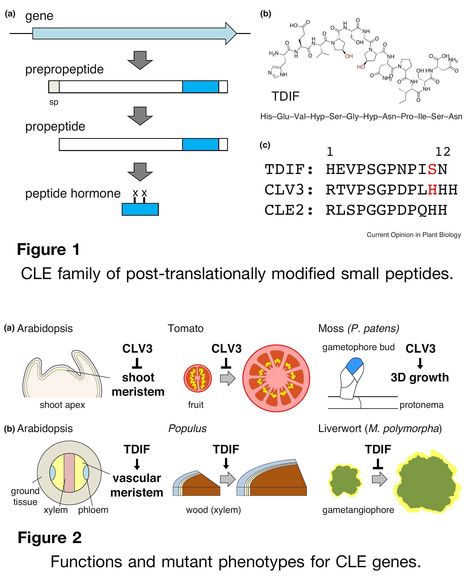
Authors: Yuki Hirakawa and Shinichiro Sawa.
Current Opinion in Plant Biology (2019)
Highlights: • Discovery of novel peptide hormone families that act in short-distance signaling. • Analysis and agronomic engineering of CLE peptide signaling in crop plants. • Identification of novel function of CLE peptide signaling in Arabidopsis. • Use of bryophyte models to understand evo-devo of CLE peptide signaling.
Abstract: "Peptide hormones have emerged as an important class of signaling molecules that mediate developmental signals between plant cells. Membrane-bound receptors bind specific extracellular peptide ligands to mediate communication between cells. In this review, we summarize novel peptide hormones identified in recent studies with an emphasis on their molecular structures. By focusing on the CLE family peptides, we will describe the details of their physiological roles in various plant species, which include Arabidopsis, crop species, and bryophyte models."
|
|
Rescooped by
Loïc Lepiniec
from lignocellulosic biomass
May 20, 2019 1:51 AM
|
Hypoxia in the shoot meristem of Arabidopsis links the regulation of metabolic activity to development by inhibiting proteolysis of a substrate of the N-degron pathway, which controls class-III homeodomain-leucine zipper transcription factors.
Via Herman Höfte
|
|
Scooped by
Loïc Lepiniec
May 12, 2019 12:12 PM
|
A protein complex consisting of a MYB, basic Helix-Loop-Helix, and a WDR protein, the MBW complex, regulates five traits, namely the production of anthocyanidin, proanthocyanidin, and seed-coat mucilage, and the development of trichomes and root hairs. For complexes involved in trichome and root hair development it has been shown that the interaction of two MBW proteins can be counteracted by the respective third protein (called competitive complex formation). We examined competitive complex formation for selected MBW proteins from Arabidopsis thaliana, Arabis alpina, Gossypium hirsutum, Petunia hybrida, and Zea mays. Quantitative analyses of the competitive binding of MYBs and WDRs to bHLHs were done by pull-down assays using ProtA- and luciferase-tagged proteins expressed in human HEC cells. We found that some bHLHs show competitive complex formation whilst others do not. Competitive complex formation strongly correlated with a phylogenetic tree constructed with the bHLH proteins under investigation, suggesting a functional relevance. We demonstrate that this different behavior can be explained by changes in one amino acid and that this position is functionally relevant in trichome development but not in anthocyanidin regulation.
|
|
Scooped by
Loïc Lepiniec
May 10, 2019 2:05 AM
|
Authors: Leonardo Jo, Julie M. Pelletier and John J. Harada.
Journal of Integrative Plant Biology (2019)
Abstract: "Seed development is a complex period of the flowering plant life cycle. After fertilization, the three main regions of the seed, embryo, endosperm and seed coat, undergo a series of developmental processes that result in the production of a mature seed that is developmentally arrested, desiccated, and metabolically quiescent. These processes are highly coordinated, both temporally and spatially, to ensure the proper growth and development of the seed. The transcription factor, LEAFY COTYLEDON1 (LEC1), is a central regulator that controls several aspects of embryo and endosperm development, including embryo morphogenesis, photosynthesis, and storage reserve accumulation. Thus, LEC1 regulates distinct sets of genes at different stages of seed development. Despite its critical importance for seed development, an understanding of the mechanisms underlying LEC1's multifunctionality is only beginning to be obtained. Recent studies describe the roles of specific transcription factors and the hormones, gibberellic acid and abscisic acid, in controlling the activity and transcriptional specificity of LEC1 across seed development. Moreover, studies indicate that LEC1 acts as a pioneer transcription factor to promote epigenetic reprogramming during embryogenesis. In this review, we discuss the mechanisms that enable LEC1 to serve as a central regulator of seed development."
|
|
Scooped by
Loïc Lepiniec
May 9, 2019 1:55 AM
|
|
|
Scooped by
Loïc Lepiniec
April 8, 2019 2:19 AM
|
A complete and accurate genome sequence provides a fundamental tool for functional genomics and DNA-informed breeding. Here, we assemble a high-quality genome (contig N50 of 6.99 Mb) of the apple anther-derived homozygous line HFTH1, including 22 telomere sequences, using a combination of PacBio single-molecule real-time (SMRT) sequencing, chromosome conformation capture (Hi-C) sequencing, and optical mapping. In comparison to the Golden Delicious reference genome, we identify 18,047 deletions, 12,101 insertions and 14 large inversions. We reveal that these extensive genomic variations are largely attributable to activity of transposable elements. Interestingly, we find that a long terminal repeat (LTR) retrotransposon insertion upstream of MdMYB1, a core transcriptional activator of anthocyanin biosynthesis, is associated with red-skinned phenotype. This finding provides insights into the molecular mechanisms underlying red fruit coloration, and highlights the utility of this high-quality genome assembly in deciphering agriculturally important trait in apple.
Proper regulation of seed germination is essential for the successful propagation of a plant. The transcription factor ABSCISIC ACID INSENSITIVE5 (ABI5) of the abscisic acid (ABA) signaling pathway plays a central role in the inhibition of seed germination. ABI5 is precisely regulated by the core ABA signaling components and multiple other factors. However, the complex regulatory network of ABI5 remains largely unknown.
In this study, we determined the biochemical interaction between ABI5 and the BRINSENSITIVE1 (BRI1)‐EMS‐SUPPRESSOR1 (BES1) transcription factor of the brassinosteroid (BR) signaling pathway, as well as the function of BES1 regulating ABI5 during seed germination in Arabidopsis.
BES1 directly interacts with ABI5 both in vitro and in vivo. The bZIP domain of ABI5, which is responsible for DNA binding, is critical for ABI5 binding to BES1. The interaction of BES1 with ABI5 significantly suppressed the binding of ABI5 to the promoter regions of downstream genes, which resulted in their reduced expression and consequently facilitated seed germination.
This study shed new light on the coordination of multiple signaling pathways during seed germination. In particular, BES1 directly binds to ABI5, which interferes with its transcriptional activity and suppresses ABA signaling output.
Via Christophe Jacquet
|
|
Scooped by
Loïc Lepiniec
January 10, 2019 8:49 AM
|
When plants evolved a vascular system containing cells that facilitate the transport of water and nutrients, this not only allowed them to conquer land, but also provided the structural stability that enabled them to increase dramatically in stature, bulk and complexity1. The cells that give rise to vascular tissue are specified in the embryo, but in many flowering plants they undergo substantial rounds of proliferation only during post-embryonic development, in a process that drives radial growth and expands the circumference of roots and shoots. This radial growth depends on the division of stem cells located in an inner cylindrical layer of cells called the cambium, which gives rise to wood and the woody fibre used for textiles, called bast.
|
|
Scooped by
Loïc Lepiniec
January 8, 2019 12:48 PM
|
Plant Development and Evolution", Special issue of Current Topics in Developmental Biology Edited by Ueli Grossniklaus
Volume 131, Pages 2-642 (2019)
|












légitimation de l'obscurantisme par notre ministère !