


Via Mary Williams

 Your new post is loading...
 Scoop.it! 
No comment yet.
Sign up to comment
Scoop.it!
Capsaicinoids are responsible for the hot taste of chili peppers. They are restricted to the genus Capsicum and are synthesized by the acylation of the aromatic compound vanillylamine (derived from the phenylpropanoid pathway) with a branched-chain fatty acid by the catalysis of the putative enzyme capsaicinoid synthase. R2R3-MYB transcription factors have been reported in different species of plants as regulators of structural genes of the phenylpropanoid pathway; therefore, we hypothesized that MYB genes might be involved in the regulation of the biosynthesis of pungent compounds. In this study, an R2R3-MYB transcription factor gene, designated CaMYB31, was isolated and characterized in Capsicum annuum L. cv. Tampiqueño 74. Bioinformatic analysis suggested that CaMYB31 could be involved in secondary metabolism, stress and plant hormone responses, and development. CaMYB31 expression analysis from placental tissue of pungent and non-pungent chili pepper fruits showed a correlation positive with the structural genes Ca4H, Comt, Kas, pAmt and AT3 expression and also with the content of capsaicin and dihydrocapsacin during fruit development. However, CaMYB31 was also expressed in vegetative tissues (leaves, roots and stems). Moreover, CaMYB31 silencing significantly reduced the expression of capsaicinoid biosynthetic genes and the capsaicinoid content. Additionally, CaMYB31 expression was affected by the plant hormones indoleacetic acid, jasmonic acid, salicylic acid and gibberellic acid or by wounding, temperature and light, factors known to affect the production of capsaicinoids. These findings indicate that CaMYB31 is indeed involved in the regulation of structural genes of the capsaicinoid biosynthetic pathway.
Scoop.it!

When the DNA bases cytosine and guanine are next to each other, a methyl group is generally added to the pyrimidine, generating a mCpG dinucleotide. This modification alters DNA structure but can also affect function by inhibiting transcription factor (TF) binding. Yin et al. systematically analyzed the effect of CpG methylation on the binding of 542 human TFs (see the Perspective by Hughes and Lambert). In addition to inhibiting binding of some TFs, they found that mCpGs can promote binding of others, particularly TFs involved in development, such as homeodomain proteins.
Scoop.it!

The mechanistic coupling of cell growth and cell cycle control with cell size regulation in tissues is not well understood. Via Herman Höfte
Scoop.it!

The mother plant plays an important dynamic role in the control of dormancy of her progeny seed, in response to environmental signals. In order to further understand the mechanisms by which this dormancy control takes place we conducted a forward genetic screen to isolate mutants which fail to enter dormancy in response to variation in temperature during seed set. We show that for the first of these mutants, designated AWAKE1, the maternal allele is required for entry into strongly dormant states, and that awake1 mutants show seed phenotypes previously shown to be associated with loss of suberin the seed. We identify awake1 as an allele of ABCG20, an ABC transporter-encoding gene required for the transport of fatty acids during suberin deposition, and show that further suberin-deficient mutants have seed dormancy defects. Seed coat suberin composition is affected by temperature during seed maturation, but this response appears to be independent of ABCG20. We conclude that seed coat suberin is essential for seed dormancy imposition by the low temperatures, and that the exclusion of oxygen and water from the seed by the suberin and tannin layers is important for dormancy imposition.
Scoop.it!

Duplicated genes are a major contributor to genome evolution and phenotypic novelty. There are multiple possible evolutionary fates of duplicated genes. Here we provide an example of concerted divergence of simultaneously duplicated genes whose products function in the same complex. We studied PRC2 (Polycomb Repressive Complex 2) in Brassicaceae. The VRN-PRC2 complex contains VRN2 and SWN, and both genes were duplicated during a whole genome duplication to generate FIS2 and MEA which function in the Brassicaceae-specific FIS-PRC2 complex that regulates seed development. We examined expression of FIS2, MEA, and their paralogs, compared their cytosine and histone methylation patterns, and analyzed the sequence evolution of the genes. We found that FIS2 and MEA have reproductive-specific expression patterns that are correlated and derived from the broadly expressed VRN2 and SWN in outgroup species. In vegetative tissues of Arabidopsis repressive methylation marks are enriched in FIS2 and MEA, whereas active marks are associated with their paralogs. We detected comparable accelerated amino acid substitution rates in FIS2 and MEA but not in their paralogs. We also show divergence patterns of the PRC2-asssociated VEL2 that are similar to FIS2 and MEA. These lines of evidence indicate that FIS2 and MEA have diverged in concert, resulting in functional divergence of the PRC2-complexes in Brassicaceae. This type of concerted divergence is a previously unreported fate of duplicated genes. In addition, the Brassicaceae-specific FIS-PRC2 complex modified the regulatory pathways in female gametophyte and seed development.
Scoop.it!

Unlike animals, plants do not set aside a germline. Instead, germ cells are developed on demand from somatic lineages. Zhao et al. examined the regulatory pathways that manage the transition from somatic to germ cell development in the small plant Arabidopsis (see the Perspective by Vielle-Calzada). The transcription factor WUSCHEL (WUS) was needed early on for development of ovules. Soon after, a trio of inhibitors that work through a cyclin-dependent kinase allowed a transcriptional repressor to down-regulate WUS. This opened the door to meiosis, while restricting the number of reproductive units per seed to one.
Scoop.it!

Cereal grasses of the Triticeae tribe have been the major food source in temperate regions since the dawn of agriculture. Their large genomes are characterized by a high content of repetitive elements and large pericentromeric regions that are virtually devoid of meiotic recombination. Here we present a high-quality reference genome assembly for barley (Hordeum vulgare L.). We use chromosome conformation capture mapping to derive the linear order of sequences across the pericentromeric space and to investigate the spatial organization of chromatin in the nucleus at megabase resolution. The composition of genes and repetitive elements differs between distal and proximal regions. Gene family analyses reveal lineage-specific duplications of genes involved in the transport of nutrients to developing seeds and the mobilization of carbohydrates in grains. We demonstrate the importance of the barley reference sequence for breeding by inspecting the genomic partitioning of sequence variation in modern elite germplasm, highlighting regions vulnerable to genetic erosion.
Scoop.it!
Plants produce diverse specialized metabolites (SMs), but the genes responsible for their production and regulation remain largely unknown, hindering efforts to tap plant pharmacopeia. Given that genes comprising SM pathways exhibit environmentally dependent co-regulation, we hypothesized that genes within a SM pathway would form tight associations (modules) with each other in co-expression networks, facilitating their identification. To evaluate this hypothesis, we used 10 global co-expression datasets, each a meta-analysis of hundreds to thousands of experiments, across eight plant species to identify hundreds of co-expressed gene modules per dataset. In support of our hypothesis, 15.3-52.6% of modules contained two or more known SM biosynthetic genes, and module genes were enriched in SM functions. Moreover, modules recovered many experimentally validated SM pathways, including all six known to form biosynthetic gene clusters (BGCs). In contrast, bioinformatically predicted BGCs (i.e. those lacking an associated metabolite) were no more co-expressed than the null distribution for neighboring genes. These results suggest that most predicted plant BGCs are not genuine SM pathways and argue that BGCs are not a hallmark of plant specialized metabolism. We submit that global gene co-expression is a rich, largely untapped resource for discovering the genetic basis and architecture of plant natural products.
Loïc Lepiniec's insight:
Share your insight
Scoop.it!

A Global Co-expression Network Approach for Connecting Genes to Specialized Metabolic Pathways in Plants Jennifer H. Wisecaver, Alexander T. Borowsky, Vered Tzin, Georg Jander, Daniel J. Kliebenstein, and Antonis Rokas Plant Cell 2017 tpc.17.00009; Advance Publication April 13, 2017; doi:10.1105/tpc.17.00009 Via Mary Williams
Scoop.it!

Abstract
Scoop.it!

The shoot apical meristem (SAM) is a small population of stem cells that continuously generates organs and tissues. We will discuss here flower formation at the SAM, which involves a complex network of regulatory genes and signalling molecules. A major downstream target of this network is the extracellular matrix or cell wall, which is a local determinant for both growth rates and growth directions. We will discuss here a number of recent studies aimed at analysing the link between cell wall structure and molecular regulation. This has involved multidisciplinary approaches including quantitative imaging, molecular genetics, computational biology and biophysics. A scenario emerges where molecular networks impact on both cell wall anisotropy and synthesis, thus causing the rapid outgrowth of organs at specific locations. More specifically, this involves two interdependent processes: the activation of wall remodelling enzymes and changes in microtubule dynamics.
Scoop.it!

Transcript elongation factors (TEFs) are a heterogeneous group of proteins that control the efficiency of transcript elongation of subsets of genes by RNA polymerase II (RNAPII) in the chromatin context. Using reciprocal tagging in combination with affinity-purification and mass spectrometry, we demonstrate that in Arabidopsis thaliana, the TEFs SPT4/SPT5, SPT6, FACT, PAF1-C, and TFIIS co-purified with each other and with elongating RNAPII, while P-TEFb was not among the interactors. Additionally, NAP1 histone chaperones, ATP-dependent chromatin remodelling factors, and some histone-modifying enzymes including Elongator were repeatedly found associated with TEFs. Analysis of double-mutant plants defective in different combinations of TEFs revealed genetic interactions between genes encoding subunits of PAF1-C, FACT, and TFIIS, resulting in synergistic/epistatic effects on plant growth/development. Analysis of sub-nuclear localisation, gene expression and chromatin-association did not provide evidence for an involvement of the TEFs in transcription by RNAPI (or RNAPIII). Proteomics analyses also revealed multiple interactions between the transcript elongation complex and factors involved in mRNA splicing and polyadenylation, including an association of PAF1-C with the polyadenylation factor CstF. Therefore, the RNAPII transcript elongation complex represents a platform for interactions among different TEFs, as well as for coordinating ongoing transcription with mRNA processing.
|
Scoop.it!

CONSTANS imparts DNA sequence-specificity to the histone-fold NF-YB/NF-YC dimer Nerina Gnesutta, Roderick W Kumimoto, Swadhin Swain, Matteo Chiara, Chamindika Siriwardana, David Stephen Horner, Ben F Holt, and Roberto Mantovani Plant Cell 2017 tpc.16.00864; Advance Publication May 19, 2017; doi:10.1105/tpc.16.00864 OPEN Via Mary Williams
Scoop.it!
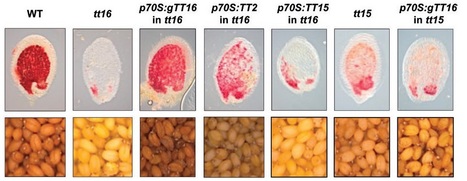
Flavonoids are secondary metabolites that fulfil a multitude of functions during the plant life cycle. In Arabidopsis proanthocyanidins (PAs) are flavonoids that specifically accumulate in the innermost integuments of the seed testa (i.e. endothelium), as well as in the chalaza and micropyle areas, and play a vital role in protecting the embryo against various biotic and abiotic stresses. PAs accumulation in the endothelium requires the activity of the MADS box transcription factor TRANSPARENT TESTA (TT) 16 (ARABIDOPSIS B-SISTER/AGAMOUS-LIKE 32) and the UDP-glycosyltransferase TT15 (UGT80B1). Interestingly tt16 and tt15 mutants display a very similar flavonoid profiles and patterns of PA accumulation. By using a combination of genetic, molecular, biochemical, and histochemical methods, we showed that both TT16 and TT15 act upstream the PA biosynthetic pathway, but through two distinct genetic routes. We also demonstrated that the activity of TT16 in regulating cell fate determination and PA accumulation in the endothelium is required in the chalaza prior to the globular stage of embryo development. Finally this study provides new insight showing that TT16 and TT15 functions extend beyond PA biosynthesis in the inner integuments of the Arabidopsis seed coat.
Scoop.it!

From
www

This 2016 ISAAA Brief is an extension of the 20 Volumes of Annual Briefs (1996 to 2015) on global status of biotech/GM crops authored by Clive James, Founder & Emeritus Chairman of ISAAA Via Saclay Plant Sciences
Scoop.it!

Communiqué : L’Académie des sciences appelle à voter Emmanuel Macron
Scoop.it!

Les dirigeants de grands instituts appellent à faire barrage à un programme "en contradiction ouverte avec les évidences établies par la recherche".
Scoop.it!

A Proteolytic Regulator Controlling Chalcone Synthase Stability and Flavonoid Biosynthesis in Arabidopsis Xuebin Zhang, Carolina Abrahan, Thomas A Colquhoun, and Chang-Jun Liu Plant Cell 2017 tpc.16.00855; Advance Publication April 26, 2017; doi:10.1105/tpc.16.00855 OPEN Via Mary Williams
Scoop.it!

An understanding of the biology of seeds has been greatly advanced in recent years. The progresses, particularly in the field of seed dormancy and germination research, have been made at a remarkable speed. Some of the possible epigenetic mechanisms, including an involvement of non-coding RNA, which were predicted for DELAY OF GERMINATION1 just a few years ago, have now been demonstrated with strong molecular and genetic evidence. Imprinting, or parent-of-origin-specific gene silencing/expression, which was characterized particularly for developing seeds, was also found in imbibed seeds and suggested for dormancy mechanisms. Hormone biology in seeds, which is the most advanced and almost a traditional area of seed research, also presents a new dimension. Upstream regulators of hormone metabolism and hormone transporters, such as ABA and GA influx/efflux carriers, have been identified. Characterization of the novel posttranslational modification pathways, including the N-end rule and S-nitrosylation pathways, which play a critical role in turnover of the major hormone signal transduction proteins, also expanded our knowledge about the complexity of hormone signaling in seeds. These progresses made at the molecular level are significant steps toward a better understanding of how seeds translate soil and other environmental signals into their internal hormone biology and make an important decision to stay dormant or commence with germination.
Scoop.it!

Polycomb group complexes PRC1 and PRC2 repress gene expression at the chromatin level in eukaryotes. The classic recruitment model of Polycomb group complexes in which PRC2-mediated H3K27 trimethylation recruits PRC1 for H2A monoubiquitination was recently challenged by data showing that PRC1 activity can also recruit PRC2. However, the prevalence of these two mechanisms is unknown, especially in plants as H2AK121ub marks were examined at only a handful of Polycomb group targets. By using genome-wide analyses, we show that H2AK121ub marks are surprisingly widespread in Arabidopsis thaliana, often co-localizing with H3K27me3 but also occupying a set of transcriptionally active genes devoid of H3K27me3. Furthermore, by profiling H2AK121ub and H3K27me3 marks in atbmi1a/b/c, clf/swn, and lhp1 mutants we found that PRC2 activity is not required for H2AK121ub marking at most genes. In contrast, loss of AtBMI1 function impacts the incorporation of H3K27me3 marks at most Polycomb group targets. Our findings show the relationship between H2AK121ub and H3K27me3 marks across the A. thaliana genome and unveil that ubiquitination by PRC1 is largely independent of PRC2 activity in plants, while the inverse is true for H3K27 trimethylation.
Scoop.it!

Het plantje Xerophyta viscosa is niet kapot te krijgen: het kan jaren van extreme droogte overleven. Wageningse onderzoekers proberen die eigenschap ook in andere gewassen ‘aan te zetten’, om ze bestand te maken tegen droogte. Via Wilco Ligterink
Scoop.it!

Understanding how genomes change as organisms become more complex is a central questionin evolution. Molecular evolutionary studies typically correlate the appearance of genes and gene families with the emergence of biological pathways and morphological features. While such approaches are of great importance to understand how organisms evolve, they are also limited, as functionally related genes work together in contexts
Scoop.it!

Significance
|




