Your new post is loading...

|
Rescooped by
Loïc Lepiniec
from lignocellulosic biomass
May 7, 2018 2:44 AM
|
|
|
Scooped by
Loïc Lepiniec
May 6, 2018 3:55 AM
|
Small RNAs trigger repressive DNA methylation at thousands of transposable elements in a process called RNA‐directed DNA methylation (RdDM). The molecular mechanism of RdDM is well characterized in Arabidopsis, yet the biological function remains unclear, as loss of RdDM in Arabidopsis causes no overt defects, even after generations of inbreeding. It is known that 24 nucleotide Pol IV‐dependent siRNAs, the hallmark of RdDM, are abundant in flowers and developing seeds, indicating that RdDM might be important during reproduction. Here we show that, unlike Arabidopsis, mutations in the Pol IV‐dependent small RNA pathway cause severe and specific reproductive defects in Brassica rapa. High rates of abortion occur when seeds have RdDM mutant mothers, but not when they have mutant fathers. Although abortion occurs after fertilization, RdDM function is required in maternal somatic tissue, not in the female gametophyte or the developing zygote, suggesting that siRNAs from the maternal soma might function in filial tissues. We propose that recently outbreeding species such as B. rapa are key to understanding the role of RdDM during plant reproduction.
|
|
Rescooped by
Loïc Lepiniec
from Plant Sciences
May 2, 2018 2:19 AM
|
Roses have high cultural and economic importance as ornamental plants and in the perfume industry. We report the rose whole-genome sequencing and assembly and resequencing of major genotypes that contributed to rose domestication. We generated a homozygous genotype from a heterozygous diploid modern rose progenitor, Rosa chinensis ‘Old Blush’. Using single-molecule real-time sequencing and a meta-assembly approach, we obtained one of the most comprehensive plant genomes to date. Diversity analyses highlighted the mosaic origin of ‘La France’, one of the first hybrids combining the growth vigor of European species and the recurrent blooming of Chinese species. Genomic segments of Chinese ancestry identified new candidate genes for recurrent blooming. Reconstructing regulatory and secondary metabolism pathways allowed us to propose a model of interconnected regulation of scent and flower color. This genome provides a foundation for understanding the mechanisms governing rose traits and should accelerate improvement in roses, Rosaceae and ornamentals.
Via Saclay Plant Sciences
|
|
Rescooped by
Loïc Lepiniec
from Plant Sciences
April 20, 2018 2:04 AM
|
Le projet « Saclay Plant Sciences Graduate School of Research » (SPS-GSR) fait partie des 29 projets sélectionnés en 2017 à l’échelle nationale dans le cadre d’un appel à projets Écoles universitaires de recherche (EUR) du programme Investissements d’Avenir.
Via Saclay Plant Sciences
Meeting by and for PhD students with interesting speakers including our head of department Christa Testerink
Via Wilco Ligterink
|
|
Scooped by
Loïc Lepiniec
April 20, 2018 2:02 AM
|
Pourquoi faudrait-il choisir entre compter et conter?
En réponse à « De quoi l’agro-bio-logique » est-elle le nom ? »
par Peter Rogowsky, chercheur à l’Inra, travaillant à l’ENS de Lyon sur le développement des plantes, et plus précisément de la graine.
|
|
Scooped by
Loïc Lepiniec
April 15, 2018 3:43 AM
|
MADS family transcription factors are crucial during plant reproductive development, and have evolved a complex protein–protein interaction (PPI) network. Proteins of the SEPALLATA (SEP) clade are required for tetramer formation and can act as critical ‘hubs’ in the network.Rümpler et al. (2018)have now provided quantitative measures of the contribution of individual amino acids to cooperative DNA binding, laying a foundation for predicting MADS tetramer formation based on primary sequence. It is an important step forward in understanding how cooperativity affects processes from flowering time to floral organ identity.
|
|
Scooped by
Loïc Lepiniec
April 8, 2018 3:00 PM
|
Mammalian peptide hormones propagate extracellular stimuli from sensing tissues to appropriate targets to achieve optimal growth maintenance1. In land plants, root-to-shoot signalling is important to prevent water loss by transpiration and to adapt to water-deficient conditions2, 3. The phytohormone abscisic acid has a role in the regulation of stomatal movement to prevent water loss4. However, no mobile signalling molecules have yet been identified that can trigger abscisic acid accumulation in leaves. Here we show that the CLAVATA3/EMBRYO-SURROUNDING REGION-RELATED 25 (CLE25) peptide transmits water-deficiency signals through vascular tissues in Arabidopsis, and affects abscisic acid biosynthesis and stomatal control of transpiration in association with BARELY ANY MERISTEM (BAM) receptors in leaves. The CLE25 gene is expressed in vascular tissues and enhanced in roots in response to dehydration stress. The root-derived CLE25 peptide moves from the roots to the leaves, where it induces stomatal closure by modulating abscisic acid accumulation and thereby enhances resistance to dehydration stress. BAM receptors are required for the CLE25 peptide-induced dehydration stress response in leaves, and the CLE25–BAM module therefore probably functions as one of the signalling molecules for long-distance signalling in the dehydration response.
|
|
Rescooped by
Loïc Lepiniec
from Plant Sciences
March 15, 2018 7:59 AM
|
Workshop: Modeling the plant from gene to the whole plant, recent progresses and challenges July 3, 2018 - Location to be determined (close to the International SPS Conference 2018)
Organizers: Vincent Fromion (MaIAGE), Marie-Laure Martin-Magniette (IPS2, MIA-Paris), Anne Goelzer (MaIAGE), Etienne Delannoy (IPS2)
Via Saclay Plant Sciences
|
|
Scooped by
Loïc Lepiniec
March 15, 2018 3:17 AM
|
The phytohormones gibberellic acid (GA) and abscisic acid (ABA) are widely recognized as essential endogenous regulators that mostly play antagonistic roles in plant developmental processes and environmental responses. A variety of both internal and external cues oppositely regulate GA and ABA biosynthesis and catabolism, which directly and indirectly affect their signaling pathways and subsequent responses. Recent discoveries have revealed direct molecular links between GA- and ABA-signaling components, which provide novel insights into their antagonistic regulation. In this review, we mainly focus on these recent reports and the growing understanding of GA and ABA antagonism in metabolic regulation and signaling interactions, and attempt to clarify the problems and challenges involved in exploring the complicated regulatory events associated with these two phytohormones.
|
|
Scooped by
Loïc Lepiniec
March 14, 2018 3:37 AM
|
Approximately half of all ethylene-responsive genes are downregulated in the presence in ethylene, but this repression has received relatively little attention compared with the ethylene-mediated activation of expression. The known positive regulators of ethylene signaling include ETHYLENE INSENSITIVE2 (EIN2) and the transcription factor EIN3. Intriguingly, EIN3 binds to promoters of both ethylene-activated and -repressed genes. EIN2, by contrast, affects gene expression via its C terminus, which is cleaved in the presence of ethylene and translocated to the nucleus, where it was recently shown to alter HISTONE3 acetylation levels in a process that involves EIN2 NUCLEAR ASSOCIATED PROTEIN1 (ENAP1; 2017). Now, Zhang et al. (2018) report that two histone deacetylases function with ENAP1 to repress gene expression in the presence of ethylene.
|
|
Scooped by
Loïc Lepiniec
March 5, 2018 2:19 AM
|
A key limitation to the use of CRISPR-Cas9 proteins for genome editing and other applications is the requirement that a protospacer adjacent motif (PAM) be present at the target site. For the most commonly used Cas9 from Streptococcus pyogenes (SpCas9), the required PAM sequence is NGG. No natural or engineered Cas9 variants shown to function efficiently in mammalian cells offer a PAM less restrictive than NGG. Here we used phage-assisted continuous evolution (PACE) to evolve an expanded PAM SpCas9 variant (xCas9) that can recognize a broad range of PAM sequences including NG, GAA, and GAT. The PAM compatibility of xCas9 is the broadest reported to date among Cas9s active in mammalian cells, and supports applications in human cells including targeted transcriptional activation, nuclease-mediated gene disruption, and both cytidine and adenine base editing. Remarkably, despite its broadened PAM compatibility, xCas9 has much greater DNA specificity than SpCas9, with substantially lower genome-wide off-target activity at all NGG target sites tested, as well as minimal off-target activity when targeting genomic sites with non-NGG PAMs. These findings expand the DNA targeting scope of CRISPR systems and establish that there is no necessary trade-off between Cas9 editing efficiency, PAM compatibility, and DNA specificity.
|
|
Scooped by
Loïc Lepiniec
February 10, 2018 5:44 AM
|
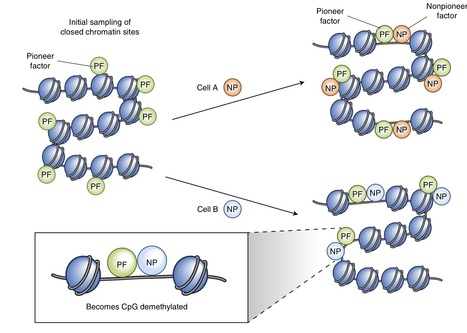
New genomic analyses indicate that pioneer transcription factors can sample a diverse repertoire of common binding sites among different cell types and become enriched where they cooperate with other factors specific to each cell. Pioneer-factor binding is mechanistically separate from, and is necessary for, subsequent phenomena of chromatin opening and epigenetic memory in vivo.
|
|
|
Scooped by
Loïc Lepiniec
May 6, 2018 6:07 AM
|
Vinblastine, a potent anticancer drug, is produced by Madagascar periwinkle in small quantities: heterologous reconstitution of vinblastine biosynthesis could provide an additional source of this drug. The chemistry underlying vinblastine synthesis makes identification of the biosynthetic genes challenging. Here we identify the two missing steps of vinblastine biosynthesis in this plant, namely an oxidase and a reductase that isomerize stemmadenine acetate into dihydroprecondylocarpine acetate, which is then deacetoxylated and cyclized to either catharanthine or tabersonine via two herein characterized hydrolases. The pathways show how plants create chemical diversity and also enable development of heterologous platforms for generation of stemmadenine-derived bioactive compounds.
|
|
Scooped by
Loïc Lepiniec
May 4, 2018 2:14 AM
|
Compared to animals, evolution of plant calcium (Ca2+) physiology has led to a loss of proteins for influx and small ligand–operated control of cytosolic Ca2+, leaving many Ca2+ mechanisms unaccounted for. Here, we show a mechanism for sorting and activation of glutamate receptor–like channels (GLRs) by CORNICHON HOMOLOG (CNIH) proteins. Single mutants of pollen-expressed Arabidopsis thaliana GLRs (AtGLRs) showed growth and Ca2+ flux phenotypes expected for plasma membrane Ca2+ channels. However, higher-order mutants of AtGLR3.3 revealed phenotypes contradicting this assumption. These discrepancies could be explained by subcellular AtGLR localization, and we explored the implication of AtCNIHs in this sorting. We found that AtGLRs interact with AtCNIH pairs, yielding specific intracellular localizations. AtCNIHs further trigger AtGLR activity in mammalian cells without any ligand. These results reveal a regulatory mechanism underlying Ca2+ homeostasis by sorting and activation of AtGLRs by AtCNIHs.
|
|
Scooped by
Loïc Lepiniec
April 24, 2018 10:00 AM
|
Many plant species produce and build up triacylglycerol (TAG) in their seeds as a main resource to provide carbon and energy during seedling development. Plant seed oils are important not only for human diets but also as renewable feedstock of industrial uses. WRINKLED1 (WRI1), an APETALA2 (AP2) transcription factor, plays an essential role in the transcriptional regulation of TAG biosynthesis as WRI1 regulates the expression of key genes in the glycolytic and fatty acid biosynthetic pathways. Recent work has identified intrinsic structural disorder in WRI1 that may affect the stability of the protein. Furthermore, WRI1 activity is modulated by post-translational modifications and interacting partners. These progresses shed new light on regulatory functions of WRI1 at the molecular levels, paving new paths to the use of WRI1 for bioengineering of TAG in plants.
|
|
Rescooped by
Loïc Lepiniec
from Wageningen Seed Lab
April 20, 2018 2:04 AM
|
Les politiques qui seront discutées durant la conférence comprendront les mesures commerciales, les mesures agro-environnementales, les règlements sur l'utilisation des terres et les politiques nutritionnelles et de santé publique liées à l’alimentation. Organisée par le MSH Paris-Saclay, elle se tiendra le 31 mai et le 1er juin à l’INRA-AgroParistech.
Via Life Sciences UPSaclay
|
|
Scooped by
Loïc Lepiniec
April 15, 2018 4:03 AM
|
Hybrid (Vitis vinifera × Vitis labrusca) table grape cultivars grown in the subtropics often fail to accumulate sufficient anthocyanins to achieve good uniform berry color. Growers of V. vinifera table grapes in temperate regions generally use ethephon and, more recently, (S)-cis-abscisic acid (S-ABA) to overcome this problem. The objective of this study was to determine if S-ABA applications at different timings and concentrations have an effect on anthocyanin regulatory and biosynthetic genes, pigment accumulation, and berry color of the Selection 21 cultivar, a new V. vinifera × V. labrusca hybrid seedless grape that presents lack of red color when grown in subtropical areas. Applications of S-ABA 400 mg/L resulted in a higher accumulation of total anthocyanins and of the individual anthocyaninsanthocyanins: delphinidin-3-glucoside, cyanidin-3-glucoside, peonidin-3-glucoside, and malvidin-3-glucoside in the berry skin and improved the color attributes of the berries. Treatment with two applications at 7 days after véraison (DAV) and 21 DAV of S-ABA 400 mg/L resulted in a higher accumulation of total anthocyanins in the skin of berries and increased the gene expression of CHI, F3H, DFR, and UFGT and of the VvMYBA1 and VvMYBA2 transcription factors in the seedless grape cultivar.
|
|
Scooped by
Loïc Lepiniec
April 10, 2018 5:28 AM
|
Arabidopsis thaliana requires a prolonged period of cold exposure during winter to initiate flowering in a process termed vernalization. Exposure to cold induces epigenetic silencing of the FLOWERING LOCUS C (FLC) gene by Polycomb group (PcG) proteins. A key role in this epigenetic switch is played by transcriptional repressors VAL1 and VAL2, which specifically recognize Sph/RY DNA sequences within FLC via B3 DNA binding domains, and mediate recruitment of PcG silencing machinery. To understand the structural mechanism of site-specific DNA recognition by VAL1, we have solved the crystal structure of VAL1 B3 domain (VAL1-B3) bound to a 12 bp oligoduplex containing the canonical Sph/RY DNA sequence 5′-CATGCA-3′/5′-TGCATG-3′. We find that VAL1-B3 makes H-bonds and van der Waals contacts to DNA bases of all six positions of the canonical Sph/RY element. In agreement with the structure, in vitro DNA binding studies show that VAL1-B3 does not tolerate substitutions at any position of the 5′-TGCATG-3′ sequence. The VAL1-B3–DNA structure presented here provides a structural model for understanding the specificity of plant B3 domains interacting with the Sph/RY and other DNA sequences.
|
|
Scooped by
Loïc Lepiniec
March 26, 2018 7:30 AM
|
Distinct plant seed/fruit structures evolved to support reproduction and dispersal in distinct environments. Appropriate biomechanical properties and interactions of the various seed compartments are indispensable to plant survival. Most seeds are dispersed in a dry state generated during seed development/maturation for which novel aspects of endosperm–embryo interaction were discovered. The various layers covering the embryo of a mature seed define the patterns of water uptake during germination. Their biomechanical weakening together with embryo cell expansion is mediated by cell wall remodelling to facilitate radicle protrusion. Recent work with different species has revealed mechanisms underpinning specific embryo growth zones. Abiotic and biotic factors were shown to release different types of seed and fruit coat-mediated constraints to water uptake and germination.
|
|
Rescooped by
Loïc Lepiniec
from Plant Sciences
March 15, 2018 7:59 AM
|
|
|
Scooped by
Loïc Lepiniec
March 15, 2018 3:14 AM
|
Early endosperm development presents a unique system to uncover epigenetic regulatory mechanisms because the contributing maternal and paternal genomes possess differential epigenetic modifications. In Arabidopsis (Arabidopsis thaliana), the initiation of endosperm coenocytic growth upon fertilization and the transition to endosperm cellularization are regulated by the FERTILIZATION-INDEPENDENT SEED (FIS)-Polycomb Repressive Complex 2 (PRC2), a putative H3K27 methyltransferase. Here, we address the possible role of the FIS-PRC2 complex in regulating the type I MADS-box gene family, which has previously been shown to regulate early endosperm development. We show that a subclass of type I MADS-box genes (C2 genes) was expressed in distinct domains of the coenocytic endosperm in wild-type seeds. Furthermore, the C2 genes were mostly upregulated biallelically during the extended coenocytic phase of endosperm development in the FIS-PRC2 mutant background. Using allele-specific expression analysis, we also identified a small subset of C2 genes subjected to FIS-PRC2-dependent maternal or FIS-PRC2-independent paternal imprinting. Our data support a dual role for the FIS-PRC2 complex in regulation of C2 type I MADS-box genes as evidenced by a generalized role in repression of gene expression at both alleles associated with endosperm cellularization and a specialized role in silencing the maternal allele of imprinted genes.
|
|
Scooped by
Loïc Lepiniec
March 6, 2018 2:28 AM
|
LE CERCLE/TRIBUNE - Une quarantaine de spécialistes appellent la communauté scientifique à un sursaut civique pour sauver la recherche face au renoncement politique.
Il y a un an, l'Assemblée nationale a adopté une résolution sur les sciences et le progrès dans la République, qui rappelle « que la France, héritière d'une longue tradition scientifique, rationaliste et de la philosophie des Lumières, a toujours incarné le progrès et la science au service de l'humanité » et « que la recherche constitue un élément indispensable à la compétitivité de la France » . Ce texte a été voté à l'unanimité pa
Grain size, one of the important components determining grain yield in rice, is controlled by the multiple quantitative trait loci (QTLs). Intensive artificial selection for grain size during domestication is evidenced in modern cultivars compared to their wild relatives. Here, we report the molecular cloning and characterization of OsLG3b, a QTL for grain length in tropical japonica rice that encodes MADS-box transcription factor 1 (OsMADS1). Six SNPs in the OsLG3b region led to alternative splicing, which were associated with grain length in an association analysis of candidate region. Quantitative PCR analysis indicated that OsLG3b expression was higher during the panicle and seed development stages. Analysis of haplotypes and introgression regions revealed that the long-grain allele of OsLG3b might have arisen after domestication of tropical japonica and spread to subspecies indica or temperate japonica by natural crossing and artificial selection. OsLG3b is therefore a target of human selection for adaptation to tropical regions during domestication and/or improvement of rice. Phylogenetic analysis and pedigree records showed that OsLG3b had been employed by breeders, but the gene still has much breeding potential for increasing grain length in indica. These findings will not only aid efforts to elucidate the molecular basis of grain development and domestication, but also facilitate the genetic improvement of rice yield.
Via Christophe Jacquet
|


 Scoop.it!