Your new post is loading...

|
Rescooped by
Loïc Lepiniec
from IRHS - Seed lab
February 10, 2018 4:18 AM
|
Seed characteristics are key components of plant fitness that are influenced by temperature in their maternal environment, and temperature will change with global warming. To study the effect of such temperature changes, Arabidopsis thaliana plants were grown to produce seeds along a uniquely designed polyethylene tunnel having a thermal gradient reflecting local global warming predictions. Plants therefore experienced the same variations in temperature and light conditions but different mean temperatures. A range of seed-related plant fitness estimates were measured. There were dramatic non-linear temperature effects on the germination behaviour in two contrasting ecotypes. Maternal temperatures lower than 15–16 °C resulted in significantly greater primary dormancy. In addition, the impact of nitrate in the growing media on dormancy was shown only by seeds produced below 15–16 °C. However, there were no consistent effects on seed yield, number, or size. Effects on germination behaviour were shown to be a species characteristic responding to temperature and not time of year. Elevating temperature above this critical value during seed development has the potential to dramatically alter the timing of subsequent seed germination and the proportion entering the soil seed bank. This has potential consequences for the whole plant life cycle and species fitness.
Via IRHS - Seed Lab
|
|
Rescooped by
Loïc Lepiniec
from Plant Sciences
February 4, 2018 3:28 AM
|
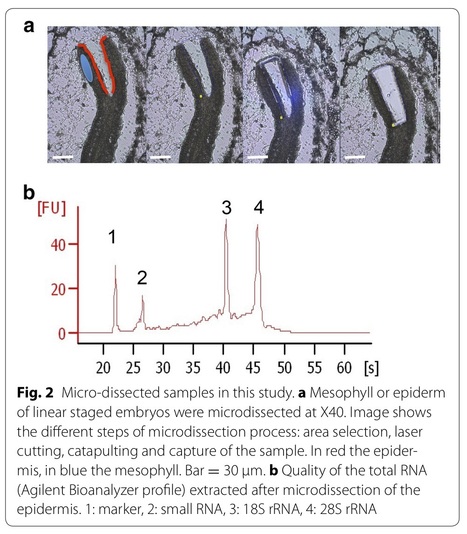
Genome-wide characterization of tissue- or cell-specific gene expression is a recurrent bottleneck in biology. We have developed a sensitive approach based on ultra-low RNA sequencing coupled to laser assisted microdissection for analyzing different tissues of the small Arabidopsis embryo. We first characterized the number of genes detected according to the quantity of tissue yield and total RNA extracted. Our results revealed that as low as 0.02 mm2 of tissue and 50 pg of total RNA can be used without compromising the number of genes detected. The optimised protocol was used to compare the epidermal versus mesophyll cell transcriptomes of cotyledons at the torpedo-shaped stage of embryo development. The approach was validated by the recovery of well-known epidermal genes such AtML1 or AtPDF2 and genes involved in flavonoid and cuticular waxes pathways. Moreover, the interest and sensitivity of this approach were highlighted by the characterization of several transcription factors preferentially expressed in epidermal cells. This technical advance unlocks some current limitations of transcriptomic analyses and allows to investigate further and efficiently new biological questions for which only a very small amounts of cells need to be isolated. For instance, it paves the way to increasing the spatial accuracy of regulatory networks in developing small embryo of Arabidopsis or other plant tissues.
Via Saclay Plant Sciences
|
|
Scooped by
Loïc Lepiniec
January 30, 2018 2:01 AM
|
Gnetophytes are an enigmatic gymnosperm lineage comprising three genera, Gnetum, Welwitschia and Ephedra, which are morphologically distinct from all other seed plants. Their distinctiveness has triggered much debate as to their origin, evolution and phylogenetic placement among seed plants. To increase our understanding of the evolution of gnetophytes, and their relation to other seed plants, we report here a high-quality draft genome sequence for Gnetum montanum, the first for any gnetophyte. By using a novel genome assembly strategy to deal with high levels of heterozygosity, we assembled >4 Gb of sequence encoding 27,491 protein-coding genes. Comparative analysis of the G. montanum genome with other gymnosperm genomes unveiled some remarkable and distinctive genomic features, such as a diverse assemblage of retrotransposons with evidence for elevated frequencies of elimination rather than accumulation, considerable differences in intron architecture, including both length distribution and proportions of (retro) transposon elements, and distinctive patterns of proliferation of functional protein domains. Furthermore, a few gene families showed Gnetum-specific copy number expansions (for example, cellulose synthase) or contractions (for example, Late Embryogenesis Abundant protein), which could be connected with Gnetum’s distinctive morphological innovations associated with their adaptation to warm, mesic environments. Overall, the G. montanum genome enables a better resolution of ancestral genomic features within seed plants, and the identification of genomic characters that distinguish Gnetum from other gymnosperms.
|
|
Rescooped by
Loïc Lepiniec
from Plant Sciences
January 29, 2018 6:48 AM
|
Dear all,
We are very pleased to announce that online registration to the International SPS Conference 2018: Plant Sciences for the Future is now open.
Via Saclay Plant Sciences
|
|
Rescooped by
Loïc Lepiniec
from Plant Sciences
January 24, 2018 2:30 AM
|
|
|
Scooped by
Loïc Lepiniec
January 20, 2018 3:14 AM
|
Chromosome dosage has substantial effects on reproductive isolation and speciation in both plants and animals, but the underlying mechanisms are largely obscure1. Transposable elements in animals can regulate hybridity through maternal small RNA2, whereas small RNAs in plants have been postulated to regulate dosage response via neighboring imprinted genes3,4. Here we show that a highly conserved microRNA in plants, miR845, targets the tRNAMet primer-binding site (PBS) of long terminal repeat (LTR) retrotransposons in Arabidopsis pollen, and triggers the accumulation of 21–22-nucleotide (nt) small RNAs in a dose-dependent fashion via RNA polymerase IV. We show that these epigenetically activated small interfering RNAs (easiRNAs) mediate hybridization barriers between diploid seed parents and tetraploid pollen parents (the ‘triploid block’), and that natural variation for miR845 may account for ‘endosperm balance’ allowing the formation of triploid seeds. Targeting of the PBS with small RNA is a common mechanism for transposon control in mammals and plants, and provides a uniquely sensitive means to monitor chromosome dosage and imprinting in the developing seed.
|
|
Rescooped by
Loïc Lepiniec
from epigenetic
January 18, 2018 2:07 AM
|
Plant epigenetics has become a fast moving research field in the plant sciences. It gained impetus in recent years thanks to developments in plant genetics and sequencing technologies. Two relatively distinct lines of research have been distinguished in the recent literature (Richards et al., 2017). On the one hand, studies conducted on a few model organisms have explored molecular mechanisms using the finest of novel sequencing technologies under the controlled conditions of high-tech laboratories. On the other hand, studies interested in the ecological and evolutionary relevance of epigenetics in real-world settings take on the challenges of working with nonmodel species in complex environments, but have been limited by less powerful genetic analysis tools. Both lines of research now depend heavily on the application of experimental and bioinformatic tools to unravel genetic and epigenetic effects, and to decipher novel sequencing data. In Vienna, researchers from across the fields of ecology, molecular biology, and bioinformatics came together during the 40thNew Phytologist Symposium to present the latest areas of research in plant ecological epigenetics. The work presented spanned the breadth of molecular model and nonmodel species as well as ecologically interesting settings. The symposium consisted of 37 oral talks and 39 posters, which altogether related to research on 10 annual plant species, 19 perennial plant species, and nine tree species (Fig. 1).
Via Bart Rymen
|
|
Rescooped by
Loïc Lepiniec
from IRHS - Seed lab
January 17, 2018 2:41 AM
|
Seed characteristics are key components of plant fitness that are influenced by temperature in their maternal environment, and temperature will change with global warming. To study the effect of such temperature changes, Arabidopsis thaliana plants were grown to produce seeds along a uniquely designed polyethylene tunnel having a thermal gradient reflecting local global warming predictions. Plants therefore experienced the same variations in temperature and light conditions but different mean temperatures. A range of seed-related plant fitness estimates were measured. There were dramatic non-linear temperature effects on the germination behaviour in two contrasting ecotypes. Maternal temperatures lower than 15–16 °C resulted in significantly greater primary dormancy. In addition, the impact of nitrate in the growing media on dormancy was shown only by seeds produced below 15–16 °C. However, there were no consistent effects on seed yield, number, or size. Effects on germination behaviour were shown to be a species characteristic responding to temperature and not time of year. Elevating temperature above this critical value during seed development has the potential to dramatically alter the timing of subsequent seed germination and the proportion entering the soil seed bank. This has potential consequences for the whole plant life cycle and species fitness.
Via IRHS - Seed Lab
|
|
Scooped by
Loïc Lepiniec
January 13, 2018 4:34 PM
|
Author summary Plant ovules are crucial reproductive structures in which the female gametophyte develops, giving rise to seeds after fertilization. Global food supply depends mainly on seed production, thus understanding the underlying regulatory mechanisms that orchestrate ovule development is vitally important. The establishment of ovule identity is a key process that largely relies on the MADS-box transcription factors that define the floral D-function. In Arabidopsis the D-class is represented by SHP1, SHP2 and STK, the closest paralogs of AG, the master regulator of floral morphogenesis. Previous studies indicated that the post-transcriptional regulatory module termed “HUA-PEP gene activity” facilitates AG pre-mRNA maturation to secure AG function. Here we show that the HUA-PEP activity also targets D-class gene expression for the correct specification of ovule identity. Homeotic transformations of ovules into flower organ-like structures occur in plants in which the HUA-PEP function is compromised. In such backgrounds, prematurely terminated transcripts of SHP1, SHP2 and STK accumulate at the expense of their respective functional transcripts. The data presented here provide compelling evidence for considering the HUA-PEP proteins as part of the co-transcriptional regulatory machinery involved in coordinating transcription and pre-mRNA processing, and further highlights the importance of precise RNA regulation for correct plant reproductive morphogenesis.
Quatorze établissements de premier plan, des équipes de recherche de réputation mondiale, des étudiants talentueux dans tous les cycles, licence, ingénieur, master, doctorat etune volonté collective de conjuguer les compétences, les idées et les pratiques. Bienvenue en 2018 à l'Université Paris-Saclay & tous nos vœux de bonheur et de réussite.
Via Saclay Plant Sciences, Life Sciences UPSaclay
|
|
Rescooped by
Loïc Lepiniec
from Early Land Plants
December 30, 2017 2:44 AM
|
In higher plants, invertases hydrolyze sucrose (Suc), the major end product of photosynthesis, into glucose (Glc) and fructose (Fru), which are used as nutrients, energy sources, and signaling molecules for plant growth, yield formation, and stress responses. The invertase enzymes, named CWINs, VINs, and CINs, are located in the cell wall, vacuole, and cytosol, respectively. We hypothesize, based on their distinctive subcellular locations and physiological roles, that invertases may have undergone different modes during evolution with important functional implications. Here, we provide phylogenetic and functional genomic evidence that CINs are evolutionarily and functionally more stable compared with CWINs and VINs, possibly reflecting their roles in maintaining cytosolic sugar homeostasis for cellular function, and that CWINs have coevolved with the vasculature, likely as a functional component of phloem unloading.
Via Philip Carella
|
|
Scooped by
Loïc Lepiniec
December 22, 2017 6:53 AM
|
DNA methylation regulates eukaryotic gene expression and is extensively reprogrammed during animal development. However, whether developmental methylation reprogramming during the sporophytic life cycle of flowering plants regulates genes is presently unknown. Here we report a distinctive gene-targeted RNA-directed DNA methylation (RdDM) activity in the Arabidopsis thaliana male sexual lineage that regulates gene expression in meiocytes. Loss of sexual-lineage-specific RdDM causes mis-splicing of the MPS1 gene (also known as PRD2), thereby disrupting meiosis. Our results establish a regulatory paradigm in which de novo methylation creates a cell-lineage-specific epigenetic signature that controls gene expression and contributes to cellular function in flowering plants.
|
|
Rescooped by
Loïc Lepiniec
from Agriculture & crop technologies
December 21, 2017 8:20 AM
|
• A cold inducible Cre recombination system has been established.
• High efficiency marker gene removal was achieved.
• The wcs120 promoter proved to be reliable for the purpose.
• Thermal separation of Cre transcription from enzyme activity was the most effective.
A Cre-lox based auto-excision strategy has been adapted for barley, capable of cre and selectable marker gene (SMG) removal. The cold inducible wheat promoter called wcs120 was utilised for driving Cre expression. The binary vector was carrying the transgene (uidA) and a so called ‘recombination cassette’ flanked by the lox sequences. This part included both the recombinase gene and the SMG (bar) under the control of a constitutive promoter. T0, T1 and T2 transgenic plants were subjected to low temperature (at 4 °C, 10 °C and 12 °C) at different developmental stages to induce recombination. The presence of uidA, cre, and bar genes and recombination footprints were studied by PCR and DNA sequencing, while cre transcription was followed by qRT-PCR. These analyses indicated that, cold treatment of the germinating seeds (4 °C for 3 days) followed by plant growing at higher temperature (24 °C) has been the most efficient (90–100%), and this treatment lead to heritable changes in the genome. Thermal separation of Cre accumulation (at low temperature) from Cre enzyme activity (at higher temperature) could have prevented the premature excision of its own encoding gene, and lead to high expression level thereby increasing recombination frequency.
Via Plant Science
|
|
|
Rescooped by
Loïc Lepiniec
from Plant Sciences
February 8, 2018 12:06 PM
|
|
|
Scooped by
Loïc Lepiniec
January 31, 2018 3:10 AM
|
Omega-7 monoenoic fatty acids (ω-7 FAs) are increasingly exploited both for their positive effects on health and for their industrial potential. Some plant species produce fruits or seeds with high amounts of ω-7 FAs. However, the low yields and poor agronomic properties of these plants preclude their commercial use. As an alternative, the metabolic engineering of oilseed crops for sustainable ω-7 FA production has been proposed. Two palmitoyl-ACP desaturases (PADs) catalyzing ω-7 FA biosynthesis were recently identified and characterized in Arabidopsis thaliana, together with MYB115 and MYB118, two transcription factors that positively control the expression of the corresponding PAD genes. In the present research, we examine the biotechnological potential of these new actors of ω-7 metabolism for the metabolic engineering of plant-based production of ω-7 FAs. We placed the PAD and MYB115 coding sequences under the control of a promoter strongly induced in seeds and evaluated these different constructs in A. thaliana. Seeds were obtained that exhibit ω-7 FA contents ranging from 10 to >50% of the total FAs, and these major compositional changes have no detrimental effect on seed germination.
The SPS Summer School 2018 is a one-week programme for outstanding and enthusiastic Master's and PhD students, as well as young post-docs, who want to acquire excellent training offered by leading scientists in plant epigenetics. It has a clearly defined and unique profile that will provide you with interdisciplinary education in the following fields:
- Plant epigenetics - Plant developmental biology - Plant RNA biology - Plant chromatin biology - Bioinformatics
The Summer School will bring together about 25 participants from all over the world and offer them the chance to receive scientific training in an international and rather informal atmosphere, facilitating exchanges.
Organizers Nicolas Bouché (Institut Jean-Pierre Bourgin) Martin Crespi (Institute of Plant Sciences Paris-Saclay) Moussa Benhamed (Institute of Plant Sciences Paris-Saclay)
Via Saclay Plant Sciences, Life Sciences UPSaclay
|
|
Scooped by
Loïc Lepiniec
January 26, 2018 12:38 PM
|
Summary
The flavonoid pathway is hypothesized to have evolved during land colonization by plants c. 450 Myr ago for protection against abiotic stresses. In angiosperms, R2R3MYB transcription factors are key for environmental regulation of flavonoid production. However, angiosperm R2R3MYB gene families are larger than those of basal plants, and it is not known whether the regulatory system is conserved across land plants. We examined whether R2R3MYBs regulate the flavonoid pathway in liverworts, one of the earliest diverging land plant lineages.
We characterized MpMyb14 from the liverwort Marchantia polymorpha using genetic mutagenesis, transgenic overexpression, gene promoter analysis, and transcriptomic and chemical analysis. MpMyb14 is phylogenetically basal to characterized angiosperm R2R3MYB flavonoid regulators.
Mpmyb14 knockout lines lost all red pigmentation from the flavonoid riccionidin A, whereas overexpression conferred production of large amounts of flavones and riccionidin A, activation of associated biosynthetic genes, and constitutive red pigmentation. MpMyb14 expression and flavonoid pigmentation were induced by light- and nutrient-deprivation stress in M. polymorpha as for anthocyanins in angiosperms.
MpMyb14 regulates stress-induced flavonoid production in M. polymorpha, and is essential for red pigmentation. This suggests that R2R3MYB regulated flavonoid production is a conserved character across land plants which arose early during land colonization.
|
|
Scooped by
Loïc Lepiniec
January 20, 2018 9:27 AM
|
Protein phosphorylation is an important post-translational modification that can regulate the protein function. The current knowledge on the phosphorylation status of plant oil body (OB) proteins is inadequate. This present study identifies the distinct physiological substrates of Arabidopsis serine/threonine/tyrosine protein kinase (STYK) and its role in seed oil accumulation; the role of Arabidopsis OLE1, a major seed OB protein has also been elucidated. In vitro kinase assay followed by mass spectrometry identifies residue that are phosphorylated by STYK. Further, co-expression of OLE1 and STYK in yeast cells increases the cellular lipid levels and reduces the total lipid when OLE1 was replaced with OLE1T166A. Moreover, in vivo experiments with OB isolated from wild-type and styk knock-out lines show the ability of STYK to phosphorylate distinct OB proteins. OLE1T166A mutant and Arabidopsis styk mutant demonstrate the significant reduction of its substrate phosphorylation. styk mutant line significantly reduces the amount of total seed oil as compared to wild-type seeds. Together, our results provide the evidences that Arabidopsis At2G24360 (STYK) is phosphorylating oil body proteins and the phosphorylation regulates the oil content in Arabidopsis seeds.
|
|
Rescooped by
Loïc Lepiniec
from Plant Sciences
January 19, 2018 3:14 AM
|
Engineering species-like barriers to sexual reproduction
Abstract
Controlling the exchange of genetic information between sexually reproducing populations has applications in agriculture, eradication of disease vectors, control of invasive species, and the safe study of emerging biotechnology applications. Here we introduce an approach to engineer a genetic barrier to sexual reproduction between otherwise compatible populations. Programmable transcription factors drive lethal gene expression in hybrid offspring following undesired mating events. As a proof of concept, we target the ACT1 promoter of the model organism Saccharomyces cerevisiae using a dCas9-based transcriptional activator. Lethal overexpression of actin results from mating this engineered strain with a strain containing the wild-type ACT1 promoter.
Via Saclay Plant Sciences
|
|
Rescooped by
Loïc Lepiniec
from epigenetic
January 18, 2018 2:07 AM
|
Understanding the context-specific role of gene function is a key objective of modern biology. To this end, we generated a resource for inducible cell-type specific trans-activation based on the well-established combination of the chimeric GR-LhG4 transcription factor and the synthetic pOp promoter. Harnessing the flexibility of the GreenGate cloning system, we produced a comprehensive set of GR-LhG4 driver lines targeting most tissues in the Arabidopsis shoot and root with a strong focus on the indeterminate meristems. We show that, when combined with effectors under control of the pOp promoter, tight temporal and spatial control of gene expression is achieved. In particular, inducible expression in F1 plants obtained from crosses of driver and effector lines allows rapid assessment of the cell type-specific impact of an effector with high temporal resolution. Thus, our comprehensive and flexible toolbox is suited to overcome the limitations of ubiquitous genetic approaches, the outputs of which are often difficult to interpret due to widespread existence of compensatory mechanisms and the integration of diverging effects in different cell types.
Via Bart Rymen
|
|
Rescooped by
Loïc Lepiniec
from Plant Sciences
January 17, 2018 2:40 AM
|
Organic agriculture is proposed as a promising approach to achieving sustainable food systems, but its feasibility is also contested. We use a food systems model that addresses agronomic characteristics of organic agriculture to analyze the role that organic agriculture could play in sustainable food systems. Here we show that a 100% conversion to organic agriculture needs more land than conventional agriculture but reduces N-surplus and pesticide use. However, in combination with reductions of food wastage and food-competing feed from arable land, with correspondingly reduced production and consumption of animal products, land use under organic agriculture remains below the reference scenario. Other indicators such as greenhouse gas emissions also improve, but adequate nitrogen supply is challenging. Besides focusing on production, sustainable food systems need to address waste, crop–grass–livestock interdependencies and human consumption. None of the corresponding strategies needs full implementation and their combined partial implementation delivers a more sustainable food future.
Via Plant Science, Saclay Plant Sciences
|
|
Scooped by
Loïc Lepiniec
January 2, 2018 3:25 AM
|
Cosmic convergence Life at the atomic level
A tiny detector for the shiest particles
Deeper roots for Homo sapiens
Pinpoint gene editing
Biology preprints take off A cancer drug’s broad swipe A new great ape species Earth’s atmosphere 2.7 million years ago Gene therapy triumph.....
|
|
Scooped by
Loïc Lepiniec
December 30, 2017 8:24 AM
|
Seed dormancy is a complex adaptive trait that controls the timing of seed germination, one of the major fitness components in many plant species. Despite being highly heritable, seed dormancy is extremely plastic and influenced by a wide range of environmental cues. Here, using a set of 92 Arabidopsis thaliana lines from Sweden, we investigate the effect of seed maturation temperature on dormancy variation at the population level. The response to temperature differs dramatically between lines, demonstrating that genotype and the maternal environment interact in controlling the trait. By performing a genome-wide association study (GWAS), we identified several candidate genes that could presumably account for this plasticity, two of which are involved in the photoinduction of germination. Altogether, our results provide insight into both the molecular mechanisms and the evolution of dormancy plasticity, and can serve to improve our understanding of environmentally dependent life-history transitions.
Developmental biology (including embryology) is proposed as "the stem cell of biological disciplines.” Genetics, cell biology, oncology, immunology, evolutionary mechanisms, neurobiology, and systems biology each has its ancestry in developmental biology. Moreover, developmental biology continues to roll on, budding off more disciplines, while retaining its own identity. While its descendant disciplines differentiate into sciences with a restricted set of paradigms, examples, and techniques, developmental biology remains vigorous, pluripotent, and relatively undifferentiated. In many disciplines, especially in evolutionary biology and oncology, the developmental perspective is being reasserted as an important research program.
Via Tatsuya Nobori
|
|
Scooped by
Loïc Lepiniec
December 22, 2017 2:10 AM
|
Triacylglycerides (TAGs) are high energy density lipids with a $25 billion commodity at international level. Plant TAGs are produced via a series of chemical reactions catalyzed by certain enzymes including diacylglycerol acyltransferases (DGATs) and phospholipid diacylglycerol acyltransferases (PDATs). In Arabidopsis, certain transcription factors including Wrinkled 1 (Wri1) and Leafy Cotyledons2 (LEC2) supply the necessary substrates for synthesis of fatty acids and/or for packaging of the oil bodies. TAGs will be stored as oil body structurs which certain proteins such as oleosin can protect them from Enzymatic degradation.
|