Your new post is loading...

|
Scooped by
mhryu@live.com
August 27, 1:56 AM
|
The rhizosphere is a key ecological niche where plants interact with microorganisms, and its health directly affects plant growth, development, and disease resistance. Existing theories have laid an important foundation for understanding plant–microbe interactions. Among them, the biological market theory interprets the mutualistic symbiosis between plants and microorganisms from the perspective of nutrient exchange, offering valuable insights into resource flow and interaction mechanisms within the rhizosphere. On this basis, this study further proposes the conceptual model of ‘biological corporation’ to integrate interaction mechanisms covering three dimensions: plant-dominated regulation, microbial functional differentiation, and signal network coordination. Within this theoretical framework, plants modulate the screening and colonization of microbial communities via a dual-genome regulatory system. Microbial populations reshape community structure and drive functional differentiation through resource competition, cross-feeding symbiosis, and defensive strategies. Interkingdom and intrakingdom signal cascades further link the physiological and metabolic processes of plants and microorganisms, thereby facilitating the steady-state maintenance of the rhizosphere microecosystem. Based on this hierarchical symbiotic mechanism, we propose a three-step regulatory scheme for rhizosphere health restoration, and provide practical strategies including crop germplasm improvement, synthetic microbial consortium construction, and cross-kingdom signal engineering to mitigate combined biotic and abiotic stresses in farmland.
|
|
Scooped by
mhryu@live.com
August 27, 1:32 AM
|
Streptomycetes are prevalent members of soil and plant microbiomes, yet how they cope with toxins produced by root-infecting fungal pathogens remains poorly understood. Plant pathogenic Fusarium species produce the mycotoxin fusaric acid (FA) that contributes to virulence and perturbs rhizosphere microbiome dynamics. Here, we show that root-colonizing Streptomyces sp. ATMOS43 neutralizes FA through amino acid conjugation. Metabolomics revealed the formation of single amino acid and dipeptidyl conjugates of FA, with FA-Ser as a major conjugate that lacked detectable toxicity in in vitro and in planta assays. Proteomics and physiological analyses revealed that FA toxicity involves, in part, zinc chelation, which is abolished upon conjugation of FA to Ser. Co-cultivation experiments further showed that Streptomyces sp. ATMOS43 restores growth of FA-sensitive streptomycetes, indicating that conjugation can mitigate the impact of FA on plant microbiome assembly. Together, our findings show that plant-associated streptomycetes can protect plants by directly inhibiting Fusarium growth and by neutralizing its toxic virulence factor FA.
|
|
Scooped by
mhryu@live.com
August 27, 1:12 AM
|
Transcriptional repression is a fundamental regulatory mechanism that enables precise control of gene expression in response to developmental signals and environmental stimuli. Synthetic biology can leverage this process within plants to engineer programmable transgene repression systems. This review examines strategies for harnessing prokaryotic repressors in eukaryotic systems to develop synthetic repression systems in plants. These systems utilize modular promoter and repressor architectures that can be tuned through operator placement and repression-domain fusion, respectively, to adjust transcriptional regulation. Chemically dependent inducibility can also be introduced either through use of native derepression mechanisms of the prokaryotic repressors or the incorporation of ligand-binding domains. Finally, this review explores key challenges in designing synthetic repression systems, including kinetics constraints, balancing ON and OFF states, and differences between transient and transgenic expression contexts. Overall, this review highlights modular design frameworks for tunable transgene expression in plants. synbio
|
|
Scooped by
mhryu@live.com
August 27, 1:08 AM
|
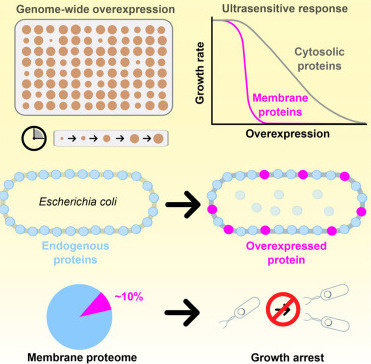
Protein overexpression is crucial in many diseases and can lead to antibiotic resistance by increasing the expression of drug targets or resistance genes. Using high-throughput colony imaging, we performed a quantitative genome-wide study of protein overexpression in E. coli. Our results show that most membrane proteins impose steep overexpression costs, leading to an abrupt growth collapse beyond a critical expression threshold. By manipulating synthetic membrane proteins to target different translocation pathways, we ruled out saturation of these pathways as the cause of these fitness costs. Instead, we found that the growth collapse is driven by the displacement of endogenous membrane proteins, as shown directly by single-cell time-lapse imaging with fluorescently tagged membrane proteins. Displacement of as little as 10% of the membrane proteome trapped most bacteria in a non-growing state. Our findings enhance the quantitative understanding of expression costs, with implications for antibiotic resistance and the biotechnological production of membrane proteins.
|
|
Scooped by
mhryu@live.com
August 27, 12:52 AM
|
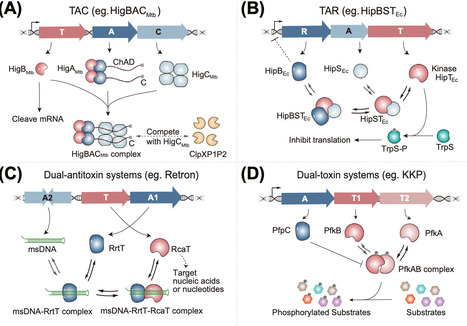
Prokaryotic toxin–antitoxin (TA) systems are genetic modules involved in stress responses, including antiphage defense and the maintenance of mobile genetic elements. Although canonical TA systems consist of two neighboring genes encoding one toxin and one antitoxin, many have evolved into tripartite systems through the incorporation of a third component that serves as a chaperone, a regulator, or an additional antitoxin or toxin to increase functional diversity and regulatory potential. This review compares tripartite TA systems [TA-chaperone (TAC), TA-regulator (TAR), dual-antitoxin, and dual-toxin systems] with bipartite systems, summarizing their neutralizing mechanisms and phage-triggered activation pathways. The regulatory capacity and modularity of tripartite TAs illuminate the evolutionary trajectory of these ‘selfish’ genetic elements, reflecting complex coevolutionary dynamics among TA systems, host bacteria, and phages.
|
|
Scooped by
mhryu@live.com
August 27, 12:40 AM
|
The endosomal sorting complexes required for transport (ESCRT) is a membrane-remodelling machinery that mediates membrane constriction and scission. Most enveloped eukaryotic viruses exploit host ESCRT during membrane budding, but none is known to encode ESCRT components. Here, we discovered homologues of two core ESCRT components, ESCRT-III and ATPase Vps4, in mirusviruses and some viruses in the phylum Nucleocytoviricota that infect unicellular eukaryotes. Mirusviruses seem to have hijacked host ESCRT machinery early in their evolution. A genomic screen reveals homologues of ESCRT components in mirusviruses that infect unicellular aquatic eukaryotes.
|
|
Scooped by
mhryu@live.com
August 27, 12:19 AM
|
Protein language models (PLMs) learn evolutionary information from large-scale sequence data, but three-dimensional relationships are encoded only implicitly. Here, we introduce Prot-LAMBDA (Protein LAnguage Model Boosted with Distance Awareness), a PLM that explicitly incorporates spatial relationships by coupling residue embeddings with inter-residue contacts. Prot-LAMBDA improves performance across diverse structure-related tasks, including contact, secondary structure, backbone geometry, solvent accessibility, and protein fold prediction. Notably, it achieves a twofold improvement in long-range contact recall and an 11.7% reduction in ψ-angle prediction error relative to ESM2-3B. Despite having approximately fivefold fewer parameters, Prot-LAMBDA also improves 3D structure prediction over ESM2-3B by 5-7% in TM-score when coupled to the same structure-prediction module. Building on these representations, we developed LambdaFold, a lightweight distance-guided structure prediction framework that achieves performance comparable to ESMFold on proteins strictly non-redundant to the training data. Finally, retrieval-augmented integration of structural templates increases mean TM-score substantially for targets with high template coverage and rescues several incorrect folds. Together, these results demonstrate that explicit spatial constraints enable efficient and generalizable structural representation learning and protein structure prediction.
|
|
Scooped by
mhryu@live.com
August 26, 11:32 PM
|
Determining which members of a microbial community are metabolically active remains a central challenge in microbial ecology. Although the 16S rRNA gene is the dominant marker for bacterial community profiling, it cannot reliably distinguish active cells from dormant or dead populations. As a result, complementary phylogenetic markers whose transcript abundance more closely reflects cellular activity are needed. Here, we systematically evaluated 80 Bacterial protein-coding marker genes and identified rpoB, encoding the beta subunit of bacterial RNA polymerase, as the optimal candidate. We designed a new primer pair (1528F 2041R) from a curated database of 305,274 unique rpoB sequences and validated it for quantitative PCR and amplicon sequencing of DNA and RNA templates. The rpoB qPCR assay achieved a limit of quantification two orders of magnitude lower than the benchmark 16S rRNA assay, for which a limit of detection could not be determined because of no-template-control amplification. In soil and sediment communities, rpoB recovered community composition comparable to 16S rRNA while providing a quantitative activity signal: rpoB cDNA:DNA ratios correlated significantly with taxon-level transcript abundance (R squared between 0.22 and 0.29, p < 0.001), whereas 16S rRNA ratios did not (p > 0.5). In a biological activated carbon biofilter experiment, rpoB transcript abundance tracked the decline in dissolved organic carbon removal rates across a 72 hour time series (correlation coefficients between 0.84 and 0.99), whereas 16S rRNA transcripts were uninformative (correlation coefficients between -0.4 and 0.98). These results establish rpoB as a quantitatively robust, activity-responsive complement to 16S rRNA for linking community composition to ecosystem processes.
|
|
Scooped by
mhryu@live.com
August 26, 11:16 PM
|
Biomolecular condensates create distinct subcellular niches, but their chemical environments and impacts on clients remain poorly understood. Using ratiometric fluorescent probes in vivo, we find that bacterial ribonucleoprotein bodies (BR-bodies) exhibit an acidic dense phase (pH ~5.1) due to the scaffold’s low pI and negative charge. Single-molecule localization microscopy and fluorescence lifetime imaging reveal spatially variable, acidic nanoscale RNase E clusters in Caulobacter crescentus BR-bodies. Reducing RNase E’s negative charge yields more neutral BR-bodies, causing morphological deects and viability loss upon outgrowth from stationary phase, likely reflecting altered pH and reduced condensation. In vitro assays with C-SNARF-4F and RNase E CTD-pHluorin2 recapitulate this acidic gradient and show that the acidic microenvironment enhances PNPase activity (optimal pH 5.3–6.3). Moreover, stationary-phase BR-bodies average just below this pH at 4.8 ± 0.2, a feature consistent with arrested RNA decay observed in vitro and stationary phase RNA storage in past work. Ratiometric pH sensors show that phase-separated BR-bodies in Caulobacter crescentus form acidic interiors, tuned by scaffold protein charge, to regulate enzymatic activity. Disrupting this pH control impairs stationary phase recovery and causes stress-induced morphological defects.
|
|
Scooped by
mhryu@live.com
August 26, 2:32 PM
|
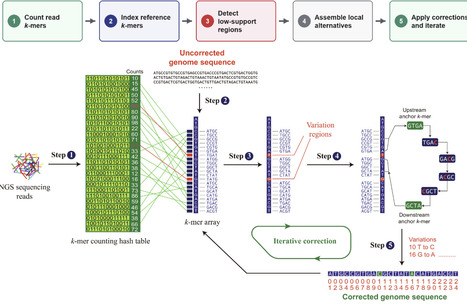
Although several tools exist for prokaryotic genome correction, most depend on external read mappers that impose computational overhead and usability barriers, leaving a need for fast, accurate, standalone solutions. We present ProGenFixer, a mapping-free tool that identifies and corrects errors in prokaryotic genomes using next-generation sequencing data. ProGenFixer compares k-mer profiles between an input genome and sequencing reads to pinpoint discrepancies, then applies a local assembly-based algorithm with a conservative correction strategy suited to refining high-quality reference genomes. In benchmarking, ProGenFixer ran over 5× faster than the existing tools tested while maintaining higher accuracy. Against slower but highly accurate tools, it showed comparable accuracy while running >17× faster, with better performance on long indels (>10 bp). ProGenFixer is designed primarily for conservative updating of already curated reference sequences rather than aggressive polishing of draft assemblies; accordingly, it does not automatically replace a reference base when substantial read support exists for both the reference and alternate alleles. Comparisons using 3 real bacterial resequencing datasets showed that most tool-specific disagreements occurred at mixed-support or low-depth sites, emphasizing that correction aggressiveness and accuracy are not equivalent in this application. ProGenFixer is implemented in C and runs as a standalone program with no external dependencies. The software is freely available at https://github.com/Scilence2022/ProGenFixer. A companion web platform is available at https://progenfixer.biodesign.ac.cn.
|
|
Scooped by
mhryu@live.com
August 26, 2:21 PM
|
The standard genetic code uses 64 codons to encode 20 canonical amino acids across domains of life. New-to-nature genetic codes enable new chemistries, therapeutics and ecosystem engineering, but recoding the genome of an organism is exceptionally challenging. Here we describe automated genetic tRNA expansion (AGENTEX) for multiplexed robotic prototyping of genetic codes in cell-free translation systems. Two Watson–Crick interactions in the ribosomal large subunit (LSU) mediate recognition of the 3′ CCA end of tRNAs, preventing tRNAs with alternative 3′ sequences from being accommodated during translation. Building on these interactions, we investigated the extent to which non-CCA-3′ tRNAs (otRNAs) would be aminoacylated by natural aminoacyl tRNA synthetases (aaRSs), allowing pools of otRNAs to specify unique genetic codes using ribosomes with altered LSU. We developed multiplexed and automated methods to read aminoacylation in libraries of synthetic tRNAs. We discovered that the tRNA 3′ end shows remarkable flexibility to mutation, allowing aminoacylation of most otRNAs by all Escherichia coli aaRSs. Building on our discovery, we developed cell-free translation systems enabling compressed genetic codes of 34 aaRSs for 34 codons. Using AGENTEX, we evaluated two genetic codes alongside the standard genetic code, with non-standard amino acid incorporation and reassignment of up to three codons. Our findings have implications for the design of radically new translation systems, the synthesis of biopolymers with several instances of non-standard monomers, and understanding of possible past and future genetic codes. A robotic, cell–free platform rapidly prototypes redesigned genetic codes, enabling the translation of proteins with reassigned codons and non-standard amino acids without altering living genomes.
|
|
Scooped by
mhryu@live.com
August 26, 12:42 PM
|
Mitochondria possess small, maternally inherited genomes that encode indispensable components of the oxidative phosphorylation machinery. Mitochondrial DNA (mtDNA) mutations underlie a broad spectrum of metabolic and degenerative disorders, yet therapeutic options remain limited. Advances in mitochondrial genome engineering, including programmable nucleases and mitochondria-compatible base editors, enable the selective depletion of mutant genomes and the installation of defined C-to-T and A-to-G substitutions. These technologies have enabled the development of cellular and animal models for mechanistic studies of mitochondrial biology and opened up avenues for potential therapeutic intervention. In this Review, we discuss the development and application of current mtDNA-editing platforms and examine the key technical barriers and opportunities for their clinical translation. Advances in mitochondrial genome editing have expanded efforts to manipulate mitochondrial DNA and model mitochondrial disease. This Review discusses the development of programmable nucleases and mitochondrial base editors, their applications in disease modelling and therapeutic correction, and the key challenges to clinical translation.
|
|
Scooped by
mhryu@live.com
August 26, 12:29 PM
|
RNA-guided obligate mobile element guided activity systems derived from transposable elements have emerged as compact genome-editing tools that may replace clustered regularly interspaced short palindromic repeats platforms. We established a dual-mode genome regulation platform using ISDge10 TnpB effectors and engineered ωRNAs, in which modulation of the ωRNA guide length enables switching between programmable transcriptional activation and genome editing. TnpB programmed with a 10-nt guide region of the ωRNA engages target DNA without inducing double-strand breaks. Fusion of transcriptional activators with Sso7d (DNA-binding protein from Sulfolobus solfataricus) enables specific transcriptional upregulation across endogenous loci. Restoring the ωRNA guide length to 20 nt triggers DNA cleavage, thereby supporting homology-directed repair-mediated sequence correction. A catalytically inactivated TnpB-based adenine base editor enabled A-to-G base conversion at genomic targets. TnpB shows strict ωRNA-dependent mismatch sensitivity with low off-target effects, suggesting its potential as a high-fidelity genome regulation platform. Compact ISDge10 TnpB facilitates co-packaging of effector and ωRNA in a single adeno-associated virus vector and co-expression of large functional domains. Thus, this study expands RNA-guided genome-editing capabilities.
|
|
|
Scooped by
mhryu@live.com
August 27, 1:44 AM
|
Lignin remains a major bottleneck in biomass valorization due to its heterogeneous and recalcitrant structure. Traditionally, lignin degradation has been developed using a single-microorganism or single-enzyme approach, with efforts focused on identifying ligninolytic activities of individual bacteria or fungi. Here, we establish a framework for designing lignin-degrading synthetic microbial communities (SynComs) by integrating top-down ecological filtering with bottom-up trait-based selection. This approach enables the selection of bacteria with ligninolytic capacity while retaining community members that form strong biofilms and contribute indirectly to overall community function. Proteomic profiling uncovered lignin-driven functional reprogramming of the SynCom, highlighting strain-specific enzymatic specializations that collectively enable lignin depolymerization. Our work highlights the potential of SynComs for lignin degradation and shows how rationally designed, functionally partitioned communities can enhance lignin conversion.
|
|
Scooped by
mhryu@live.com
August 27, 1:30 AM
|
Intracellular plant–microbe interactions rely on host-derived interface membranes: as sites for reciprocal nutrient and signal exchange during symbiosis, or as conduits for asymmetrical nutrient acquisition and effector delivery by pathogens. Sustaining these dynamic structures places substantial metabolic and vesicular trafficking demands on host cells. This review examines how cell cycle reprogramming may help plants meet these demands. During plant–pathogen interactions, biotrophic pathogens can reprogram host cell cycle pathways to establish metabolically favorable niches, whereas plant immunity can engage cell cycle checkpoints to restrict resource allocation and reinforce physical barriers. In arbuscular mycorrhizal symbiosis, localized endoreduplication in host cells could function as a “metabolic amplification program” to boost biosynthetic output, whereas host cells may adopt a “division-restricted state” that enables extensive intracellular remodeling while preserving the transcellular infection pathway. Root nodule symbiosis and mycorrhizal symbiosis share several cellular programs for microbial accommodation and the cell cycle could be further activated during symbiotic nodule development. Thus, we speculate that interface formation—during either symbiotic or pathogenic infection—may rely on a shared cellular toolkit that is potentially governed by distinct regulatory thresholds, tentatively suggesting the possibility of engineering cell cycle programs to improve symbiotic efficiency or enhance resistance against pathogens.
|
|
Scooped by
mhryu@live.com
August 27, 1:11 AM
|
Komagataella phaffii has emerged as an important eukaryotic microbial cell factory for the production of industrial enzymes, biopharmaceuticals, and food-related proteins owing to its rapid growth, capacity for eukaryotic post-translational modifications, and suitability for high-cell-density fermentation. However, efficient heterologous protein production remains constrained by limitations in transcriptional regulation, protein secretion, and endoplasmic reticulum (ER) protein-folding capacity. This review summarizes recent advances in engineering key expression elements underlying heterologous protein production in K. phaffii, with particular emphasis on promoter architecture redesign (e.g., upstream activating sequence (UAS) duplication and core promoter mutagenesis), signal peptide replacement and sequence engineering, molecular chaperone co-expression, and quantitative regulation of the unfolded protein response (UPR). Rather than focusing on individual expression modules, this review highlights a systems-level engineering perspective that integrates regulatory elements, intracellular processing, and secretory pathway optimization, illustrating the ongoing transition from empirical modification of individual expression elements to systems-level engineering of the secretory pathway. Recent advances in synthetic biology and artificial intelligence (AI)-assisted approaches are further accelerating the development of predictive and precision engineering approaches for K. phaffii. Together, these advances provide a foundation for the rational design of next-generation K. phaffii cell factories for the sustainable production of structurally complex and high-value recombinant proteins.
|
|
Scooped by
mhryu@live.com
August 27, 1:04 AM
|
Cell-to-cell heterogeneity leads to the formation of subpopulations within an isogenic population, resulting in the coexistence of high and low producer cells. However, the impact of this phenotypic heterogeneity on bioproduction has been overlooked. Using flow cytometry to analyse commonly used yeast promoters, we found that many display macro-heterogeneity, generating multiple discrete subpopulations. Additionally, by regressing single-cell protein expression on single-cell RNA sequencing data, we explored the use of predictive models as a guide for selecting promoters with more homogeneous expression at desired expression levels. As a proof of concept, we engineered an improved lycopene pathway by substituting homogeneous promoters for macro-heterogeneous ones and implemented single-cell Raman spectroscopy to demonstrate up to a threefold increase in single-cell and bulk lycopene production. Overall, our results show that promoter heterogeneity can have a large impact on microbial bioprocesses and that the selection of homogeneous promoters can achieve more efficient production in a metabolically engineered pathway.
|
|
Scooped by
mhryu@live.com
August 27, 12:48 AM
|
Whole-cell models (WCM) that mechanistically represent every gene and gene function have many potential applications, from knowledge discovery to addressing real-world problems in engineering and medicine. However, there are many challenges to building, simulating and validating WCMs. It would be more realistic to achieve each cell-specific WCM as a long-term goal, where each model is built in stages and released as incremental versions. This strategy is exemplified by recent WCMs for two bacterial species, each of which has been continuously expanded since the release of their first model versions. Each expansion improved the models but also revealed biological insights about cells. This demonstrated the values of WCMs and the benefits (to both authors and the wider community) of disseminating organism-specific models as incremental versions. In this review, I compare existing bacterial WCMs and extract a set of minimal features that would be attainable in the short term while maintaining the distinctive abilities of WCMs. This minimal set could be used as guidance for initial versions of future WCMs, such as for organisms with large genomes. I discuss different collaborative formats and what we would need for community-driven development of WCMs. I also discuss how we can leverage emerging technologies in artificial intelligence and computing to accelerate whole-cell modelling.
|
|
Scooped by
mhryu@live.com
August 27, 12:27 AM
|
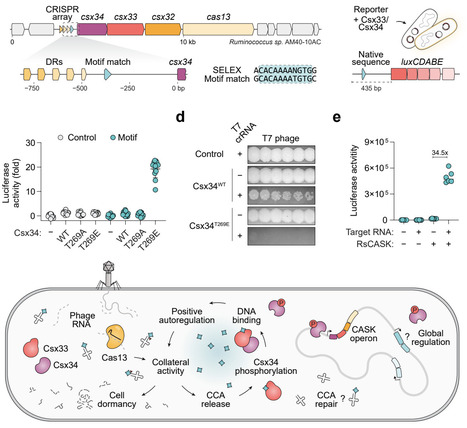
CRISPR-Cas systems are RNA-guided nucleases that enable prokaryotic immunity; however, some loci encode additional associated genes that cooperate with CRISPR effectors to perform diverse biological functions. Here, we uncover a CRISPR-associated kinase (CASK) system that links the recognition of target RNA to protein phosphorylation. We show that the kinase Csx33 phosphorylates Csx34 following activation of Cas13, enabling Csx34 to bind DNA in a sequence-specific manner. Together, Csx33 and Csx34 function as a transcriptional activation module that upregulates cas13 and associated genes, revealing a positive autoregulatory circuit that potentiates the immune response upon detection of foreign RNA. At the molecular level, Csx33 is activated by CCA trinucleotide RNA generated by Cas13-mediated cleavage of tRNA 3′ tails, uncovering a novel linear second messenger in bacterial immunity and a previously unrecognized signaling role of collateral RNA fragments. Together, these findings establish CASK systems as a new platform for RNA sensing and for engineering programmable phosphorylation-based signaling systems.
|
|
Scooped by
mhryu@live.com
August 27, 12:05 AM
|
The 5' untranslated region (UTR) and the start-codon-proximal region of the coding sequence (CDS) jointly influence translation efficiency and local RNA secondary-structure stability, while synonymous codon choices throughout the CDS shape codon adaptation. Because the encoded protein is often predetermined, practical mRNA design must coordinate these quantitative objectives while preserving specified nucleotide sequences and amino-acid identities. Existing generative approaches typically address continuous-valued targeting, explicit sequence constraints, and codon-usage control separately rather than integrating all three within a single model. We present UTR-Diffusion, a diffusion-based framework for 5' UTR and 5' UTR-CDS junction design. UTR-Diffusion conditions generation on continuous-valued MRL and MFE targets and supports nucleotide-level constraints, amino-acid-level constraints with synonymous-codon flexibility, and codon-adaptiveness control that modulates the sequence-level codon adaptation index (CAI). Systematic evaluations across dense MRL-MFE target grids showed that generated distributions shifted consistently with both targets, retained substantial diversity, and strictly preserved specified nucleotide sequences and amino-acid identities. Codon-adaptiveness control yielded distinct, monotonically ordered CAI levels that closely followed the specified adaptiveness targets. In comparative benchmarks, UTR-Diffusion outperformed representative existing methods in high-MRL optimization and precise MRL targeting for 5-prime UTR design, and achieved higher MRL, less-negative junction MFE, and higher CAI than peptide-preserving baselines in 50-nt 5-prime UTR-CDS junction design.
|
|
Scooped by
mhryu@live.com
August 26, 11:28 PM
|
Rising demand for rare earth elements, including lanthanides (Lns), has intensified environmental pressures and supply-chain vulnerabilities, motivating the development of bio-based methods for their extraction and separation. However, the lack of high-throughput assays for analysing the selectivity of lanthanide-binding proteins remains a key bottleneck in engineering bio-based Ln-extraction systems. Here, we report the development of high-throughput assays based on Ln-responsive protein biosensors. These β-lactamase-based biosensors contain receptors with a single Ln-binding site derived from either lanmodulin or the AI-designed protein RF2. We established multiplexed colourimetric assays that quantify biosensor activity and selectivity in vitro and in the periplasm of E. coli. We further demonstrate that E. coli cells expressing these biosensors exhibit Ln-dependent survival in the presence of β-lactam antibiotics. These platforms enable large-scale testing of Ln biosensors and Ln-binding proteins.
|
|
Scooped by
mhryu@live.com
August 26, 10:35 PM
|
Fucoidans, a class of complex polysaccharides produced by brown algae and diatoms, contribute to long-term carbon sequestration owing to their resistance to microbial degradation. Although individual microorganisms can break down portions of these polysaccharides, it remains unclear whether complete breakdown is possible in nature and, if so, by what mechanisms. Here we show that fucoidans are degraded through synergistic interactions between specialized bacteria with complementary metabolic functions. Using metabolomic analysis of a reconstructed marine consortium, we uncovered metabolic guilds of bacteria that preferentially degrade either the sulfated fucose backbone or the side branches of rare monomers. This functional division of labor leads to an unexpectedly high number of synergistic interactions between different degraders that enhanced degradation efficiency up to 97.1%. Despite varying fucoidan structures across different types of algae, the metabolic functions of degraders remained conserved, enabling quantitative prediction of degradation outcomes based on community and substrate composition. The frequent co-occurrence of functionally complementary fucoidan degraders in ocean metagenomes suggests that synergistic degradation is a globally relevant strategy. Our findings suggest that the environmental turnover of complex biopolymers depends not only on individual metabolic capabilities of degraders but also on ecological interactions shaped by substrate architecture. This work provides a mechanistic framework for understanding carbon cycling in the ocean and for engineering synthetic microbial consortia to degrade recalcitrant polysaccharides. Efficient degradation of fucoidans depends on complementary bacterial guilds that cooperatively break backbone and side-chain sugars, revealing a conserved, globally relevant mechanism that shapes marine carbon cycling.
|
|
Scooped by
mhryu@live.com
August 26, 2:27 PM
|
Recent advances in mRNA therapeutics have driven further research on the untranslated regions (UTRs) of mRNA. However, prior studies have mainly focused on either the 5′ or 3′ UTR individually. Increasing evidence suggests potential cooperative effects between these two regions, which remain largely unexplored in computational studies. We present a deep learning-based approach to predicting relationships between 5′ and 3′ UTRs by leveraging latent representations from a pre-trained RNA language model and contrastive learning. Our method effectively identifies highly related UTRs, uncovering sequence and expression characteristics that suggest functional interplay. Our analysis revealed that Highly Related UTRs (HRUs) are significantly enriched in genes associated with neural development, exhibit distinctive UTR length and secondary structure characteristics, and are involved in cell type-specific regulation of translation efficiency. These findings provide new insights into UTR co-optimization for mRNA therapeutics.
|
|
Scooped by
mhryu@live.com
August 26, 2:07 PM
|
The distribution of functional proteins across amino acid sequence space, and the proportion of functional space covered by existing proteins, remains unknown. Illuminating this distribution is integral to understanding protein evolution and advancing protein design. The recent explosion of AI/ML protein design tools presents an opportunity to explore protein sequence space distant from extant proteins, but these tools remain poorly validated. Here, we determine that portions of protein sequence space, despite being unobserved in nature, contains many functional proteins that cannot be predicted accurately in silico. We measure experimental fitness of highly diverse proteins across 3 families and assemble the largest known dataset of diverse, functionally labeled natural protein orthologs and new-to-nature proteins. For each family, we observe many functional, new-to-nature sequences with low amino acid identity to existing orthologs. Sequence-based scoring metrics, especially Potts models and protein language models, provide accurate but inconsistent and highly correlated function predictions. Empirical protein fitness landscapes are rugged, and predictions of function do not consistently capture either the local shape or global trends of the empirical fitness landscapes. Finally, we find extensive functional sequence space between existing proteins in each family, providing experimental support for the hypothesis that natural protein sequences explored by evolution represent a minuscule fraction of all possible functional sequences.
|
|
Scooped by
mhryu@live.com
August 26, 12:41 PM
|
The flexibility of nucleic acids plays a central role in numerous biological processes, including chromatin organization, gene regulation, and ribosome assembly. While elastic network models (ENMs) have successfully captured conformational changes in proteins through harmonic normal modes (NMs), analogous approaches for nucleic acids remain limited. Here, we introduce a generalized essential dynamics-refined ENM (edENM) for both DNA, RNA, and protein–nucleic acid complexes, parametrized against a diverse set of molecular dynamics simulations and validated using experimental ensembles from nuclear magnetic resonance, X-ray crystallography, and cryogenic electron microscopy. edENM achieves high agreement with experimental conformational changes across a curated benchmark of ∼60 DNA, RNA, and protein–nucleic acid systems. Compared to uniform-spring parametrizations, it produces significantly more collective NMs and suppresses unphysical backbone ruptures. We further integrate edENM into eBDIMS2, an efficient Brownian Dynamics path-sampling framework, extending its applicability to nucleic acid-containing systems at the megadalton scale. This enables the exploration of complex conformational transitions, including rearrangements of RNA folds in coronaviruses, large-scale remodeling in Argonaute–RNA complexes, multi-nucleosome assemblies in chromatin, as well as ribosomal particles. Together, these results establish an accessible and scalable elastic network framework for modeling conformational changes across the full spectrum of nucleic acid-containing biological systems.
|