Your new post is loading...

|
Scooped by
Jean-Michel Ané
August 4, 2023 3:39 PM
|
Plants interact with a diversity of microorganisms that influence their growth and resilience, and they can therefore be considered as ecological entities, namely “plant holobionts,” rather than as singular organisms. In a plant holobiont, the assembly of above- and belowground microbiota is ruled by host, microbial, and environmental factors. Upon microorganism perception, plants activate immune signaling resulting in the secretion of factors that modulate microbiota composition. Additionally, metabolic interdependencies and antagonism between microbes are driving forces for community assemblies. We argue that complex plant–microbe and intermicrobial interactions have been selected for during evolution and may promote the survival and fitness of plants and their associated microorganisms as holobionts. As part of this process, plants evolved metabolite-mediated strategies to selectively recruit beneficial microorganisms in their microbiota. Some of these microbiota members show host-adaptation, from which mutualism may rapidly arise. In the holobiont, microbiota members also co-evolved antagonistic activities that restrict proliferation of microbes with high pathogenic potential and can therefore prevent disease development. Co-evolution within holobionts thus ultimately drives plant performance.
|
|
Scooped by
Jean-Michel Ané
August 4, 2023 3:30 PM
|
The surrounding gene networks of Nod factor receptors that govern the symbiotic process remain largely unexplored. In the present study, we identified 13 novel GmNFR1α-associated proteins by Y2H screening, and a potential interacting protein GmBI-1α was described. GmBI-1α had the highst positive correlation with GmNFR1α in the co-expression network analysis, and its expression at the mRNA level in roots was enhanced by rhizobial infection. Moreover, GmBI-1α- GmNFR1α interaction was shown to occur in vitro and in vivo. The GmBI-1α protein was localized to multiple subcellular locations, including the Endoplasmic Reticulum (ER) and Plasma Membrane (PM). Overexpression of GmBI-1α increased the nodule number in transgenic hairy roots or transgenic soybean, whereas down-regulation of GmBI-1α transcripts by RNA interference (RNAi) reduced the nodule number. Besides, the nodules in GmBI-1α-OX plants became smaller in size and infected area with reduced nitrogenase activity. In GmBI-1α-OX transgenic soybean, the elevated GmBI-1α level also promoted plant growth and suppressed the expression of defense signaling-related genes. IT analysis of GmBI-1α-OX showed that GmBI-1α promoted rhizobial infection. Collectively, our current findings supported a GmNFR1α-associated protein in the Nod factor signaling pathway and shed new light on the regulatory mechanism of GmNFR1α in rhizobial symbiosis.
|
|
Scooped by
Jean-Michel Ané
August 4, 2023 3:20 PM
|
Strigolactones (SLs) are a class of plant hormones that regulate many aspects of plant growth and development. SLs also improve symbiosis with arbuscular mycorrhizal fungi (AMF) in the rhizosphere. Recent studies have shown that the DWARF14-LIKE (D14L)/ KARRIKIN-INSENSITIVE2 (KAI2) family, paralogs of the SL receptor D14, are required for AMF colonization in several flowering plants, including rice. In this study, we found that (−)-GR5, a (2’S)-configured enantiomer of a synthetic SL analog (+)-GR5, significantly activated SL biosynthesis in rice roots via D14L. This result is consistent with a recent report showing that the D14L pathway positively regulates SL biosynthesis in rice. In fact, the SL levels tended to be lower in the roots of the d14l mutant under both inorganic nutrient-deficient and -sufficient conditions. We also show that the increase in SL levels by (−)-GR5 was observed in other mycorrhizal plant species. In contrast, the KAI2 pathway did not upregulate the SL level and the expression of SL biosynthetic genes in Arabidopsis, a non-mycorrhizal plant. We also examined whether the KAI2 pathway enhances SL biosynthesis in the liverwort Marchantia paleacea, where SL functions as a rhizosphere signaling molecule for AMF. However, the SL level and SL biosynthetic genes were not positively regulated by the KAI2 pathway. These results imply that the activation of SL biosynthesis by the D14L/KAI2 pathway has been evolutionarily acquired after the divergence of bryophytes to efficiently promote symbiosis with AMF, although we cannot exclude the possibility that liverworts have specifically lost this regulatory system.
|
|
Scooped by
Jean-Michel Ané
August 4, 2023 3:14 PM
|
The smo locus (sorbitol mannitol oxidation) is found on the chromosome of S. meliloti’s tripartite genome. Mutations at the smo locus reduce or abolish the ability of the bacterium to grow on several carbon sources, including sorbitol, mannitol, galactitol, d-arabitol and maltitol. The contribution of the smo locus to the metabolism of these compounds has not been previously investigated. Genetic complementation of mutant strains revealed that smoS is responsible for growth on sorbitol and galactitol, while mtlK restores growth on mannitol and d-arabitol. Dehydrogenase assays demonstrate that SmoS and MtlK are NAD+-dependent dehydrogenases catalysing the oxidation of their specific substrates. Transport experiments using a radiolabeled substrate indicate that sorbitol, mannitol and d-arabitol are primarily transported into the cell by the ABC transporter encoded by smoEFGK. Additionally, it was found that a mutation in either frcK, which is found in an operon that encodes the fructose ABC transporter, or a mutation in frk, which encodes fructose kinase, leads to the induction of mannitol transport.
|
|
Scooped by
Jean-Michel Ané
August 4, 2023 3:08 PM
|
Salinity is one of the most significant environmental factors limiting legumes development and productivity. Salt stress disturbs all developmental stages of legumes and affects their hormonal regulation, photosynthesis and biological nitrogen fixation, causing nutritional imbalance, plant growth inhibition and yield losses. At the molecular level, salt stress exposure involves large number of factors that are implicated in stress perception, transduction, and regulation of salt responsive genes’ expression through the intervention of transcription factors. Along with the complex gene network, epigenetic regulation mediated by non-coding RNAs, and DNA methylation events are also involved in legumes’ response to salinity. Different alleviation strategies can increase salt tolerance in legume plants. The most promising ones are Plant Growth Promoting Rhizobia, Arbuscular Mycorrhizal Fungi, seed and plant’s priming. Genetic manipulation offers an effective approach for improving salt tolerance. In this review, we present a detailed overview of the adverse effect of salt stress on legumes and their molecular responses. We also provide an overview of various ameliorative strategies that have been implemented to mitigate/overcome the harmful effects of salt stress on legumes.
|
|
Scooped by
Jean-Michel Ané
August 4, 2023 1:26 PM
|
In recent years, fungi have attracted avid interest from the research community. This interest stems from several motives, including their network creation capabilities and fundamental role in the ecosystem. Controlled laboratory experiments of fungal behaviors are crucial to further understanding their role and functionalities.
In this paper, we propose a method for automating the quantification and observation of fungal spores. Our approach consists of four steps: 1) a Z-stack image acquisition of the sample is performed, 2) a detection algorithm is applied to all Z-planes, 3) clustering of spores detected in different Z-planes, 4) determination of the optimal Z-plane for each cluster through an ad-hoc focus measure. We compared the spore count obtained through the automated tool to a manual count and the count obtained by applying the detection algorithm to a single plane. The result is a highly automated, non-invasive tool to determine spore count, estimate each spore depth, and retrieve an all-in-focus image to analyze further.
|
|
Scooped by
Jean-Michel Ané
August 3, 2023 2:55 PM
|
Arbuscular mycorrhizal (AM) fungi play an important role in soil organic matter (SOM) formation and stabilization. Previous studies have emphasized organic compounds produced by AM fungi as persistent binding agents for aggregate formation and SOM storage. This concept overlooks the multiple biogeochemical processes mediated by AM fungal activities, which drive SOM generation, reprocessing, reorganization, and stabilization. Here, we propose an updated conceptual framework to facilitate a mechanistic understanding of the role of AM fungi in SOM dynamics. In this framework, four pathways for AM fungi-mediated SOM dynamics are included: ‘Generating’, AM fungal exudates and biomass serve as key sources of SOM chemodiversity; ‘Reprocessing’, hyphosphere microorganisms drive SOM decomposition and resynthesis; ‘Reorganizing’, AM fungi mediate soil physical changes and influence SOM transport, redistribution, transformation, and storage; and ‘Stabilizing’, AM fungi drive mineral weathering and organo–mineral interactions for SOM stabilization. Moreover, we discuss the AM fungal role in SOM dynamics at different scales, especially when translating results from small scales to complex larger scales. We believe that working with this conceptual framework can allow a better understanding of AM fungal role in SOM dynamics, therefore facilitating the development of mycorrhiza-based technologies toward soil health and global change mitigation.
|
|
Scooped by
Jean-Michel Ané
August 2, 2023 10:54 AM
|
Photosynthesis is the primary energy input to plants, but most plant metabolic processes are powered much or all of the time by ATP and NAD(P)H that come from respiratory oxidation of photosynthetically produced carbohydrates, that is, “dark respiration” (Amthor, 1994). The processes of growth, nutrient uptake and assimilation, active transport, and maintenance are thus all clients of respiration and compete for their share of a respiratory energy budget that is capped by photosynthate income. The economic principle of opportunity cost applies to these clients’ competing demands: spending respiratory energy on process A means missing the benefit of investing that energy in process B (Mahmoudabadi et al., 2019). This principle is key to assessing prospects for crop improvement by metabolic engineering. As de Lorenzo (2015) put it: “metabolism…frames and ultimately resolves whether a given genetic program (existing…or engineered) can be deployed or not.” Foreign or reconfigured native processes bolted on to a crop-plant’s metabolic chassis must compete for respiratory energy with native ones without crashing the energy economy. A proviso on plant carbon budgets is that photosynthetic carbon fixation (“source activity”) can in certain cases increase to meet increased carbon demand (“sink activity”), that is, budget envelopes are not always fixed (Smith et al., 2018). However, as there is some consensus that productivity is most often limited or co-limited by carbon supply (Ainsworth and Long, 2005; Körner, 2015; Sonnewald and Fernie, 2018), we make this our basal assumption in the analyses below.
|
|
Scooped by
Jean-Michel Ané
July 31, 2023 11:13 AM
|
A number of companies hope to reduce the greenhouse gas emissions and water pollution associated with synthetic nitrogen fertilizer by replacing it with nitrogen-producing microbes. After years of research and testing, these products are now being deployed on millions of hectares of farmland. While many customers are successfully reducing their use of synthetic fertilizer, some farmers and researchers say the microbes aren’t living up to companies’ claims. The firms are pushing back. They argue that their own studies show that the products are effective and will help abate synthetic fertilizer’s harms without sacrificing food production.
|
|
Scooped by
Jean-Michel Ané
July 14, 2023 11:47 AM
|
It is well-known that plant breeding aims to develop new plant varieties with desirable traits. However, this process promotes the loss of certain genetic traits, such as nodulation by indigenous rhizobia in soils. Therefore, this study aimed to assess the potential effect of lima bean breeding on root nodulation by indigenous rhizobia. Five genotypes were utilized in this experiment, following the steps of lima bean breeding, including two parent plants (P1 and P2) and three segregating generations (F2, F7, and F8). The plant growth and nodulation traits were evaluated during the flowering period, which varied depending on each genotype. The results of the multivariate analysis clearly separated the parent plants from the segregating generations based on nodulation traits. Nodulation by indigenous rhizobia varied across the evaluated genotypes and generally decreased as the generations advanced. The highest nodulation traits were found in P1 and P2, while they decreased in F2 and were undetectable in F7 and F8, indicating a loss of ability to nodulate in this region with the advancement of generations. This study demonstrated that lima bean breeding has a negative impact on the ability of indigenous rhizobia to nodulate lima bean genotypes during the advance generations.
|
|
Scooped by
Jean-Michel Ané
July 14, 2023 9:55 AM
|
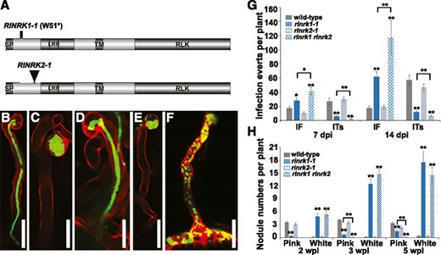
During the legume-rhizobium symbiotic interaction, rhizobial invasion of legumes is primarily mediated by a plant-made tubular invagination called an infection thread (IT). Here, we identify a gene in Lotus japonicus encoding a Leu-rich repeat receptor-like kinase (LRR-RLK), RINRK1 (Rhizobial Infection Receptor-like Kinase1), that is induced by Nod factors (NFs) and is involved in IT formation but not nodule organogenesis. A paralog, RINRK2, plays a relatively minor role in infection. RINRK1 is required for full induction of early infection genes, including Nodule Inception (NIN), encoding an essential nodulation transcription factor. RINRK1 displayed an infection-specific expression pattern, and NIN bound to the RINRK1 promoter, inducing its expression. RINRK1 was found to be an atypical kinase localized to the plasma membrane and did not require kinase activity for rhizobial infection. We propose RINRK1 is an infection-specific RLK, which may specifically coordinate output from NF signaling or perceive an unknown signal required for rhizobial infection.
|
|
Scooped by
Jean-Michel Ané
July 14, 2023 9:41 AM
|
Legume roots can be symbiotically colonized by arbuscular mycorrhizal (AM) fungi and nitrogen-fixing bacteria. In Lotus japonicus, the latter occurs intracellularly by the cognate rhizobial partner Mesorhizobium loti or intercellularly with the Agrobacterium pusense strain IRBG74. Although these symbiotic programs show distinctive cellular and transcriptome signatures, some molecular components are shared. In this study, we demonstrate that 3-deoxy-d-arabino-heptulosonate 7-phosphate synthase 1 (DAHPS1), the first enzyme in the biosynthetic pathway of aromatic amino acids (AAAs), plays a critical role in root hair development and for AM and rhizobial symbioses in Lotus. Two homozygous DAHPS1 mutants (dahps1-1 and dahps1-2) showed drastic alterations in root hair morphology, associated with alterations in cell wall dynamics and a progressive disruption of the actin cytoskeleton. The altered root hair structure was prevented by pharmacological and genetic complementation. dahps1-1 and dahps1-2 showed significant reductions in rhizobial infection (intracellular and intercellular) and nodule organogenesis and a delay in AM colonization. RNAseq analysis of dahps1-2 roots suggested that these phenotypes are associated with downregulation of several cell wall-related genes, and with an attenuated signaling response. Interestingly, the dahps1 mutants showed no detectable pleiotropic effects, suggesting a more selective recruitment of this gene in certain biological processes. This work provides robust evidence linking AAA metabolism to root hair development and successful symbiotic associations.
|
|
Scooped by
Jean-Michel Ané
July 13, 2023 9:35 AM
|
Root traits including root exudates are key factors affecting plant interactions with soil and thus play an important role in determining ecosystem processes. The drivers of their variation, however, remain poorly understood. We determined the relative importance of phylogeny and species ecology in determining root traits and analyzed the extent to which root exudate composition can be predicted by other root traits.
We measured different root morphological and biochemical traits (including exudate profiles) of 65 plant species grown in a controlled system. We tested phylogenetic conservatism in traits and disentangled the individual and overlapping effects of phylogeny and species ecology on traits. We also predicted root exudate composition using other root traits.
Phylogenetic signal differed greatly among root traits, with the strongest signal in phenol content in plant tissues. Interspecific variation in root traits was partly explained by species ecology, but phylogeny was more important in most cases. Species exudate composition could be partly predicted by specific root length, root dry matter content, root biomass, and root diameter, but a large part of variation remained unexplained.
In conclusion, root exudation cannot be easily predicted based on other root traits and more comparative data on root exudation are needed to understand their diversity.
|
|
|
Scooped by
Jean-Michel Ané
August 4, 2023 3:36 PM
|
Plant microbiomes play crucial roles in nutrient cycling and plant growth, and are shaped by a complex interplay between plants, microbes, and the environment. The role of bacteria as mediators of the 400-million-year-old partnership between the majority of land plants and, arbuscular mycorrhizal (AM) fungi is still poorly understood. Here we test whether AM hyphae-associated bacteria influence the success of the AM symbiosis. Using partitioned microcosms containing field soil, we discovered that AM hyphae and roots selectively assemble their own microbiome from the surrounding soil. In two independent experiments, we identified several bacterial genera, including Devosia, that are consistently enriched on AM hyphae. Subsequently, we isolated 144 pure bacterial isolates from a mycorrhiza-rich sample of extraradical hyphae and isolated Devosia sp. ZB163 as root and hyphal colonizer. We show that this AM-associated bacterium synergistically acts with mycorrhiza on the plant root to strongly promote plant growth, nitrogen uptake, and mycorrhization. Our results highlight that AM fungi do not function in isolation and that the plant-mycorrhiza symbiont can recruit beneficial bacteria that support the symbiosis.
|
|
Scooped by
Jean-Michel Ané
August 4, 2023 3:22 PM
|
The capacity of beneficial microbes to compete for host infection—and the ability of hosts to discriminate among them—introduces evolutionary conflict that is predicted to destabilize mutualism. We investigated fitness outcomes in associations between legumes and their symbiotic rhizobia to characterize fitness impacts of microbial competition. Diverse Bradyrhizobium strains varying in their capacity to fix nitrogen symbiotically with a common host plant, Acmispon strigosus, were tested in full-factorial coinoculation experiments involving 28 pairwise strain combinations. We analyzed the effects of interstrain competition and host discrimination on symbiotic-interaction outcomes by relativizing fitness proxies to clonally infected and uninfected controls. More than one thousand root nodules of coinoculated plants were genotyped to quantify strain occupancy, and the Bradyrhizobium strain genome sequences were analyzed to uncover the genetic bases of interstrain competition outcomes. Strikingly, interstrain competition favored a fast-growing, minimally beneficial rhizobia strain. Host benefits were significantly diminished in coinoculation treatments relative to expectations from clonally inoculated controls, consistent with competitive interference among rhizobia that reduced both nodulation and plant growth. Competition traits appear polygenic, linked with inter-strain allelopathic interactions in the rhizosphere. This study confirms that competition among strains can destabilize mutualism by favoring microbes that are superior in colonizing host tissues but provide minimal benefits to host plants. Moreover, our findings help resolve the paradox that despite efficient host control post infection, legumes nonetheless encounter rhizobia that vary in their nitrogen fixation.
|
|
Scooped by
Jean-Michel Ané
August 4, 2023 3:16 PM
|
|
|
Scooped by
Jean-Michel Ané
August 4, 2023 3:11 PM
|
Purpose
Drought induces mortality in plants; however, how symbioses mediate the plant drought response remains understudied and may be crucial to understanding how shifts in symbioses under climate change scenarios may impact plant drought induced mortality.
Methods
Drought was experimentally imposed in parallel on two legume hosts, Acmispon strigosus and Lotus japonicus, whose roots are nodulated by nitrogen fixing rhizobia in different genera. Within each host taxon, greenhouse experiments factorially combined legume genotypes varying in root nodule investment with rhizobia varying in nitrogen fixation capacity, to investigate how costs and benefits of symbiosis modulate plant performance under drought.
Results
Net benefits of symbiosis with nitrogen fixing symbionts, namely increased number of leaves and shoot mass, were maintained under drought irrespective of nodulation level or host species, mitigating the carbon strain during drought. Net benefits of symbiosis occurred despite increased water cost associated with the maintenance of nitrogen fixation, costs that were evident even in pre drought baseline conditions.
Conclusion
Our results demonstrate that benefits of root nodule symbiosis can be robust to environmental perturbations, and potentially mediate carbon starvation during drought induced mortality events. The investment in symbiosis and its impacts on biomass suggest that in long term droughts legumes may be more limited by carbon than water. Ongoing stability of these associations is predicted, even under extended drought conditions.
|
|
Scooped by
Jean-Michel Ané
August 4, 2023 3:06 PM
|
In natural and agricultural systems, the plant microbiome–the microbial organisms associated with plant tissues and rhizosphere soils–has been shown to have important effects on host physiology and ecology, yet we know little about how these plant-microbe relationships play out in urban environments. Here we characterize the composition of fungal communities associated with living leaves of one of the most common sidewalk trees in the city of San Francisco, California. We focus our efforts on endophytic fungi (asymptomatic microfungi that live inside healthy leaves), which have been shown in other systems to have large ecological effects on the health of their plant hosts. Specifically, we characterized the foliar fungal microbiome of Metrosideros excelsa (Myrtaceae) trees growing in a variety of urban environmental conditions. We used high-throughput culturing, PCR, and Sanger sequencing of the internal transcribed spacer nuclear ribosomal DNA (ITS nrDNA) region to quantify the composition and structure of fungal communities growing within healthy leaves of 30 M. excelsa trees from six distinct sites, which were selected to capture the range of environmental conditions found within city limits. Sequencing resulted in 854 high-quality ITS sequences. These sequences clustered into 85 Operational Taxonomic Units (97% OTUs). We found that these communities encompass relatively high alpha (within) and beta (between-site) diversity. Because the communities are all from the same host tree species, and located in relatively close geographical proximity to one another, these analyses suggest that urban environmental factors such as heat islands or differences in vegetation or traffic density (and associated air quality) may potentially be influencing the composition of these fungal communities. These biogeographic patterns provide evidence that plant microbiomes in urban environments can be as dynamic and complex as their natural counterparts. As human populations continue to transition out of rural areas and into cities, understanding the factors that shape environmental microbial communities in urban ecosystems stands to become increasingly important.
|
|
Scooped by
Jean-Michel Ané
August 4, 2023 1:25 PM
|
Background
A major aim in plant microbiome research is determining the drivers of plant-associated microbial communities. While soil characteristics and host plant identity present key drivers of root microbiome composition, it is still unresolved whether the presence or absence of important plant root symbionts also determines overall microbiome composition. Arbuscular mycorrhizal fungi (AMF) and N-fixing rhizobia bacteria are widespread, beneficial root symbionts that significantly enhance plant nutrition, plant health, and root structure. Thus, we hypothesized that symbiont types define the root microbiome structure.
Results
We grew 17 plant species from five families differing in their symbiotic associations (no symbioses, AMF only, rhizobia only, or AMF and rhizobia) in a greenhouse and used bacterial and fungal amplicon sequencing to characterize their root microbiomes. Although plant phylogeny and species identity were the most important factors determining root microbiome composition, we discovered that the type of symbioses also presented a significant driver of diversity and community composition. We found consistent responses of bacterial phyla, including members of the Acidobacteria, Chlamydiae, Firmicutes, and Verrucomicrobia, to the presence or absence of AMF and rhizobia and identified communities of OTUs specifically enriched in the different symbiotic groups. A total of 80, 75 and 57 bacterial OTUs were specific for plant species without symbiosis, plant species forming associations with AMF or plant species associating with both AMF and rhizobia, respectively. Similarly, 9, 14 and 4 fungal OTUs were specific for these plant symbiont groups. Importantly, these generic symbiosis footprints in microbial community composition were also apparent in absence of the primary symbionts.
Conclusion
Our results reveal that symbiotic associations of the host plant leaves an imprint on the wider root microbiome – which we term the symbiotype. These findings suggest the existence of a fundamental assembly principle of root microbiomes, dependent on the symbiotic associations of the host plant.
|
|
Scooped by
Jean-Michel Ané
August 3, 2023 2:41 PM
|
The global agri-food system relies on synthetic nitrogen (N) fertilisation to increase crop yields, yet the use of synthetic N fertiliser is unsustainable. In this study we estimate global greenhouse (GHG) emissions due to synthetic N fertiliser manufacture, transportation, and field use in agricultural systems. By developing the largest field-level dataset available on N2O soil emissions we estimate national, regional and global N2O direct emission factors (EFs), while we retrieve from the literature the EFs for indirect N2O soil emissions, and for N fertiliser manufacturing and transportation. We find that the synthetic N fertiliser supply chain was responsible for estimated emissions of 1.13 GtCO2e in 2018, representing 10.6% of agricultural emissions and 2.1% of global GHG emissions. Synthetic N fertiliser production accounted for 38.8% of total synthetic N fertiliser-associated emissions, while field emissions accounted for 58.6% and transportation accounted for the remaining 2.6%. The top four emitters together, China, India, USA and EU28 accounted for 62% of the total. Historical trends reveal the great disparity in total and per capita N use in regional food production. Reducing overall production and use of synthetic N fertilisers offers large mitigation potential and in many cases realisable potential to reduce emissions.
|
|
Scooped by
Jean-Michel Ané
July 31, 2023 4:24 PM
|
Understanding the complex nature of root exudate and soil microbiome interaction at the root–soil interface has greatly intensified recently.
Biological nitrification inhibition (BNI) can help to reduce excess nitrogen leaching into the outer soil layers, improving nitrogen use efficiency (NUE) and reducing the negative impact of excess nitrogen fertilization on the environment.
Single omics analysis will not help understand complex interactions at the root–soil interface. Instead, a PANOMICS approach can determine the spatiotemporal dynamics of root exudates and microbiome.
Root exudates mediate plant–microbe interactions, facilitating nutrient uptake and specifically inhibiting soil nitrification, thereby reducing our dependency on fertilizer.
Metabolomics of root exudates is widely studied in different crops and germplasm under diverse environmental conditions; combining this with rhizosphere microbiota metabolomics is an upcoming trend.
|
|
Scooped by
Jean-Michel Ané
July 14, 2023 11:53 AM
|
Orchid mycorrhiza (OM) represents an unusual symbiosis between plants and fungi because in all orchid species carbon is provided to the host plant by the mycorrhizal fungus at least during the early stages of orchid development, named a protocorm. In addition to carbon, orchid mycorrhizal fungi provide the host plant with essential nutrients such as phosphorus and nitrogen. In mycorrhizal protocorms, nutrients transfer occurs in plant cells colonized by the intracellular fungal coils, or pelotons. Whereas the transfer of these vital nutrients to the orchid protocorm in the OM symbiosis has been already investigated, there is currently no information on the transfer of sulfur (S). Here, we used ultra-high spatial resolution secondary ion mass spectrometry (SIMS) as well as targeted gene expression studies and laser microdissection to decipher S metabolism and transfer in the model system formed by the Mediterranean orchid Serapias vomeracea and the mycorrhizal fungus Tulasnella calospora. We revealed that the fungal partner is actively involved in S supply to the host plant, and expression of plant and fungal genes involved in S uptake and metabolism, both in the symbiotic and asymbiotic partners, suggest that S transfer most likely occurs as reduced organic forms. Thus, this study provides novel information about the regulation of S metabolism in OM protocorms, adding a piece of the puzzle on the nutritional framework in OM symbiosis.
|
|
Scooped by
Jean-Michel Ané
July 14, 2023 10:41 AM
|
Soil nitrogen (N) is a renewable resource of N fixed by free-living N fixation (FLNF) diazotrophs. Thus, understanding the microbial driving mechanism of FLNF activity can aid in the optimization of N input. However, the role of co-symbiosis between diazotrophs and arbuscular mycorrhizal fungi (AMF) in the FLNF activity at different soil depths has been largely overlooked, particularly in karst ecosystems. Thus, we investigated soil properties and the characteristics of diazotroph and AMF across soil depths, from topsoil to soil-rock mixing layer, based on the soil profile. Soil properties such as soil organic matter and ammonium N decreased with increasing soil depth, whereas pH showed the opposite trend. Similarly, diazotroph abundance and diversity and AMF abundance were higher by 8–73% in 0–20 cm soil than in 20–40 cm and soil-rock mixing layer. Despite high diazotroph abundance in the topsoil, the FLNF activity was higher by 30% at soil-rock mixing layer than in 0–20 cm. The co-occurrence network analysis revealed a strengthening of the cooperative relationship between the diazotroph and AMF taxa at the soil-rock mixing layer via an increase in the number of unique AMF taxa. A structural equation model indicated that increasing soil depth improves the FLNF activity due to increasing soil pH and mutualistic cooperations between diazotrophs and AMF taxa, such as Bradyrhizobium to AMF unclassified taxa and Bradyrhizobium to Racocetra. This study provides novel insights into the interspecific interactions between diazotrophs and AMF, rather than their abundance and diversity, which were found to be the most important driving factors of FLNF activity at the soil-rock mixing layer. Consequently, the roles of biotic factors in influencing mutually beneficial microbial taxa regulating FLNF activity should be considered during vegetation recovery in the fragile karst region.
|
|
Scooped by
Jean-Michel Ané
July 14, 2023 9:43 AM
|
The symbiosis between leguminous plants and soil rhizobia culminates in the formation of nitrogen-fixing organs called nodules that support plant growth. Two Medicago truncatula Tnt1-insertion mutants were identified that produced small nodules, which were unable to fix nitrogen effectively due to ineffective rhizobial colonization. The gene underlying this phenotype was found to encode a protein containing a putative membrane-localized domain of unknown function (DUF21) and a cystathionine-β-synthase domain. The cbs1 mutants had defective infection threads that were sometimes devoid of rhizobia and formed small nodules with greatly reduced numbers of symbiosomes. We studied the expression of the gene, designated M. truncatula Cystathionine-β-Synthase-like1 (MtCBS1), using a promoter-β-glucuronidase gene fusion, which revealed expression in infected root hair cells, developing nodules, and in the invasion zone of mature nodules. An MtCBS1-GFP fusion protein localized itself to the infection thread and symbiosomes. Nodulation factor-induced Ca2+ responses were observed in the cbs1 mutant, indicating that MtCBS1 acts downstream of nodulation factor signaling. MtCBS1 expression occurred exclusively during Medicago-rhizobium symbiosis. Induction of MtCBS1 expression during symbiosis was found to be dependent on Nodule Inception (NIN), a key transcription factor that controls both rhizobial infection and nodule organogenesis. Interestingly, the closest homolog of MtCBS1, MtCBS2, was specifically induced in mycorrhizal roots, suggesting common infection mechanisms in nodulation and mycorrhization. Related proteins in Arabidopsis have been implicated in cell wall maturation, suggesting a potential role for CBS1 in the formation of the infection thread wall.
|
|
Scooped by
Jean-Michel Ané
July 13, 2023 10:38 AM
|
Plant surfaces host complex microbial communities. Carbon source composition dictates whether microbes can live there, but species interactions make it difficult to predict which microbe combinations will thrive on a given substrate. Schäfer et al. examined the carbon source preferences of 224 bacterial strains from plant leaves and used metabolic genome-scale models to simulate pairwise interactions. Most interactions were found to be negative, with bacteria growing less well in pairs than in isolation. Metabolic flux analyses indicated that occasional positive interactions may occur for versatile strains that use amino acids and organic acids more easily. This work may inform the construction of synthetic microbial communities according to substrate
|